

A separation does not automatically end a spouse’s inheritance rights in Ireland. If a couple lives apart without a formal separation agreement or divorce, they remain spouses in law, and the survivor may retain an entitlement to the estate. Divorce usually changes that position, although a former spouse may still have grounds to apply for provision.
It is understandable to assume that living apart or ending a marriage settles who can inherit. The legal position depends on marital status, the will and the circumstances of any claim. This guide explains the inheritance rights of a spouse in Ireland, including the legal right share and the deadlines for asserting it.
You’ll also learn how civil partnerships and cohabitation are treated, what an executor must tell a surviving spouse, and how renouncing rights, desertion or certain offences may affect an entitlement. The aim is to make the rules and possible next steps clear.
Key Takeaways
- Separation alone does not end a spouse’s inheritance rights; a formal agreement or court order may change the position.
- A surviving spouse’s entitlement depends on whether there is a valid will and whether the deceased had children or grandchildren.
- Deadlines apply to choosing or claiming an entitlement, so establish when notice was given and when the Grant of Representation was taken out.
- Civil partners have inheritance rights similar to spouses, while cohabiting partners may need to meet separate criteria to seek provision.
- Joint ownership, desertion and certain offences can affect whether a person receives an inheritance.
Does divorce automatically end inheritance rights in Ireland?
Divorce usually ends a former spouse’s automatic inheritance entitlement, but separation alone does not. The inheritance rights of a spouse in Ireland depend on marital status, the will and any formal agreement or court order.
Effects of Divorce or Legal Agreement
Divorce changes the legal relationship between spouses, while a separation agreement or court order may address succession rights. Living apart does not, by itself, remove a spouse’s inheritance entitlement. Spouses may renounce succession rights in a separation agreement, and a court may extinguish them in a judicial separation. A divorced person is not normally entitled to inherit unless the former spouse left them a gift in a valid will.
Spouses’ and Civil Partners’ Inheritance Rights
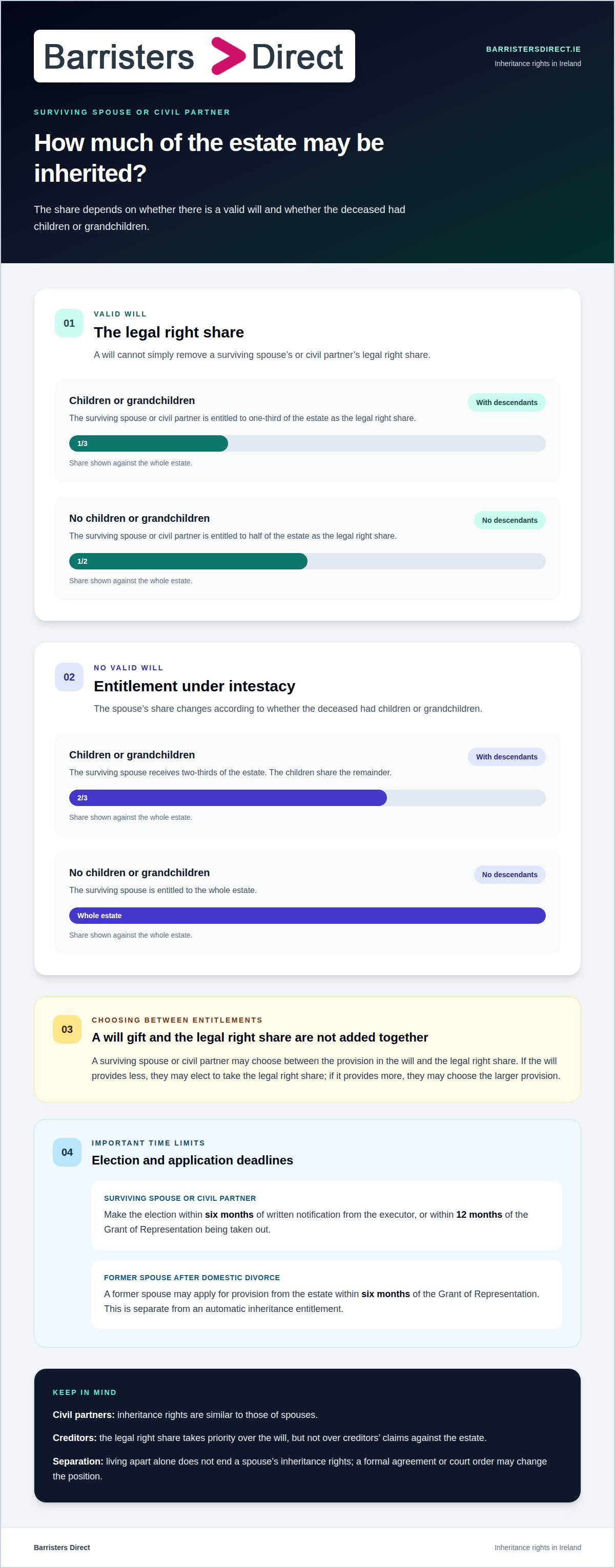
The Succession Act 1965 gives a surviving spouse or civil partner a legal right share, even if a will makes different provision. This matters because a will cannot simply remove that entitlement. With a valid will and children or grandchildren, the share is one-third of the estate, according to the Irish Statute Book. The share is half if there are no children or grandchildren.
If there is no valid will, the surviving spouse is entitled to the whole estate when there are no children or grandchildren. If there are children or grandchildren, the spouse receives two-thirds, according to the Irish Statute Book. The children share the remainder. The legal right share takes priority over the will, but not over creditors’ claims against the estate.
Section 115 of the Succession Act 1965 allows a surviving spouse or civil partner to choose between the will provision and the legal right share. The executor must notify the surviving spouse in writing of this choice. The spouse must make the election within six months of notification or within 12 months of the Grant of Representation being taken out. These deadlines make prompt attention to the executor’s notice important.
A gift under a will does not always match the legal right share. If the will provides less, the surviving spouse may elect to take the legal right share instead. If a spouse with children is left more than one-third under a valid will, they can choose the larger provision in the will. The choice is between the available entitlements, not an automatic addition of both.
A former spouse may apply for provision from an estate within six months of the grant of representation following a domestic divorce. This application is distinct from an automatic inheritance entitlement. The inheritance rights of a spouse in Ireland can also depend on whether succession rights were renounced or extinguished through a formal agreement or judicial separation. This distinction matters when an executor considers a claim after a relationship has ended.
Is a Separated Spouse Entitled to Inherit in Ireland?
In Ireland, spouses who live apart without divorce or a formal separation agreement remain spouses in law. The surviving spouse may retain the inheritance entitlement that applies to their marriage.
Rights While Separated but Not Divorced
Informal separation does not itself end a spouse’s succession rights. If a married couple lives apart without a formal agreement or divorce, the surviving spouse may still be entitled to a share of the estate. Separate homes, finances or daily lives do not, on their own, change marital status under succession law.
The will and family circumstances still affect the share. For example, living apart does not prevent a surviving spouse from choosing the legal right share instead of a smaller gift under the will. The executor administers the estate according to the applicable rules, so the legal form of the separation matters more than the couple’s living arrangements.
Effects of Separation or Divorce
A separation agreement can record a spouse’s decision to renounce succession rights. This may change what the surviving spouse can claim, unlike an informal arrangement between the couple. A court can also extinguish a spouse’s succession rights in a judicial separation by making an order to that effect.
Divorce changes the position: a former spouse is not normally entitled to inherit unless the deceased left them a gift in a valid will. A former spouse may, however, apply for provision from the estate after a domestic divorce. This is separate from inheriting automatically as a surviving spouse, and the distinction can affect how an executor considers a claim.
Inheritance After Informal Separation
After an informal separation, an existing will may still benefit an estranged spouse. The same issue can arise after a change in relationship status, because an old will may not reflect the deceased’s current wishes. Making a new will after separation or divorce is strongly advisable to clarify intended gifts and reduce uncertainty about the estate.
Assets also need to be considered in context. A spouse’s entitlement concerns succession to the deceased’s estate; it does not mean every asset held by either person automatically forms part of that estate. The will, legal status and any formal agreement or court order all inform the position. If an executor receives competing claims, these documents help establish which rights remain relevant.
Where the effect of a separation agreement or an existing will is unclear, specialist legal advice on inheritance rights can help assess the documents and the available claim.
Civil Partnership and Certain Rights and Obligations of Cohabitants Act 2010
Ireland distinguishes civil partners from cohabiting partners when deciding inheritance rights. The Civil Partnership and Certain Rights and Obligations of Cohabitants Act 2010 provides a route for certain cohabitants to seek provision from an estate.
Eligibility of Spouses and Civil Partners
A spouse or civil partner has an automatic legal right to a share of their partner’s estate, subject to the applicable succession rules. This matters because an unmarried cohabitant does not have the same automatic entitlement, even after a long relationship.
Civil partnerships registered before the Marriage Act 2015 remain valid in Ireland. A surviving civil partner has the same inheritance rights as a surviving spouse, including a legal right share. That entitlement applies whether the deceased left a will or died without one. A judicial separation or a formal agreement may affect succession rights, so the legal status and any relevant court order or agreement require careful consideration.
Inheritance Rights of Civil Partners
A surviving civil partner may choose between a provision in the will and the legal right share. This distinction matters if the will provides less than the statutory entitlement. The choice is made through the estate administration process, and the executor must notify the surviving partner in writing.
A surviving spouse or civil partner pays no Capital Acquisitions Tax on an inheritance from their spouse or civil partner. The tax position therefore differs from that of an unmarried partner receiving a benefit. Legal relationship status, rather than the length of time the couple lived together, determines whether this exemption applies.
A cohabiting partner has no automatic right to inherit from the deceased partner’s estate if there is no will. The Civil Partnership and Certain Rights and Obligations of Cohabitants Act 2010 offers a separate route: a financially dependent qualified cohabitant may apply to court for provision from the estate.
To qualify, a couple generally must have lived together for five years, or for two years if they have a dependent child. The application must be made within six months of the grant of probate or administration. The court considers the applicant’s circumstances and financial dependence when deciding whether to order provision.
A cohabitants’ agreement must be in writing and signed by both partners, and both must receive legal advice before signing. It may exclude an application under the redress scheme, although a court can override that term in exceptional circumstances if enforcing it would be very unfair. A court order for a cohabitant cannot reduce a surviving spouse’s or civil partner’s legal right share.
Tax also differs: cohabiting partners pay Capital Acquisitions Tax at 33% on gifts or inheritances above €20,000 for benefits dated on or after 2 October 2024. A cohabitant should therefore distinguish a court application for provision from an automatic inheritance, and consider the separate tax consequences of receiving a benefit.
Circumstances that can prevent a person inheriting
A spouse’s inheritance entitlement can be affected by more than the wording of a will. In Ireland, ownership arrangements, desertion, certain offences and changes in relationship status can each affect what passes from the deceased’s estate. The key is to distinguish property that passes outside the estate from a succession entitlement that may be lost or changed.
Joint tenancy is an important distinction. If a property is held as joint tenants, it passes automatically to the surviving owner by survivorship and does not form part of the deceased owner’s estate. The will therefore does not distribute that property. The ownership arrangement matters: an executor administering the estate must identify what belonged to the deceased and what passed directly to another owner.
Desertion can affect a spouse’s claim. A spouse who deserted the deceased for more than two years is not entitled to a legal right share, unless the desertion resulted from the deceased’s behaviour. Desertion can also affect a benefit under a will: a spouse who deserted the deceased for upwards of two years may be precluded from receiving that benefit. The legal right share and a gift under a will are distinct entitlements, so it is important to identify which claim is involved.
Certain criminal conduct can also prevent an inheritance. A spouse or civil partner may lose the legal right share if convicted of an offence against the deceased or a child carrying a sentence of more than two years. Separately, a person who committed an offence against the deceased, the deceased’s spouse or the deceased’s children, punishable by imprisonment for more than three years, may not inherit. The offence, victim and applicable sentence threshold matter.
Relationship status can change a will’s effect. In Ireland, marriage or entering a civil partnership automatically cancels a pre-existing will, unless it was made in contemplation of the marriage or civil partnership. A later marriage can therefore leave an earlier document invalid, even if it names the surviving spouse. The executor must establish whether the will remains valid before distributing estate assets.
Creditors’ claims also take priority over a spouse’s legal right share. The share ranks ahead of gifts under the will, but it does not remove the deceased’s debts. This affects the estate available for distribution rather than automatically disqualifying the spouse. A solicitor can assess the will, ownership records, separation history and relevant court or criminal records together. This advice can help distinguish an excluded asset from a lost succession right or a reduced estate.
Irish inheritance for civil and cohabiting partners
Ireland treats civil partners and cohabiting partners differently when a partner dies. Civil partners have inheritance rights similar to spouses, while cohabitants may need to apply for provision instead of inheriting automatically.
A civil partnership registered before the Marriage Act 2015 remains valid. The surviving civil partner has the same inheritance rights as a spouse, including a legal right share. That entitlement comes from legal status, not from how long the couple shared a home. A surviving civil partner may also choose between a will provision and the legal right share.
The distinction is substantial for cohabiting partners. If someone dies without a valid will, their cohabiting partner has no automatic right to a share of the estate, regardless of how long the relationship lasted. Moving in together does not change an existing will either. If the will does not name the surviving partner, they may need to rely on a separate legal application.
The Civil Partnership and Certain Rights and Obligations of Cohabitants Act 2010 provides a redress route for a qualified cohabitant. A couple generally qualifies after living together for five years, or two years if they have a dependent child. A financially dependent cohabitant may apply to court for provision from the deceased partner’s estate.
Timing matters: the application must be made within six months of the grant of probate or administration. Evidence of cohabitation, financial dependence or financial need can strengthen the application. Relevant records may help show the shared household, financial arrangements and support exchanged during the relationship. The court considers the application under the statutory redress scheme, rather than treating the applicant as an automatic heir.
Ownership can also affect what passes to a surviving cohabitant. Jointly owned items pass automatically to the survivor and do not form part of the deceased partner’s estate. That is different from a claim for provision from estate assets. Identifying which property was jointly owned helps distinguish survivorship from an application under the 2010 Act.
A cohabitants’ agreement must be in writing and signed by both partners, and both must receive legal advice before signing. It may exclude an application under the redress scheme. A court can override that term in exceptional circumstances if it considers the result very unfair. Any such order cannot affect a surviving spouse’s or civil partner’s legal right share.
If a partner has died, get legal advice on a cohabitant’s estate claim to assess eligibility, evidence and the application deadline.
Barristers Direct
Barristers Direct connects people in Ireland with specialist barristers for expert legal advice. If you’re unsure how separation, a will or an executor’s notice affects your position, a barrister can assess the relevant documents and explain the available options. Wills and Probate Legal Advice can help clarify succession issues, including the legal right share, estate administration and claim deadlines. The fixed-fee initial consultation provides expert advice and clear next steps, so you can understand the legal position before deciding what to do. Where a case requires legal action, it remains necessary to engage a solicitor.
Contact Barristers Direct to discuss your inheritance question.
Take the next step with informed advice
A useful next step is to have the relevant documents considered together. The will, any separation or cohabitation agreement, ownership records and executor correspondence may all affect how an estate is handled. A legal assessment can clarify whether the issue concerns a succession entitlement, an application for provision or property passing outside the estate. It can also identify which information matters before you decide how to proceed.
Advice on the inheritance rights of a spouse in Ireland should take account of the relationship history and the documents governing the estate. If an executor is already administering it, getting advice promptly can help you understand your options and make decisions with a clearer view of their legal effect.
Barristers Direct offers Wills and Probate Legal Advice for people seeking specialist guidance on estate and succession issues. Contact Barristers Direct for advice and take a considered next step.
Frequently Asked Questions
What Happens to Succession Rights After Informal Separation?
Informal separation alone does not end a spouse’s succession rights in Ireland. If spouses live apart without a formal separation agreement or divorce, the survivor remains a spouse in law. Moving to separate homes, for example, does not itself remove an entitlement to the estate. A separation agreement may renounce succession rights, while a court can extinguish them in a judicial separation order. The wording and legal effect of any agreement or order matter.
Who Can Make an Inheritance Claim?
A surviving spouse or civil partner may claim their statutory entitlement, while a qualified cohabitant may apply for provision from an estate. A child who believes they were not adequately provided for may bring a claim under Section 117 of the Succession Act 1965. These are separate legal routes with different eligibility criteria. For example, a cohabitant’s application depends on qualifying circumstances, rather than simply being named as the deceased person’s partner.
Can I disinherit my spouse while still married in Ireland?
A will cannot normally remove a surviving spouse’s legal right share while the marriage remains legally in force. A spouse can renounce succession rights in a separation agreement, and a court may extinguish those rights in a judicial separation. Desertion or certain criminal convictions can also affect entitlement. For instance, a will leaving a spouse nothing does not, by itself, cancel the statutory share. The relevant agreement, court order and circumstances must be considered.
Can unmarried partners inherit in Ireland?
An unmarried partner has no automatic right to inherit if their partner dies without a valid will. A qualified cohabitant who meets the statutory criteria may apply to court for provision from the estate. Generally, the couple must have lived together for five years, or for two years if they have a dependent child. The application deadline is six months from the grant of probate or administration. A valid will can separately provide for an unmarried partner.
Who can make a Section 117 claim?
A child of a deceased person may bring a claim under Section 117 of the Succession Act 1965 if they believe the will failed to provide adequately for them. The claim concerns the parent’s legal duty to make proper provision for the child in the circumstances. It is distinct from a spouse’s legal right share or a cohabitant’s application. The child’s circumstances and the provision made by the will are central to assessing the claim.
What inheritance rights does a spouse have under Irish law if their spouse dies with a will?
A surviving spouse can claim a legal right share even if the will leaves them less or nothing. If the deceased had children or grandchildren, the share is one-third of the estate; without them, it is half. The spouse may choose the legal right share or the provision in the will, rather than automatically adding the two together. For example, a larger gift in the will may be preferable to the statutory share.
What is a surviving spouse's legal right share in Ireland?
The legal right share is the minimum statutory entitlement of a surviving spouse under succession law, despite contrary terms in a will. Its amount depends on whether the deceased had children or grandchildren. The executor must notify the surviving spouse in writing about the choice between the will gift and the statutory share. The spouse then needs to make an informed election, considering the estate’s contents and the value of any provision made by the will.
How does the Irish legal right share differ when the deceased has children or no children?
With a valid will, the share is one-third of the estate if the deceased had children or grandchildren, according to the Irish Statute Book. If there were none, it is half. Where there is no valid will, a surviving spouse receives two-thirds if children or grandchildren survive, according to the Irish Statute Book, and the whole estate if there are none. These rules concern the spouse’s entitlement, not how children may share the remainder.
Disclaimer
This article does not constitute legal advice. Barristers Direct does not provide legal advice. To obtain legal advice, you should contact a legal practitioner.


