

The most effective strategy for commercial dispute resolution begins with specialist advocacy at the consultation stage, not just the courtroom floor. In a landscape where legal conflicts can quickly become all-consuming, the difference between a protracted battle and a swift resolution often lies in the quality of initial strategic advice. You're likely already feeling the weight of unpredictable legal fees and the frustratingly slow pace of traditional litigation, coupled with a nagging uncertainty about the actual strength of your legal position.
We understand that Irish business owners require more than just representation; they need a transparent, solution-oriented approach that prioritises clarity over complexity. This guide will show you how to navigate complex business conflicts by accessing specialist legal counsel for strategic, early-stage advice. You'll discover how to secure a clear understanding of your legal merits and a cost-effective path to resolution without the typical delays of the standard process.
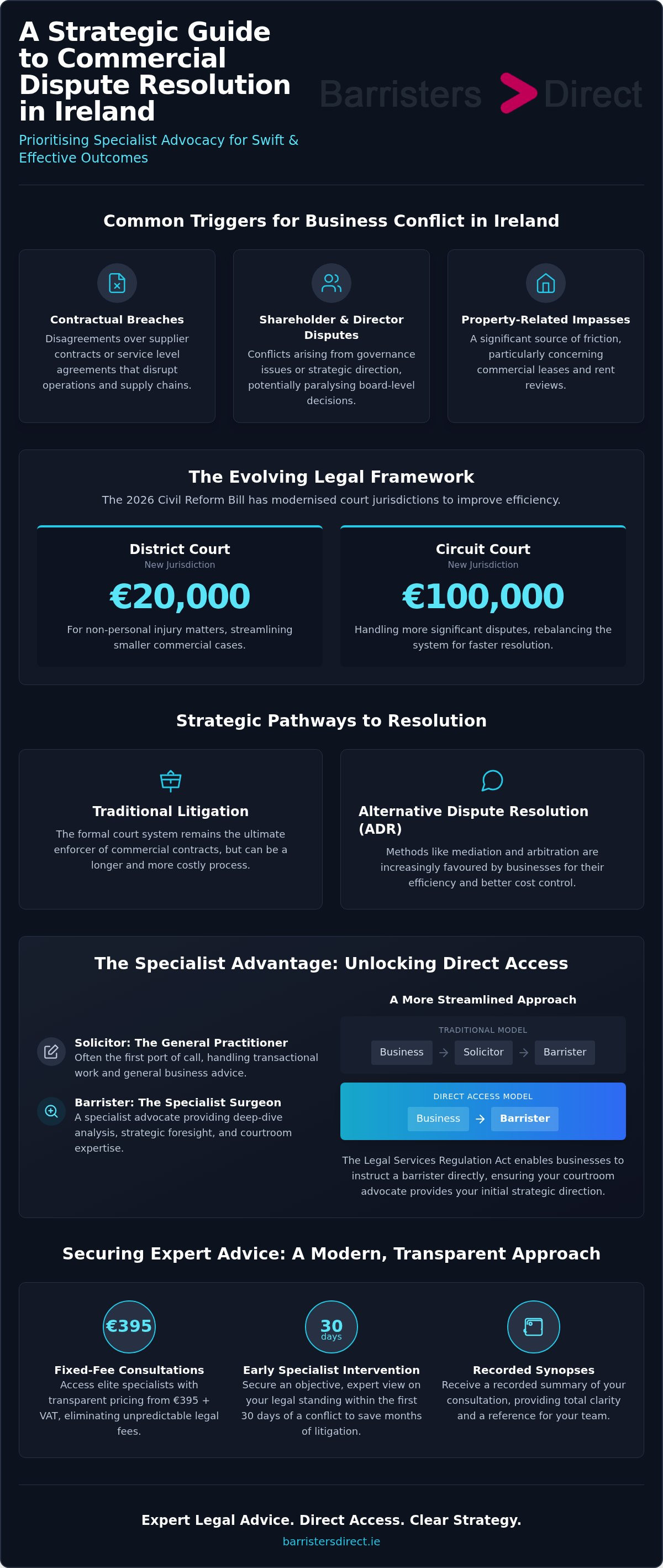
We'll examine the impact of the 2026 Civil Reform Bill, which has increased the District Court jurisdiction to €20,000 and the Circuit Court to €100,000, and explain how direct access to top-tier barristers can provide the precision your business demands. From fixed-fee consultations starting at €395 plus VAT to the benefits of recorded synopses, you'll learn how modern advocacy is changing the face of Irish commercial law.
Key Takeaways
- Learn to identify common triggers for business conflicts and how the 2026 Civil Reform Bill impacts your legal strategy in the Irish courts.
- Understand how direct access to specialist barristers can streamline your commercial dispute resolution strategy by prioritising expert advocacy from the very beginning.
- Discover the criteria used to evaluate whether traditional litigation or alternative dispute resolution, such as arbitration, offers the most effective path for your specific case.
- Find out how to organise your essential documentation and define clear commercial objectives to ensure your legal counsel can provide the most precise advice.
- Explore a modern, transparent approach to legal consultation that provides fixed-fee access to elite specialists and recorded synopses for total clarity.
Understanding Commercial Dispute Resolution in the Irish Legal Landscape
Commercial dispute resolution is the technical process of resolving legal disagreements between business entities. Whilst every commercial venture aims for seamless operations, conflicts are a statistical reality in a competitive market. The method you choose to resolve these issues often determines the long-term health and viability of your organisation. It's a field governed by strict professional ethics and the independence of the Irish Bar. This independence is vital; it ensures that your legal strategy remains objective and focused on the merits of the case rather than the emotional weight of the conflict.
Common Triggers for Business Conflict in Ireland
Business disagreements in Ireland typically stem from three primary areas. First, contractual breaches regarding suppliers or service level agreements frequently disrupt operations and supply chains. Second, shareholder and director disputes often arise from disagreements over company governance or strategic direction, which can paralyse decision-making at a board level. Finally, property-related impasses, particularly commercial lease disagreements and rent reviews, remain a significant source of friction. Addressing these early through commercial dispute resolution channels prevents small frictions from becoming existential threats to your company's cash flow.
The Legal Framework for Resolution
The Irish court system remains the ultimate enforcer of commercial contracts, but the 21st century has seen a decisive shift towards smarter, faster resolution methods. The 2026 Civil Reform Bill has modernised the landscape by adjusting monetary thresholds to rebalance the system. The District Court now hears cases up to €20,000, whilst the Circuit Court's jurisdiction has increased to €100,000 for non-personal injury matters. These changes are intended to divert less complex cases to lower courts, effectively reducing the time and expense required to reach a conclusion.
Businesses are increasingly moving away from traditional court proceedings in favour of Alternative Dispute Resolution (ADR), such as mediation and arbitration. This shift is driven by the necessity for efficiency and better cost control. Early specialist intervention is no longer a luxury; it's a critical component of modern risk management. Securing an objective, expert view on your legal standing within the first 30 days of a conflict can save months of unproductive litigation. This front-loading of legal expertise ensures that resources are allocated based on strategic intelligence rather than procedural momentum.
The Specialist Role: Barristers and the Direct Access Model
Understanding the difference between solicitors and barristers is the first step toward a more efficient legal strategy. Whilst solicitors are often the first port of call for transactional work and general business advice, barristers occupy a distinct space as specialist advocates and legal consultants. If you consider a solicitor to be the general practitioner of the legal world, the barrister is the specialist surgeon. They provide a deep-dive analysis into specific, complex legal problems that require a high degree of precision and strategic foresight.
The Legal Services Regulation Act has fundamentally changed how businesses access this expertise. Historically, a solicitor acted as a mandatory gatekeeper for all legal matters. Today, the direct access model permits businesses to instruct a barrister directly for legal advice. This shift allows for a more streamlined approach to commercial dispute resolution, ensuring that the person who may eventually argue your case in court is the same person providing your initial strategic direction.
Specialist Advocacy and Strategic Counsel
Barristers operate as independent sole practitioners. This independence is a cornerstone of the Irish legal system, ensuring you receive an objective view of your case merits. Having a courtroom advocate evaluate your position at the outset provides a distinct tactical advantage. They don't just look at the letter of the law; they look at how that law is likely to be interpreted in Ireland's Commercial Court. This specialist advice is far more granular than general legal support, focusing on the specific evidentiary and procedural hurdles your business might face during a conflict.
Navigating Direct Access Regulations
Your business has a legal right to seek advice directly from a barrister. This removes unnecessary layers of communication and ensures your commercial objectives are understood by the specialist without delay. It's important to recognise that a solicitor's role remains vital in specific contexts. If your dispute requires formal litigation filings, the management of large-scale discovery, or the holding of client monies, a solicitor must be involved to manage these administrative and procedural functions. However, for strategic advice and merit assessment, consulting a specialist directly ensures you are equipped with the highest level of legal intelligence from day one. This direct path prioritises the quality of the advice above all else, allowing for a more focused and effective resolution strategy.
Evaluating Strategic Pathways: Litigation vs ADR
Choosing between the courtroom and the negotiating table is a critical pivot point in commercial dispute resolution. It's not a decision to be made lightly or based on procedural habit. A specialist barrister evaluates the merits of your case by scrutinising evidence against current legal precedents. This objective assessment determines if your position is legally sound or if a strategic settlement offers a more favourable commercial outcome. If the legal merits are weak, early settlement is a victory. If they're strong, you proceed with the confidence that your strategy is backed by expert analysis.
Litigation in the Irish Courts
Litigation involves presenting formal legal arguments to a judge. In the Commercial List of the High Court, this process is rigorous and highly structured. It relies heavily on cross-examination and expert witness testimony to test the veracity of each party's claims. According to The Courts Service of Ireland, the system is designed for efficiency, yet litigation remains a resource-intensive final resort. It's the path taken when a complex impasse cannot be resolved through dialogue and requires a binding judicial ruling to achieve closure. A judge's decision provides finality, but it also removes control of the outcome from the business entities involved.
Alternative Dispute Resolution (ADR) Options
ADR provides a sophisticated alternative to the public nature of the courts. These methods are increasingly favoured for their flexibility and focus on commercial reality. Mediation is a collaborative, non-binding process where a neutral third party helps both sides find a middle ground. It's often the fastest way to preserve business relationships. In contrast, arbitration is a private, binding process frequently mandated in construction and commercial contracts. In Dublin, arbitration can often be organised within 30 days, providing a swift alternative to the court diary.
The primary benefits of ADR include:
- Confidentiality: Keeping sensitive business details and financial records out of the public record.
- Speed: Bypassing the traditional court schedule to reach a conclusion on your own timeline.
- Expertise: The ability to select an arbitrator with specific industry knowledge relevant to the conflict.
A cost-benefit analysis is essential. Settling out of court isn't a sign of weakness; it's often a sign of strategic intelligence. If the cost of a judge's ruling outweighs the potential recovery, a specialist will advise on the most pragmatic route forward. This ensures your legal spend is always aligned with your commercial reality. By identifying the most effective pathway early, you avoid the trap of "litigation by default" and keep your resources focused on business growth.
How to Organise Your Commercial Dispute Strategy
Success in commercial dispute resolution depends heavily on the quality of the information provided to your specialist at the outset. A barrister cannot build a robust strategy on vague recollections or incomplete records. Organisation is the foundation of precision. By front-loading the preparation, you enable your counsel to provide a definitive assessment of your position within a fraction of the time required by traditional, unstructured methods. This methodical approach ensures that every strategic decision is based on cold facts rather than optimistic assumptions.
Documentation and Evidence Gathering
You must create a comprehensive file containing every written agreement, email exchange, and invoice relevant to the conflict. In many cases, a construction claim or commercial disagreement hinges on a single piece of correspondence that clarifies intent or records a breach. A clear timeline of events is the most valuable tool you can provide; it allows the specialist to spot legal triggers that might otherwise be buried in a disorganised archive.
Your evidence gathering should include:
- Signed contracts: Including any subsequent amendments or side letters.
- Chronological correspondence: Email threads between key decision-makers and the opposing party.
- Financial records: Proof of payment, outstanding invoices, and documented financial losses.
- Internal logs: Project notes or memos that record the history of the disagreement.
Identifying key internal stakeholders early is equally vital. Their firsthand accounts provide the context that documents alone might lack. This evidence directly influences the strategic path your barrister recommends; if the paper trail is weak, they may suggest mediation. If it's ironclad, they might advise a more assertive stance.
Defining Your Commercial Objectives
Before seeking expert advice, you must be clear about your desired outcome. Legal victory is rarely a single-track result. You might be seeking a specific financial settlement, the enforcement of a particular contract term, or perhaps a clean termination of a toxic business relationship. Each objective requires a different tactical approach from your counsel.
Consider the impact of the dispute on your ongoing operations. Is a swift, private resolution more valuable than a higher financial payout that takes years to secure? Preparing a list of specific questions for your specialist barrister ensures that your consultation remains focused on these commercial realities. If you are ready to define your strategy with an expert, you can arrange a consultation with a specialist barrister today. A clear timeline of events, mapped against your core objectives, allows for a more incisive review and a strategy that serves your business's long-term interests.
Securing Expert Advice: The Barristers Direct Model
The traditional model of seeking legal advice often involves layers of ambiguity regarding timeframes and final costs. Barristers Direct provides a modern alternative by offering a platform where businesses can consult with over 100 specialist barristers across Ireland. This direct access model removes the barriers between you and the high-level expertise required for effective commercial dispute resolution. It's a system built on the principle that the best strategy is formed when you engage directly with the advocate who understands the nuances of the law and the courtroom environment.
Financial transparency is a core component of this service. We provide a clear, fixed-fee structure to ensure your business can plan its legal spend with certainty. If you require a deep-dive consultation with a specialist barrister, the fee is €395 + VAT. For more complex or contentious matters where the presence of a solicitor is beneficial to provide additional transactional context, the fee is €595 + VAT. This upfront pricing allows you to access elite legal intelligence without the risk of open-ended hourly billing.
Transparency Through Technology
Modern advocacy requires modern tools. Consultations are conducted via secure platforms like Zoom or Microsoft Teams, allowing you to access expert advice from any location in Ireland. To ensure absolute clarity, every session includes an automatically generated synopsis of the discussion. This summary provides a permanent record of the barrister's view on your case merits and the suggested next steps. If you've ever left a legal meeting feeling overwhelmed by complex terminology, this synopsis acts as a vital reference point to keep your strategy on track.
Security and confidentiality remain paramount. The recordings and AI-generated summaries are shared exclusively with you and the barrister involved. This process is designed to be a standalone strategic exercise; there's a strict "no further obligation" policy following the initial consultation. You gain the insights you need to make an informed decision without being pressured into a long-term commitment or unnecessary litigation.
A Strategic Path Forward
The primary outcome of a Barristers Direct consultation is a definitive roadmap. If the specialist barrister identifies a strong legal position, they'll outline the specific evidence needed to prevail. If they identify significant risks, they'll suggest alternative pathways to mitigate those losses. Should your case require formal litigation filings or the management of discovery, we facilitate a seamless transition to a solicitor who can handle the procedural requirements whilst maintaining the strategic direction set by the barrister. You can book a fixed-fee commercial consultation today to secure the expert clarity your business deserves.
Securing Strategic Clarity for Your Business
Effective commercial dispute resolution is defined by the precision of your initial strategy rather than the duration of the conflict. By prioritising specialist advocacy and meticulous organisation, you transition from a position of uncertainty to one of calculated action. The current Irish legal framework supports a more direct, transparent path to expert counsel, ensuring that your commercial objectives remain the primary focus of every tactical decision.
Accessing this level of legal intelligence is now a straightforward process. Through a network of over 100 independent specialist barristers, your business can secure a definitive assessment of its legal merits for a fixed fee. Each session includes an automatic AI-generated consultation summary, providing you with a clear roadmap for the next steps without any further obligation. This ensures that no detail is lost and that you have a functional record of the specialist's advice.
If you're ready to resolve your conflict with professional confidence, Get Expert Commercial Advice for a Fixed Fee. With consultations starting from €395 + VAT, you can secure the specialist direction needed to protect your business's future. It's time to move forward with clarity and purpose.
Frequently Asked Questions
Can I talk to a barrister without a solicitor in Ireland?
Yes, you can consult a barrister directly for legal advice without first retaining a solicitor. This direct access is permitted under the Legal Services Regulation Act. It allows businesses to secure a specialist's opinion on a commercial dispute resolution strategy early in the process. Whilst direct access is suitable for initial advice and merit assessment, you'll still need a solicitor if your matter requires formal court filings or the management of client funds.
What is the difference between a barrister and a solicitor in a commercial dispute?
The distinction lies in their specific roles within the legal system. A barrister is an independent sole practitioner who specialises in courtroom advocacy and providing granular legal opinions on complex problems. Conversely, a solicitor handles broader client interaction, manages transactional legalities, and is authorised to hold client monies. The relationship is similar to a GP referring a patient to a specialist surgeon for a specific procedure.
How much does a commercial legal consultation cost with Barristers Direct?
A standard consultation with a specialist barrister through our platform costs €395 plus VAT. If the matter is contentious and requires a solicitor to also be in attendance, the fixed fee is €595 plus VAT. These predetermined fees cover the expert's time to review your documentation and provide a clear strategic path forward. There's no further obligation to continue the engagement after this initial meeting.
What happens if my commercial dispute needs to go to court?
If your matter requires formal litigation, you must engage a solicitor to manage the procedural requirements. Barristers specialise in presenting arguments in court, but solicitors are necessary for filing originating documents and managing discovery. We can refer you to a solicitor if litigation becomes unavoidable, ensuring a seamless transition from initial advice to full representation. This ensures your commercial dispute resolution remains focused on achieving the best possible outcome.
Is the advice I receive from a barrister confidential?
Yes, all advice provided during your consultation is strictly confidential. The relationship between you and the introduced barrister is governed by professional ethics and legal privilege. Any recording or synopsis generated during the session is shared exclusively with you and the barrister involved. No third parties have access to these files, ensuring your business's sensitive information and strategic discussions remain entirely private and secure.
How long does the commercial dispute resolution process typically take?
The timeline for resolution depends entirely on the chosen pathway and the complexity of the disagreement. Traditional litigation in the Irish courts can be a lengthy process due to court diaries and procedural requirements. However, Alternative Dispute Resolution (ADR) methods like arbitration can often be organised in Dublin within 30 days. Securing early specialist advice helps identify the fastest route to a conclusion, potentially avoiding months of unnecessary delays.
Can a barrister help with debt recovery or unpaid invoices?
Yes, specialist barristers provide expert advice on debt recovery and issues involving unpaid invoices. They can evaluate the strength of your claim and advise on the most effective method for securing payment, whether through formal demand or legal proceedings. Accessing a barrister's view early in a debt dispute ensures you don't waste resources on claims with low recovery prospects whilst identifying the most robust path for enforcement.
What is a 'synopsis' in the context of a Barristers Direct consultation?
A synopsis is an automatically generated summary of your legal consultation. It is created using AI technology to provide a clear, written record of the barrister's advice, the case merits, and the recommended next steps. This document, along with a recording and transcript, is sent to you and the barrister immediately after the meeting. It ensures that no critical details are lost and provides a reliable reference for your ongoing business strategy.
Disclaimer
This article does not constitute legal advice. Barristers Direct does not provide legal advice. To obtain legal advice, you should contact a legal practitioner.


