

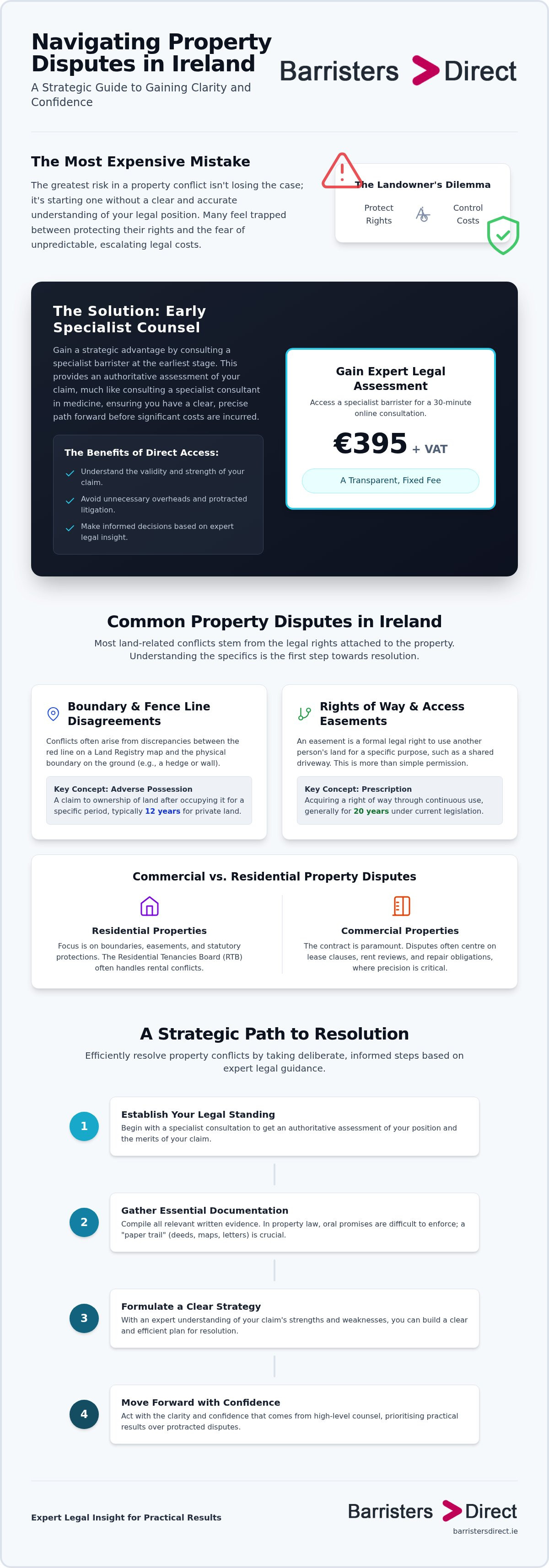
The most expensive mistake in a property conflict isn't losing the case; it's starting one without knowing exactly where you stand. If you're currently embroiled in property disputes, it's natural to fear that the costs of resolution will eventually eclipse the value of the land or building in question. You might feel trapped between a desire to protect your rights and the daunting prospect of complex, protracted litigation that feels entirely out of your control.
It's understandable to feel overwhelmed by the technicalities of land law and the confusion surrounding the roles of different legal professionals. This article demonstrates how you can navigate these complexities by securing expert guidance from specialist barristers at the earliest opportunity. You'll learn how to establish a clear, strategic path forward that prioritises legal precision and efficient resolution. We'll explore how to gain a definitive understanding of your claim's validity, ensuring you have the high-level counsel required to move forward with confidence and clarity, without being weighed down by unnecessary overheads.
Key Takeaways
- Understand the legal framework governing boundary lines and rights of way in Ireland to determine the validity of your claim.
- Learn why consulting a specialist barrister provides an authoritative assessment of your position, acting as the "specialist consultant" of the legal system.
- Discover the essential documentation and strategic steps required to resolve property disputes efficiently before legal costs escalate.
- Access high-level legal expertise through a 30-minute online consultation with a barrister for a transparent fixed fee of €395 + VAT.
- Gain a clear, strategic path forward that prioritises expert legal insight and practical results over tradition for tradition's sake.
Understanding Property Disputes in the Irish Legal Framework
Property disputes are legal disagreements concerning real estate, land boundaries, or rights of way. These conflicts often arise when the legal reality of a property title doesn't align with the physical use of the land. Under the Legal Services Regulation Act, the path to resolving these issues has become more direct. You can now access specialist counsel earlier, which is vital for preventing minor disagreements from escalating into expensive, multi-year court cases. Early intervention ensures you understand your legal position before committing to a specific course of action.
Barristers Direct serves as a modern bridge to the Law Library, introducing you to barristers who act as the specialist consultants of the legal world. If you're unsure about the validity of your claim, a 30-minute online consultation for a fixed fee of €395 + VAT provides a clear, authoritative assessment. Barristers Direct does not provide legal advice itself; it introduces you to a network of over 100 barristers who can provide the necessary expertise. This transparency allows you to make informed decisions without the hidden costs often associated with traditional legal routes.
The Legal Basis for Property Conflicts
Irish land law is built on a complex foundation, much of which is rooted in the history of Irish Land Acts. Today, ownership is primarily established through the Land Registry or the Registry of Deeds. While the Land Registry provides a state-guaranteed title, property disputes often emerge from "the line on the map" not matching the physical boundary. In these instances, relying on verbal agreements is a high-risk strategy. In property matters, oral promises are notoriously difficult to enforce; the law generally requires written evidence to prove a transfer or modification of rights. If your claim lacks a paper trail, you'll need expert advice to determine if a "doctrine of lost modern grant" or other legal principles apply.
Commercial vs Residential Property Disputes
The legal protections available to you depend heavily on the nature of the property. For private homeowners, the focus is often on boundaries or easements. If you're a tenant in a domestic rental, the Residential Tenancies Board (RTB) is usually the first port of call for domestic rental conflicts. However, commercial disputes operate under a different set of rules. Business tenants don't enjoy the same statutory protections as residential ones. Instead, the contract is king. Lease break clauses, rent reviews, and repair obligations frequently become the centre of business property disputes. If a break clause isn't executed with absolute precision, a company can find itself locked into a costly lease for several more years.
Common Types of Property Disputes Amongst Irish Landowners
Most land-related conflicts in Ireland aren't just about the dirt; they're about the legal rights attached to it. Whether it's a residential boundary or a commercial lease, clarity is your best defence. Many property disputes also involve nuisance or trespass, where unauthorised entry or interference with your enjoyment of the land requires a formal legal response. If you're unsure of your position, consulting a specialist barrister provides the strategic direction needed to resolve the matter efficiently.
Boundary and Fence Line Disagreements
These disputes often centre on the difference between the red line on a Land Registry map and the physical hedge or wall on the ground. Historic inaccuracies in title deeds are common, leading to modern friction when a neighbour builds an extension or replaces a fence. You should seek professional guidance on boundary disputes to understand how surveyors and legal experts work together. A frequent challenge here is "adverse possession", where one party claims ownership of land they've occupied for a specific period, usually 12 years for private land. Resolving this requires precise mapping and a barrister's analysis of the title's strength.
Rights of Way and Access Easements
An easement is a legal right to use another person's land for a specific purpose, such as a shared driveway or a drainage pipe. It's fundamentally different from simple permission, which can be revoked at any time. Many rights of way are acquired through "prescription", which generally requires 20 years of continuous use under the Land and Conveyancing Law Reform Act 2021. If an established access route is blocked or altered, the legal fallout can be significant. Expert counsel is essential to determine if the right has been properly established or if it has been extinguished through non-use. A barrister can provide a definitive view on whether a right of way exists, preventing you from entering into a weak legal battle.
Commercial Lease and Rent Review Conflicts
In the business sector, property disputes often revolve around the financial obligations of a tenancy. Dilapidation claims, where a landlord demands repairs at the end of a lease, can involve substantial sums. Similarly, rent reviews often lead to disagreements over market value. The interpretation of complex lease terms is a specialist task; for instance, understanding the strict requirements of commercial lease break clauses is critical to avoiding unintended financial liability. In these high-stakes scenarios, the specialist insight of a barrister ensures that your commercial interests are protected through precise legal interpretation and strategic planning.
The Role of Specialist Counsel in Property Litigation
Understanding the distinct roles of legal professionals is the first step in resolving property disputes with precision. In the Irish legal system, the relationship between a solicitor and a barrister is often compared to that of a General Practitioner (GP) and a specialist consultant. While solicitors provide essential case management, handle day-to-day correspondence, and manage the broad requirements of a file, barristers are the specialist advocates who focus on high-level legal interpretation and courtroom representation. If your conflict involves complex land law, you need the specific expertise of counsel to provide a definitive path forward.
A barrister’s primary value lies in their ability to offer an objective, independent view of your case's strength. Because they operate as independent practitioners, they're not just there to confirm your perspective; they're there to provide a detached assessment of the legal merits. Their courtroom experience is a critical asset here. By seeing how judges interpret specific statutes on a daily basis, a barrister can often predict the likely outcome of a trial. This insight informs their advice on settlement potential, helping you decide whether to resolve the matter through negotiation or proceed to a full hearing.
Why Specialist Advocacy Matters for Property Claims
Property litigation frequently relies on technical evidence that goes beyond simple boundary lines. Barristers are specifically trained to cross-examine expert witnesses, such as land surveyors or structural engineers, to test the validity of their technical findings. Before you commit to the High Court, obtaining a formal "Barrister’s Opinion" is a vital strategic move. This written document provides a detailed analysis of your legal position and the probability of success. In any property conflict, the quality of the expert advice you receive is the single most important factor in achieving a successful outcome.
Barristers as Independent Sole Practitioners
It's important to recognise that Irish barristers are independent sole practitioners. They aren't employees of a large firm or under the influence of public authorities. This independence ensures you receive an entirely unbiased assessment of your property disputes, free from conflicting interests. By accessing this level of expertise, you gain a clear-eyed view of your situation that is focused solely on the legal reality.
Through Barristers Direct, you can secure this specialist insight via a 30-minute online consultation for a fixed fee of €395 + VAT. This modern approach allows you to understand the difference between solicitors and barristers whilst gaining immediate access to the Law Library's elite counsel. This ensures you have the high-level strategic intelligence required to protect your assets without the traditional barriers to entry.
Strategic Steps to Resolve a Property Conflict Efficiently
Efficiency in property disputes is a result of deliberate strategy rather than chance. If you react emotionally to a conflict, you risk a cycle of expensive, reactive litigation that serves neither your interests nor your finances. A structured approach allows you to regain control of the situation. By following a clear set of strategic steps, you can move from a position of uncertainty to one of informed action. This begins with rigorous preparation and the early involvement of specialist counsel to determine the legal merits of your claim.
Evidence Gathering and Case Assessment
Before you seek a professional opinion, you must organise your evidence. Counsel cannot provide a definitive assessment without a complete set of facts. If you're preparing for a consultation, gather the following essential documents:
- Original title deeds and any relevant Land Registry folios or maps.
- A clear, chronological timeline of events leading to the dispute.
- All written correspondence, including emails and letters, exchanged with the other party.
- High-resolution photographic evidence, particularly for boundary disagreements or physical nuisance.
A precise timeline is crucial. It allows a barrister to identify key legal triggers, such as the commencement of an adverse possession period or the breach of a specific lease covenant. If the facts are muddled, the advice will be qualified; if the facts are clear, the strategy will be robust.
Mediation and Arbitration in Property Law
Litigation in the High Court is not always the most efficient path. Mediation is a voluntary process that allows parties to reach a settlement with the help of a neutral third party, avoiding the binary "win-lose" outcome of a courtroom. It's often a faster and more private way to resolve property disputes. Alternatively, many commercial contracts include an arbitration clause. If your agreement specifies this, arbitration in Dublin is often a mandatory requirement. These proceedings must typically be conducted in English, with a resolution sought within 30 days of the arbitrator's appointment. A barrister can represent your interests in these forums, ensuring your specialist legal arguments are presented with the same rigour as they would be in court.
When to Transition to a Solicitor
Whilst a barrister provides the high-level legal strategy, a solicitor is essential for formal litigation or complex transactional work. If your case requires the issuing of court proceedings, a solicitor will manage the day-to-day administration and procedural requirements. There is a significant benefit to this collaborative model; a barrister can prepare the initial legal framework for a solicitor to take forward into the court system. This ensures that the case is built on a solid foundation of expert advice from the outset. If you're currently facing issues with a rental property, you can access specific landlord and tenant legal advice to begin this process. To secure a clear assessment of your position, book a fixed-fee consultation with a specialist barrister today.
Direct Access: Expert Property Advice via Barristers Direct
The landscape of Irish legal services has evolved, allowing you to bypass traditional barriers and speak directly with the Law Library's elite counsel. If you require immediate clarity on complex property disputes, Barristers Direct provides a streamlined path to expert counsel. This model is designed for transparency, stripping away the layers of opaque billing and slow communication often found in traditional legal structures. By facilitating direct access to a nationwide network of over 100 specialist barristers, we ensure you receive high-level strategic intelligence when it matters most.
Our service operates on a transparent fixed-fee model. For a flat rate of €395 + VAT, you receive a 30-minute online consultation with a specialist barrister. This initial meeting is focused entirely on providing a clear assessment of your legal position without any further obligation. To ensure maximum efficiency, we deliver these consultations via modern platforms such as Zoom, Teams, or Google Meet. This approach respects your time and provides a modern, solution-oriented experience that matches the pace of today's business and personal property markets.
The Advantages of Direct Consultation
Securing a specialist opinion at the earliest possible stage is a decisive move. If you understand the legal merits of your claim before committing to a course of action, you can avoid the financial drain of pursuing a weak case. One of the primary advantages of instructing a barrister directly is the precision of the advice provided. To support this, our platform uses technology to generate an automated recording and a detailed synopsis of your meeting. This provides you with a permanent, accurate record of the advice given, ensuring you have a reliable reference point as you decide on your next steps.
How to Book Your Property Dispute Consultation
The process of securing expert guidance is straightforward and purposeful. Once you contact the Barristers Direct platform, we match you with a barrister based on their specific expertise in property disputes. After the fixed fee of €395 + VAT is settled, your consultation is scheduled at a time that suits you. It's important to understand that Barristers Direct does not provide legal advice itself; we act as an introducer, connecting you with the right specialist for your needs. Any contract for advice is formed directly between you and the introduced barrister. This structure ensures that you benefit from the barrister's professional independence whilst enjoying the efficiency of a modern, technology-driven platform. If your situation requires a more comprehensive approach, we also offer a consultation involving both a barrister and a solicitor for €595 + VAT.
Secure a Strategic Path for Your Property Claim
Resolving a conflict over land or premises requires more than just persistence; it demands a precise understanding of your legal standing. We've explored how early intervention and specialist advocacy can prevent minor disagreements from escalating into overwhelming court battles. By accessing the expert insight of a barrister, you gain a definitive assessment of the merits of your case. This allows you to make strategic decisions based on legal reality rather than uncertainty.
Barristers Direct provides a modern, transparent bridge to this expertise, introducing you to the right specialist for your specific needs. You can consult with one of over 100 specialist barristers in our nationwide Irish network for a fixed fee of €395 + VAT. Every session includes a digital recording and an AI-generated synopsis for your records, ensuring you have a clear roadmap for the future. If you're currently navigating the complexities of property disputes, taking this proactive step ensures your assets and interests remain protected through elite counsel.
Book your property dispute consultation with an expert barrister today and move forward with confidence.
Frequently Asked Questions
Can I talk to a barrister about a property dispute without a solicitor?
Yes. Under the Legal Services Regulation Act, members of the public can engage a barrister directly for advice without first retaining a solicitor. This allows you to gain specialist insight into your property disputes at an earlier stage. Whilst a solicitor is still required for formal court proceedings, this direct access model provides a faster way to understand the legal merits of your case and develop a clear strategy forward.
How much does a consultation for a property dispute cost?
A standard online consultation with a specialist barrister costs €395 + VAT. If the matter is contentious and you require a solicitor to attend as well, the fixed fee is €595 + VAT. These transparent costs cover the initial expert meeting and the review of your case. After this session, there is no further obligation, and any additional fees for work beyond the meeting are agreed directly between you and the introduced barrister.
What is the difference between a property solicitor and a property barrister?
The roles are distinct but complementary. Solicitors manage the day-to-day administration of your file, handle transactional work like conveyancing, and maintain direct client contact. Barristers are independent sole practitioners who specialise in courtroom advocacy and high-level legal interpretation. If you need a specialist opinion on a complex land law issue or representation before a judge, a barrister provides the expert advocacy required to test the legal arguments and influence the outcome of your case.
Can a barrister help me with a boundary dispute?
Yes, a barrister is highly effective at resolving boundary disagreements by providing an objective assessment of your title deeds and maps. They can identify the legal strength of your claim and advise on the probability of success in court. If the dispute involves technical evidence from surveyors, a barrister is specifically trained to cross-examine these witnesses to test the validity of their findings and ensure your property rights are protected through precise legal argument.
Is a verbal agreement regarding property legally binding in Ireland?
Generally, no. In Irish law, contracts for the sale or transfer of land must be in writing to be enforceable. Verbal promises regarding property boundaries or rights of way are notoriously difficult to prove and rarely hold up in court without significant supporting evidence. If you are relying on an oral agreement, you should seek a specialist opinion to determine if specific legal principles, such as the doctrine of part performance, might allow your claim to proceed.
What happens if my property dispute needs to go to court?
If litigation becomes necessary, you must engage a solicitor to manage the formal court proceedings. Whilst a barrister provides the strategy and courtroom advocacy, the solicitor handles the procedural requirements and holds client monies. This collaborative model ensures that your case is managed efficiently. The initial advice you receive from a barrister helps prepare the legal framework, ensuring your solicitor can move forward with a strong case that has been assessed by an expert.
Are consultations with barristers conducted in person or online?
Consultations are primarily delivered online via Zoom, Microsoft Teams, or Google Meet to ensure speed and efficiency. This modern approach allows you to access elite legal counsel from anywhere in Ireland without the need for travel. After the meeting, you and the barrister automatically receive a digital recording and an AI-generated synopsis. This ensures you have an accurate record of the specialist advice provided for your property disputes, making the legal system feel manageable.
What information should I prepare before a property law consultation?
You should gather all relevant documentation to ensure the barrister can provide a precise assessment. This includes your original title deeds, Land Registry folios, and any maps related to the land. It is also helpful to prepare a clear timeline of events and copies of all correspondence with the other party. If the dispute is physical, such as a boundary issue, high-quality photographs are essential evidence for the barrister to review during your recorded session.
Disclaimer
This article does not constitute legal advice. Barristers Direct does not provide legal advice. To obtain legal advice, you should contact a legal practitioner.


