

A barrister is not only someone who speaks in court. A barrister consultation in Ireland can give you direct access to specialist legal advice under the Legal Services Regulation Act. If legal proceedings need to be issued, you must still engage a solicitor.
It’s understandable to be unsure which legal professional to approach. Barristers provide specialist legal advice, while solicitors manage the client relationship and may engage barristers for advice, court documents or representation. Direct access may let you consult a barrister without first going through a solicitor, though some matters may still require a solicitor. This guide explains what barristers do, which matters may suit direct access and how their role differs from a solicitor’s. It also covers fees, booking a consultation and choosing counsel with relevant expertise, so you can understand the options before deciding what to do next.
Key Takeaways
- Direct access may allow you to seek a barrister’s legal advice without first instructing a solicitor, though some matters may require a solicitor’s involvement.
- Understand the distinct roles: barristers provide specialist advice, while solicitors manage the client relationship and can handle matters such as court documents and representation.
- Before booking, define the issue and the advice you need so the consultation can focus on the relevant facts and next steps.
- Compare fees by understanding what the quoted charge covers and whether the work is billed by consultation or by time.
- Choose counsel with expertise relevant to your legal matter, and consider whether your case needs advice alone or a solicitor’s involvement.
Types of legal issues suitable for direct access
Direct access may suit you when you need a barrister’s specialist legal advice rather than immediate court representation. In Ireland, the Legal Services Regulation Act allows members of the public to engage a barrister directly for advice. Whether this route fits depends on the work you need and whether your matter requires legal proceedings.
People may seek advice about an employment dispute, debt recovery, a landlord and tenant disagreement or a family law matter. A barrister can assess the legal position, explain relevant options and advise on a practical next step. A consultation can help clarify whether you mainly need to understand your rights and obligations or prepare for formal proceedings.
Documents can help inform that discussion. You might bring an employment contract, a letter from a landlord or correspondence about an unpaid debt. A barrister can consider the documents alongside your account of events and explain their legal significance. If you need a document reviewed or prepared, state that when arranging the consultation so the requested work is clear. A one-off meeting may have a different scope from ongoing work on documents or a dispute.
The Act also defines the relevant work: Section 2(4)(b) of Ireland’s Legal Services Regulation Act 2015, as amended, lists what constitutes providing legal services as a barrister for the purposes of the Act. This gives the statutory context for a barrister’s professional work. In practice, a barrister’s role may include analysing legal issues, advising a client and preparing a written legal Opinion after consultation and research into the case.
Direct access has limits. A matter involving formal proceedings may call for a solicitor’s involvement. A consultation may help clarify what further legal support your matter could require if it proceeds to court. Advice about a will is also distinct from arranging its execution: consult a solicitor about preparing wills and witnessing or attesting documents.
Are there risks or limits to a one-off barrister consultation in Ireland? Yes. A single meeting may not cover later developments, document work or the steps needed to issue proceedings. Set out your objective, provide relevant documents and ask the barrister to clarify the scope of the advice and any further work required.
If you are deciding whether to instruct a barrister directly, understanding the advantages of direct instruction can help you weigh the route against the demands of your matter.
Barrister advice compared with a solicitor
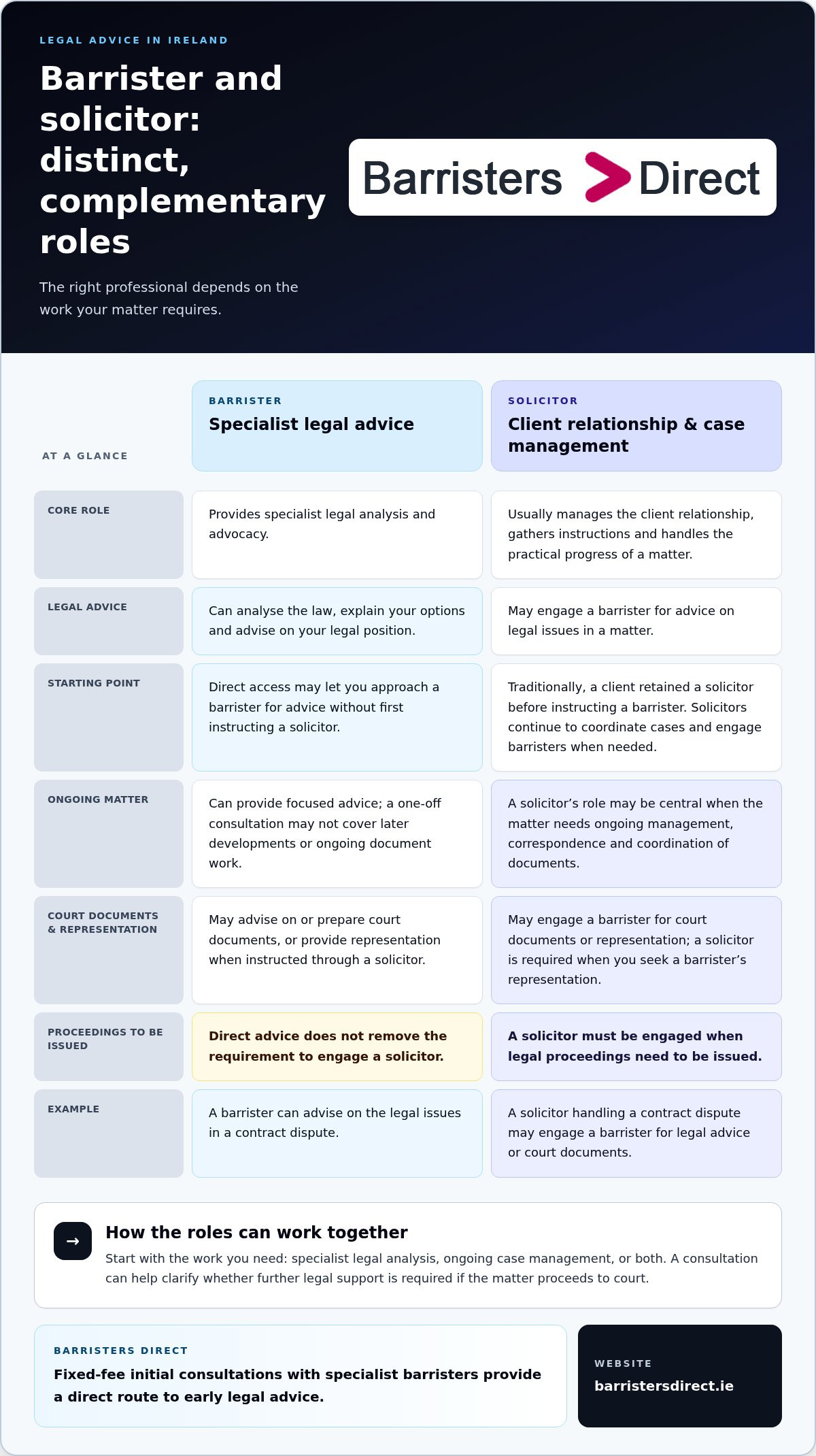
In Ireland, solicitors and barristers have different, complementary roles. A solicitor usually manages the client relationship, gathers instructions and handles the practical progress of a matter. A barrister provides specialist legal analysis and advocacy. For example, a solicitor handling a contract dispute may engage a barrister to advise on the legal issues or prepare court documents. The right professional depends on the work your matter requires.
Traditionally, a client retained a solicitor before instructing a barrister. Direct access changes the starting point for legal advice: you may approach a barrister directly without first instructing a solicitor. This does not make the roles interchangeable. Solicitors continue to coordinate cases and engage barristers for contentious matters, including advice, court documents or representation.
The practical distinction is the objective. If you need an opinion on your legal position, a barrister can provide focused advice. If you need someone to manage an ongoing matter, handle correspondence and coordinate documents, a solicitor’s role may be central. For instance, an employer facing a workplace dispute may need legal advice, followed by separate assistance with the dispute’s ongoing steps.
Direct access may help when advice could clarify a dispute before litigation. Barristers Direct provides fixed-fee initial consultations with specialist barristers, giving clients a direct route to early legal advice. Whether one professional can address your immediate need depends on the work required, not simply the label attached to the dispute. A consultation can help identify whether you need legal analysis, ongoing case management or both.
There is a clear boundary when proceedings are required. In Ireland, you must engage a solicitor when legal proceedings need to be issued. Direct advice from a barrister does not remove that requirement, and a solicitor is also required when you seek a barrister’s representation. Once a dispute moves from assessing options to issuing proceedings, the solicitor’s involvement becomes necessary.
Consider these distinctions when deciding whom to approach:
- Specialist legal advice: a barrister can analyse the law and advise on options.
- Ongoing management: a solicitor manages the client relationship and coordinates the matter.
- Court documents or representation: a solicitor may brief a barrister for this work.
- Proceedings to be issued: a solicitor must be engaged.
If you’re weighing direct advice against the traditional solicitor-led route, the direct access approach explains how to begin with specialist barrister advice while recognising where a solicitor remains essential.
Booking and consultation process
Booking typically involves explaining your legal issue, paying the consultation fee and meeting a barrister with relevant expertise. Preparing a clear question and useful documents helps keep the meeting focused.
Arranging a consultation
To arrange a consultation, set out your issue so a suitably experienced barrister can advise on it. A direct-access service arranges the meeting after you make contact and pay the fixed fee. Give a concise account of the dispute, its current stage and the advice you need. For example, explain whether you need guidance on an employment issue or debt recovery. This information helps match the consultation to your legal question.
Fees and affordable advice
Barristers Direct charges a fixed fee for the initial consultation, with no further fee for that session. Can you get free or low-cost advice from a barrister in Ireland? Don’t assume a direct barrister consultation is free: the initial consultation is a paid service. A fixed fee makes the charge for that meeting clear, but does not include subsequent work.
Preparing questions
Prepare questions by identifying the decisions or uncertainties you want the barrister to address. A focused discussion helps connect the facts to practical options. Ask: “What are the strengths and risks in my position?” and “What should I do next?” If you have a contract, demand letter or relevant correspondence, organise the documents and note their dates. Ask whether reviewing them is part of the agreed consultation scope.
Next steps after advice
After the meeting, the barrister explains the legal position and options relevant to your circumstances. What happens after a barrister consultation in Ireland? The barrister may prepare a written legal Opinion after consulting you and researching your case. The advice may identify further documents or work needed, or explain when a solicitor must be involved. If proceedings need to be issued, you must engage a solicitor.
Before the consultation ends, summarise the action you understand is required and clarify any proposed follow-up work. Separate advice received in the meeting from additional drafting, document review or ongoing assistance. If direct access suits your need for specialist advice, you can arrange a barrister consultation through the direct-access route.
Choosing a barrister
Choose counsel whose experience matches both the legal issue and the work you need. A barrister advising on an employment contract dispute needs relevant employment law expertise; a complex High Court matter calls for different experience. Describe the issue precisely, then identify whether you need an initial legal opinion, advice on documents or a barrister for a particular stage. A close match helps keep the advice focused.
Check that the barrister is entitled to practise. Practising barristers in Ireland must appear on the Roll of Practising Barristers maintained by the Legal Services Regulatory Authority. The Roll is a practical first step when assessing a named barrister. Then consider their area of practice and experience with issues like yours, rather than relying on a broad description such as “civil law”. A landlord and tenant dispute, for example, calls for expertise relevant to that relationship.
Seniority is another factor, but it should reflect the demands of your case. Senior Counsel typically appear in more complex or significant cases and are frequently instructed alongside Junior Counsel in major High Court and appellate litigation. Senior Counsel is not automatically the right choice for every consultation. Consider the legal question, the complexity of the dispute and whether you need advice for litigation or a defined, non-court issue.
Look for a clear match between the barrister’s specialism and the advice you need. A debt dispute over an unpaid invoice, for example, raises different issues from a family law question or personal injury claim. Before booking, write a short summary naming the parties, the key event and the decision you need to make. This helps distinguish counsel with relevant expertise from someone whose practice addresses a different legal problem.
Use these points to compare your options:
- Professional status: confirm the barrister appears on the practising Roll.
- Relevant experience: match their practice area to your specific issue.
- Case demands: consider whether complexity or court proceedings require particular experience.
- Advice required: define whether you need an opinion, document input or advice about next steps.
For a matter that may involve proceedings, consider the solicitor’s role too. In Ireland, you must engage a solicitor when legal proceedings need to be issued, and a solicitor is also required if you seek a barrister’s representation. Select counsel for the specialist advice you need, while recognising when your case also requires a solicitor’s support.
Finally, assess the proposed scope of the consultation. Ask which legal issue the advice will address and whether document review or a written Opinion is included. A written legal Opinion follows consultation and research into the case. Matching the barrister’s expertise, professional status and proposed work to your objective gives you a sound basis for choosing.
Are barrister fees in Ireland charged by the hour or per consultation?
Barristers Direct offers a fixed fee for the initial consultation, with no further fee charged for that session. This makes the initial consultation charge clear before you book. The fee covers the initial meeting, not any additional work. Clarify the scope of any further work directly with the barrister.
The consultation fee and the cost of further legal work are separate matters. For example, advice on an employment issue may involve reviewing documents or preparing a written Opinion after consultation and research. Those tasks may fall outside the meeting’s agreed scope. Ask what the initial fee covers, whether document review is included and how any additional work would be charged.
The fee depends on the case and is given after a quote request; relevant factors include the legal issue, the documents to be reviewed and the work requested. A focused question about a family law matter may require a different scope from a detailed review of a lengthy contract. The important comparison is not simply hourly versus fixed. It is whether the proposed charge matches the work and advice you need.
Before agreeing to a fee, clarify these points in writing:
- Billing basis: establish whether the fee is fixed for the consultation or calculated by time.
- Included work: identify whether the meeting covers your documents, verbal advice or a written Opinion.
- Further steps: ask how additional research, drafting or follow-up advice would be charged.
- Payment arrangements: confirm when payment is due and what it relates to.
For instance, if you want advice on an employment dispute and review of a contract, make both requirements clear before the meeting. If the quote covers the consultation only, a separate fee may apply to a later written Opinion or document work. Clear scope helps you understand what you are paying for, while allowing the barrister to focus on relevant legal analysis.
Direct access can make the initial fee easier to understand where the consultation is offered for a fixed fee. That does not establish a universal fee for all barristers or all legal issues in Ireland. The barrister’s expertise and the work agreed remain central. If you’re ready to discuss a legal issue with a barrister, you can request a consultation and fee quote.
Barristers Direct: Commercial Dispute Resolution
Barristers Direct helps individuals and businesses access specialist barrister advice through a fixed-fee initial consultation. If a commercial dispute raises questions about a contract, unpaid obligations or how to resolve a disagreement, a specialist barrister can provide legal advice on the issues and potential next steps.
The service matches your matter with a barrister whose expertise fits the legal area. It also offers advice on wills and probate, employment law and debt recovery. A consultation is a practical starting point when you need a barrister’s assessment before deciding what further work may be required. If legal proceedings must be issued, you must engage a solicitor.
To discuss a legal issue and arrange a consultation, contact Barristers Direct.
Make your next legal decision with clarity
A barrister consultation in Ireland can be a useful starting point when a legal issue needs focused expert attention. Before booking, identify the decision you need to make and what you want the advice to help you assess. This gives the discussion a clear purpose and connects legal analysis to the practical choices ahead.
Barristers Direct provides access to specialist barrister advice for people and businesses facing different legal concerns. Its services include Commercial Dispute Resolution, Wills and Probate Legal Advice, and Employment Law Consultation. Whether you’re considering a commercial disagreement or need guidance on an employment matter, the value lies in advice from a barrister with expertise in the relevant area.
If you’re ready to discuss your circumstances, contact Barristers Direct to discuss your case. A clear first step can help you approach the next decision with greater purpose.
Frequently Asked Questions
What does a barrister do?
A barrister provides specialist legal advice and may represent clients in court. Barristers analyse complex legal questions, present arguments to judges and juries, and cross-examine witnesses. For example, a business facing a contractual dispute may need a barrister’s opinion on its legal position. Barristers are independent practitioners subject to professional ethical standards. Their courtroom advocacy differs from the broader client-management and transactional work often handled by solicitors.
How do I arrange a consultation with a barrister in Ireland?
To arrange a consultation, explain your legal issue and request a meeting with a barrister whose expertise fits. A direct-access service can match you with specialist counsel based on the area of law, then arrange an initial consultation after payment of the fixed fee. Give a concise account of the problem, its current stage and the advice you need. This helps keep the meeting focused on your specific concern.
Can I contact an Irish barrister directly, or do I need a solicitor?
You can contact a barrister directly for legal advice in Ireland; you don’t always need to instruct a solicitor first. Direct access may suit you when you want a specialist opinion before deciding what to do. If legal proceedings need to be issued, however, you must engage a solicitor. Direct consultation provides access to advice, but does not remove the solicitor’s role in formal proceedings or barrister representation.
What is the difference between a barrister and a solicitor in Ireland?
A barrister focuses on specialist legal advice and courtroom advocacy, while a solicitor generally manages direct client contact and broader legal matters. For example, a solicitor may handle a house purchase and hold purchase monies, then engage a barrister for a complex legal opinion. The relationship can resemble a GP referring a patient to a specialist: each professional contributes different expertise, and the solicitor remains central to managing the client’s matter.
What should I bring to a barrister consultation in Ireland?
Bring documents that show the key events and what remains unresolved. For an unpaid invoice, these might include the contract or agreed terms, the invoice, payment reminders and the other party’s replies. Prepare a brief timeline and identify which facts are disputed. A clear set of documents helps the barrister understand the sequence, distinguish evidence from assumptions and address your most important questions during the meeting.
How do I find a barrister in Ireland who specialises in my case?
Match the barrister’s practice area to your legal issue, then confirm they’re listed on Ireland’s Roll of Practising Barristers, maintained by the Legal Services Regulatory Authority. Describe the matter specifically: a dispute over an unpaid invoice, for example, is more informative than a request for general business advice. A specialist-matching service can use your legal area and summary to connect your query with relevant counsel.
Disclaimer
This article does not constitute legal advice. Barristers Direct does not provide legal advice. To obtain legal advice, you should contact a legal practitioner.


