

A threatening letter can make an immediate reply feel like the safest move. It may not be. Knowing how to respond to a legal threat in Ireland starts with pausing long enough to establish what you’ve received, what it asks of you and whether it sets out a deadline.
It’s understandable to feel unsure whether a threat is formal or credible, especially when the documents are unfamiliar. A rushed response could complicate matters, but ignoring the correspondence may leave you unclear about what happens next. Keep the letter and related records together, note any dates mentioned and avoid making admissions before you understand the position.
This guide explains how to assess the threat, organise the evidence and choose a proportionate next step. Where the issues are complex, a specialist barrister’s opinion may help clarify your options. Barristers Direct arranges paid consultations with barristers; the barrister provides any advice directly. A solicitor can remain an important part of the process if further legal work is needed.
Key Takeaways
- Identify what the correspondence asks of you and whether it appears to be a formal document. A threat alone doesn’t prove the sender’s case.
- To decide how to respond to a legal threat, compare a measured reply, a request for clarification, a negotiated discussion and specialist legal input.
- Build a dated chronology from documents and communications, keeping recorded facts separate from memory and assumptions.
- Keep any reply concise and professional: identify the correspondence, address clear facts and state a proportionate next step.
- If the facts are disputed or the potential consequences are significant, a consultation with a specialist barrister may help clarify your options. Barristers Direct arranges the consultation, and the barrister provides any advice.
Responding to a Legal Threat: Understand the Document
A threatening message deserves attention, but it doesn’t establish that the sender’s allegation is true or that the outcome they threaten will follow. Before deciding how to respond to a legal threat, identify what you’ve received and what it asks of you. A demand, warning or solicitor’s letter is not automatically the same as a document issued by a court.
This section offers practical information for people and businesses in Ireland. The sender, source, wording and surrounding circumstances all matter. Don’t assume a message is harmless because it arrived by email, or that a threatened consequence is certain because it is stated forcefully. General information can’t determine the merits of an individual dispute or confirm whether a particular document has legal effect.
Is it a demand, a warning or a formal court document?
Start with the details on the document and the message that delivered it. Check who sent it, who it names as the recipient, the subject of the dispute, what action is requested and whether a response date is stated. Look for referenced attachments and check that you have received them. These details help you understand the correspondence, but appearance alone cannot establish whether a document is legally effective.
The sender may be making a demand or warning that they intend to take further action. If court documents are mentioned or enclosed, treat the correspondence seriously and seek prompt, case-specific guidance from an Irish legal professional. Don’t rely on a document’s appearance or a general online explanation to decide what it requires in your circumstances.
What is the sender actually asking you to do?
Separate the message into three questions: what does the sender allege happened, what do they want you to do, and what consequence do they say may follow if you don’t? For example, a letter might allege an unpaid invoice, request payment or an explanation, and state that legal action is being considered. Recording each point separately makes the demand easier to assess without accepting the allegation as fact.
Identify the broad subject, such as a contract, employment matter, debt or another dispute, without trying to decide its merits from the wording alone. Understanding Legal Threats provides general background on the concept, but it can’t determine the status of the message you received.
- Allegation: What conduct, agreement or event does the sender say is in dispute?
- Requested remedy: Are they asking for payment, a particular action, an explanation or something else?
- Stated consequence: What do they say they may do if you don’t comply, and is that described as a possibility or a definite step?
A threat communicates an intention; it doesn’t, by itself, prove the underlying allegation. Equally, that distinction doesn’t make the correspondence safe to ignore. Read it carefully, note any stated response date and seek case-specific guidance if court documents are involved or you’re unsure what the document means.
Before replying to a legal threat, preserve evidence and establish the facts
A clear record helps you understand the dispute and explain it accurately if you seek professional guidance. Before drafting a response, preserve the material as it is and build a factual timeline. This makes it easier to check what the correspondence refers to, spot gaps and avoid relying on memory alone.
How to organise the correspondence and supporting records
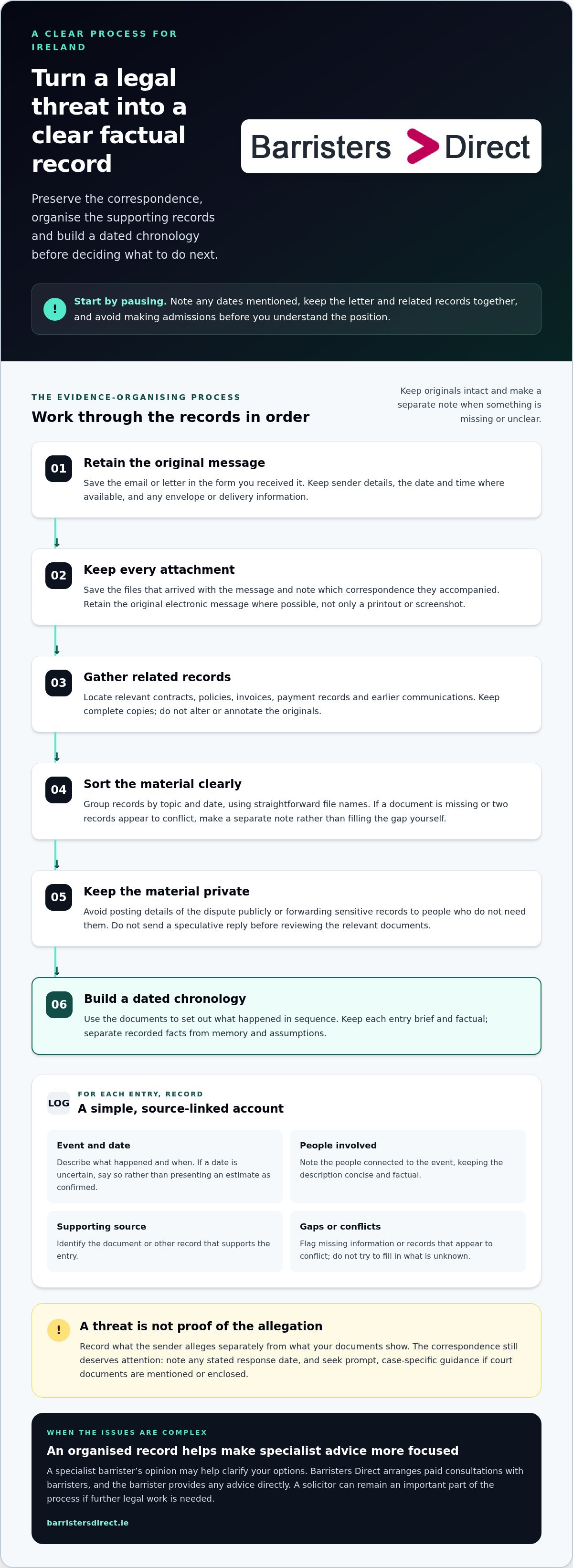
Work through the records in a consistent order. Keep originals intact, save complete copies and avoid adding notes directly to documents or messages that may need to be reviewed later.
- Retain the original message. Save the email or letter in the form you received it. Keep sender details, the date and time where available, and any envelope or delivery information.
- Keep every attachment. Save the files that arrived with the message and note which correspondence they accompanied. Don’t rely only on a printout or screenshot if you can retain the original electronic message as well.
- Gather related records. Locate relevant contracts, policies, invoices, payment records and earlier communications. Keep complete copies and don’t alter or annotate the originals.
- Sort the material clearly. Group records by topic and date, using straightforward file names. If an expected document is missing, or two records appear to conflict, make a separate note rather than trying to fill the gap.
- Keep the material private. Avoid posting details of the dispute publicly or forwarding sensitive records to people who don’t need them. Don’t send a speculative reply before reviewing the relevant documents.
An organised record can help a legal professional understand the sequence without reconstructing it from scattered messages. Citizens Information provides general information about Irish Legal Aid and Advice, including routes for learning about legal advice in Ireland.
How to make a neutral chronology
Once the documents are together, create a dated chronology. For each entry, record the event, the date, the people involved and the document or other source that supports it. Keep each description factual and brief. If a date is uncertain, say so rather than presenting an estimate as confirmed.
A useful chronology connects each key event to the record supporting it. For example, distinguish “email received on the date shown in the message” from “I recall discussing this around the same time”. If accounts differ, label the point as disputed and record whose account it is. This keeps evidence, recollection and assumption separate.
Preparing this material can also make a specialist discussion more focused. Barristers Direct arranges access to a barrister for a paid consultation in the relevant area of law; the barrister provides any advice directly. Find out about arranging a barrister consultation.
Compare your response options before choosing what to say
There’s no single response that suits every dispute. The right approach depends on what the sender is asking for, the records available and the possible consequences of acting or not acting. A firm denial, an admission or a counter-threat can affect how the matter develops, so don’t use one simply to sound decisive. Consider what each option could clarify and what it cannot promise.
When a brief, factual response may be appropriate
If you can respond accurately and the matter is straightforward, a short reply may be enough to acknowledge receipt without accepting the sender’s account. Address the specific request and avoid unnecessary argument. For instance, you might confirm that you’ve received the letter and ask for a particular point to be explained, without commenting on facts you haven’t checked.
Keep the wording neutral. Don’t invent facts, make admissions you haven’t considered or threaten action just to sound forceful. In a business dispute, the relevant issues may depend on the commercial relationship and records involved. The commercial disputes guidance provides context for that type of disagreement.
When specialist input may help clarify the options
If the claim raises complex questions or the consequences could be significant, a specialist barrister consultation may help you assess the issues before choosing a response. Barristers Direct arranges a paid consultation with a barrister matched to the relevant area; the barrister provides any advice directly. Solicitors also play an important role in client support and legal work. The difference between solicitors and barristers explains their distinct roles.
For general information about the courts and court-related resources in Ireland, consult the Irish Courts System. It can provide background, but it doesn’t assess your individual correspondence. Comparing your options first helps you decide whether to reply, seek clarification, explore discussion or get specialist input.
Writing a Measured Response to a Legal Threat
A written reply can shape how the other party understands your position. The aim isn’t to win an argument through forceful language. It’s to communicate accurately, address what needs a response and avoid adding claims that haven’t been checked. If the correspondence refers to a formal process or gives a response date, seek prompt, case-specific guidance from an Irish legal professional rather than assuming the date or document can be ignored.
A simple structure for a calm written reply
Before writing, decide what the reply needs to achieve. A useful structure keeps the message focused and makes it easier to review before sending:
- Identify the correspondence. Refer clearly to the letter or message, using its date or subject where helpful. Confirm receipt only if that is accurate and serves a purpose.
- State why you’re replying. Explain briefly whether you’re acknowledging the message, answering a specific request or seeking clarification.
- Address verifiable points. Respond only to matters you can answer from reliable records. If an allegation is disputed or unclear, say so neutrally instead of guessing or making a broad denial.
- Set out a proportionate next step. Ask a focused question if information is missing, or state what you intend to do next if that is clear and appropriate.
For example, if you can’t tell what an amount in a demand relates to, you could ask the sender to identify the relevant item or provide a breakdown. That keeps the exchange centred on the issue. It doesn’t concede that the amount is owed or determine whether the wider claim is valid.
Wording and actions that can make matters harder
Keep the tone professional, even if the original message feels provocative. Avoid sarcasm, insults, counter-threats and sweeping statements. Don’t promise a particular action, admit liability or make allegations unless they’re accurate and you’ve considered them in context. A template can suggest a format, but it can’t account for the facts, legal issues or formal documents in your individual matter.
Review the draft against the correspondence before sending it. Check that each factual statement is supported, that you’ve answered the request you intend to address and that no unnecessary detail has crept in. Don’t delete relevant records, publish private correspondence or involve third parties without a clear reason. If a point is uncertain, pause and seek appropriate guidance rather than filling the gap with an assumption.
Understanding how to respond to a legal threat includes knowing when a reply may need specialist review. Barristers Direct arranges paid consultations with barristers, who provide any advice directly. Learn more about arranging a barrister consultation.
When a barrister consultation can help you decide what comes next
Some correspondence is difficult to assess without specialist legal knowledge. A consultation may be worth considering if the issues are complex, important facts are disputed, the possible consequences are significant or you’ve received formal documents. A barrister matched to the relevant area can consider the information you provide and give advice on possible next steps. This can help you make a more informed decision about whether and how to respond.
A consultation doesn’t guarantee a particular outcome or automatically mean ongoing representation. Its value is in obtaining advice tailored to the circumstances, rather than relying on a generic template or assuming that the sender’s position is correct.
What to prepare for a specialist consultation
Good preparation helps make the discussion focused. Gather the material that explains the issue and make a short note of what you need help understanding. Don’t try to present a perfect legal argument; a clear, accurate account is more useful than speculation.
- The threatening correspondence and any attachments or related messages.
- A concise chronology that links key events to the relevant records.
- The other party’s requests and any dates or process stated in the documents.
- The points that remain unclear or disputed, labelled as such.
- A note of what you hope to achieve, without assuming that result can be guaranteed.
If something is missing, say so. Don’t fill gaps with assumptions. The barrister can consider the information available and explain what further details may matter to the issues raised.
How direct access fits alongside a solicitor’s role
Barristers Direct arranges a paid consultation with a barrister matched to the relevant area of law. The consultation can take place online or by telephone, and the barrister provides any advice directly. Any further advice or engagement is between you and that barrister. The platform arranges access; it doesn’t itself provide legal advice.
Arranging an initial consultation directly with a barrister can provide access to specialist expertise, but it doesn’t make solicitors unnecessary. Solicitors remain important for broader client support and legal work. If the matter proceeds to litigation, a solicitor may need to be engaged for the relevant proceedings. The appropriate arrangement depends on the work involved and your circumstances.
If you’re weighing how to respond to a legal threat and want advice grounded in your documents and situation, consider whether a specialist consultation could clarify your options. Arrange a paid consultation with a specialist barrister.
Choose your next step with clarity
The next move doesn’t need to settle the entire dispute. It should help you understand the position and make a considered decision about what comes after. If you’re still uncertain how to respond to a legal threat, focused advice on your circumstances can help you weigh the available options before taking action.
Seeking specialist input is a practical step when you need a clearer view of the issues, not a commitment to a particular course or outcome. Barristers Direct arranges paid consultations with barristers matched to the relevant area of law. The discussion can take place online or by telephone. Any advice is provided by the barrister, and a solicitor may continue to play an important role in further legal work.
If a tailored perspective would help you decide how to proceed, arrange a paid consultation with a specialist barrister. Discuss the issues directly with a barrister and consider your next steps with greater clarity.
Frequently Asked Questions
Is a legal threat the same as being sued?
No. A statement that someone intends to take legal action doesn’t, by itself, show that proceedings have started. Check what you actually received, including any enclosed documents, rather than relying only on the sender’s description. If you’re unsure whether papers relate to a court process, keep the full correspondence and seek prompt, case-specific guidance from an Irish legal professional. Don’t infer the status of a case from threatening wording alone.
Can I ignore a legal threat if I think the other person is wrong?
It’s risky to dismiss a message solely because you believe the allegation is mistaken. To decide how to respond to a legal threat, first check what the sender says happened and whether any documents support or contradict that account. Note any request or date stated, and avoid replying in anger. If the correspondence refers to formal proceedings or serious consequences, get professional input promptly rather than relying on your own assessment alone.
Should I reply to a legal threat by email?
Not necessarily. The fact that a threat arrived by email doesn’t mean you should answer immediately or by the same channel. Preserve the message and attachments, then consider whether email is suitable for the matter and the information you need to communicate. If you reply, keep the wording factual and professional, and retain a copy of what you send. Seek case-specific guidance first if formal documents or complex issues are involved.
Can I ask the sender to explain the legal threat?
Yes, a neutral request may help if you can’t identify the allegation or what action the sender wants. Ask a focused question, such as which invoice or agreement a demand refers to, rather than making assumptions about the answer. Avoid adding admissions or counter-threats. Keep a copy of your request and the reply with the relevant records. Whether clarification is suitable depends on the correspondence and any stated process or dates.
How much time do I have to respond to a legal threat in Ireland?
There’s no single response period that applies to every threatening message. Read the correspondence carefully and note whether a date is a requested reply date or appears connected to a formal process. Don’t assume that a stated date can be ignored or extended. If court documents are enclosed, or the demand appears time-sensitive, contact an Irish legal professional promptly for advice based on the documents and circumstances.
Can I consult a barrister directly in Ireland about a legal threat?
Yes. Barristers Direct arranges a paid consultation with a barrister matched to the relevant area of law. The consultation can take place online or by telephone, and any advice is provided directly by the barrister. Any further engagement is between you and that barrister. This route to specialist input doesn’t replace solicitors across all legal work; if litigation proceeds, a solicitor may need to be engaged for the relevant proceedings.
What documents should I keep after receiving a legal threat?
Keep the complete correspondence and material that may help explain the issue, such as a relevant agreement, invoice, policy or earlier exchange. For digital records, retain the original email rather than relying on a copied excerpt, so sender details and available timestamps remain visible. Keep documents in a secure, organised folder and avoid altering originals. If you later seek advice, this helps the professional identify what information is available and what may still be missing.
Disclaimer
This article does not constitute legal advice. Barristers Direct does not provide legal advice. To obtain legal advice, you should contact a legal practitioner.


