

What if the best first step in a commercial dispute isn’t choosing whether to fight or settle, but getting a clearer view of the issues first? If you’re searching for commercial litigation advice Ireland, uncertainty about your position, the evidence or the consequences of delay can make it difficult to decide what to do next.
That uncertainty is understandable. A specialist barrister can assess the issues and explain the strengths, risks and possible routes available, helping you make a more informed decision without promising a particular outcome. Through Barristers Direct, businesses can arrange a paid, fixed-fee initial consultation with a qualified barrister whose expertise matches the relevant area of law. Consultations take place online or by telephone.
This advice can complement, rather than replace, a solicitor’s role. A solicitor can support your broader legal needs and must be engaged if formal legal proceedings are required. This article explains what a barrister’s advice can clarify, how the two roles can work together, and what information to prepare so you can use an initial consultation effectively.
Key Takeaways
- Commercial litigation advice Ireland can help separate the facts of a dispute from the legal and commercial questions that need careful assessment.
- A barrister may analyse specialist legal issues and provide courtroom advocacy, while a solicitor can support broader client-facing and procedural work.
- Prepare a concise chronology, relevant documents and clear priorities, and include facts that may complicate your position.
- Use the consultation to identify the questions that matter and consider possible next steps, without assuming a particular outcome.
When commercial litigation advice in Ireland can help clarify a business dispute
A dispute can put pressure on decisions beyond the legal issue itself. A disagreement may affect cash flow, working relationships, planning or the time management can give to other priorities. Start by understanding what is actually in dispute and what choices are available, rather than assuming that court proceedings are inevitable.
Commercial litigation advice is a specialist analysis of a business dispute, the relevant legal issues and possible procedural choices. It can help a business identify what needs closer attention, which information may matter and what questions to consider before responding. It cannot guarantee settlement, success in court or any other particular result. For businesses seeking commercial litigation advice in Ireland, a direct consultation provides access to a specialist barrister’s advice at an early stage, before deciding how to proceed.
Commercial law covers legal issues arising from business activity. The overview of Commercial Law provides background to the wider field, but a barrister’s advice considers the facts and issues of the particular dispute. A commercial disputes advice consultation can help a business understand its concerns without treating every disagreement as a court case.
What counts as a commercial dispute requiring specialist input?
Commercial disputes can arise from a contractual disagreement, a shareholder conflict or a breakdown in a business relationship. The label alone doesn’t determine whether specialist advice is useful. Consider seeking input if the facts are contested, the documents are difficult to interpret, several parties are involved, or the issue could have meaningful consequences for the business.
For example, two businesses may give different accounts of what was agreed, while a disagreement between shareholders may raise questions about both the company’s interests and the parties’ positions. These examples don’t establish who is legally right. They show why it can help to have a specialist distinguish the factual account from the legal issues and practical implications that need analysis.
Why seek advice before choosing a response?
An early discussion can help organise the problem: what has happened, what remains disputed, which documents or facts may be important, and what the business wants to achieve. That structure can make it easier to identify what needs attention before sending a substantive response or committing resources to a particular approach.
Seeking advice doesn’t commit a business to issuing proceedings. Depending on the circumstances, it may consider further discussions, a negotiated resolution or formal steps. The appropriate options depend on the facts and the advice received. An initial consultation is a chance to understand those options, not a decision made on the business’s behalf.
Early advice can clarify the choices, but it cannot guarantee how a dispute will end.
What a barrister may assess when advising on commercial litigation
A useful consultation starts with the specific dispute, not a pre-set checklist. The barrister may first need to understand your account of events, the other party’s position and what the business hopes to achieve. They can then identify which legal and commercial questions merit closer attention. The aim is to clarify the issues, not to assume that one route or result is inevitable.
For commercial litigation advice in Ireland, the information available can shape the discussion. A barrister’s view is based on the facts and documents presented, so a clear, balanced account helps make the advice relevant. If important information is missing or an account is disputed, that may affect which questions can be answered in the consultation.
How facts, documents and disputed issues shape the advice
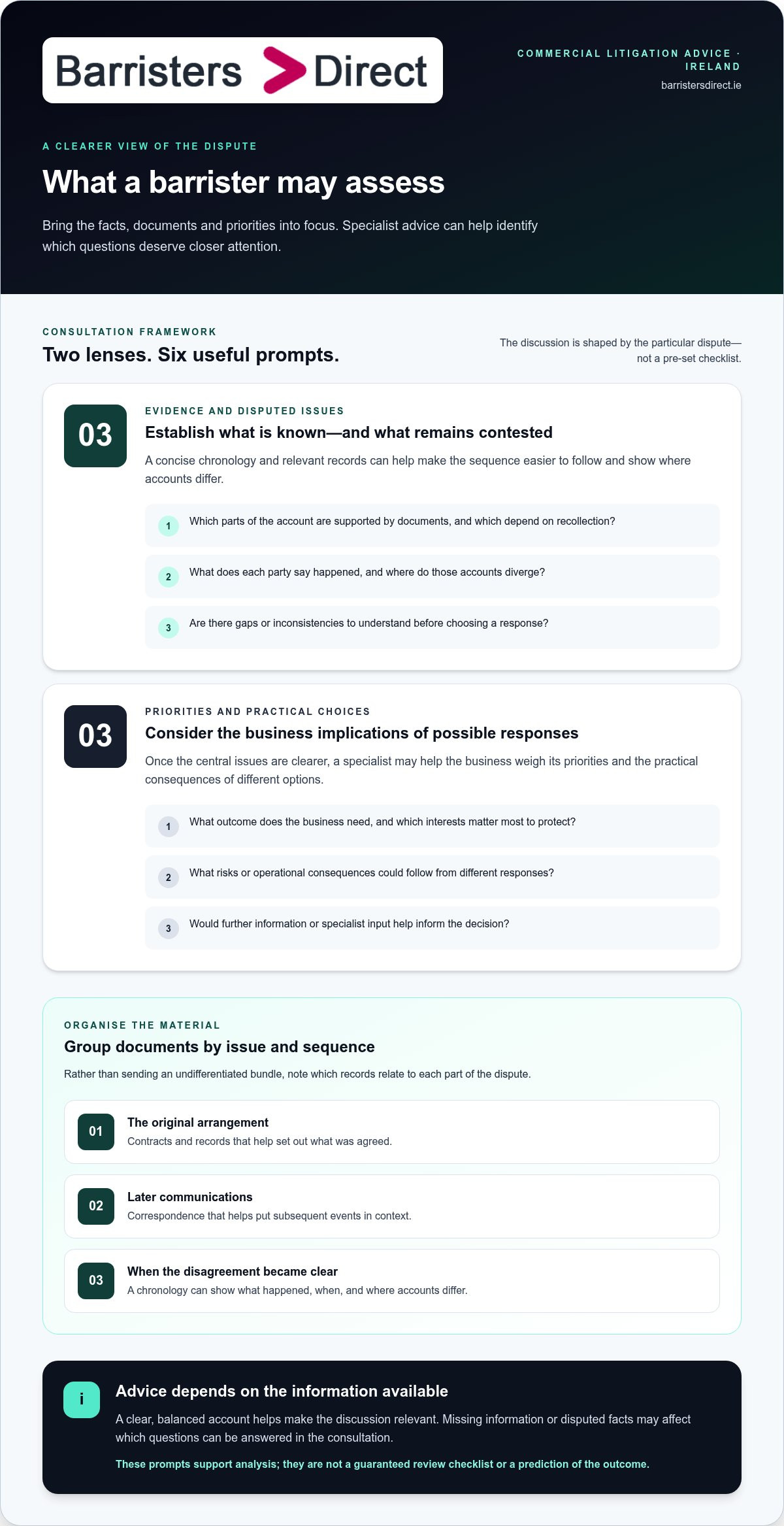
Contracts, correspondence and records of key events can help put a dispute in context. A concise chronology shows what happened, when it happened and where the parties’ accounts differ. It doesn’t need to resolve every uncertainty. Its purpose is to make the sequence easier to follow and distinguish what appears to be agreed from what remains contested.
As you organise the material, group it by issue rather than sending an undifferentiated bundle. For example, note which documents relate to the original arrangement, later communications or the point when the disagreement became clear. The barrister may then consider questions such as:
- Which parts of the factual account are supported by documents, and which depend on recollection?
- What does each party appear to say happened, and where do those accounts diverge?
- Are there gaps or inconsistencies that need to be understood before the business chooses a response?
These are prompts for analysis, not a guaranteed review checklist. The relevance of each document or issue depends on the circumstances.
Strategic questions a specialist may help you consider
Once the central issues are clearer, advice may help the business weigh its priorities and the practical implications of different options. The barrister may explore questions such as:
- What outcome does the business need, and which interests are most important to protect?
- What risks or operational consequences could follow from different responses?
- Would further information or specialist input help the business make a sound decision?
If formal court proceedings are being considered, the Irish Commercial Court Operations information from the Courts Service of Ireland provides context on how that court operates. Whether a particular process is relevant depends on the dispute and requires specific advice. Considering a procedural route is not a prediction that it will succeed or a commitment to pursue it.
A barrister’s view depends on the facts and material presented, so clear information supports a more focused discussion. If an early specialist conversation would help you assess the issues, Barristers Direct can arrange a consultation with a qualified barrister matched to the relevant area.
Barrister or solicitor for commercial litigation advice in Ireland?
A barrister and a solicitor bring different, complementary skills to a commercial dispute. A business seeking commercial litigation advice in Ireland can speak directly with a specialist barrister for an initial view, while a solicitor can support broader legal work and manage formal proceedings where required. It isn’t always a choice between one professional and the other.
| Aspect | Barrister | Solicitor |
|---|---|---|
| Typical role | Provides specialist legal advice and courtroom advocacy. | Advises across a client’s broader legal needs and may manage work connected with formal proceedings. |
| Client contact | Can meet a business directly for an initial consultation, or be engaged by a solicitor. | Typically maintains direct contact with the client and coordinates the wider legal work. |
| Specialist contribution | Offers focused analysis and advocacy relevant to their area of expertise. | Provides continuing advice and handles broader advisory and transactional matters. |
In Ireland, barristers are independent sole practitioners. A solicitor may engage one to advise on a specialist issue or provide advocacy, much as a GP may refer a patient to a specialist. The analogy has limits, but it helps explain how the professions work together: each contributes distinct expertise to the client’s needs.
What direct access to a barrister means for a business
Direct access gives a business a route to an initial consultation with a qualified barrister whose expertise matches the relevant area. Barristers Direct arranges the paid consultation; the barrister gives the legal advice, and any further engagement is between the client and that barrister. This route can help a business obtain specialist input without implying that Barristers Direct itself provides legal advice or litigation representation. You can read about the advantages of instructing a barrister directly as part of understanding this option.
Direct access doesn’t replace a solicitor. It offers a way to seek a specialist barrister’s view at an early stage, so the business can better understand its position and consider what support may be needed next. Consultations can take place online or by telephone.
When a solicitor may remain part of the litigation route
If a dispute moves towards formal proceedings, a solicitor must be engaged to manage the proceedings and provide broader client-facing support. The solicitor’s ongoing role can complement a barrister’s specialist advice or advocacy. The precise arrangement depends on the matter and the work required. Further litigation work or representation is a separate engagement and isn’t automatically included in an initial consultation.
Understanding the difference between solicitors and barristers can help a business see how their contributions fit together. The practical question is not simply which professional to choose, but what expertise and support the dispute calls for at each stage.
How to prepare for a commercial litigation advice consultation
You don’t need a polished legal submission to make an initial discussion useful. A clear account of the problem, the key material and the decisions facing the business give a specialist barrister a practical starting point. Preparation is there to focus the conversation, not to meet a formal standard or guarantee a particular answer.
To make the most of a consultation, separate what you know from what you suspect, and be clear about what you need help deciding. Keep the material proportionate: prioritise what relates directly to the dispute rather than trying to assemble every record the business holds.
Documents and information to organise beforehand
Start with documents that explain the arrangement and how the disagreement developed. Depending on the issue, these might include a relevant contract, important emails or letters, and records of key discussions or decisions. This is a practical guide, not an exhaustive list or a requirement to produce particular documents.
A short chronology can make your account easier to follow. Note the main events, who was involved, what was agreed or communicated, and which points remain unclear or disputed. If dates are approximate, say so rather than presenting them as certain. The aim is to help the barrister see the sequence and identify where further clarification may be useful.
Before the consultation, it may help to:
- Write a brief summary of the dispute and the other party’s position, as you understand it.
- Gather the most relevant contracts, correspondence and related records in an accessible format.
- Mark uncertainties, gaps or differences in the accounts, rather than trying to resolve them yourself.
- Identify the business priorities, such as protecting an ongoing relationship or understanding operational risks.
Be candid about facts that may complicate the business’s position. An incomplete or overly one-sided account can make it harder for the barrister to address the real issues. If you’re unsure whether something matters, flag it and explain the uncertainty.
Questions that make the consultation more useful
Use your priorities to shape the discussion. You might ask which legal and factual issues appear most important based on the information provided, and whether any part of the account needs clarification. Ask what options could be considered, what uncertainties remain, and what practical risks the business should weigh before choosing a route.
It can also help to ask what further information may assist, and whether additional professional involvement will be needed if the matter moves towards formal proceedings. A solicitor must be engaged for formal legal proceedings and may have an important role in broader legal work. The barrister can explain how that may relate to the issues discussed, but the consultation itself doesn’t commit the business to proceedings or determine the outcome.
With a focused summary and relevant material to hand, you can use the time to address the questions that matter most. Arrange an initial consultation with a specialist barrister through Barristers Direct.
Arranging commercial litigation advice through Barristers Direct
Once you know the questions you want to address, an initial specialist consultation offers a focused way to discuss the dispute. Barristers Direct arranges a paid, fixed-fee consultation with a qualified barrister matched to the relevant area of law. For businesses seeking commercial litigation advice across Ireland, the consultation can take place online or by telephone.
What to expect from the initial consultation route
Barristers Direct arranges access to the consultation. The barrister provides any legal advice directly to you, based on the information you share and the issues discussed. This distinction matters: the platform does not itself give legal advice or provide litigation representation.
The consultation is an initial opportunity to discuss your position with a specialist. It doesn’t automatically commit either you or the barrister to further work or require either of you to continue the relationship afterwards. If you decide to engage the barrister for additional advice or work, that is a separate arrangement between you and the barrister. The same applies to any later engagement of a solicitor.
To make the discussion productive, explain what the business needs to understand or decide. The barrister may address the legal issues raised, discuss the questions that remain open and outline possible considerations. The advice will be specific to the information available. It can inform your thinking, but it cannot promise a settlement, success in court or another particular outcome.
Choosing the next step after receiving advice
After the consultation, you can consider the advice and decide what, if anything, to do next. You may wish to clarify facts, weigh the practical implications for the business or seek further professional support. An initial consultation doesn’t have to lead to a court claim or continued engagement with the barrister.
If formal litigation is pursued, a solicitor must be engaged to manage the proceedings and provide broader client-facing support. Any such work requires a separate arrangement. The barrister’s specialist input and a solicitor’s ongoing role can complement one another, depending on the needs of the dispute.
The purpose of the initial consultation is to give you access to relevant specialist advice, so you can make a more informed decision about the route ahead. Explore a commercial litigation advice consultation through Barristers Direct.
Make your next decision with greater clarity
A commercial dispute can make it tempting to react quickly, especially when business relationships or important decisions are under pressure. A more considered next step is to identify what the business needs to decide, what remains uncertain and who needs to be involved. That gives any legal discussion a clear purpose and keeps the focus on the issues that matter to the business.
Seeking commercial litigation advice in Ireland is not the same as deciding to litigate. It brings specialist legal judgement into a decision that may have wider commercial consequences. The advice can help you understand the questions ahead, while the choice of what to do remains yours.
If you’re ready to discuss the issues with a specialist, arrange a fixed-fee commercial litigation advice consultation through Barristers Direct. A clearer understanding of the choices can help your business move forward thoughtfully, whatever route it ultimately takes.
Frequently Asked Questions
Can I speak directly to a barrister about a commercial dispute in Ireland?
Yes. You can arrange an initial consultation directly with a barrister, without first retaining a solicitor for that meeting. Barristers Direct arranges a paid consultation with a qualified barrister whose expertise matches the relevant area. The barrister, not the platform, provides any legal advice. This route lets you raise a specific commercial issue with a specialist and discuss what further questions or support may be relevant.
Do I need a solicitor before consulting a barrister about commercial litigation?
No, you don’t need to engage a solicitor just to have an initial consultation with a barrister through Barristers Direct. A solicitor may still be important for broader legal support, and must be engaged if you proceed with formal legal proceedings. Any further work involves a separate arrangement. The appropriate combination of professionals depends on the advice received and what the business decides to do next.
What documents should I prepare for a commercial litigation advice consultation?
Consider bringing the main agreement or contract, key correspondence and any records that help explain the disagreement. A brief chronology can note important events, the people involved and the points where accounts differ. You don’t need to create a complete legal file. Prioritise material that explains the issue, and flag information that may not support the business’s position so the barrister can consider the circumstances accurately.
Can a barrister advise whether my business dispute should go to court?
A barrister can discuss whether court proceedings may be one of the options, based on the facts and information you provide. You can ask what practical considerations, uncertainties or further information may affect that decision. The advice can inform your choice, but it won’t determine the decision for your business or guarantee how a court would resolve the dispute. A solicitor must be engaged for formal proceedings.
Will a commercial litigation consultation guarantee a particular outcome?
No. A consultation can provide specialist legal analysis of the information discussed, but no barrister can guarantee that a dispute will settle, that proceedings will succeed or that a particular result will follow. The assessment may also change if relevant facts or documents emerge later. Use the discussion to understand the issues and choices more clearly, rather than as assurance of a specific result.
Can I use online or telephone consultation for commercial litigation advice?
Yes. A commercial litigation consultation arranged through Barristers Direct can take place online or by telephone. These options let you discuss the dispute with a relevant barrister without meeting in person. Before the consultation, consider how you’ll refer to key documents and dates during the discussion, and have your main questions to hand. The advice comes directly from the barrister you consult.
Disclaimer
This article does not constitute legal advice. Barristers Direct does not provide legal advice. To obtain legal advice, you should contact a legal practitioner.


