

A former employee joins a competitor, and you suspect they’re using confidential information or taking valuable client relationships with them. If you’re researching how to enforce a non-compete agreement Ireland courts may uphold, a signed clause is only the starting point. The wording, the employee’s role and the available evidence all matter.
In Ireland, restrictive covenants are generally treated as restraints of trade. An employer must show that a clause protects a legitimate business interest and is no wider than reasonably necessary. Its duration, geographic reach and scope can all affect the assessment. Acting before those issues are clear may lead to a costly or disproportionate response.
This guide explains the legal hurdles, the documents and evidence to review, and the practical options to consider before taking action. It also explains how an early consultation with a specialist employment-law barrister, arranged through Barristers Direct, can help you assess the merits, risks and possible next steps. Any legal advice is provided by the barrister.
Key Takeaways
- Explore how to enforce a non-compete agreement Ireland employers may rely on by matching any response to the clause, evidence and business interest at stake.
- Review the signed clause alongside employment documents and the former employee’s role before deciding whether the restriction fits the circumstances.
- Preserve relevant records lawfully and assess what they show about possible use of confidential information or business relationships.
- Consider a measured discussion, a formal written request or advice about court remedies, based on the evidence and potential impact on the business.
- A paid consultation with a specialist employment-law barrister can help clarify the merits, risks and next steps. Any advice is provided by the barrister.
How to enforce a non-compete agreement in Ireland: start with the real business concern
A former employee joining a competitor can raise immediate concerns, but the new role alone doesn’t establish that a contract has been breached. A non-compete is a post-termination restriction intended to prevent specified competing activity, such as working for a competitor or setting up a competing business within defined limits. Whether it applies depends on its wording and the circumstances, not simply on the employee having signed it.
Irish law treats restrictive covenants as restraints of trade. A non-compete is not automatically enforceable because it may restrict a person’s ability to earn a living. The background principle is outlined in Restraint of Trade. That overview is not a substitute for assessing the clause under current Irish law. The key question is what genuine business interest the restriction is intended to protect.
What does a non-compete clause seek to restrict?
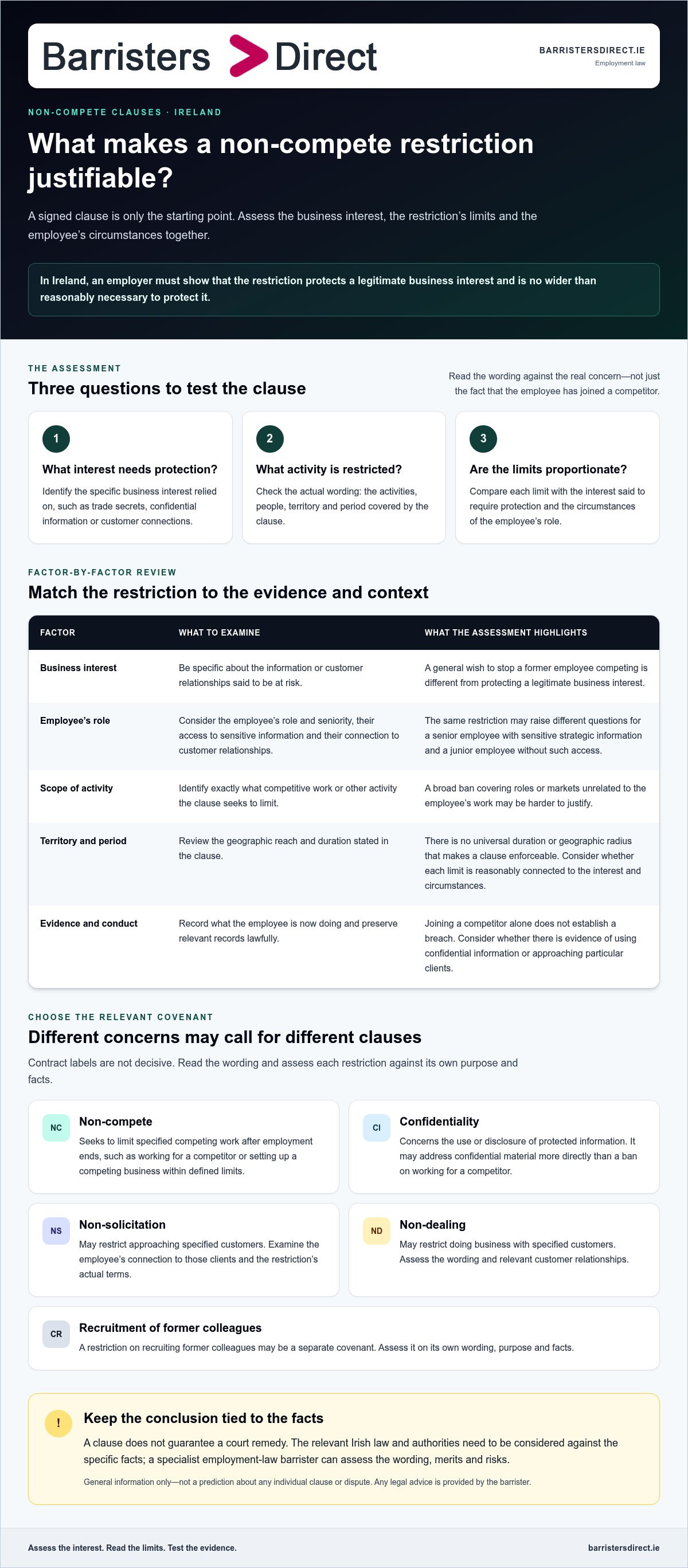
A non-compete clause seeks to limit particular kinds of competitive work after employment ends. It differs from a confidentiality provision, which concerns the use or disclosure of protected information, and from non-solicitation or non-dealing provisions, which may restrict approaching or doing business with specified customers. A restriction on recruiting former colleagues may be a separate covenant. The labels used in a contract aren’t decisive: read the wording and assess each restriction against its own purpose and facts.
What should an employer clarify before considering enforcement?
Start with the known facts, rather than assuming that any move to a rival is unlawful. Record the employee’s role and seniority, their access to sensitive information or customer relationships, how they left and what they are now doing. Then identify the specific interest you believe is exposed. For example, is the concern simply that the employee has joined a competitor, or do you have evidence that they are using confidential pricing information or approaching particular clients?
This distinction matters. Competing for business in the ordinary course is not, by itself, proof of a contractual breach. If the concern is misuse of information or contact with clients, a confidentiality, non-solicitation or non-dealing term may be more relevant than a broad restriction on taking a new job. Consider the wording of the relevant clause alongside the evidence and the employee’s actual conduct.
These questions help frame how to enforce a non-compete agreement Ireland employers may be considering. This guide provides general information, not a prediction about any individual clause or dispute. A specialist employment law consultation can help assess the wording and circumstances. Any advice is provided by the barrister, and the outcome depends on the specific facts and applicable law.
When may a non-compete agreement be enforceable under Irish law?
Once you have identified the clause and the concern, assess whether the restriction could be justified rather than assuming it should be enforced. In Ireland, a non-compete is treated as a restraint of trade. The employer must be able to show that it protects a legitimate business interest and is no wider than reasonably necessary to protect that interest. The employee’s role and the business context matter as well as the wording.
Separate the assessment into three questions: what interest needs protection, what activity does the clause restrict, and are its limits proportionate to that interest? There is no automatic answer to how to enforce a non-compete agreement Ireland employers may face. A clause does not guarantee a court remedy, and the relevant Irish law and authorities need to be considered against the specific facts.
Which business interests may be relevant?
Potential interests include trade secrets, confidential information and customer connections, where the facts and current Irish authorities support relying on them. Be specific about the interest. For example, identify what information is genuinely sensitive or which customer relationships the employee helped develop. A general wish to stop a former employee competing is different: preventing ordinary competition, by itself, is not a legitimate business interest.
This distinction is practical as well as legal. If the concern is confidential material, consider whether a confidentiality obligation addresses it more directly than a ban on working for a competitor. If client relationships are at risk, examine the employee’s connection to those clients and the restriction’s actual terms. Assess each proposed interest and covenant against current Irish law rather than assuming it qualifies.
How do scope and proportionality affect the assessment?
Read the clause carefully to identify the activities, people, territory and period it covers. Compare each limit with the interest said to require protection. A restriction aimed at a senior employee with access to sensitive strategic information may raise different questions from the same wording applied to a junior employee with no such access. A broad ban covering roles or markets unrelated to the employee’s work may be harder to justify.
There is no universal duration or geographic radius that makes a clause enforceable. The question is whether the particular limits are reasonably connected to the interest and circumstances. A territory isn’t justified simply because it appears in the contract. Consider where the employer operates and where the employee’s role or influence was relevant. Apply the same careful analysis to the length of the restriction.
In Ireland, a non-compete is potentially enforceable only if it protects a legitimate business interest and its restrictions are reasonably tailored to that purpose. The contract alone does not settle the question. Whether enforcement is proportionate depends on the circumstances. A specialist barrister can help evaluate the clause, the business rationale and the risks before you choose a response. Barristers Direct arranges paid consultations with specialist barristers, including for employment-law advice. Any advice is provided by the barrister.
How to assess a suspected breach before taking action
Before choosing a response, build a clear picture of what the agreement says and what the former employee is known to have done. A concern about a competitor is not the same as evidence that a specific contractual restriction has been breached. Approach how to enforce a non-compete agreement Ireland employers may face through a documented review, not a hurried assumption.
Work through the material in sequence:
- Read the operative clause. Check the signed contract and any later variation or amendment. Identify the activities, customers, territory and period covered, and note any terms that qualify or define the restriction.
- Review the employment and exit documents. Look at relevant policies, role descriptions, acknowledgements, resignation or termination correspondence, and any settlement or exit agreement. These may help establish which terms applied and what was discussed when employment ended.
- Set out the known facts. Record the employee’s role, responsibilities and access to information or client relationships. Note the departure circumstances and the specific conduct causing concern. Don’t infer misuse simply from access or a move to a competitor.
- Assess evidence and potential impact. Identify what supports each concern, where it came from and how it relates to the clause. Consider the concrete business risk, such as a documented approach to a client or apparent use of confidential material, rather than relying on a general fear of lost business.
Which documents and facts should be reviewed?
Keep the review focused on records that help explain the agreement and events. Include the signed contract, amendments and relevant exit or settlement documents, alongside role records and contemporaneous communications. Note when each concern first arose and what is actually known. A dated record helps distinguish what was observed at the time from explanations or conclusions formed later.
How can an employer distinguish suspicion from evidence?
Create a chronology with dates, sources and a clear label for each point: confirmed fact, reported information or inference. For instance, a client independently mentioning contact is different from a rumour that the former employee has approached the account. Then assess whether the information relates to a specific restriction and supports the alleged conduct.
Documented evidence helps show what is known, how it was obtained and whether it connects the suspected conduct to the clause before you choose an enforcement step. Preserve relevant business records in their original form where possible, recording where they came from and avoiding unnecessary changes. Keep collection and access lawful and consistent with applicable data-handling and employment obligations. Don’t use intrusive monitoring or access personal accounts or devices without proper authority. If you’re uncertain about a proposed collection method or the status of particular records, obtain legal guidance before proceeding.
A structured file can also make an initial discussion with a specialist more focused. It allows the clause, evidence and possible business impact to be considered together, while keeping unverified claims distinct from established facts.
Proportionate response to a competing former employee?
After reviewing the clause and available evidence, decide what response is justified by the facts. Escalation isn’t automatic. A measured conversation may clarify what the former employee is doing. A formal written request may be appropriate where the concern is specific and supported. If the issue appears urgent or the potential harm serious, obtain specialist advice before considering court remedies.
For employers asking how to enforce a non-compete agreement Ireland, match each step to the clause, the evidence and the business interest at risk. Avoid demands broader than the restriction itself or presenting disputed allegations as established facts. A proportionate response can protect the employer’s position while leaving room to reassess if further information emerges.
When might an early, non-court response be considered?
If information is incomplete or the suspected conduct is not clearly established, a focused request for clarification may help. It could ask about a particular concern and refer to the relevant contractual wording, without assuming the employee has breached it. A constructive discussion may resolve a factual misunderstanding or clarify the parties’ positions, but it can’t guarantee agreement or prevent the dispute from escalating.
A formal written request may be considered where you can point to specific conduct and explain why it appears to fall within the clause. Keep the request tied to the evidence and stated business interest. The appropriate wording, timing and any requested action depend on the circumstances, so don’t assume a particular letter or deadline suits every case. Case-specific legal advice can help avoid an unsupported or overreaching demand.
When might formal legal remedies need assessment?
If there is credible evidence of conduct that may cause serious or time-sensitive harm, seek specialist advice promptly about available options. An injunction may be considered in some disputes, but its availability and the applicable legal tests require assessment under current Irish law. Damages and other potential remedies also depend on the facts and legal basis of the claim. No remedy is automatic, and the contract wording alone cannot predict a court’s response.
Before taking formal steps, weigh the strength of the evidence, the restriction’s apparent enforceability, the urgency and the likely business impact. If proceedings are appropriate, a solicitor may need to be engaged for formal representation. A barrister’s initial specialist advice is distinct from representation in court. Barristers Direct arranges paid consultations with barristers, and any advice is provided by the barrister. For a wider dispute involving business relationships or contractual issues, commercial dispute guidance may also help frame the questions to address.
For specialist insight on the merits, risks and possible next steps, arrange a consultation with a barrister through Barristers Direct.
Get specialist advice on enforcing a non-compete agreement in Ireland
A specialist employment-law barrister can assess the clause alongside the documents and evidence, then help you understand the strengths, risks and possible next steps. This can be useful where the wording appears clear but its application is uncertain, or where the evidence is incomplete and you need to decide whether a response is justified.
Barristers Direct arranges a paid initial consultation with a barrister selected for the relevant area of law. The consultation can take place online or by telephone. Barristers Direct arranges access to specialist advice; it doesn’t itself provide legal advice. Any advice or further engagement is between you and the barrister. A consultation can help clarify your position, but it can’t guarantee a particular outcome or replace formal representation if proceedings follow. A solicitor may need to be engaged for that work.
What should an employer prepare for an initial consultation?
A focused set of papers helps the barrister understand the issue. Organise the signed contract, later amendments and relevant exit or settlement documents. Add a concise chronology identifying when the concern arose and what is known about the former employee’s conduct.
Include supporting records, such as relevant business correspondence, and distinguish confirmed information from reports or assumptions. Note what remains unclear. Finally, set out your commercial objective: for example, clarifying whether a specific restriction may apply, protecting a client relationship or deciding whether to take a proportionate next step. Flag any known urgency, without treating it as proof that court action is necessary.
What can a specialist consultation help clarify?
The barrister can consider how the clause works in the context of the employment documents, the evidence and the business objective. This may help you identify the key legal and factual questions, understand the risks in a proposed demand, and consider whether discussion, a written request or further legal steps warrant attention. The assessment is specific to the material and circumstances presented.
For focused employment-law consultation, Barristers Direct arranges an initial discussion with a specialist barrister. If formal proceedings become necessary, that is a separate step and may require a solicitor. The consultation offers an opportunity to obtain specialist insight before deciding how to proceed, not a promise that a clause will be upheld or a remedy granted.
You can explore a specialist barrister consultation through Barristers Direct. Bring the documents and questions that matter most so you can use the discussion to understand your options.
Make your next step informed and proportionate
For employers considering how to enforce a non-compete agreement Ireland, the next step is not necessarily a demand or court action. Start with a clear, case-specific view of the clause, the available evidence and the outcome you are seeking. Specialist advice can help you decide whether to raise the issue, seek clarification or consider a more formal route. No legal outcome can be guaranteed.
Barristers Direct arranges a paid consultation with a specialist barrister matched to the relevant area of law. You can discuss the matter online or by telephone, and any advice is provided by the barrister. If formal proceedings are needed, a solicitor may also have a role.
Bring your key documents and questions to the discussion, then choose a response that fits the evidence and your business objectives. Arrange an initial consultation with a specialist barrister to explore your options with informed guidance.
Frequently Asked Questions
Can a non-compete agreement apply to a self-employed contractor?
It may, depending on the contract, the working relationship and the legal principles that apply. A clause written for employees shouldn’t be assumed to cover a contractor, but describing someone as self-employed doesn’t settle the question either. The agreement’s wording and the parties’ actual arrangements may both matter. Have a qualified legal professional review the contract and working arrangements under current Irish law before relying on the restriction.
Does a non-compete agreement still matter if an employee resigns rather than being dismissed?
Resignation doesn’t, by itself, determine whether a restriction applies or has been breached. The wording, the circumstances of departure and the former employee’s later conduct all need to be considered. Correspondence about notice, handover or the employee’s intentions may help explain the context, but won’t decide the issue alone. Review the contract and relevant communications together before reaching a view or taking action.
Can a non-compete agreement prevent a former employee from contacting colleagues?
Not necessarily. A restriction on joining or working for a competitor is distinct from a clause addressing solicitation of colleagues, and the wording determines what conduct it covers. A former employee contacting a colleague doesn’t, on its own, establish a breach. Consider the purpose and terms of any relevant restriction, what the contact involved and the supporting evidence. A qualified professional can assess those facts under current Irish law.
What if the non-compete clause was changed after the employee signed the contract?
Don’t assume the later wording automatically replaced the original clause. Establish which version was agreed, when the change was made and whether the employee accepted it. Keep the original and amended documents, along with emails or other communications about the change. A signed variation may be relevant, but its effect depends on the circumstances and applicable law. Have the contract history reviewed before relying on either version.
Can an employer enforce a non-compete after making an employee redundant?
Redundancy doesn’t, on its own, determine whether a post-termination restriction can be enforced. The clause, the circumstances of termination, the business interest relied on and the former employee’s subsequent conduct may all be relevant. Keep redundancy communications and related documents with the agreement so they can be considered together. Avoid a blanket yes or no: a specialist should assess the facts and current Irish-law position before you decide how to respond.
What happens if a former employee ignores a request to comply with a non-compete?
Silence doesn’t prove a breach or decide what remedy may be available. Keep a record of the request and any replies, then reassess the evidence and whether the suspected conduct falls within the clause. Employers considering how to enforce a non-compete agreement Ireland should get case-specific legal advice before escalating. Court remedies may be considered in appropriate circumstances, but their availability and prospects depend on the facts and current Irish law.
Disclaimer
This article does not constitute legal advice. Barristers Direct does not provide legal advice. To obtain legal advice, you should contact a legal practitioner.


