

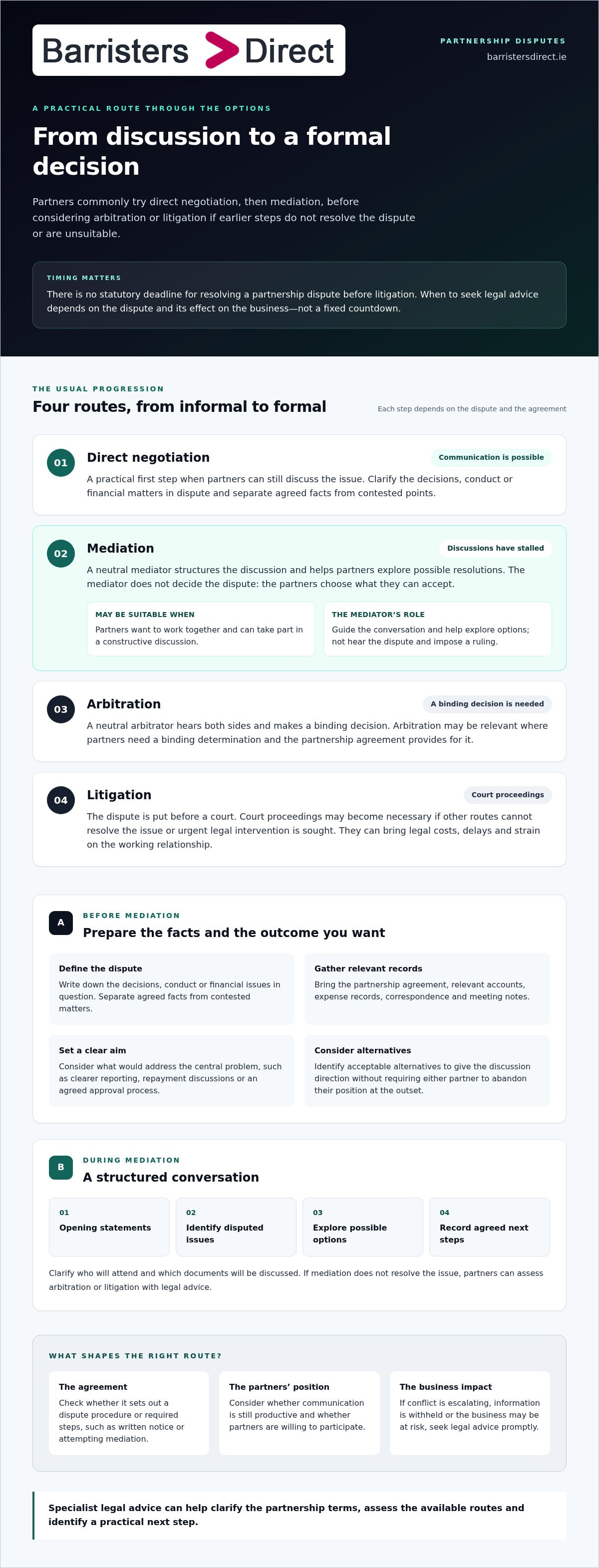
There is no statutory deadline for resolving a partnership dispute before it becomes litigation in Ireland. If you are considering how to resolve a partnership dispute, a common sequence is to try direct negotiation, then mediation, and consider arbitration or litigation if those steps do not resolve the issue or are unsuitable. The right time to seek legal advice depends on the dispute and its effect on the business, not on a fixed countdown.
It is understandable to want to settle matters privately and preserve the working relationship. But if discussions stall, financial information is withheld, or a partner’s conduct may harm the business, delaying advice can make it harder to protect your position. Early guidance can help you understand the partnership agreement, assess your options and decide what to do next.
This article explains how negotiation and mediation work, when arbitration or court proceedings may be appropriate, and how partnership terms can affect a dispute. It also outlines when legal advice can help you move from uncertainty to a clear, practical course of action.
Key Takeaways
- Use your partnership agreement to understand how decisions, profit-sharing, exits and disputes are meant to be handled.
- Keep relevant financial records, correspondence and meeting notes organised so you can explain the issue clearly.
- Arbitration can provide a private process in which an arbitrator hears both sides and makes a binding decision.
- Seek legal advice if conflict is escalating, information is being withheld or the business may be at risk.
- Barristers Direct’s Commercial Dispute Resolution service can connect you with specialist barrister advice on the dispute and your options.
Mediation
In Ireland, litigation resolves a partnership dispute in court after proceedings are filed. It can bring legal costs, delays and strain on the working relationship, so partners often consider negotiation and mediation first.
Collaborative mediation
Mediation gives each partner an opportunity to explain their position with a third party present. The mediator structures the discussion and helps explore possible resolutions, but the partners decide what they can accept. For example, partners disputing business expenses can identify the records in question and discuss how to address them.
A mediator’s impartial perspective may help partners consider the dispute more clearly. Mediation can also avoid some costs and delays associated with legal proceedings while leaving open the possibility of maintaining an amicable working relationship. It may suit partners who still want to work together and can take part in a constructive discussion.
Preparing for mediation
Start preparing by defining the dispute. Write down the decisions, conduct or financial issues in question, then separate agreed facts from contested matters. Gather the partnership agreement, relevant accounts, expense records, correspondence and meeting notes. A dated record can show how the disagreement developed and what steps the partners have already taken.
Before the meeting, decide what outcome would address the central problem. For example, a disagreement about company funds might call for clearer reporting, discussions about repayment or an agreed approval process. Identify acceptable alternatives as well. This gives the discussion direction without requiring either partner to abandon their position at the outset.
Choosing mediation, arbitration or litigation
The appropriate route depends on the dispute, the agreement and the partners’ willingness to participate. Direct negotiation can be a practical first step when communication remains possible. Mediation adds a neutral facilitator if discussions have stalled. In arbitration, a neutral arbitrator hears both sides and makes a binding decision. Litigation puts the dispute before a court.
These options are not interchangeable. If a partnership agreement sets out a dispute procedure, its wording matters when deciding what steps to take. If discussions remain productive, mediation may help preserve the relationship. Arbitration may be relevant when partners need a binding determination and the agreement provides for it. Court proceedings may become necessary if other routes cannot resolve the dispute or urgent legal intervention is sought.
Expertise and the mediation process
Choose a mediator whose experience fits the issues, such as business management, partnership accounts or commercial disagreements. A mediator guides discussion; an arbitrator hears evidence and decides the dispute. The distinction matters when partners need help reaching their own agreement rather than a binding ruling.
Mediation commonly moves from opening statements to identifying the disputed issues, exploring options and recording agreed next steps. Partners should clarify who will attend and which documents will be discussed. If mediation does not resolve the issue, they can assess arbitration or litigation with legal advice, rather than treating mediation as a substitute for understanding their legal position.
Partnership agreement terms and dispute procedures
A written partnership agreement can define how decisions, profits, exits and disputes are handled. Identify the clause connected to the disagreement, then compare its terms with what the partners actually did.
Reviewing agreement terms
Read the agreement for decision-making powers, profit-sharing, expenses, access to company funds and dispute procedures. Note any required steps, such as giving written notice or attempting mediation before moving to another process. For example, a disagreement about a major purchase may turn on whether one partner could approve it alone.
Compare the wording with financial records, meeting minutes and correspondence. Check whether later changes were recorded and whether the clause covers the current issue. A clear timeline can show where the partners’ interpretations differ and which terms need legal advice.
Buy-sell and valuation disputes
A buy-sell clause may set out when a partner can buy another’s interest and how its price is calculated. Disagreements can arise over the valuation method, the date used, or whether business debts and assets have been treated consistently. Identify the precise point of disagreement before discussing a figure.
Review the clause alongside the accounts and any valuation material it refers to. If the agreement provides a process for appointing an independent valuer, follow its terms carefully. Partnership buyouts may be paid in instalments over 12 to 36 months, sometimes longer, so payment terms can also require discussion.
Disputes without a written agreement
The Partnership Act 1890 provides default rules for partnerships without a written agreement. According to the Irish Statute Book, partners share profits and losses equally unless there is evidence of a different arrangement. Gather records of contributions, profit distributions and any communications that may show what the partners agreed in practice.
Under the default rules described for an unwritten partnership, partners are entitled to participate in management, and a partner cannot be expelled without the agreement of all other partners. This can make a unilateral change contentious. Record what was decided, who took part and how each partner responded.
Partners’ rights and duties
Partners owe each other a duty of good faith because of the nature of their relationship. A failure to meet fiduciary responsibilities can undermine trust. If one partner controls company funds or makes decisions without consultation, identify the conduct in question and preserve the records that explain it.
Section 35(d) of the Partnership Act, 1890 allows a court to dissolve a partnership when a partner wilfully or persistently breaches the agreement, or behaves in a way that makes continuing the partnership not reasonably practicable. As the consequences can be substantial, specialist legal advice on commercial disputes can help clarify how agreement terms and conduct affect the available options.
Arbitration clauses in partnership and shareholder agreements
An arbitration clause describes how parties will submit a dispute to a neutral decision-maker. In Ireland, read its wording alongside the specific disagreement and the agreement’s other dispute procedures before deciding whether arbitration is suitable.
What arbitration involves
An arbitrator hears both sides and makes a binding decision. Unlike mediation, where partners seek an agreement themselves, arbitration asks a neutral decision-maker to determine the dispute. It may suit parties seeking a binding outcome on a contested issue, such as the interpretation of a shareholder agreement or a disagreement about business decisions.
Arbitration is private, so its outcome is not a public record. This may matter when a dispute involves sensitive commercial information. Privacy does not remove the need to present evidence clearly: each party should be ready to explain its position and support it with relevant documents.
Read the clause closely
Check which disputes the clause covers, how arbitration begins and how an arbitrator is appointed. Look for any stated rules, procedural steps and provisions about the tribunal’s composition. If a partnership agreement refers to arbitration for disagreements about accounts, for example, assess whether the clause also covers disputes about management decisions.
Do not assume a shareholder agreement and a partnership agreement use equivalent wording. The parties, legal relationship and scope of each clause may differ. Read the relevant definitions and connected dispute provisions together. Note any required notice or preliminary step, then seek advice if the wording leaves uncertainty about how the process applies.
Consider the tribunal and process
The tribunal’s composition can affect the process and its expense. A tribunal with three arbitrators can make arbitration very expensive, so consider whether the agreement provides for that structure. The dispute’s complexity and the expertise needed to assess its subject matter also matter when considering the appropriate decision-maker.
For example, a dispute involving detailed accounts may require careful examination of financial records. Before proceeding, understand how each party will present its position, which documents may be relevant and what the clause says about the hearing process. These practical points help parties prepare for arbitration and assess what the agreed procedure involves.
Check what the clause means in Ireland
For an Irish partnership or company, focus on the wording the parties actually agreed and the dispute it covers. Avoid relying on sample clauses written for another jurisdiction, as their rules or institutions may not match the agreement’s Irish context. Read a clause as part of the full agreement, not in isolation.
Before invoking arbitration, define the decision sought and identify the evidence supporting it. If the other party disputes whether the clause applies, legal advice can clarify the contractual wording and the next procedural step. Arbitration is not an automatic solution: the clause, the issue and the outcome sought all inform whether it is appropriate.
When to seek legal advice
Seek legal advice when the dispute affects business operations, finances or a partner’s ability to protect their interests. There is no statutory deadline for resolving a partnership dispute before it becomes litigation, so the practical trigger is the dispute’s intensity and what is at risk.
Early advice can clarify the partnership agreement, the evidence and the available options. For example, if partners disagree about who may approve payments, a legal review can identify the relevant terms and help frame the issue. If the disagreement continues, advice can also help assess whether negotiation, mediation, arbitration or court proceedings fit the circumstances.
Act promptly if a partner’s conduct may damage the business or dissipate its assets. A lawyer may help seek a court injunction to prevent harmful action, and a court may freeze assets during the dispute. These are serious steps, so the facts, urgency and potential impact on the business matter.
Withheld financial information is another clear reason to obtain advice. If one partner controls the accounts and refuses access, a court may order the production of financial records. Keep a dated record of requests, responses and outstanding information. This helps explain the problem and gives a legal adviser a clearer basis for assessing next steps.
Consider legal advice when partners cannot untangle the dispute without escalating conflict. For instance, one partner may want to continue trading while another seeks an exit, but the agreement may not resolve the practical disagreement. Advice can help identify the rights and obligations involved, the available routes and the consequences of each option.
Before meeting a legal adviser, organise the documents that show how the dispute developed. Include the partnership agreement, relevant accounts, messages, meeting notes and records of decisions. Prepare a short chronology that separates agreed events from contested claims. This lets the adviser focus on the central issue rather than reconstructing the background from scattered records.
Seeking advice does not mean starting litigation. A legal professional can assess whether a constructive discussion remains possible, whether the agreement sets out a dispute procedure, and whether urgent court protection may be needed. If the dispute is intensifying, financial information is being withheld or business assets are at risk, obtain advice before taking steps that could further inflame the disagreement.
What evidence and documents should partners gather during a dispute?
Build a clear record of the disagreement before positions harden. Start with a dated chronology identifying each disputed decision, the people involved and its effect on the business. For example, if a partner approved a payment that others challenge, record when it happened, who authorised it and which records support each account. Separate what you witnessed from what someone else told you. This distinction helps an adviser assess the evidence accurately.
Collect documents that relate directly to the issue, rather than building an unstructured archive. Depending on the dispute, useful records may include:
- Bank statements, invoices and ledger entries relevant to disputed transactions.
- Emails, letters and messages showing what partners discussed or agreed.
- Meeting minutes and decision records identifying attendance and objections.
- Contracts, purchase orders or customer records affected by the contested decision.
Preserve original files where possible, including dates and sender details. If an email chain explains why a transaction was approved, keep the full thread rather than an isolated message. Do not edit documents for readability. If you create a summary or spreadsheet, label it as a working document and retain the underlying records.
Financial evidence should link figures to their sources. For a disputed expense, keep the invoice, proof of payment and relevant accounting entry together. If partners disagree about profit distribution, gather the accounts and records showing payments made. Mark the precise entries in question, but do not alter the original accounting records. A clear link between each amount and its supporting document makes the issue easier to explain.
Record important conversations promptly. Note the date, attendees, subject discussed and any decision or action agreed. For example, after a meeting about access to company funds, send a neutral written summary of what you understood and invite corrections. Keep any replies with the meeting record. This creates a contemporaneous account rather than relying only on later recollections.
Organise material by topic, such as payments, management decisions or a proposed partner exit. Use consistent file names and keep a simple index showing what each item supports. If a record is missing, note what is absent and why it matters, without filling gaps with assumptions. A legal adviser can then assess the evidence against the issue and identify any further relevant material.
For focused guidance on presenting records and assessing a commercial disagreement, discuss your partnership dispute with a legal professional.
Barristers Direct: Commercial Dispute Resolution
Barristers Direct arranges initial consultations with specialist barristers for commercial disputes, including partnership disputes. You can access senior or junior counsel directly for the initial consultation, without needing a solicitor for that meeting. A barrister can assess the partnership agreement, available evidence and dispute procedure, then explain a clear path forward.
This advice can help if negotiations have stalled, partners disagree about their legal rights, or you need to understand whether mediation, arbitration or litigation may be appropriate. It can also help you prepare focused questions and organise the key documents before deciding your next step. Solicitors continue to play an important role in legal matters, and may be involved as your case progresses.
Contact Barristers Direct to discuss advice on your partnership dispute.
Choose a clear next step
Deciding how to resolve a partnership dispute is also a business decision: the next step should support the outcome you need, not simply prolong the disagreement. Before acting, clarify what matters most to you. Is it continuing the partnership, protecting day-to-day operations, agreeing an exit, or establishing responsibility for a disputed issue? A clear priority helps keep discussions focused.
Then consider what you need from legal advice. You may want an assessment of your position, an explanation of the available routes, or guidance on preparing for a difficult conversation. A specialist barrister can help clarify the legal issues so you can make decisions with a better understanding of their implications. You do not have to decide immediately whether proceedings are necessary.
If you are ready to discuss the dispute and your options, contact Barristers Direct. A considered next step can help you move forward with purpose and confidence.
Frequently Asked Questions
Should You Try Talking to Your Partner First, or Go Straight to a Lawyer?
If it is safe and practical to communicate, start with a focused conversation about the specific disagreement. For many partners, resolving a partnership dispute starts with discussing one contested decision rather than reopening every past conflict. Seek legal advice first if you suspect funds may be moved, important records are at risk, or a partner’s actions could harm the business. Advice can help you prepare for a discussion without requiring you to begin court proceedings.
What Happens After You Settle?
Put the agreement in writing so each partner understands what was decided and what happens next. Record any agreed payment, change in responsibilities, decision-making process or exit arrangement, with relevant dates and actions. For example, if one partner will take over a supplier relationship, specify who will notify the supplier and when. Keep a copy with the partnership records, and seek legal advice if the settlement affects continuing rights or obligations.
What If There’s No Partnership Agreement?
The Partnership Act 1890 provides default rules for partnerships without a written agreement. According to the Irish Statute Book, partners share profits and losses equally unless evidence shows a different arrangement. Look for evidence of how the partners operated, such as accounts, payment records or communications about contributions. The partners’ actual arrangements may matter, so organise relevant documents and obtain advice before treating an assumed practice as an agreed term.
What if both partners want to exit?
If both partners want to leave, they can discuss ending the partnership and how to deal with its affairs. List the business assets, debts, outstanding invoices, contracts and responsibilities that still need attention. For example, identify who will collect unpaid customer accounts and handle a supplier commitment. Agree how records will be retained and decisions documented. Get legal advice if the partners disagree about value, liabilities or the terms of closure.
What if the other side doesn’t engage properly?
Keep communication clear and documented if the other partner avoids meetings or gives incomplete replies. Send a concise written proposal identifying the issue, the outcome sought and the information needed to make progress. Keep copies of messages and note missed or cancelled discussions. If engagement remains unproductive, review the dispute procedure in the partnership agreement and seek legal advice about next steps, including whether to begin a formal process.
What does a partnership agreement say about resolving disputes in Ireland?
A partnership agreement may specify how disagreements should be raised and what steps partners should take before escalating matters. It can also explain how decisions are made, profits divided and a partner’s departure handled. Read the dispute clause alongside any notice requirements or defined terms. For example, a clause may distinguish disputes about accounts from those about management. If the wording is unclear, legal advice can help explain how it applies to the issue.
What steps should partners take to resolve a dispute through direct negotiation?
To resolve a partnership dispute through direct negotiation, identify the exact decision or outcome in dispute, then invite the other partner to discuss it in writing. Share documents relevant to that point and ask what evidence or change would address their concern. Keep the meeting focused on practical options, such as changing the approval process for future spending. Afterwards, promptly circulate a written record of any proposal or agreed action.
How does mediation work for business partnership disputes in Ireland, and what does it cost?
In mediation, a neutral third party helps the partners discuss their positions and explore a possible agreement; the partners decide whether to settle. Costs depend on the mediator’s fees, the preparation required, time involved and complexity of the issues. Before proceeding, clarify how the fee is calculated, what preparation is included and how the parties will share the expense. A dispute involving extensive financial records, for example, may require more preparation than a focused disagreement.
Disclaimer
This article does not constitute legal advice. Barristers Direct does not provide legal advice. To obtain legal advice, you should contact a legal practitioner.


