

Most Irish businesses mistakenly believe a breakdown in vendor relations leaves them with only two choices: absorb the financial loss or commit to an indefinite cycle of litigation. In reality, the most effective way to resolve a conflict isn't through immediate legal action, but by establishing a position of tactical strength through early specialist intervention. If you're currently seeking supplier contract dispute advice due to stalled supply chains or breached terms, you're likely concerned about the uncertainty of your legal position and the potential for spiralling costs.
We understand that business disruption is a heavy burden, and the fear of escalating fees often prevents companies from asserting their rights. This guide provides a clear path forward, showing you how to evaluate your standing and access specialist barrister advice to protect your commercial interests. We will explore how to identify your contractual rights, utilise modern dispute resolution methods, and leverage expert counsel to achieve a strategic, predictable resolution that prioritises your business objectives.
Key Takeaways
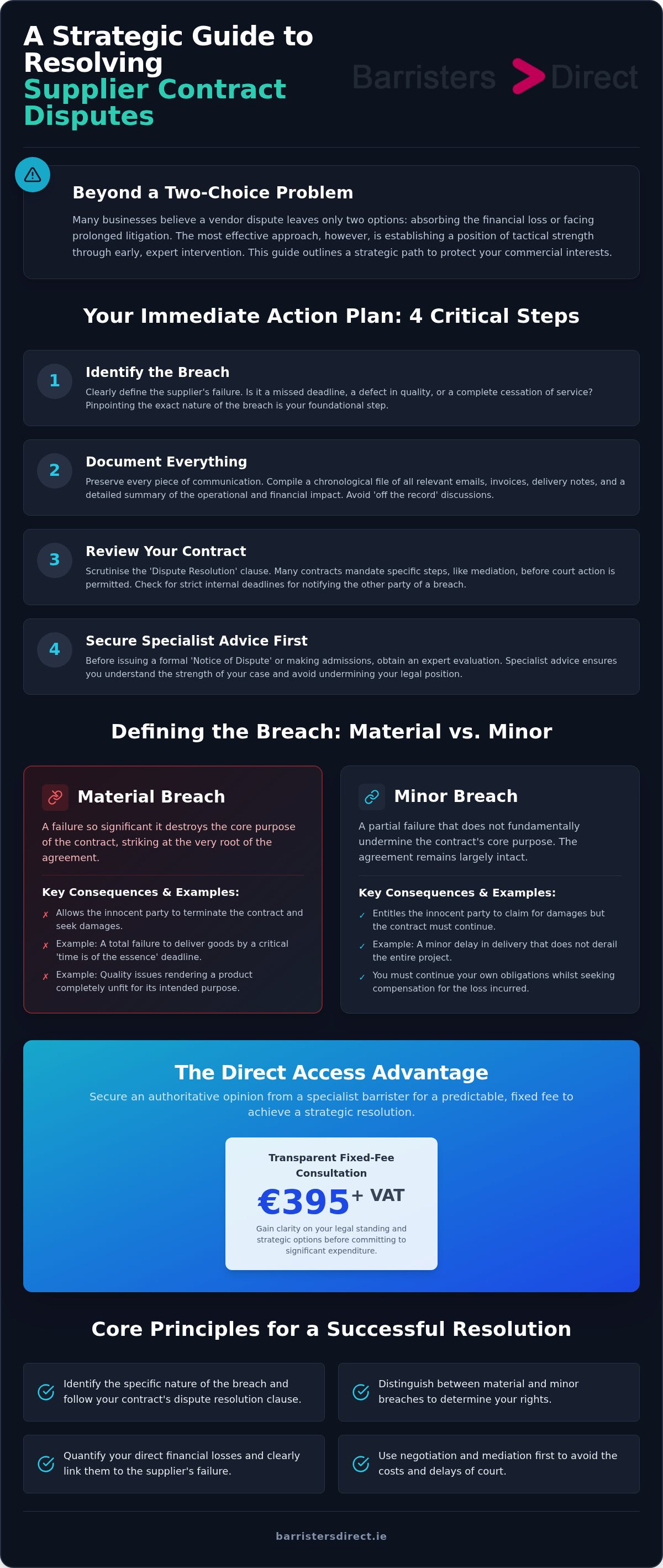
- Identify the specific nature of the contract breach and review the mandatory steps in your dispute resolution clause to preserve your legal standing.
- Distinguish between material and minor breaches to evaluate whether the failure is significant enough to warrant termination or claim for damages.
- Access expert supplier contract dispute advice to quantify direct financial losses and establish a clear link between the breach and your business damages.
- Utilise strategic negotiation and mediation as first-line responses to reach a commercial settlement whilst avoiding the costs and delays of court.
- Secure an authoritative opinion from a specialist barrister via a direct consultation for a transparent fixed fee of €395 plus VAT.
Navigating Supplier Contract Disputes: Immediate Steps for Businesses
When a supplier relationship falters, your initial response often dictates the final outcome. Seeking early supplier contract dispute advice is vital to ensure that your business doesn't inadvertently waive its rights or accept liability. The first step involves identifying the exact nature of the breach; whether it is a failure to deliver on time, a defect in quality, or a complete cessation of service. Once identified, you must preserve every piece of communication related to the issue, as these documents form the evidentiary backbone of any future claim.
The Importance of Documenting the Breach
A disorganised paper trail is one of the greatest risks to a successful resolution. You should immediately begin compiling a chronological file that includes:
- All relevant emails, messages, and letters regarding the contract.
- Invoices, delivery notes, and proof of payment.
- A detailed summary of the operational disruption and financial impact caused by the breach.
It's essential to avoid informal, 'off the record' discussions with the supplier. Whilst it might feel like a pragmatic way to solve the problem, undocumented concessions can undermine your legal position if the dispute escalates. Every interaction should be treated as potential evidence.
Reviewing Contractual Obligations and Timelines
Before taking action, you must scrutinise the 'Dispute Resolution' clause in your agreement. Many modern commercial contracts in Ireland mandate specific steps, such as Alternative dispute resolution (ADR), before court proceedings can begin. These clauses are designed to keep costs manageable and resolve issues without the need for a judge.
You must also check for strict time limits. Whilst the Statute of Limitations Act 1957 generally allows six years to bring a claim for breach of contract in Ireland, your specific agreement may impose much shorter internal deadlines for notification. For example, some contracts require a formal notice of breach within 30 days. You also need to determine if the breach is 'material' enough to justify terminating the contract. A material breach goes to the heart of the agreement, whereas a minor breach might only entitle you to compensation while the contract continues.
Once you've assessed these elements, issuing a formal 'Notice of Dispute' triggers the contractual timelines. However, you shouldn't issue this notice without a specialist's view. Obtaining an expert evaluation of the contract ensures you don't make binding admissions. Through commercial dispute resolution channels, you can access authoritative advice from a specialist barrister to determine if your case is strong enough to pursue before committing to significant expenditure.
Defining a Breach of Contract: Material vs Minor Breaches
A breach occurs when a supplier fails to perform a specific obligation without a legal excuse. Identifying the severity of this failure is the foundation of effective supplier contract dispute advice. Irish law distinguishes between different levels of non-performance, and misjudging the category of a breach can lead to significant legal complications. If a supplier misses a minor deadline, it is handled differently than if they fail to deliver the core service entirely.
What Constitutes a Material Breach in Ireland?
A material breach is a failure so significant that it destroys the core purpose of the contract. It strikes at the very root of the agreement, making further performance impossible or pointless for the innocent party. In these cases, the law generally allows you to terminate the contract and seek damages for your losses. Examples often seen in Irish commercial disputes include:
- A total failure to deliver goods or services by a 'time is of the essence' deadline.
- Quality issues so severe that the product is entirely unfit for its intended purpose.
- Persistent non-payment or a consistent pattern of late payments that undermines the financial viability of a supply-chain agreement.
If the breach is material, you have the right to treat the contract as being at an end. However, you must be certain of this status before acting. Securing a specialist evaluation of your contract can help you determine the severity of a breach before you take irreversible action.
Minor Breaches and the Duty to Mitigate Loss
Minor or 'partial' breaches involve failures that do not fundamentally undermine the agreement. If a supplier delivers a slightly lower quantity than agreed or misses a non-critical deadline, the contract remains in force. You don't have the right to terminate the relationship, but you may be entitled to damages to cover the specific loss. These issues are typically resolved through price adjustments, credits, or repairs.
When a breach occurs, you have a legal duty to mitigate your loss. This means you must take reasonable steps to minimise the financial impact of the supplier's failure. If you fail to take these steps, any damages awarded by a court may be reduced. A major risk for businesses is 'wrongful termination'. If you terminate a contract over a minor breach, you may inadvertently find yourself being sued for breach of contract by the supplier.
You should also be aware of anticipatory breaches. This occurs when a supplier signals, either through words or conduct, that they will not meet their future obligations. If a supplier informs you today that they cannot fulfil an order due next month, you may be able to claim for a breach immediately. Accurate supplier contract dispute advice is essential here to ensure you don't act prematurely and jeopardise your own standing.
Assessing the Merits: Proving Your Case in Ireland
Once you have identified a breach, the focus shifts to the evidentiary requirements of the Irish legal system. To succeed in a claim, you must first establish that a valid, binding contract exists. This requires evidence of an offer, acceptance, consideration, and a clear intention to create legal relations. Whilst written agreements are the gold standard, the absence of a signed document doesn't automatically negate your claim. However, the strength of your supplier contract dispute advice depends heavily on the clarity and consistency of your evidence.
Proving a breach is only half the battle; you must also quantify the loss. Irish courts require you to prove a direct financial link between the supplier's failure and the damages you've suffered. This isn't about speculation; it's about demonstrating specific, measurable financial harm. You must also be mindful of the Statute of Limitations Act 1957. In Ireland, you generally have six years from the date of the breach to initiate proceedings. Waiting too long can extinguish your right to seek a remedy entirely, regardless of the strength of your case.
A strategic assessment also involves anticipating the supplier's response. Common defences include 'Force Majeure' clauses, which may excuse non-performance due to extraordinary events outside their control, or claims of contributory negligence if your own actions played a part in the loss. Evaluating these potential hurdles early allows you to build a more robust case and avoid unnecessary expenditure on weak claims.
The Burden of Proof in Commercial Disputes
In civil litigation, the standard of proof is the 'balance of probabilities'. This means you must prove that your version of events is more likely than not to be true. It's a lower threshold than the standard used in criminal law, but it still requires compelling evidence. For technical or industry-specific conflicts, expert witness testimony is often necessary to explain complex standards or failures to the court. Engaging a barrister for a specialist opinion at this stage is invaluable. Their expertise allows them to identify evidentiary weaknesses that might not be apparent to a layperson, ensuring your strategy is based on legal reality.
Can You Sue for Breach of a Verbal Contract?
Verbal contracts are generally enforceable in Ireland, but they are notoriously difficult to prove. Without a written record, the court will look at the 'conduct of the parties' to determine what was agreed. This includes past invoices, email chains that reference verbal discussions, and the actual behaviour of both businesses during the project. If you've been acting as though a contract exists, the court may find that one does. For those navigating these complexities, evaluating your position on verbal contracts with a specialist is the most efficient way to determine the viability of your claim before committing resources to commercial dispute resolution.
Effective Dispute Resolution: Strategies to Avoid Court
Whilst the threat of litigation often brings parties to the table, the actual pursuit of a court date is rarely the most efficient way to settle a conflict. Most businesses find that the most effective supplier contract dispute advice focuses on alternative pathways that prioritise speed and commercial viability. Negotiation remains the primary and most cost-effective route. It allows both parties to reach a settlement that preserves the underlying business relationship without the public scrutiny or high costs associated with traditional litigation.
If direct negotiation fails, mediation offers a confidential and voluntary process facilitated by a neutral third party. Unlike a judge, a mediator doesn't impose a decision but helps the parties find a mutually acceptable compromise. For more formalised conflicts, many commercial contracts stipulate arbitration. When conducting arbitration in Dublin, Ireland, parties can often benefit from a streamlined process designed to reach a binding conclusion within a 30-day timeline once the hearing concludes. This provides a level of finality that litigation often lacks.
The Benefits of Alternative Dispute Resolution (ADR)
Adopting Alternative dispute resolution (ADR) strategies offers several tactical advantages for an Irish business. Firstly, it allows for the preservation of commercial relationships that would likely be destroyed by the adversarial nature of public legal battles. Secondly, the confidentiality of these processes ensures that sensitive business information, pricing structures, and internal failures remain out of the public record. The speed of ADR is also a significant factor. You can often resolve complex disputes in a matter of weeks, whereas waiting for a court date can take years, causing prolonged business disruption.
Direct Access: A Modern Path to Expert Advice
The legal landscape in Ireland changed significantly with the introduction of the Legal Services Regulation Act. This legislation allows businesses to bypass the traditional route for initial consultations and seek specialist counsel directly. By engaging a barrister at the earliest stage of a dispute, you gain a high-level strategic view of your case. This authoritative perspective is vital when drafting a robust letter of claim or a settlement proposal that the other party will take seriously.
Having a barrister evaluate the merits of your position early provides a psychological and tactical advantage. It signals to the supplier that you're prepared and well-advised, which often encourages them to settle on more favourable terms. You can learn more about the advantages of instructing a barrister directly to see how this model fits your current needs. Before committing to a lengthy legal battle, you should consult with a specialist strategist to ensure your next move is your strongest.
Specialist Advice: The Direct Access Advantage
Securing high-level supplier contract dispute advice shouldn't require navigating an opaque system of referrals and variable hourly rates. Through Barristers Direct, your business can access the expertise of senior and junior counsel directly to obtain an authoritative view on your conflict. This modern approach provides immediate clarity on whether your position is legally sound or if a strategic compromise is the more pragmatic path forward.
Transparency is a core component of this service. If you require a specialist consultation with a barrister alone, the fixed fee is €395 plus VAT. For more contentious matters where a solicitor's presence is beneficial for procedural continuity, the consultation fee is €595 plus VAT. This fixed-fee structure ensures you receive elite-level strategic intelligence without the risk of unmanaged legal spend. It allows you to focus on the quality of the legal opinion rather than the clock.
Predictable Costs for High-Level Strategy
Traditional legal models often rely on hourly billing, which can make the cost of initial advice difficult to forecast. If you choose a fixed-fee consultation, then you decouple the quality of the advice from the time spent on the call. This approach allows you to treat a barrister as a specialist strategist, much like a medical consultant. Once the meeting concludes, there is no further obligation; you can use the provided strategy to settle the dispute yourself or decide to proceed with formal representation. For those facing complex vendor issues, specialist commercial dispute resolution advice becomes an accessible asset rather than a financial burden.
How the Consultation Process Works
Efficiency is central to the process. Consultations are conducted online via Zoom, Teams, or Google Meet, allowing you to secure expert input regardless of your location in Ireland. To ensure maximum value during the call, the barrister reviews your contract and evidence in advance. This preparation means the discussion focuses on solutions rather than information gathering.
Following the meeting, you receive an automatically generated recording and a synopsis of the discussion. This document serves as a clear reference point for your strategic path forward. If the barrister's opinion suggests that a settlement is the most viable option, you can proceed with confidence. If litigation is necessary, you'll have a precise understanding of the evidence required to succeed. This system strips away the intimidating layers of legal communication, providing a transparent, solution-oriented framework for resolving your dispute.
Securing a Strategic Resolution for Your Business
Resolving a supplier conflict requires more than just persistence; it demands a precise understanding of your contractual standing and the evidence required to prove a breach. By identifying the nature of the failure early and exploring alternative resolution paths like mediation, you can protect your operations from prolonged disruption. Expert supplier contract dispute advice is no longer a slow or prohibitively expensive process reserved for the final stages of litigation.
You can now access smarter, faster, and more transparent legal strategy through our network of over 100 specialist barristers. If you need an authoritative view on your case to settle a conflict or prepare for the next steps, a consultation with a senior or junior counsel is available for a fixed fee of €395 plus VAT. This direct access model ensures you have the intelligence needed to make informed commercial decisions without the uncertainty of hourly billing. Book a Fixed-Fee Consultation with a Specialist Barrister today to regain control of your commercial interests and move forward with confidence.
Frequently Asked Questions
Can I talk to a barrister without a solicitor in Ireland?
Yes, you can consult a barrister directly in Ireland without first retaining a solicitor. This is permitted under the Legal Services Regulation Act, which provides businesses and individuals with a direct path to specialist counsel for early-stage advice. By bypassing the traditional referral model for initial meetings, you can obtain a high-level strategic view of your case more efficiently. This direct access is particularly useful for establishing the strength of your legal position.
How much does a consultation for supplier contract dispute advice cost?
A consultation for supplier contract dispute advice costs a fixed fee of €395 plus VAT for a meeting with a specialist barrister. If the matter is contentious and requires a solicitor to be present, the fixed fee is €595 plus VAT. These predetermined rates ensure complete price transparency and allow you to access elite legal intelligence without the uncertainty of hourly billing. The fee covers the barrister’s time to review your contract before the online meeting.
What is the difference between a material and a minor breach of contract?
A material breach is a failure so significant that it destroys the core purpose of the agreement, such as a total failure to deliver essential goods. In these cases, you are generally entitled to terminate the contract and seek damages. A minor breach, such as a slight delay in a non-critical delivery, doesn't end the contract. Instead, it entitles you to compensation for the specific loss while the relationship continues. Distinguishing between them is essential.
How long do I have to sue for breach of contract in Ireland?
You generally have six years from the date the breach occurred to initiate legal proceedings in Ireland. This timeline is set by the Statute of Limitations Act 1957. Whilst six years may seem like a long period, waiting can lead to the loss of critical evidence or the fading of witness memories. It’s advisable to seek specialist counsel early to preserve your position and ensure all relevant documentation is organised before the limitation period expires.
Is an automatically generated recording of the legal consultation provided?
Yes, an automatically generated recording and synopsis of the meeting are provided to both the participant and the barrister. This ensures you have a clear, accurate record of the strategic advice given and the recommended path forward. These documents are shared only with the parties involved in the consultation and are not disclosed to any third parties. This feature provides a reliable reference point for your business as you implement the agreed resolution strategy.
Can a barrister help me resolve a dispute without going to court?
Yes, a barrister can provide the strategic framework needed to resolve a conflict through negotiation or Alternative Dispute Resolution (ADR). By drafting a robust letter of claim or evaluating a settlement proposal, a specialist barrister can often help you reach a commercial agreement without the need for court. Their authoritative view signals your seriousness to the supplier, which frequently encourages a faster, out-of-court settlement that preserves your commercial relationship and avoids public litigation.
What happens if my supplier dispute requires formal court proceedings?
If your dispute cannot be resolved through negotiation and requires formal litigation, you must engage a solicitor. Barristers Direct facilitates the initial specialist consultation, but a solicitor is required to manage the court process, hold client funds, and issue proceedings. If litigation becomes necessary, we can refer you to a solicitor to ensure a smooth transition. This ensures you have the correct legal team in place for courtroom advocacy while maintaining your initial strategy.
Are verbal supplier contracts legally binding in Ireland?
Verbal supplier contracts are legally binding in Ireland, provided they meet the basic requirements of an offer, acceptance, and consideration. However, they are significantly harder to prove than written agreements. In the absence of a signed document, a barrister will look at the conduct of the parties, such as email exchanges, invoices, and past deliveries, to establish the terms. Proving a verbal agreement requires consistent evidence to demonstrate that both parties intended to be legally bound.
Disclaimer
This article does not constitute legal advice. Barristers Direct does not provide legal advice. To obtain legal advice, you should contact a legal practitioner.


