

Most people believe that hiring a solicitor is the only way to start a legal journey, but understanding the distinction between a barrister and a solicitor in Ireland could save you thousands in legal fees. If you feel the weight of billable hour anxiety or the frustration of not knowing whether you need a generalist or a specialist, you aren't alone. It's common to fear being trapped in long-term litigation without a clear strategy or a transparent view of the final cost.
This guide clarifies the fundamental differences between these two roles and introduces the direct access model. This modern approach allows you to secure expert legal opinions without the traditional middleman, ensuring your strategy is sound from day one. We promise to strip away the intimidating layers of the legal system to show you a more efficient, cost-effective way to get results whilst maintaining total clarity. You'll learn how to navigate the Irish legal hierarchy, bypass unnecessary gatekeepers for initial advice, and establish a clear strategic path for your specific dispute.
Key Takeaways
- Understand why "lawyer" is a broad term in Ireland and how the dual branch system defines the specific duties of solicitors and barristers.
- Distinguish between the solicitor's role as a legal project manager and the barrister's function as a specialist consultant for complex legal opinions and advocacy.
- Learn how the direct access model for a barrister vs solicitor ireland allows you to engage expert counsel directly for initial strategy without the need for a middleman.
- Discover how fixed-fee consultations can eliminate billable hour anxiety whilst providing a clear, strategic path forward for your dispute.
- Identify the specific scenarios, such as commercial disputes or employment law, where early intervention from a barrister provides the most value.
The Dual Branch System: Understanding the Irish Legal Profession
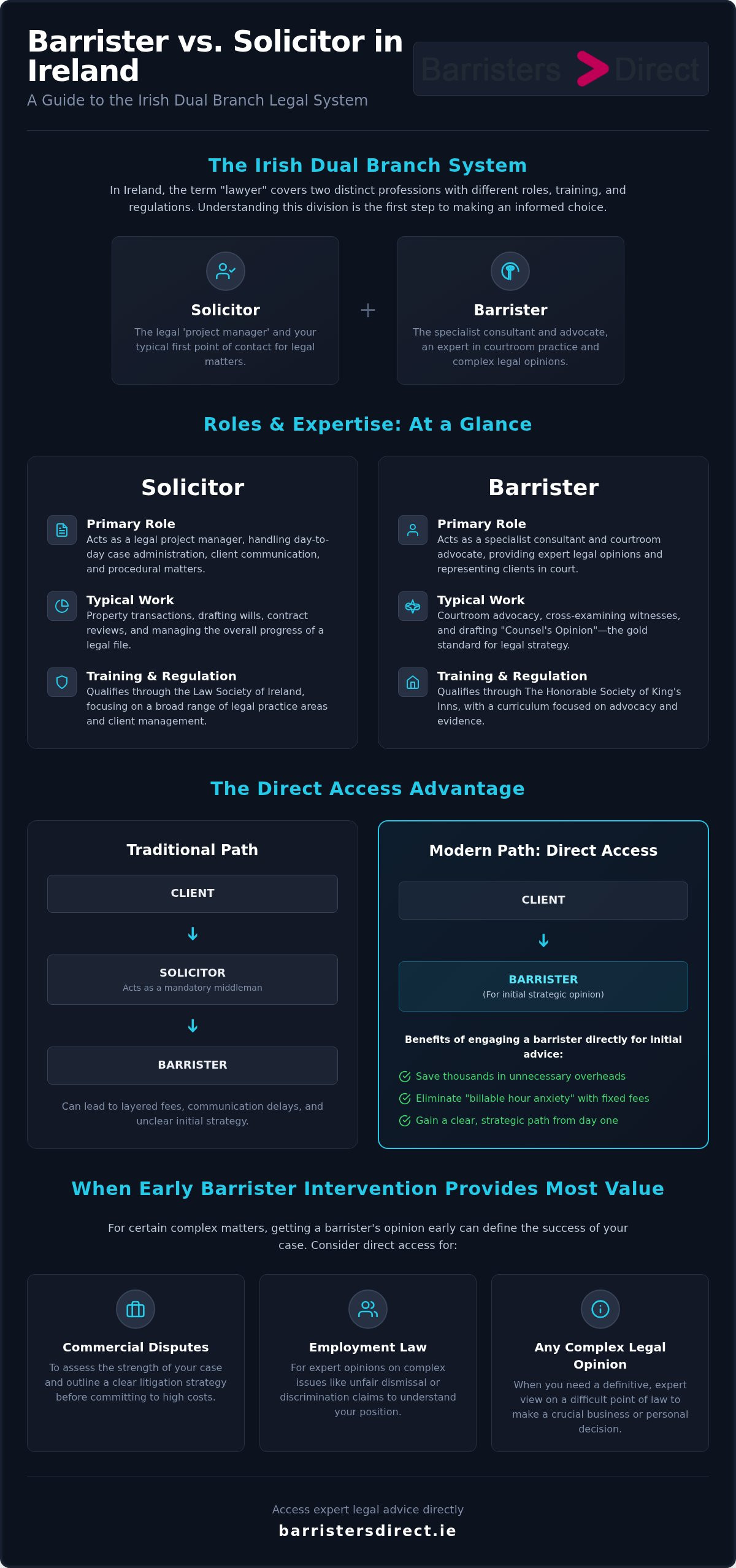
In Ireland, the term "lawyer" functions as a broad umbrella, but it actually describes two distinct professions with different training, regulations, and daily duties. Unlike the unified system seen in American legal dramas like Suits, where one attorney handles every aspect of a case, Ireland maintains a dual branch system. This historical division between solicitors and barristers in Ireland is central to how legal services are delivered and billed. Understanding the barrister vs solicitor in Ireland distinction is vital because it dictates who you hire, when you hire them, and how your strategy is formed.
The two branches are governed by separate regulatory bodies. Solicitors are regulated by the Law Society of Ireland, whilst barristers are members of The Bar of Ireland. This split isn't just about tradition; it impacts your wallet and your legal strategy. Traditionally, the solicitor acted as a gateway, but modern regulations now allow for more direct paths to specialist advice, which can significantly lower initial costs.
What exactly is a Solicitor?
Think of a solicitor as your legal project manager. They are typically your first port of call and often operate from "High Street" offices. Their role involves managing files, handling client money, and overseeing the general administration of a legal matter. If you need a will drafted, a property transaction completed, or a contract reviewed, a solicitor is the appropriate lead. They manage the day-to-day communication and ensure that all procedural requirements are met throughout the life of your case.
What exactly is a Barrister?
If the solicitor is the project manager, the barrister is the specialist consultant. Often described as the "consultant surgeons" of the legal world, barristers are called in for their specific expertise in advocacy or for providing complex legal opinions. Most work as independent sole practitioners from the Law Library. Within this branch, you'll find Junior Counsel and Senior Counsel. Senior Counsel, often called "silks," are experienced practitioners recognised for their high level of expertise. Barristers provide the strategic intelligence needed for complex disputes, such as commercial litigation or employment law issues. Through platforms like Barristers Direct, you can now access this specialist knowledge directly for initial consultations, bypassing the need for a middleman during the strategy phase.
Barrister vs Solicitor: Key Differences in Roles and Expertise
The divide between a barrister and solicitor in Ireland begins at the education stage. Solicitors qualify through the Law Society of Ireland at Blackhall Place, focusing on a broad range of legal practice areas and client management. Barristers, conversely, train at the Honorable Society of King's Inns, where the curriculum emphasises oral advocacy and the technicalities of legal evidence. This divergent training creates a system where solicitors act as generalists managing the overall process, whilst barristers function as specialists providing the final strategic opinion.
Traditional client interaction once required a solicitor to act as the sole conduit to a barrister. If you had a problem, you went to a solicitor first. Modern methods have evolved to meet the needs of a faster, more transparent market. You can now engage with specialist counsel directly for strategic advice, stripping away the layers that often lead to billable hour anxiety and opaque legal fees.
Direct Advocacy and the Courtroom
In the Irish court system, the barrister is the primary voice. Whilst solicitors have rights of audience in all courts, they typically lead in the District and Circuit Courts for routine matters. For complex litigation in the High Court or higher, the barrister takes the lead. They are trained to stand up and speak, cross-examine witnesses, and argue points of law before a judge. This specialisation in oral advocacy is what defines the barrister's role in the public eye.
The solicitor's role in this environment is vital but distinct. They prepare the "book of evidence" and brief the barrister on the specific facts of the case. Effective litigation usually requires both professionals working in tandem: the solicitor managing the procedural timeline and the barrister focusing on the oral presentation and legal arguments.
Legal Advice and Strategic Opinions
A barrister's written advice, known as "Counsel's Opinion," is often considered the gold standard for legal strategy. Solicitors frequently use these opinions to advise their clients on the specific risks of proceeding with a case. If a barrister identifies a significant legal hurdle, it allows the client to pivot before incurring heavy costs. This opinion provides a high-level view of how a judge is likely to interpret the law in your specific circumstances.
Strategic legal advice differs from procedural work. Procedural work involves the "how" of a case, such as filing forms or meeting deadlines. Strategic advice focuses on the "why" and the "whether," determining the most likely outcome based on case law and judicial trends. Accessing this strategic view early in a dispute is often the most cost-effective way to resolve a conflict without entering long-term litigation.
The Direct Access Advantage: Rethinking Legal Costs in Ireland
The traditional legal gateway in Ireland is undergoing a significant shift. For decades, the path to legal expertise was strictly linear: you hired a solicitor, who then briefed a barrister. This model often created a financial barrier, as clients were forced to pay for a generalist's time before ever receiving a specialist's opinion. When evaluating the cost-efficiency of a barrister vs solicitor in Ireland, the direct access model now provides a more transparent alternative. Since 25 September 2024, the Legal Services Regulation Act 2015 has permitted the public to engage barristers directly for non-contentious matters.
This change means you no longer need to pay a solicitor to act as a middleman for initial strategy or legal advice. By bypassing the traditional project management phase, you can secure an expert opinion on your dispute without the overheads associated with maintaining a formal legal file. If your goal is to understand your legal standing quickly, direct instruction is the most pragmatic choice. The LSRA Code of Practice for Practising Barristers, which became effective on 26 September 2024, ensures that these direct interactions maintain the highest professional standards. This regulatory framework provides reassurance that whilst the method of access has changed, the quality of the legal counsel remains elite.
Reducing Legal Fees Through Direct Consultation
Starting a formal file with a solicitor involves administrative costs that can escalate quickly. Hourly billing cycles often lead to anxiety, as the final invoice remains a moving target. In contrast, a direct consultation with a barrister is typically offered on a fixed-fee basis. This provides immediate cost certainty for small businesses and individuals. You pay for a specific strategic outcome rather than a generic administrative process. If you can resolve a dispute through a single expert opinion, you avoid the thousands of Euro often lost to the early stages of a traditional litigation path. This transparency allows you to make informed decisions about your legal strategy without the fear of hidden costs.
The Role of Barristers Direct in Modern Law
Our platform, Barristers Direct, matches you with the appropriate Junior or Senior Counsel from the Law Library immediately. We specialise in making elite legal expertise accessible and straightforward. If your matter is non-contentious, i.e. legal proceedings have not yet been formally issued, or you are seeking advice on a contract or a probate issue, you can speak to a barrister directly. If the situation evolves and requires formal court proceedings, it then becomes "contentious" under the law. At that point, a solicitor must be engaged to manage the litigation process. This hybrid approach ensures you only pay for a solicitor's project management services when they are strictly necessary, keeping your legal spend focused on high-value expertise.
When to Choose Which: Guidance for Common Legal Disputes
The choice between a barristers vs solicitors in Ireland often depends on the complexity of the legal question rather than just the stage of the dispute. Whilst solicitors are essential for managing the long-term mechanics of a case, barristers provide the strategic foresight needed to prevent a case from escalating. Getting an early expert assessment can be the difference between a swift settlement and years of costly litigation. This strategic intervention is particularly valuable in high-stakes areas where the legal interpretation of a single clause can determine the entire outcome.
Commercial and Business Disputes
For businesses, time is a significant cost. If you are facing contract breaches or require debt recovery, a barrister's strategic view can settle a case before it ever reaches a courtroom. They evaluate the strength of your evidence and provide a clear-eyed assessment of your legal position. This allows you to protect company interests without immediately committing to a full litigation team. By utilising Commercial Dispute Resolution services through a direct access model, you can obtain a specialist opinion that often forces the opposing party to the negotiating table. This approach focuses on precision and tactical intelligence rather than administrative volume.
Private Client Matters: Wills and Employment
In probate law, the language of a will can be notoriously complex. If you are challenging a will or need to ensure an estate is protected, a barrister's role in interpreting probate law is indispensable. They provide high-level advice on judicial interpretation that a generalist might overlook. Similarly, in employment law, navigating workplace conflicts like unfair dismissal requires specialist counsel who understands the nuances of the Workplace Relations Commission (WRC). Obtaining a direct opinion on your chances of success allows you to negotiate a settlement from a position of strength, often avoiding the stress of a public hearing. This direct path provides the strategic intelligence needed to resolve private disputes with minimal disruption.
Matters involving medical negligence or personal injury also require an early expert assessment to determine if a duty of care was breached. Barristers specialise in identifying the specific legal thresholds required to succeed in these complex areas. By engaging counsel early, you ensure that the foundation of your claim is strategically sound before you invest significant time and emotional energy into the process. If you are currently facing a dispute and need immediate strategic clarity, you can consult a barrister directly to determine your next steps.
How to Instruct a Barrister Directly in Ireland
Instructing a barrister directly is a streamlined process designed to provide immediate strategic clarity without the traditional administrative delays. Whilst the barrister vs solicitor dichotomy often focuses on roles, the practical shift toward direct access to barristers is about efficiency. The process begins with a clear submission of your case details through a professional platform. This allows for an initial assessment to determine if your matter is suitable for direct instruction under the current Legal Services Regulatory Authority (LSRA) guidelines.
To ensure maximum value from your consultation, preparation is essential. You should organise all relevant documentation, including contracts, correspondence, or previous legal advice, into a chronological format. Providing a concise summary of the dispute helps your barrister identify the core legal issues quickly. During a fixed-fee session, you can expect a candid assessment of your position, a review of the potential risks, and a defined strategic path forward. This model replaces the uncertainty of open-ended billing with a transparent, results-oriented meeting.
The Consultation Process Simplified
A key advantage of this model is the ability to match your specific dispute to the expertise of either a Junior or Senior Counsel. If your case involves a standard employment dispute or debt recovery, a Junior Counsel provides expert specialist advice at a proportional cost. For high-value commercial litigation or complex probate issues, a Senior Counsel offers the depth of experience required for high-stakes decision-making. This initial review is vital because it defines a clear path forward before you commit to significant legal spend.
This approach has become the preferred choice for cost-conscious corporate clients in Ireland who prioritise expert strategy. By engaging a specialist first, you gain a high-level perspective on the likely judicial outcome of your case. This allows you to negotiate from a position of intelligence, often resolving conflicts through strategic correspondence rather than entering the court system.
Your Path Forward with Barristers Direct
If your legal matter evolves and requires formal court proceedings, the transition to a solicitor is managed seamlessly. Under Irish law, once a case becomes contentious, a solicitor must be engaged to manage the litigation process and hold client funds. Starting with Barristers Direct ensures that the expert who provides your initial strategy is the same professional who would ultimately argue your case in court. This continuity is a significant tactical advantage, as your advocate is involved in the foundation of the case from day one.
Starting with the specialist advocate ensures that your legal strategy is courtroom-ready from the outset. This prevents the need for costly course corrections later in the litigation cycle. If you require immediate clarity on a dispute or need a specialist second opinion on an ongoing matter, the direct access model is your most efficient route to expertise. Book your fixed-fee consultation with a specialist barrister today and take the first step toward a transparent, strategy-led resolution.
Secure Strategic Clarity for Your Legal Matter
Navigating the Irish legal landscape doesn't have to be a journey through opaque fees and administrative delays. By understanding the functional differences between a barrister vs solicitor, you can choose the path that best serves your strategy and your budget. The solicitor acts as a project manager whilst the barrister provides the specialist consultant opinion needed to resolve complex disputes. This distinction is the key to managing your legal spend effectively from the very beginning of your case.
The direct access model is a modern solution for those who prioritise efficiency. It allows you to bypass the initial solicitor cost during the strategy phase, giving you immediate access to independent sole practitioners from the Law Library of Ireland. Fixed-fee transparency ensures you know exactly what your initial investment is, removing the anxiety of the billable hour. Whether you're dealing with a commercial dispute or an employment issue, starting with an expert opinion is the most pragmatic way forward. If you're ready to define your legal strategy with precision, secure a fixed-fee consultation with a specialist barrister today. Taking control of your legal path starts with the right advice from day one.
Frequently Asked Questions
Can I hire a barrister without a solicitor in Ireland?
Yes, you can hire a barrister directly in Ireland for legal advice and non-contentious matters under the Legal Services Regulation Act 2015. This model allows you to bypass the traditional requirement of engaging a solicitor first when you simply need an expert legal opinion or strategic guidance. If your matter involves issuing court proceedings, it becomes contentious, and you must then engage a solicitor to manage the formal litigation process.
Is a barrister more expensive than a solicitor?
Costs vary based on the complexity of the matter, but a barrister is not inherently more expensive than a solicitor. In the context of a barrister vs solicitor comparison, direct access often reduces the overall spend. You pay a fixed fee for specialist advice rather than an hourly rate for administrative file management. This efficiency ensures your budget is spent on high-level legal strategy rather than procedural overheads.
Who is higher, a barrister or a solicitor?
Neither role is "higher" than the other; they are separate but equal branches of the Irish legal profession. A solicitor manages the overall case and interacts with the client daily, acting as a project manager. A barrister acts as a specialist consultant and advocate. They work in tandem during litigation, each bringing a distinct set of skills whilst ensuring the best possible outcome for the client's specific dispute.
What happens if my case needs to go to court after a direct consultation?
If your case requires court proceedings after a direct consultation, you must engage a solicitor to manage the litigation. Barristers are prohibited from initiating legal proceedings or holding client money. In this scenario, your barrister will work alongside your chosen solicitor. This transition is straightforward and ensures that the specialist advocate who shaped your initial strategy remains involved as your primary voice in the courtroom.
Do I need a barrister for a small commercial dispute?
A barrister is highly beneficial for small commercial disputes because they provide an early assessment of your legal position. Their strategic opinion can determine whether a claim is likely to succeed before you invest significant time and money. Often, a well-reasoned legal opinion from counsel can lead to a swift settlement, avoiding the need for a full litigation team and reducing the stress of a prolonged conflict.
What is the difference between a Senior Counsel and a Junior Counsel?
The distinction lies in experience and the complexity of the work they undertake. A Junior Counsel handles a wide range of legal matters and provides essential specialist advice. A Senior Counsel, or "Silk," is a barrister recognised for their exceptional expertise and seniority. They are typically instructed in the most complex or high-value cases. Choosing between them depends on the strategic requirements and the financial scale of your dispute.
Can a barrister give me a second opinion on my current solicitor's advice?
Yes, a barrister can provide an independent second opinion on legal advice you have received from a solicitor. This is a common practice when a client seeks additional reassurance or a specialist perspective on a complex issue. Direct access platforms facilitate this by matching you with an independent expert who can review your case with fresh eyes, ensuring your strategy is robust and your interests are fully protected.
How do fixed fees work for legal consultations in Ireland?
Fixed fees for legal consultations provide you with cost certainty from the outset of your engagement. Unlike traditional hourly billing, where costs can escalate unexpectedly, a fixed-fee model involves a set price for a specific meeting or written opinion. This transparency eliminates billable hour anxiety and allows individuals and small businesses to access elite legal expertise without the fear of hidden charges or escalating administrative costs.
Disclaimer
This article does not constitute legal advice. Barristers Direct does not provide legal advice. To obtain legal advice, you should contact a legal practitioner.


