

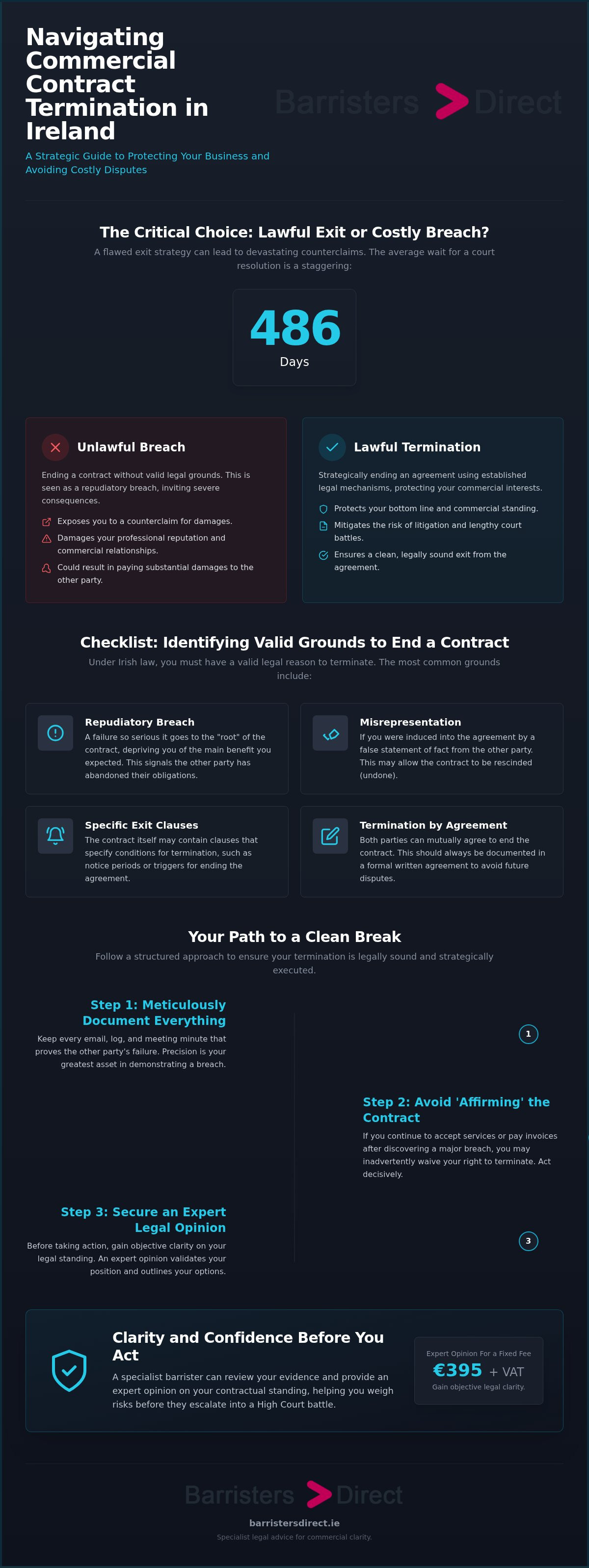
Terminating a commercial agreement is rarely as simple as sending a notice and walking away; in fact, the wrong move could leave you vulnerable to a devastating claim for damages. If you're wondering can a contract be broken Ireland, you aren't just looking for an exit; you're looking for a strategy that preserves your reputation and your bottom line. It's natural to feel overwhelmed by dense legal jargon or the looming threat of a 486-day average wait for a court resolution. You want to move forward with confidence, without the shadow of a counter-suit hanging over your business.
This guide provides the clarity you need to navigate Irish contract law with precision. We'll strip away the complexity to reveal the specific grounds for termination, from repudiatory breaches to force majeure clauses, whilst ensuring you understand how to protect your commercial interests. You'll discover how a specialist barrister's opinion can validate your standing for a fixed fee of €395 + VAT, allowing you to access expert legal advice whilst avoiding the high costs of traditional litigation. We'll outline a specialist checklist to help you identify your exit options, manage notice periods, and secure a clean break.
Key Takeaways
- Learn the critical distinction between an unlawful breach and lawful termination to protect your commercial interests and professional reputation.
- Understand the legal grounds for a repudiatory breach to determine can a contract be broken Ireland whilst mitigating the risk of wrongful termination claims.
- Recognise the financial dangers of counterclaims and how a flawed exit strategy can lead to paying substantial damages to the other party.
- Evaluate the validity of exit clauses and notice periods to ensure your departure from an agreement is both legally sound and strategic.
- Secure a specialist barrister’s expert opinion for a fixed fee of €395 + VAT to gain objective clarity on your contractual standing before taking action.
Understanding Contractual Termination in Ireland
Many business owners and directors ask can a contract be broken Ireland when a partnership sours or a supplier fails to meet their obligations. In strict legal terms, "breaking" a contract usually refers to a breach of contract, which is an unlawful failure to fulfil a promise. Lawful termination, however, is the strategic process of ending an agreement using established legal mechanisms. Under Irish law, a contract is a binding promise. If you walk away without a valid legal ground, you aren't just ending an agreement; you're inviting a potentially expensive claim for damages.
Generally, an agreement concludes in one of three ways. Performance occurs when both parties have completed their duties. Agreement happens if both sides decide to walk away together. Finally, a breach occurs when one party defaults. Understanding which category your situation falls into is the first step in protecting your commercial interests. If you exit prematurely without a legal right, the court will likely view your actions as a repudiatory breach, which gives the other party the right to sue.
The Legal Framework for Irish Contracts
Irish contract law is rooted in common law principles. This means it's shaped by both legislation and previous court decisions. When commercial disputes arise, the interpretation of these rules often falls to independent specialist advocates who operate as sole practitioners. These specialists provide the expertise needed to determine if a specific clause allows for an exit. If the original document lacks clarity, the process of leaving becomes significantly more complex. Clarity in the original document determines the ease of exit, but even a poorly drafted agreement can often be managed with the right expert advice.
Breach vs. Rescission: Key Terminology
It's vital to distinguish between rescission and termination. Rescission essentially "undoes" the contract from its inception, treating it as if it never existed. This usually happens in cases of fraud or serious misrepresentation. Termination, by contrast, ends the contract from a specific point forward, leaving previous obligations intact. If you choose to exit, the other party may seek damages. In Ireland, damages are monetary awards designed to put the wronged party back in the position they'd have enjoyed if the contract had been performed correctly. Consulting a specialist barrister for a fixed fee of €395 + VAT provides a clear, objective analysis of whether a breach has actually occurred. This early insight helps you weigh these risks before they escalate into a High Court battle.
Checklist: Identifying Valid Grounds to End a Contract
Determining if you have the legal right to walk away is the most critical step in any commercial dispute. If you're asking can a contract be broken Ireland, you must first identify which specific legal ground applies to your circumstances. Unlike consumer agreements, which are heavily protected by the Consumer Rights Act 2022, B2B commercial contracts rely more heavily on the specific terms negotiated and common law doctrines. A valid exit requires a clear trigger. This might be a material breach, which is a failure that goes to the "root" of the agreement, depriving you of the benefit you reasonably expected.
Alternatively, you might be dealing with misrepresentation, where you were induced into the deal by a false statement of fact. If you find yourself in this position, you must act quickly. Under the Statute of Limitations Act 1957, you generally have six years to bring a claim for breach of a simple contract, but waiting too long can make it harder to prove your case or may be seen as an acceptance of the breach. Identifying these grounds early is the difference between a clean break and a messy court battle.
Spotting a Repudiatory Breach
A repudiatory breach is a failure so serious it justifies immediate termination without the need for further performance. It essentially signals that the other party has abandoned their obligations. To manage this effectively, you must document the default with absolute precision. Keep every email, log, and meeting minute that proves the failure. Crucially, you must avoid "affirming" the contract. If you continue to accept services or pay invoices after discovering a major breach, you may inadvertently waive your right to terminate. A specialist barrister can review your evidence for a fixed fee of €395 + VAT to confirm if the breach is legally repudiatory before you send a formal notice.
The Doctrine of Frustration in Ireland
Frustration is a high bar to meet in Irish courts. It applies only when an unforeseen event, such as a sudden change in law or the physical destruction of the subject matter, makes performance truly impossible. It isn't enough for the contract to become more expensive or difficult to complete. For example, a fire that destroys a warehouse might frustrate a storage contract, but a rise in fuel prices rarely justifies walking away from a delivery agreement. Because the courts apply this doctrine so sparingly, getting an expert opinion is vital. Specialist barristers provide the objective view needed to decide if frustration is a viable defence or if you're risking a successful counterclaim for breach of contract.
Evaluating Exit Clauses and Notice Periods
Before searching for a fundamental breach, you should examine the contract's own mechanisms for ending the relationship. Many commercial agreements include specific "exit doors" that allow a party to walk away without proving a default. If you are wondering can a contract be broken Ireland, the answer often lies in the fine print of your notice periods and break clauses rather than a dramatic courtroom showdown. Following these procedures exactly is vital; a small administrative error in how you serve a notice can invalidate your termination and leave you liable for damages.
Break clauses are particularly common in commercial leases and long-term service agreements, often occurring at specific milestones like the third or fifth year. Missing a "time is of the essence" deadline by even a single day can lock you into a contract for several more years. Similarly, if the contract specifies notice must be sent by registered post to a specific office, an email notice will likely fail. You can secure a fixed-fee consultation with a specialist barrister for €395 + VAT to review your notice requirements. This ensures your exit is procedurally perfect and prevents the other side from claiming a technical breach against you.
Navigating Termination for Convenience
These clauses are the most straightforward way to exit. They allow either party to end the agreement for any reason, or no reason at all, provided they give the required notice. Usually, this is 30, 60, or 90 days. If your contract is silent on termination but isn't for a fixed term, Irish law may imply a "reasonable notice" period. What is "reasonable" depends on the length of the relationship and the nature of the business. A specialist barrister can provide an objective view on what constitutes reasonable notice in your specific industry, helping you avoid a claim for wrongful termination.
Force Majeure and Unforeseen Events
Force majeure clauses protect you when an extraordinary event beyond your control prevents performance. Irish courts interpret these clauses strictly. You cannot simply claim frustration because of a market shift; the event must usually be explicitly listed in the contract, such as an act of God or a specific legislative change. It is essential to check if your contract includes a specific list of events and what the required notification period is once that event occurs. For a deeper look at managing high-stakes disagreements, see our guide on Commercial Dispute Resolution in Ireland. Specialist advice ensures you don't misapply these clauses, as an incorrect claim of force majeure is itself a breach of contract.
The Risks of Unlawful Termination: Avoiding Counterclaims
Terminating an agreement without sufficient legal grounds is a high-risk manoeuvre that often leads to a claim for wrongful termination. If you are considering can a contract be broken Ireland, you must realise that an incorrect exit transforms you from the victim of a poor service into the party liable for a breach. In the close-knit Irish business community, the reputational fallout of a public contract dispute can be just as damaging as the financial penalties. Once a dispute enters the court system, you face an average case disposition time of 486 days, a period of uncertainty that few businesses can afford.
Many directors attempt self-help remedies, such as withholding payment until a service improves. This is a common strategic error. Unless the other party's failure is legally classified as a repudiatory breach, your refusal to pay constitutes a breach of your own obligations. This gives the other side a clear path to terminate the agreement and sue you for the remaining value of the contract. Instead of solving the problem, you provide your opponent with the legal ammunition they need to file a successful counterclaim.
Calculating Potential Liabilities
If a court finds your termination was unlawful, you will likely be ordered to pay damages. These are split into direct losses, such as the cost of finding a replacement supplier, and consequential losses, which include lost profits. Irish law also imposes a strict duty to mitigate your losses. This means you must take reasonable steps to minimise the financial impact of the breach; you cannot simply let costs spiral and expect the other party to pay. Understanding these potential liabilities early allows you to make a cold, commercial decision about whether the exit is worth the risk.
The Importance of Strategy Before Action
Sending a heated letter or an immediate notice of termination without expert validation is a significant tactical mistake. It is far more effective to use a barrister to stress test your grounds for exit before you commit to a course of action. By obtaining a specialist opinion, you can identify the advantages of instructing a barrister directly to review your position. A fixed-fee consultation at €395 + VAT provides the objective, expert view needed to ensure your termination notice is bulletproof. This strategic approach protects your commercial interests and ensures that if the matter does reach the Commercial Court, your standing is already validated by a specialist advocate. Consult a specialist barrister today to evaluate your contractual position before taking action.
Strategic Steps: Consulting a Specialist Barrister
When the stakes involve high-value commercial agreements, the question of can a contract be broken Ireland requires more than a cursory review of the document; it demands a specialist advocacy perspective. Obtaining an objective, expert view of your contractual position before you take action is the most effective way to protect your business. By engaging a barrister early, you gain access to the same level of expertise usually reserved for the final stages of a court battle, allowing you to resolve disputes before they escalate into costly litigation.
Direct Access for Commercial Disputes
Modern legal frameworks have transformed how businesses access expert counsel. Under the Legal Services Regulation Act, commercial entities can now instruct barristers directly for specialist advice on commercial disputes. This direct access model removes unnecessary layers, providing you with high-quality expertise immediately. It's an efficient way to secure a strategic advantage, as independent barristers are expert sole practitioners who specialise in the interpretation of complex contractual terms. This streamlined approach ensures you receive precise guidance on whether your grounds for termination are legally sound whilst significantly reducing the time spent in traditional advisory cycles.
What to Expect from Your Consultation
The process is designed for modern business efficiency. You can arrange a fixed-fee consultation for €395 + VAT, which is conducted online via secure platforms like Zoom or Microsoft Teams. This removes geographical barriers and fits into a busy commercial schedule. During the session, a specialist barrister will review your contract and the specific facts of the dispute to provide a clear, strategic path forward.
Following the meeting, you'll receive a synopsis of the discussion and the expert's view on your standing. If the barrister determines that you have a valid right to exit, you can proceed with confidence. If the situation is more complex, you'll understand exactly where the risks lie before any formal notices are sent. Should the matter eventually require formal litigation, the barrister will advise on how to proceed, including when it's necessary to involve a solicitor for court representation. This methodical approach ensures your commercial interests are prioritised, providing elite legal insight in an egalitarian, accessible format.
Securing Your Commercial Exit Strategy
Navigating the complexities of Irish contract law requires more than a cursory glance at your agreement. You've seen that the question isn't just can a contract be broken Ireland, but how to terminate it whilst shielding your business from costly counterclaims and reputational damage. Success depends on identifying a valid legal ground, such as a repudiatory breach or a specific break clause, and following notice procedures with absolute precision. Taking a "self-help" approach or sending unverified notices often leads to the very litigation you're trying to avoid.
The most effective way to gain clarity is through an objective, expert review of your position. Barristers Direct provides a modern, transparent platform where you can access elite advocacy skills early in a dispute. With direct access to over 100 independent specialist barristers across our nationwide network, you can secure the strategic intelligence needed to move forward. Book a fixed-fee consultation with a specialist barrister today for €395 + VAT. This small investment provides the certainty you need to protect your commercial interests and ensures your next move is based on expert validation rather than guesswork. You don't have to navigate these complex systems alone.
Frequently Asked Questions
Can I break a contract if the other party is not doing what they promised?
You can lawfully terminate an agreement if the other party commits a repudiatory breach, which is a failure so fundamental it goes to the heart of the contract. If the breach is minor, you are generally limited to claiming damages whilst the contract continues. It is vital to determine the severity of the failure before taking action, as misjudging the situation can lead to a claim for wrongful termination against you.
What happens if I terminate a contract without a valid legal reason?
Terminating an agreement without a valid legal ground constitutes a "wrongful termination," effectively making you the party in breach. This allows the other side to claim damages for their losses, including lost profits and the cost of finding a replacement. You might also face an injunction to prevent the termination. To avoid this outcome, many businesses seek an expert opinion to "stress test" their grounds before sending a formal notice.
How much does it cost to get a legal opinion on a contract dispute in Ireland?
At Barristers Direct, a fixed-fee consultation with a specialist barrister costs €395 plus VAT. This provides you with an objective, expert view of your contractual standing and a strategic path forward. If the matter is contentious and requires a solicitor to attend, the fee is €595 plus VAT. These transparent, flat-fee models allow businesses to access elite legal insight early in a dispute without the uncertainty of traditional hourly billing.
Can a verbal contract be broken as easily as a written one?
Verbal contracts are legally binding in Ireland, but they are significantly more difficult to enforce or "break" due to the lack of a written record. The challenge lies in proving the specific terms agreed upon at the time of formation. If you are wondering can a contract be broken Ireland when no written document exists, you must rely on evidence like emails, invoices, or witness testimony to establish the grounds for termination.
What is a "cooling-off period" and does it apply to commercial contracts?
Cooling-off periods are primarily a feature of consumer protection law and rarely apply to B2B commercial contracts. Unless your specific agreement includes a "termination for convenience" clause or a trial period, you are generally bound from the moment the contract is formed. Commercial entities are expected to conduct due diligence before signing, as the law assumes a higher level of bargaining power and sophistication compared to individual consumers.
Do I need a solicitor to talk to a barrister about a contract dispute?
No, you do not need a solicitor to speak with a barrister for an initial consultation. Under the Legal Services Regulation Act, businesses and individuals can now access specialist barristers directly for expert advice. This direct access model allows you to obtain a specialist opinion on your contract dispute quickly and efficiently. If your case eventually requires formal court proceedings, a solicitor must then be engaged to handle the litigation process.
What should I do if I receive a notice of breach of contract?
If you receive a notice of breach, you should immediately review the specific allegations against the terms of your agreement. Do not ignore the notice, as silence can be interpreted as an admission of the breach. You should document your response and take reasonable steps to mitigate any potential losses. Getting an early specialist opinion helps you determine if the claim has merit or if it is a tactical manoeuvre by the other party.
How long does it take to resolve a contract dispute in Ireland?
The time to resolve a contract dispute varies, but the average case disposition time in Irish courts was 486 days in 2024. However, many disputes are settled much faster through negotiation or alternative dispute resolution. Obtaining an early expert opinion from a specialist barrister can often prevent a long court battle by providing a clear view of each party’s standing, which frequently encourages an early settlement or a managed exit.
Disclaimer
This article does not constitute legal advice. Barristers Direct does not provide legal advice. To obtain legal advice, you should contact a legal practitioner.


