

A verbal agreement in Ireland is not just a "gentleman’s agreement"; it is a binding legal contract that the courts are fully equipped to enforce. If you are currently asking "can I sue for breach of verbal contract", you likely feel the weight of uncertainty that comes from lacking a signed document. It is natural to worry that a dispute will devolve into a "he-said, she-said" scenario, or that the financial cost of seeking a remedy will exceed the value of the agreement itself. However, Irish law recognises the validity of oral promises, provided the core pillars of a contract are present.
This guide provides the clarity you need to move forward with confidence. You will learn how to identify the legal status of your agreement and what specific evidence, from digital trails to patterns of conduct, can be used to prove its existence. If you understand the strategic steps required to validate your claim, the path to a resolution becomes far more manageable. We also outline how to access an expert assessment from a specialist barrister for a fixed fee of €395 plus VAT. This approach ensures you receive high-quality legal guidance from an independent expert, allowing you to weigh the merits of your case before engaging in formal litigation.
Key Takeaways
- Understand that verbal agreements are legally enforceable in Ireland provided you can demonstrate the four essential pillars of a contract: offer, acceptance, consideration, and intention.
- Learn how to reconstruct your agreement using contemporaneous evidence and conduct to determine if you can sue for breach of verbal contract on the balance of probabilities.
- Identify the specific legal challenges unique to oral agreements, including the six-year window provided by the Statute of Limitations and the risk of term uncertainty.
- Discover how a fixed-fee consultation for €395 plus VAT allows you to access a specialist barrister for an objective assessment of your claim's strategic path forward.
Are Verbal Contracts Legally Binding in Ireland?
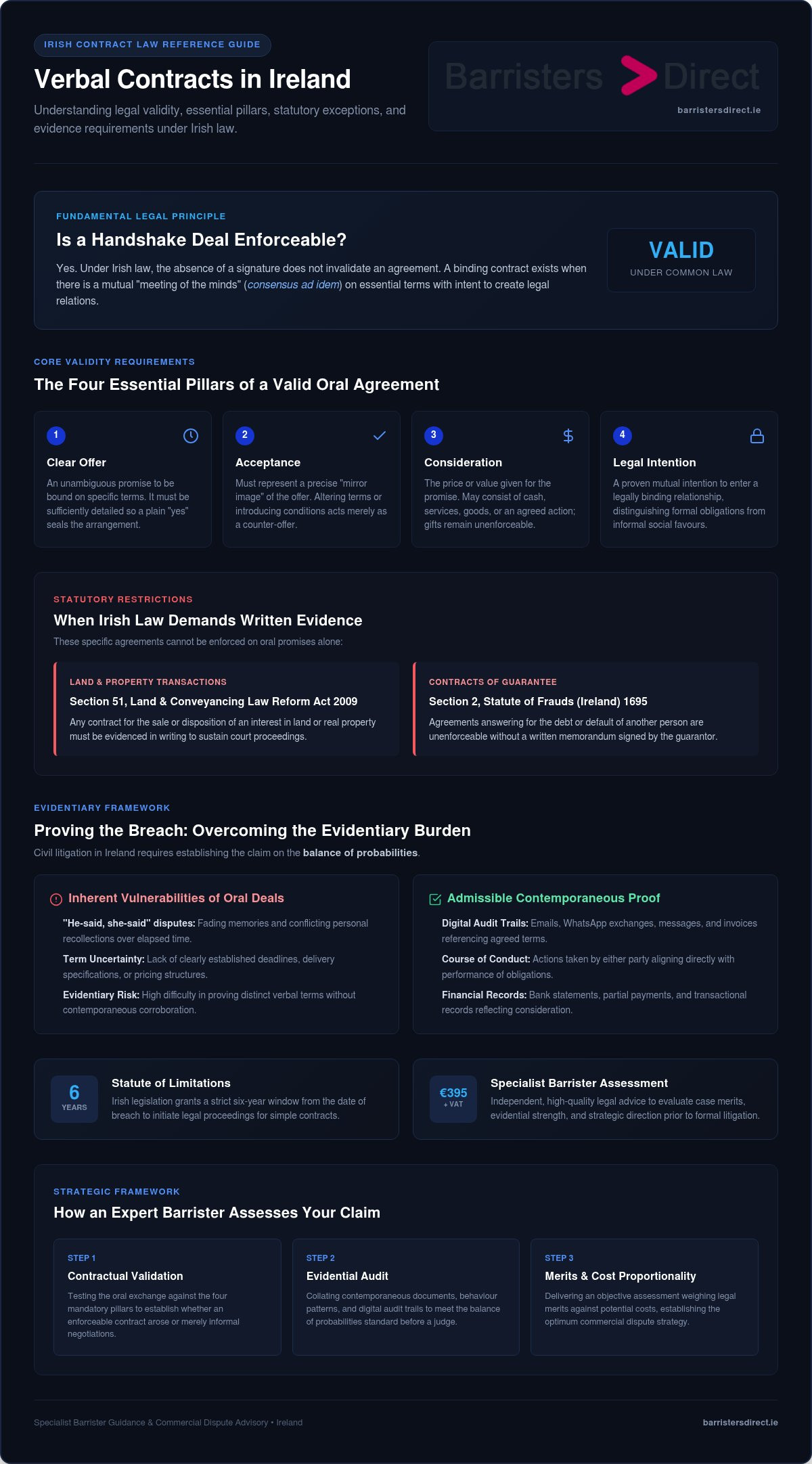
Under Irish law, the absence of a signature on a piece of paper does not automatically invalidate an agreement. The fundamental principle is that a contract is formed when there is a "meeting of the minds", known as consensus ad idem. If two parties agree on essential terms with the intention to be legally bound, a contract exists. When individuals ask "can I sue for breach of verbal contract", the answer is generally yes, provided the agreement is not one of the few types the law requires to be in writing. In legal terms, it's vital to distinguish between a "void" contract, which has no legal effect from the start, and an "unenforceable" contract. An unenforceable contract might be valid in principle, but the court cannot grant a remedy because it lacks the specific written evidence required by statute.
The Legal Reality of the Handshake Deal
Handshake deals remain a staple of Irish commercial and personal life. A verbal contract is a legally binding agreement made through spoken words rather than a written document. Whilst these agreements are convenient, they carry a significant evidentiary risk. The primary difficulty is not the legality of the deal, but the challenge of proving specific terms years later as memories fade or relationships sour. These disputes often rely on the common law rules governing oral contracts, which require the court to look at the conduct of the parties to infer what was actually agreed. If you find yourself in a dispute, obtaining a clear strategic path forward from a specialist barrister can help determine if your evidence is sufficient to satisfy a judge.
Exceptions: When a Written Document is Mandatory
Certain agreements are strictly governed by legislation that overrides the general rule of verbal validity. Under Section 51 of the Land and Conveyancing Law Reform Act 2009, any contract for the sale or transfer of an interest in land must be evidenced in writing to be enforceable. This means that a verbal promise to sell a property or grant a long-term lease is generally not enough to sustain a court action. Similarly, Section 2 of the Statute of Frauds (Ireland) 1695 requires contracts of guarantee, where one person promises to answer for the debt of another, to be supported by a written memorandum signed by the party being charged. If your agreement falls into these specific categories, a purely oral promise might leave you without a legal remedy. Accessing an expert opinion through commercial dispute resolution services allows you to understand these statutory hurdles early. A specialist barrister provides an objective assessment of the merits of your case, helping you decide if the value of the claim justifies the potential costs of litigation.
The Four Essential Pillars of a Valid Oral Agreement
To determine if you can sue for breach of verbal contract, you must first establish that a legally binding agreement actually formed. Irish law identifies four mandatory components that must coexist for any contract to be valid. If any of these are absent, the arrangement is viewed as a mere social agreement or an incomplete negotiation rather than a legal obligation. Success in court depends on proving these pillars existed through the specific words used and the subsequent conduct of both parties. A specialist barrister evaluates these elements during an initial consultation to provide an objective view on the merits of your case.
Offer, Acceptance, and Consideration
An offer is a clear, unambiguous promise to be bound on specific terms. It must be sufficiently detailed so that a simple "yes" creates the deal. If the terms are too vague, the court may rule that there was no "certainty of terms", rendering the agreement unenforceable. Acceptance must be a "mirror image" of that offer. If you introduce new conditions or alter the price, you haven't accepted the deal; you've made a counter-offer. This distinction is vital in verbal negotiations where the "meeting of the minds" can be easily misconstrued.
Consideration is the "price" paid for the promise. In Ireland, this doesn't have to be cash. It could be a service, a physical item, or a promise to perform an action. Without consideration, a verbal promise is usually viewed as a gift or a favour, which the law generally won't enforce. For example, in debt recovery matters, the consideration is usually the goods or services provided in exchange for the agreed payment.
Intention to Create Legal Relations
The final pillar is the mutual intention that the deal be legally binding. In commercial or business settings, the law presumes this intention exists. In social or domestic settings, the presumption is reversed, meaning the burden is on you to prove that the parties intended the law to step in if the deal failed. Courts often look at "detrimental reliance" to find this intent. If one party acted to their cost, such as by starting work or purchasing materials based on the spoken promise, it strongly suggests a binding agreement was intended.
Timing is also a critical legal factor. Under Section 11 of the Statute of Limitations 1957, you generally have six years from the date of the breach to initiate proceedings for a simple contract. Proving these elements through spoken testimony alone is difficult, but a specialist barrister can help you reconstruct the agreement through a strategic assessment. If you are unsure whether your "handshake deal" meets these legal standards, you can book a consultation with a specialist barrister for €395 plus VAT to receive an expert opinion on your position.
Proving the Breach: Gathering Evidence Without a Written Document
The burden of proof in an Irish civil case rests with the plaintiff, who must establish their claim on the balance of probabilities. This legal standard means you must demonstrate that it's more likely than not that the verbal agreement existed and was breached. Success doesn't require absolute certainty, but it does require a cohesive narrative supported by secondary evidence. If you're asking "can I sue for breach of verbal contract", your primary task is to move beyond a simple "he-said, she-said" dispute by identifying contemporaneous evidence created at the time of the deal.
Constructing a Paper Trail from Digital Fragments
Whilst the core agreement may have been spoken, the surrounding communication often leaves a significant digital footprint. Resolving commercial disputes often begins with this evidence audit. You should gather any records that refer to the terms or the existence of the deal, such as:
- Digital Messaging: WhatsApp threads, SMS, or Slack messages that discuss delivery dates, pricing, or project milestones.
- Email Correspondence: Follow-up emails that say "as discussed on our call" or "following our meeting earlier today".
- Financial Records: Invoices, bank statements showing specific transfer amounts, or receipts that prove payment was made or accepted.
Financial records are particularly persuasive. If one party accepted a bank transfer that matches an oral quote, it's difficult for them to later argue that no contract existed. These fragments, when viewed together, allow a barrister to reconstruct the agreement's terms with a high degree of precision.
Conduct and Witness Statements
The behaviour of the parties after the conversation is often the most powerful evidence of a contract. In Irish law, this is known as "part performance". If you began providing a service and the other party accepted that service without objection, their conduct implies the existence of a binding deal. A judge will look at whether your actions are consistent with the verbal promise you claim was made.
Third-party witnesses also play a vital role. If a colleague, business partner, or independent bystander was in the room or on the call when the deal was struck, their testimony can provide the necessary weight to tip the balance of probabilities in your favour. A specialist barrister is uniquely skilled at evaluating how such testimony will stand up in court. They can assess the strength of your witnesses and the overall "merits of the case" during a fixed-fee consultation for €395 plus VAT, providing you with a clear strategic path before you commit to the costs of formal litigation.
Navigating the Challenges of Suing for a Verbal Breach
Suing for a verbal breach requires careful strategic planning. The first hurdle is the clock. In Ireland, the Statute of Limitations allows six years from the date of the breach to initiate proceedings. If you wait too long, your right to seek a remedy expires. Beyond timing, the primary challenge is "uncertainty". If the terms are too vague, a judge may find the contract void because the court cannot invent terms that weren't clearly agreed.
You must also consider the venue for your claim. If your dispute is valued at €15,000 or less, it typically falls within the District Court. Claims between €15,001 and €75,000 are heard in the Circuit Court, whilst any amount exceeding €75,000 moves to the High Court. Higher courts involve higher legal costs, so a rigorous cost-benefit analysis is essential. For more on the mechanics of termination, see Can a contract be broken in Ireland?.
The Risk of Conflicting Recollections
When you wonder "can I sue for breach of verbal contract", remember that Irish judges are experts at resolving credibility contests. Without a written record, the court relies heavily on the consistency of your testimony and your ability to recall details under cross-examination. If your account shifts during proceedings, the judge may favour the opposing party's version of events. The absence of a written record places a higher premium on the consistency of your testimony.
Pre-Action Protocols and Dispute Resolution
Litigation is often the final resort. Irish courts encourage parties to attempt resolution before entering a full trial. Engaging a specialist barrister early can provide an objective "merits of the case" assessment that often facilitates a settlement. If both sides understand the legal strengths and weaknesses of the oral deal, they are more likely to reach a compromise. This is particularly relevant for supplier contract dispute advice, where maintaining a business relationship is often as important as the claim itself.
To secure an expert opinion on your specific circumstances, you can access a specialist barrister for a fixed-fee consultation of €395 plus VAT. This direct access allows you to weigh the strength of your evidence before committing to formal litigation.
How a Specialist Barrister Evaluates Your Verbal Contract Claim
When you ask can I sue for breach of verbal contract, the final determination often rests on how a court will perceive your evidence. Barristers are independent sole practitioners who specialise in providing objective, high-quality legal advice and courtroom advocacy. By accessing a specialist barrister at the outset, you receive a professional "merits of the case" assessment. This evaluation determines whether your oral agreement meets the necessary legal thresholds and if your supporting evidence is robust enough to withstand cross-examination. For a fixed fee of €395 plus VAT, you gain direct access to this expertise, allowing you to weigh your options before committing to the formal litigation process.
If the barrister’s assessment indicates that your claim is strong and litigation is required, the next step involves engaging a solicitor. Solicitors remain essential for the formal conduct of proceedings, including the management of court documents and the holding of client funds. This collaborative relationship ensures that your case is built on a foundation of specialist strategic advice whilst being managed through the necessary procedural channels.
The Strategic Path Forward
During a consultation, the barrister reviews the evidence you have gathered, such as the digital fragments and witness accounts discussed in previous sections. They identify potential legal weaknesses that an opponent might exploit and provide a clear strategic path forward. Every consultation through the Barristers Direct platform includes an AI-generated transcript and summary, ensuring you have a precise record of the specialist advice provided. Understanding the advantages of instructing a barrister directly helps you move from a state of uncertainty to one of informed action.
Bypassing Tradition for Efficiency
The Legal Services Regulation Act has modernised how individuals and businesses interact with the Irish legal system. It allows you to speak to a specialist barrister first, ensuring that the quality of the initial advice dictates your strategy. This approach focuses on precision and strategic intelligence rather than traditional, slower methods of case assessment. By prioritising high-quality advice at the earliest stage, you can avoid unnecessary legal expenditure on claims that may lack the requisite evidentiary weight. If you are ready to determine the viability of your claim, you can book a fixed-fee consultation with a specialist barrister today for €395 plus VAT. This direct access provides the clarity needed to resolve your dispute with professional confidence.
Securing Your Strategic Path Forward
Navigating a dispute without a written document requires a shift from uncertainty to objective analysis. You now understand that verbal agreements are legally enforceable in Ireland, provided the four pillars of a contract are present and the claim is initiated within the six-year statutory limit. Success in these cases relies on reconstructing the deal through digital fragments, witness testimony, and a consistent narrative that satisfies the balance of probabilities. Determining if you can I sue for breach of verbal contract depends on the strength of your evidence and the clarity of the original agreement.
The most efficient way to assess your position is to seek an early opinion from a specialist advocate. With a national network of over 100 barristers, we provide the expertise needed to evaluate the merits of your case with professional precision. You can instruct a specialist barrister directly for a fixed-fee consultation of €395 plus VAT to receive a clear, strategic path forward. This transparent model ensures you have the high-quality advice necessary to make an informed decision about your next steps. Take the first step toward resolving your dispute with confidence today.
Frequently Asked Questions
Can I sue for breach of verbal contract in Ireland?
Yes, you can sue for breach of verbal contract in Ireland as long as the agreement contains the four essential legal pillars: offer, acceptance, consideration, and an intention to create legal relations. Whilst many believe a signed document is mandatory, the law generally recognises spoken promises as binding. The primary challenge is evidentiary rather than statutory. You must initiate any legal proceedings within six years from the date the breach occurred to remain within the Statute of Limitations.
How do I prove a verbal contract exists without a witness?
Proving an agreement without a witness requires you to demonstrate "part performance" or identify a digital paper trail. If you began work or made a payment that the other party accepted, this conduct suggests a contract was in place. You should also gather contemporaneous records such as WhatsApp messages, emails, or bank transfer descriptions that refer to the agreed terms. These fragments allow a specialist barrister to reconstruct the deal on the balance of probabilities.
Is a handshake deal legally binding in business?
A handshake deal is legally binding in an Irish business context because the law presumes that parties in a commercial setting intend to create legal relations. However, certain exceptions exist where writing is mandatory by statute. For instance, agreements involving the sale of land or the provision of a guarantee must be evidenced in writing to be enforceable. Outside of these specific areas, a verbal agreement reached during a business meeting is a valid contract.
What is the time limit for suing for breach of contract in Ireland?
The time limit for initiating a claim for breach of a simple contract, which includes verbal agreements, is six years from the date the breach occurred. This limit is established by the Statute of Limitations 1957. If you fail to issue proceedings within this window, your claim will likely be statute-barred. This means the court won't hear the case regardless of the strength of your evidence or the underlying merits of your attempt to sue for breach of verbal contract.
Can an email or text message count as a written contract?
Emails and text messages often serve as a "note or memorandum" of an agreement rather than the contract itself. In many cases, these digital records provide the necessary written evidence to satisfy statutory requirements, such as those found in the Statute of Frauds. Whilst they aren't always a formal "written contract" in the traditional sense, they are highly persuasive in court as they provide a contemporaneous record of what the parties actually agreed.
What happens if the other party denies the verbal agreement ever happened?
If the other party denies the agreement, the case becomes a credibility contest that the judge resolves on the balance of probabilities. The court will examine the conduct of both parties after the alleged deal was struck. If your actions are consistent with the existence of a contract, such as delivering goods or paying a deposit, the judge is more likely to accept your version of events. Consistency in your testimony is vital in these scenarios.
How much does it cost to get a legal opinion on a verbal contract breach?
At Barristers Direct, you can obtain a specialist legal opinion from an independent barrister for a fixed fee of €395 plus VAT. This fee covers a consultation where the barrister reviews your evidence and provides a strategic path forward. If the matter is contentious and requires a solicitor to also attend, the fee is €595 plus VAT. This model provides transparency and ensures you receive high-quality advice at an early stage of your dispute.
Do I need a solicitor to talk to a barrister about my contract dispute?
You don't need a solicitor to talk to a barrister for an initial consultation regarding your contract dispute. The Legal Services Regulation Act allows members of the public and businesses to access specialist barristers directly for expert advice. This direct access model is designed to provide a faster and more transparent way to assess the merits of your case. However, if formal court proceedings are eventually initiated, you'll then need to engage a solicitor.
Disclaimer
This article does not constitute legal advice. Barristers Direct does not provide legal advice. To obtain legal advice, you should contact a legal practitioner.


