

What if the complexity of the Irish family law system didn't have to stand between you and your child's future? For many parents, the search for child custody legal advice ireland is born out of a deep-seated fear of losing contact or being overwhelmed by the legal distinction between guardianship and custody. It's understandable to feel intimidated by a framework that often prioritises traditional, solicitor-led routes that can be both slow and costly. However, securing specialist child custody legal advice ireland at the earliest opportunity ensures that your actions are guided by strategic intelligence rather than emotional reactivity.
This guide provides a professional roadmap through the Irish framework, helping you protect your child’s best interests with confidence. You'll gain a clear understanding of the "Best Interests of the Child" test and how independent expertise can provide a clear path forward. By accessing high-level child custody legal advice ireland, you can bypass unnecessary layers of communication and focus on practical results. We will preview the roles of the District and Circuit Courts, the importance of mediation, and how a modern approach to legal consultancy empowers you to navigate the system with certainty.
Key Takeaways
- Understand the vital legal distinction between custody, which governs day-to-day care, and guardianship, which involves significant life decisions regarding a child’s upbringing.
- Discover how Irish courts apply the "Best Interests of the Child" principle as the paramount consideration when determining any arrangement for a child's welfare.
- Learn why securing specialist child custody legal advice ireland at an early stage provides the strategic clarity needed to navigate mediation and court proceedings effectively.
- Explore how voluntary parental agreements can be formalised through a "Rule of Court" to create a legally binding framework that ensures long-term stability.
- Gain insight into how direct access to specialist family law barristers for a fixed fee of €395 plus VAT offers a transparent and expert-led alternative to traditional models.
Understanding Child Custody Laws and Parental Rights in Ireland
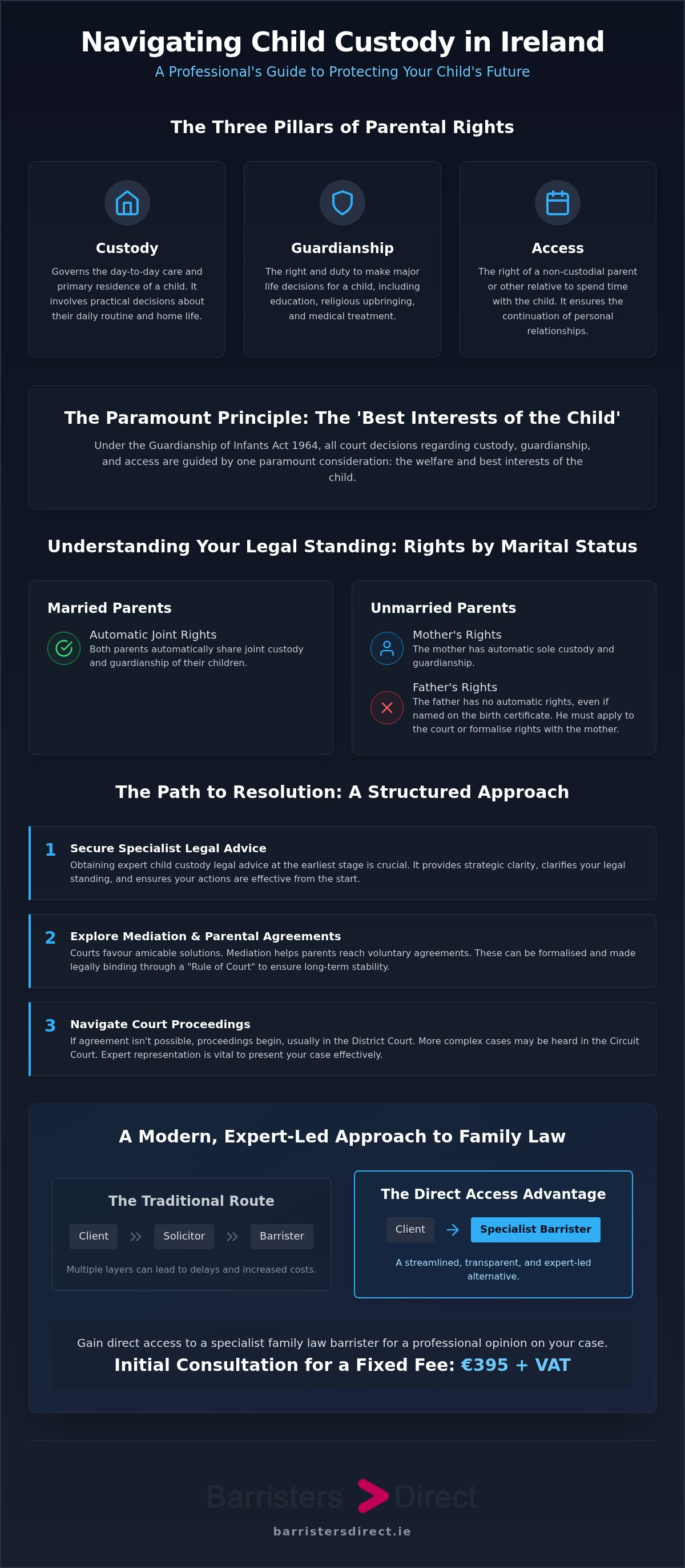
In Ireland, custody specifically refers to the day-to-day care and home life of a child under the age of 18. This involves the practicalities of where the child lives and the immediate decisions regarding their daily routine. Under the Guardianship of Infants Act 1964, the court's priority is always the child's welfare. Most modern arrangements favour joint custody, where the child spends time with both parents, though one parent may have primary care and control. Sole custody, by contrast, places the child in the full-time care of one parent. Seeking specialised child custody legal advice ireland helps parents understand which arrangement best serves their specific circumstances.
The legal landscape has evolved significantly to meet the needs of modern families. The Legal Services Regulation Act has modernised how individuals access high-level expertise. It allows for a more direct route to specialist barristers, stripping away the layers that often make family law feel inaccessible. This means you can obtain a professional opinion on the strength of your case earlier in the process, ensuring your strategy is sound from the outset.
Automatic Custody vs Court-Ordered Arrangements
Marital status creates distinct legal starting points that parents must navigate. In Ireland, a mother has automatic sole custody of a child born outside of marriage. Married parents, however, share joint custody and guardianship automatically. If you're a father in a non-marital relationship, you don't automatically possess these rights, even if your name is on the birth certificate. You must apply to the court for a custody or guardianship order, or enter a statutory declaration with the mother. These distinctions often cause confusion, making it essential to secure expert insight to clarify your standing before taking action.
The Legal Framework of the Family Courts
Custody disputes are generally heard in the District Court, though more complex cases or those involving divorce may move to the Circuit Court. The system is designed to be less adversarial than criminal law, but the stakes remain exceptionally high. Amongst conflicting claims, the court relies on evidence of parental capacity and the child's emotional needs. Before you file an application, obtaining specialist child custody legal advice ireland is a vital step. This ensures your strategy is grounded in how judges actually interpret the "best interests" principle. It's a pragmatic step that moves your case from emotional uncertainty to legal clarity. If you understand the framework, you're better positioned to protect your child's future.
Guardianship, Access, and Custody: Defining Your Legal Position
Understanding your legal standing requires a clear distinction between three separate but overlapping concepts: guardianship, custody, and access. While the Irish court system defines custody as the day-to-day care of the child, it's often the most contentious element because it dictates the child's primary residence. However, custody doesn't exist in a vacuum. A specialist barrister evaluates the interaction between your custodial rights and your role as a guardian to ensure a cohesive legal strategy. Securing child custody legal advice ireland at this stage is essential to understand how these pillars support your child's long-term stability.
The interplay between these statuses determines how much influence you have over your child's upbringing. If you've primary custody but share joint guardianship, you cannot make major life decisions unilaterally. Conversely, having access without guardianship limits your involvement in significant milestones. This complexity is why many parents seek expert legal insight to clarify their specific rights and obligations before entering negotiations or court proceedings.
Guardianship: Rights and Responsibilities
Guardianship is the most comprehensive legal status a parent can hold. It grants the right and duty to make major decisions regarding a child's welfare, including their education, medical treatment, and religious upbringing. While mothers and married fathers are automatic guardians, others may need to apply to the court or sign a statutory declaration. The court views guardianship as a fundamental responsibility; consequently, it's rarely removed or restricted unless there's clear evidence that a guardian's involvement poses a risk to the child's welfare. Most disputes arise not from the status itself, but from how joint guardians exercise their shared decision-making power.
Access Rights and Enforcement
Access refers to the time a child spends with the parent they don't live with. Schedules are typically structured based on the child's age and developmental needs; infants may have frequent, short visits, whilst older children might have overnight stays and alternate weekends. Access is a right belonging primarily to the child, not the parent. When access orders are breached or ignored, the court can intervene with enforcement orders. If a parent consistently fails to facilitate access, the court may even consider a variation in the primary custody arrangement to ensure the child's right to a relationship with both parents is upheld. Obtaining child custody legal advice ireland ensures you're prepared to handle these sensitive enforcement issues with professional precision.
How Irish Courts Determine Child Custody: The 'Best Interests' Principle
The "Best Interests of the Child" isn't just a guideline; it's the sole paramount consideration in Irish law. When a judge examines a case, they're looking for the arrangement that most effectively promotes the child's physical, emotional, and psychological development. This test overrides the personal preferences or "rights" of the parents. If you're preparing for a hearing, obtaining child custody legal advice ireland is essential to understand how your specific circumstances will be measured against this standard. Judges typically focus on three core areas: the child’s emotional needs, the stability of the proposed home environment, and each parent’s capacity to meet those needs.
To provide the court with an objective view, judges often commission a Section 32 report. These reports are prepared by independent expert assessors, such as psychologists or social workers, who interview the family and observe interactions in a neutral setting. A specialist barrister plays a critical role here by interpreting these findings within a legal context. They don't just present facts; they frame your case to align with judicial expectations, ensuring the evidence highlights your commitment to the child's welfare rather than focusing on the conflict with the other parent. This strategic framing is often what determines the court's final direction.
The Views of the Child
As children grow, the court increasingly weighs their own preferences. Whilst there's no fixed age, the court typically begins to consider a child’s views more heavily from around the age of 12, depending on their individual maturity. However, the child’s voice is heard through an assessor or a guardian ad litem to avoid the distress of testifying in a courtroom. It's vital to distinguish between "hearing" the child and the child making the decision. The judge listens to their wishes but remains the final arbiter, often making a ruling that differs from the child’s stated preference if it's in their best interests.
Parental Conduct and Its Impact on Custody
A parent’s behaviour or lifestyle only becomes relevant if it directly impacts the child’s wellbeing or safety. The court is generally uninterested in personal grievances between adults unless they manifest as alienation or the deliberate obstruction of the other parent's relationship with the child. If one parent seeks to "poison the well" by undermining the child's bond with the other parent, the court may view this as a significant failure of parental capacity. Maintaining a child-centred focus whilst undergoing a difficult legal battle is challenging but necessary for a positive outcome. Specialist child custody legal advice ireland helps you stay focused on the legal benchmarks the court cares about, protecting your case from the pitfalls of emotional reactivity and ensuring your conduct remains beyond reproach.
Navigating Custody Disputes: Mediation and the Court Process
Under Irish law, parties in a family dispute are generally required to consider mediation before a court hearing is scheduled. Mediation offers a space to reach a voluntary agreement, but it lacks the enforcement power of a judge's order. To rectify this, parents often seek a "Rule of Court", which formalises a mediated agreement into a legally binding document. This ensures that the terms agreed upon are enforceable, providing long-term security for the children involved. If mediation is unsuccessful, the process moves into the formal court system, where obtaining specialist child custody legal advice ireland becomes a critical factor in your preparation.
Moving from a dispute to a resolution requires a methodical approach. You need to gather specific documentation, such as existing informal agreements, correspondence regarding the children, and any relevant school or medical reports. This preparation allows a specialist to identify the legal merits of your position quickly. For those seeking clarity without immediately committing to full litigation, you can book a fixed-fee consultation with a specialist barrister to review your case strategy and establish a clear path forward.
Preparing for Your Specialist Consultation
To maximise the value of a professional meeting, you should come prepared with a clear timeline of care. Document who has been the primary caregiver and note any significant events or changes in the children's routine. Identifying the core areas of disagreement, whether it's holiday schedules or educational choices, allows the barrister to focus on high-impact solutions. A 60-minute fixed-fee consultation is an efficient way to establish whether your goals align with the "best interests" test applied by the courts. Having these details ready ensures the advice you receive is precise and actionable.
The Role of the Solicitor and Barrister
Understanding the difference between solicitors and barristers is vital when navigating the Irish legal system. Solicitors often handle the initial administrative and transactional elements of a case, such as drafting affidavits or managing correspondence between parties. However, if your case involves complex legal arguments or requires advocacy in a courtroom, a barrister is the specialist you need. They are independent practitioners who focus on the strategic interpretation of the law. Whilst the traditional model often requires a solicitor to instruct a barrister, modern regulations allow you to access a barrister directly for initial child custody legal advice ireland, providing a faster route to expert insight before you commit to formal representation if litigation becomes necessary.
Accessing Specialist Family Law Advice through Barristers Direct
Barristers Direct provides a gateway to some of the most experienced legal minds in Ireland, ensuring that your case is guided by high-level specialist advocacy. The platform connects parents with a network of over 100 independent sole practitioners from the Law Library of Ireland, each of whom brings a wealth of expertise to complex family matters. When seeking child custody legal advice ireland, the calibre of the professional assessing your situation is the most critical factor. By engaging a specialist barrister directly, you benefit from a concentrated focus on the legal merits of your case, delivered with the professional independence and strategic intelligence required to navigate the court system effectively.
This model is built on the principle that elite legal insight should be accessible and transparent. Whilst the quality of the advice remains the paramount consideration, the platform's structure ensures that this expertise is delivered in a way that is both efficient and modern, removing the administrative complexities often found in traditional legal engagements. This approach allows you to secure a professional opinion on your case’s strengths before committing to a long-term legal strategy.
Fixed-Fee Consultations for Family Law
The cornerstone of the service is the provision of an intensive, 60-minute consultation with a family law specialist. For a fixed fee of €395 plus VAT, you gain direct access to a barrister who will conduct a rigorous review of your circumstances and provide a definitive strategic path forward. This depth of expertise is what allows parents to move from a state of uncertainty to one of legal clarity. The consultation is designed to deliver immediate value through:
- An expert legal assessment of your custodial and guardianship rights.
- A strategic framework tailored to the specific needs of your children.
- An automatically generated recording of the session for your reference.
- A digital synopsis capturing the core advice and legal insights provided.
Taking the Next Step with Professional Confidence
Securing child custody legal advice ireland through this platform is a streamlined process that prioritises your time and focus. Consultations are held online via Zoom, Microsoft Teams, or Google Meet, allowing you to access specialist counsel from any location. There is no further obligation following this initial meeting; you remain in control of how you choose to proceed with your case. This flexibility, combined with the high standard of legal expertise provided, makes it a smarter and more transparent way to handle family law matters. For a deeper understanding of this model, you can review the advantages of instructing a barrister directly. By choosing this modern approach, you ensure your case is anchored in professional excellence and strategic precision.
Securing Your Child's Future with Strategic Clarity
The Irish court system prioritises the welfare of the child above all else. Success in these proceedings relies on your ability to present a case that aligns with the "best interests" principle whilst maintaining a clear, child-centred focus. By understanding the legal distinctions between custody and guardianship, you're better prepared to negotiate a stable future for your family. Early access to specialist insight is the most effective way to prevent protracted disputes and ensure your parental rights are upheld correctly.
Accessing child custody legal advice ireland no longer requires navigating an opaque or prohibitively expensive system. Through Barristers Direct, you can connect with a nationwide network of over 100 independent sole practitioners who provide the high-level advocacy your case requires. You can book a fixed-fee family law consultation with a specialist barrister for €395 plus VAT to receive immediate strategic clarity. This professional meeting includes a digital synopsis of the advice provided, ensuring you have a precise record to guide your next steps. Choosing a modern, transparent path allows you to focus on what truly matters: the long-term wellbeing of your children.
Frequently Asked Questions
Can a father get full custody of a child in Ireland?
Yes, a father can be granted sole custody of a child in Ireland if the court determines it is in the child's best interests. Whilst the court often favours joint custody to ensure the child maintains a relationship with both parents, sole custody may be awarded if one parent is deemed better suited to provide day-to-day care. Specialist insight is vital here to present evidence of parental capacity and stability effectively.
What is the difference between legal custody and physical custody?
In the Irish legal system, custody refers to the day-to-day physical care and control of the child. This is what some jurisdictions call physical custody. Guardianship corresponds to legal custody, involving the right to make major decisions about the child's upbringing, such as education and health. It's common for parents to share joint guardianship even if one parent has sole physical custody of the child.
How much does a child custody barrister cost in Ireland?
Obtaining expert child custody legal advice ireland through a specialist barrister is available for a fixed fee of €395 plus VAT for an initial consultation. If the matter is contentious and requires a solicitor to attend, the fee is €595 plus VAT. These transparent, flat-fee models allow parents to access high-level legal expertise without the uncertainty of hourly rates, providing a clear strategic path forward for their specific case.
Can I get legal advice on child custody without a solicitor?
Yes, under the Legal Services Regulation Act, you can now access a specialist barrister directly for initial advice without first retaining a solicitor. This allows you to gain an expert opinion on your case's merits and a clear strategy early in the process. While a solicitor is still required for formal legal proceedings and litigation, this direct access model provides a faster and more transparent way to secure specialist guidance.
What happens if we cannot agree on child custody arrangements?
If parents cannot reach an agreement, they are generally required to consider mediation as a first step. If mediation fails to produce a resolution, either parent can apply to the District Court for a custody or access order. The court will then hear evidence from both sides and potentially commission expert reports before making a final decision based on the child's welfare and best interests.
How does the court decide what is in the best interests of the child?
The court examines several factors to determine the child's best interests, including their physical, emotional, and intellectual needs. Judges consider the stability of the home environment and the capacity of each parent to care for the child. They may also weigh the child's own views, depending on their age and maturity. Specialist child custody legal advice ireland helps parents frame their evidence to meet these specific judicial benchmarks.
Is a mediation agreement legally binding in Ireland?
A mediation agreement is not automatically legally binding in Ireland. It is a voluntary arrangement that relies on the cooperation of both parents. To ensure the agreement is enforceable, it must be formalised as a Rule of Court. This process involves a judge reviewing the agreement and turning it into a court order, which provides the same legal weight and protection as a decision made after a full hearing.
How long does a child custody court case usually take?
The duration of a custody case varies significantly depending on the complexity of the issues and the court's schedule. A straightforward application in the District Court might be resolved in a few months, but cases involving expert assessments or high levels of conflict can take much longer. Seeking early specialist advice can often help streamline the process by identifying the core issues and potential paths to settlement before litigation escalates.
Disclaimer
This article does not constitute legal advice. Barristers Direct does not provide legal advice. To obtain legal advice, you should contact a legal practitioner.


