

Could a single handshake agreement made during your first year of trading eventually dismantle the company you've spent years building? If your founding team is currently facing misaligned interests, then you aren't alone in feeling that the future of your enterprise is at risk. Most founders launch with a shared vision, yet as a business scales, a startup shareholder dispute in Ireland can quickly escalate into a crisis that threatens your equity and control. It's natural to feel overwhelmed by the ambiguity of verbal contracts or the potential for spiralling legal costs when seeking professional help from traditional firms.
This guide provides a clear, strategic roadmap to resolve these disagreements while ensuring your intellectual property remains protected. You'll learn how to navigate complex legal frameworks through direct access to specialist barristers, moving away from traditional, opaque hourly rates. By prioritising expert legal opinion at a predictable cost, such as a fixed fee of €395 plus VAT for a specialist consultation, you can secure the clarity needed to move forward. We will examine the essential steps to safeguard your startup, the importance of written documentation, and how a recording and synopsis of your legal advice can provide the ultimate foundation for resolution.
Key Takeaways
- Identify the primary triggers for a startup shareholder dispute in Ireland, focusing on how informal founding agreements can create significant equity risks during periods of rapid growth.
- Establish a defensive perimeter for your startup by prioritising formal Shareholders’ Agreements and the comprehensive assignment of all Intellectual Property to the company.
- Recognise the distinct roles within the Irish legal system to ensure you engage the right specialist expertise when a strategic legal opinion is required.
- Prevent disagreements from escalating into costly litigation by seeking an early assessment that provides a clear path forward for the business.
- Access expert legal guidance through a transparent, fixed-fee model starting at €395 plus VAT, ensuring you receive specialist advice without the uncertainty of traditional hourly rates.
Common Causes of Startup Shareholder Disputes in Ireland
A startup shareholder dispute in Ireland is rarely just a disagreement over numbers; it's a strategic crisis that affects the company's trajectory, valuation, and operational stability. These conflicts typically centre on three pillars: the long-term direction of the business, the allocation of equity, and the professional conduct of the founders. Whilst established firms have rigid governance structures, startups often operate in a state of flux where informal agreements are the norm. This lack of formality, combined with rapid scaling, creates a vacuum where misaligned expectations can quickly turn into legal liabilities.
The emotional and commercial impact of these disputes shouldn't be underestimated. When a founding team is at odds, the business often enters a state of paralysis. Decision-making slows, investor confidence wanes, and the culture of the startup can deteriorate. If left unresolved, these internal frictions can lead to the total collapse of the venture, regardless of how innovative the underlying product might be.
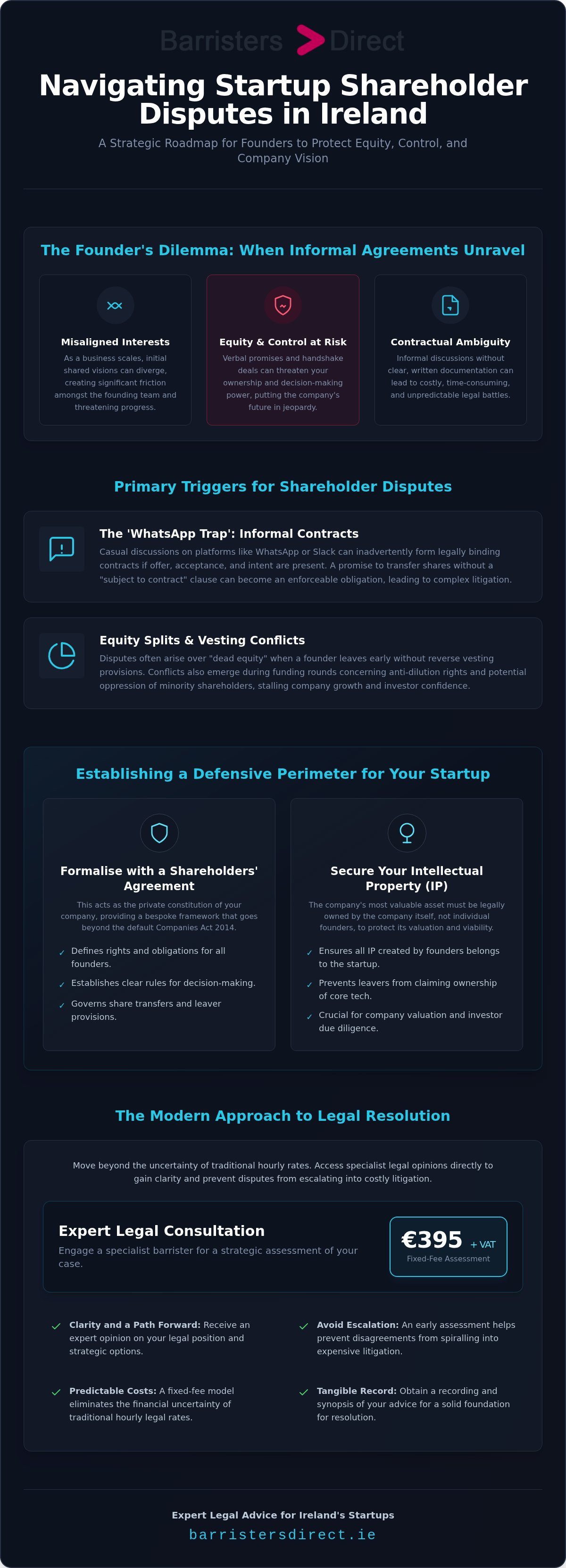
The 'WhatsApp Trap' and Informal Contracts
In the early "honeymoon phase" of a business, founders often communicate via instant messaging platforms like Slack or WhatsApp. It's a common mistake to assume these conversations are merely casual brainstorming. Under Irish law, a series of messages can satisfy the requirements for a binding contract if there's a clear offer, acceptance, and an intention to create legal relations. If a founder promises a share transfer in a WhatsApp message without including a "subject to contract" caveat, they may inadvertently create a legally enforceable obligation.
This "digital boardroom" risk is a frequent catalyst for litigation. Startups often overlook formal documentation in the rush to build, only to find that their informal discussions on share transfers or roles have become binding commitments. Without a clear paper trail, the courts may be forced to interpret these fragmented messages to determine the founders' original intent.
Equity Splits and Vesting Disagreements
Equity is a startup's most valuable currency, yet it's often the source of its most bitter disputes. Conflicts frequently arise when a founder departs the business early, leaving behind "dead equity" that makes the company less attractive to future investors. Without robust reverse vesting provisions, the remaining founders may find themselves working to build value for someone who's no longer contributing.
Disagreements also surface during subsequent funding rounds, particularly regarding anti-dilution rights and the Oppression Remedy in Irish Law. If a minority shareholder feels the majority is acting in a way that's unfairly prejudicial to their interests, the resulting conflict can stall the company's progress. Resolving these commercial disputes requires a precise legal assessment of existing documentation. Specialist advice is essential to re-negotiating equity structures whilst maintaining the momentum necessary to secure the next round of investment.
Protecting Your Startup: Shareholders’ Agreements and IP Assignment
Whilst informal agreements often spark the initial flame of conflict, the Shareholders’ Agreement (SHA) is the definitive tool for resolving a startup shareholder dispute ireland before it consumes the business. This document serves as the private constitution of your company, providing a bespoke framework that goes far beyond the default provisions of the Companies Act 2014. A robust Founders' Shareholder Agreement ensures that every participant understands their rights and obligations from the outset, transforming potential flashpoints into manageable procedural steps. If your startup lacks this foundation, you effectively leave the resolution of future conflicts to the discretion of the courts, a path that is both expensive and unpredictable.
Beyond governance, these agreements protect the commercial viability of the entity. By establishing clear rules for decision-making and share transfers, you insulate the startup's operations from founder-level friction. If you're currently facing a startup shareholder dispute ireland, consulting Shareholder Dispute Advice Ireland: A Strategic Legal Guide can provide the necessary context to understand how these documents function as a shield during periods of instability.
Key Provisions in an Irish Shareholders’ Agreement
To be effective, an SHA must address the specific realities of the Irish business landscape. Key clauses often include:
- Good Leaver and Bad Leaver Clauses: These determine the valuation of shares when a founder departs. A "Bad Leaver," such as someone joining a direct competitor, may be forced to sell their shares at nominal value, whilst a "Good Leaver" might receive fair market value.
- Drag-along and Tag-along Rights: These provisions manage exit scenarios. Drag-along rights allow a majority to force a minority to sell during a company buyout, whereas tag-along rights protect minority shareholders by ensuring they can join a sale on the same terms.
- Pre-emption Rights: These ensure existing shareholders have the first right of refusal on new share issuances, preventing unwanted dilution during early funding rounds.
Implementing these provisions early is a strategic move that prevents a startup shareholder dispute ireland from stalling a potential exit or investment round, ensuring the business remains attractive to venture capital.
Securing Intellectual Property Assets
The most devastating leverage a departing founder can hold is the ownership of core Intellectual Property (IP). If code, designs, or trademarks aren't legally assigned to the company entity, they remain the property of the individual creator. This creates a risk of "IP ransom," where a founder holds technical assets hostage during a conflict. Ensuring every founder and employee signs a comprehensive IP assignment agreement is essential for long-term survival and prevents a startup shareholder dispute ireland from becoming a total loss of the company's underlying technology.
If you're unsure whether your current documentation is sufficient, seeking a specialist opinion can identify vulnerabilities before they're exploited. You can consult with an expert barrister to audit your IP strength and ensure your startup's most valuable assets are legally secure. This proactive approach ensures that founder disagreements don't derail your technical roadmap.
Barristers vs Solicitors: Navigating Your Legal Team
Understanding the structure of the Irish legal profession is essential for any founder facing a startup shareholder dispute ireland. The system is split into two distinct branches: solicitors and barristers. To use a medical analogy, your solicitor acts as a General Practitioner (GP), managing your overall legal health and day-to-day requirements. A barrister, by contrast, is the specialist consultant called in to provide a definitive opinion on a specific, complex problem or to perform advocacy in court. Both roles are vital, but they serve different functions within the lifecycle of a business disagreement.
One of the most significant features of the Irish system is that barristers are independent sole practitioners. Whilst they often operate from dedicated professional chambers, they do not form part of large law firms. This independence ensures that the advice you receive during a startup shareholder dispute ireland is objective and untainted by the internal politics of a multi-disciplinary practice. If you are unsure which professional you need to consult first, it helps to review the fundamental Difference Between Solicitors and Barristers to ensure your strategy is correctly aligned from the start.
The Solicitor’s Role in Startup Management
Solicitors are the primary point of contact for most Irish companies. They handle the essential administrative and transactional tasks that keep a business compliant. This includes managing company incorporation, drafting standard employment contracts, and holding client monies in regulated accounts. Because they maintain long-term relationships with founders, they possess a deep understanding of a startup's history and its commercial goals. They act as the project managers of the legal process, coordinating various workflows and ensuring that all statutory filings are in order.
The Barrister’s Strategic Advantage
When a disagreement escalates into a potential startup shareholder dispute ireland, the barrister’s expertise becomes the decisive factor. Their primary focus is on the law's application to specific, contentious facts. Because barristers spend a significant portion of their professional lives in the High Court, they have a unique perspective on how judges interpret Shareholders' Agreements and IP disputes. They do not just draft documents; they provide a strategic assessment of how those documents will hold up under the pressure of litigation.
A barrister provides a "second pair of eyes" that is both elite and impartial. They can identify the strengths and weaknesses of your position with clinical precision, often suggesting a "path forward" that avoids the courtroom altogether. By instructing a specialist early in a startup shareholder dispute ireland, you gain access to high-level advocacy and strategic intelligence that can protect your equity and the future of your startup.
Strategic Case Assessment: Avoiding Escalation and Litigation
The primary goal during a startup shareholder dispute in Ireland should be the preservation of the company's value and momentum. High Court litigation is a resource-intensive process that can drain a startup's cash reserves and distract the founding team from their commercial objectives. If you find yourself in a position where consensus has broken down, seeking early specialist insight is the most effective way to prevent a disagreement from escalating into a business-ending legal battle. A barrister provides a clinical, objective reality check that allows you to see past the interpersonal friction and focus on the legal and commercial reality of the situation.
By obtaining an expert opinion on Commercial Dispute Resolution early in the process, you gain the strategic clarity required to facilitate a settlement. Barristers are trained to identify the "settlement window," which is the point where both parties recognise that the costs and risks of litigation outweigh the benefits of a court-mandated outcome. This clarity often leads to swifter resolutions, allowing the startup to return to its core operations without the shadow of an unresolved dispute hanging over its valuation or its ability to attract future investment.
Evaluating the Merits of a Shareholder Claim
Before incurring significant legal costs, it's essential to evaluate the merits of your claim with total honesty. A specialist barrister can analyse the Shareholders' Agreement and IP assignment documents discussed earlier to determine exactly where the leverage lies. They can identify specific weaknesses in an opponent's position that may not be obvious to a layperson, such as technical breaches of fiduciary duty or non-compliance with the Companies Act 2014. This neutral assessment provides the board with a reliable foundation for decision-making, ensuring that the company doesn't pursue a "lost cause" based on founder emotion or misaligned expectations.
The Direct Access Advantage for Founders
In a fast-moving startup environment, time is a critical asset. One of the primary Advantages of Instructing a Barrister Directly is the speed with which you can obtain a specialist opinion. Instead of waiting for information to pass through multiple channels, you can engage directly with the expert who will ultimately argue your case if it reaches court. This direct access allows for immediate clarity on complex legal positions, ensuring that you can make informed decisions at the pace your business demands. If you require a definitive strategic roadmap to resolve your current conflict, consulting a specialist barrister can provide the necessary direction to protect your equity and the future of your enterprise.
Instructing a Specialist Barrister Directly for Your Startup
The traditional route to securing elite legal counsel often involves layers of administration that can feel slow and opaque to a fast-moving business. Barristers Direct has modernised this approach, allowing founders to consult directly with specialist barristers from the Law Library. This model is designed for efficiency, providing a direct line to the strategic expertise required to resolve a startup shareholder dispute in Ireland. If you require an authoritative opinion on your legal position, you can now access it without the barriers of the old system, ensuring your focus remains on your company's growth.
The process is built around transparency and predictable costs. For a fixed fee of €395 plus VAT, you receive a dedicated consultation with a specialist barrister. These meetings take place via secure video platforms like Zoom, Teams, or Google Meet, fitting into a founder's busy schedule. To ensure total clarity, every session includes an automatically generated recording and an AI-powered synopsis. This allows you to revisit the specific strategic advice provided, ensuring every member of your board is aligned on the recommended path forward.
How to Secure Your Strategic Consultation
Arranging your meeting is a straightforward procedural task. First, you must identify the primary legal area relevant to your conflict, such as Commercial Dispute Resolution or Employment Law Consultation. Once you've selected the appropriate category, you pay the advertised fixed fee to confirm your appointment. To maximise the value of the barrister's time, it's advisable to prepare your Shareholders’ Agreement and any relevant communications in advance. This preparation allows the specialist to move swiftly into the merits of your case, providing a precise assessment from the first minute of the call.
A Transparent Path to Resolution
One of the primary benefits of this model is the lack of ongoing obligation. After your initial fixed-fee consultation, you're provided with a clear strategic roadmap for your startup’s dispute. You're then free to decide how to proceed based on that expert insight. If the roadmap indicates that formal legal proceedings or the management of client monies are necessary, you can then engage a solicitor to coordinate that transactional work. This ensures you only pay for the specific level of expertise you need at each stage. By starting with a specialist barrister, you gain the high-level advocacy and strategic intelligence required to protect your equity whilst maintaining full control over your legal expenditure.
Securing the Future of Your Enterprise
Resolving a startup shareholder dispute in Ireland requires more than just a surface-level understanding of company law; it demands a strategic approach that prioritises the company's long-term health over founder-level friction. By moving from informal digital communications to robust Shareholders’ Agreements and seeking early specialist assessment, you can navigate these complex disagreements without depleting your startup's cash reserves. The transition from uncertainty to clarity is often just a single consultation away.
You can access high-level legal intelligence through a network of over 100 specialist barristers who provide objective, expert opinions on your specific case. Whether you require a barrister-only consultation for €395 plus VAT or a joint session with a solicitor for €595 plus VAT, you'll receive an AI-generated transcript and synopsis to ensure total board alignment. Secure your fixed-fee specialist legal consultation today to obtain the strategic roadmap your business needs. Protecting your equity and your vision is a manageable process when you have the right expert guidance by your side.
Frequently Asked Questions
Can a startup founder talk to a barrister directly in Ireland?
Yes, members of the public and business owners in Ireland can now instruct a barrister directly without first retaining a solicitor. This change, enabled by the Legal Services Regulation Act, allows you to access specialist expertise at the earliest stage of a disagreement. By going straight to a barrister for a startup shareholder dispute in Ireland, you gain immediate strategic clarity on complex legal positions, which can often prevent a conflict from escalating into formal litigation.
What is the cost of a shareholder dispute consultation?
The cost depends on the complexity of the matter and whether a solicitor is required to attend. A consultation with a specialist barrister alone is priced at a fixed fee of €395 plus VAT. If the matter is contentious and you require a solicitor to be present, the fixed fee is €595 plus VAT. This transparent pricing model ensures you receive elite legal insight without the uncertainty of traditional hourly rates often associated with larger firms.
How does a shareholders' agreement help in a dispute?
A shareholders' agreement acts as the primary governance framework for your company. It provides pre-defined mechanisms to resolve conflicts regarding equity, board control, and founder exits. By including specific clauses such as "Good Leaver" or "Bad Leaver" provisions, the agreement ensures that disputes are handled according to a clear set of rules rather than through unpredictable court proceedings. Having this document in place significantly reduces the commercial risk during a startup shareholder dispute in Ireland.
Is an online legal consultation as effective as an in-person meeting?
Modern online consultations via platforms like Zoom, Microsoft Teams, or Google Meet are highly efficient and just as effective as traditional meetings. They allow founders to access specialist advice from any location without travel time. A unique advantage of the Barristers Direct service is the inclusion of an automatically generated recording and an AI-powered synopsis of the meeting. This ensures you have a permanent, accurate record of the strategic advice provided for future reference and internal board alignment.
What happens if my startup needs to go to court after the consultation?
If a dispute cannot be resolved through advice and requires formal litigation, you must then engage a solicitor. Barristers Direct can facilitate a seamless transition by referring you to a qualified solicitor who will coordinate the legal proceedings and manage client funds. Whilst the initial consultation provides the strategic roadmap, formal representation in the High Court or Circuit Court requires the traditional two-professional model to ensure all procedural and administrative requirements are met.
Are WhatsApp messages legally binding in a startup shareholder dispute in Ireland?
Yes, informal communications such as WhatsApp or Slack messages can be considered legally binding if they meet the requirements of a contract. In Ireland, if a message contains a clear offer, acceptance, and an intention to create legal relations, the courts may enforce those terms. Founders should be extremely cautious when discussing share transfers or equity splits on messaging apps, as these discussions often become central evidence in a startup shareholder dispute in Ireland.
What is the difference between a barrister and a solicitor for a startup?
The relationship is similar to that of a GP and a medical specialist. Solicitors manage day-to-day legal administration, such as company incorporation and drafting standard contracts. Barristers are independent sole practitioners who specialise in courtroom advocacy and providing expert opinions on complex legal problems. For a startup, the solicitor handles the ongoing commercial legalities, whilst the barrister is instructed when a specialist view or strategic intervention is needed to resolve a specific, contentious dispute.
Where are disputes regarding the Barristers Direct service settled?
Any dispute arising from the use of the Barristers Direct service is settled by arbitration in Dublin, Ireland. The proceedings are conducted in English. If the parties cannot agree on an arbitrator, one is appointed by the Chairperson of the Chartered Institute of Arbitrators Ireland Branch. This appointment must occur within 30 days after a request for arbitration is made. For any further questions or comments, you can reach the team directly at [email protected].
Disclaimer
This article does not constitute legal advice. Barristers Direct does not provide legal advice. To obtain legal advice, you should contact a legal practitioner.


