

What if the greatest threat to your company isn't the competition, but the person sitting across the boardroom table? If a professional relationship fractures, the resulting deadlock can bring a thriving business to a standstill, risking both your commercial interests and personal reputation. You likely feel that every day spent in conflict is a day of lost growth, yet the uncertainty of your legal standing makes it difficult to take decisive action. Seeking specialist shareholder dispute advice ireland is the first step toward regaining control, ensuring that your next move is based on strategic intelligence rather than emotional reaction.
This guide provides a clear strategic path forward, showing you how to resolve conflicts whilst preserving the underlying value of your business. You'll discover the most effective legal pathways, including the nuances of Section 212 of the Companies Act 2014 and the benefits of early expert assessment. We'll explore how direct access to specialist barristers offers a modern way to understand the true strength of your position. By the end of this article, you'll have a roadmap for navigating disputes with confidence, moving from uncertainty to a neutral, expert-led resolution that protects your company's future.
Key Takeaways
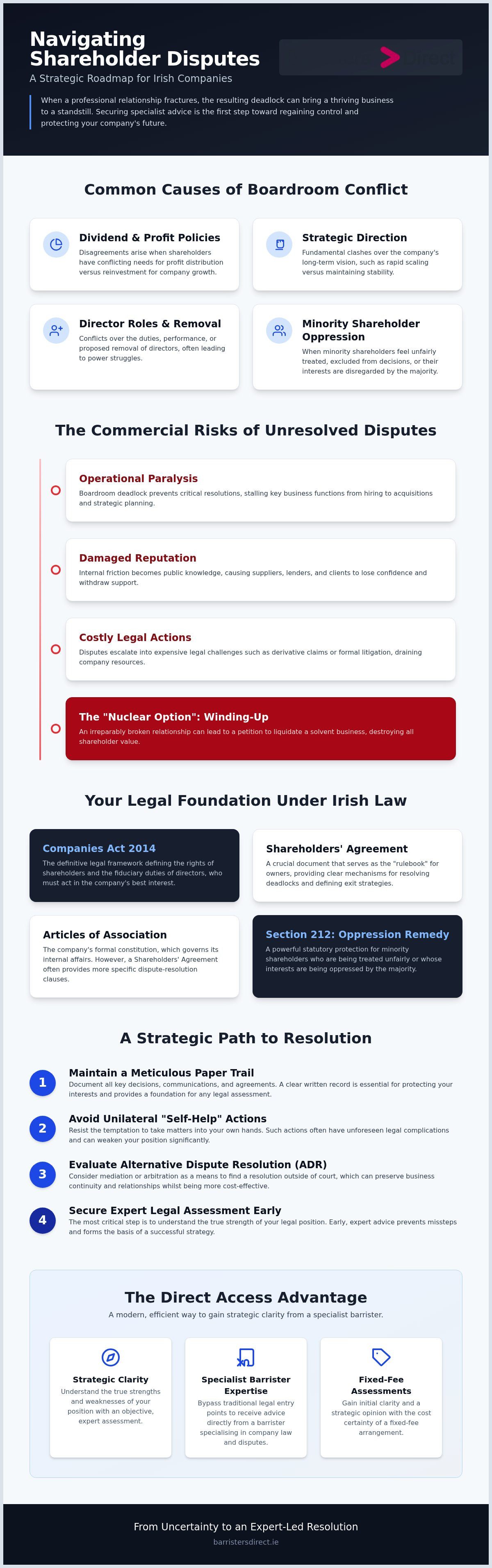
- Identify common conflict triggers such as dividend disagreements and director removals whilst understanding your statutory rights under the Companies Act 2014.
- Learn why maintaining a meticulous paper trail is essential for protecting your interests and why unilateral "self-help" actions often result in legal complications.
- Evaluate the benefits of Alternative Dispute Resolution (ADR) to preserve business continuity and secure expert shareholder dispute advice ireland early in the process.
- Explore the direct access model that enables you to receive strategic clarity from specialist barristers for a fixed fee, bypassing traditional legal entry points for initial assessments.
- Establish a clear roadmap to resolve boardroom deadlocks, ensuring your commercial reputation and business value remain intact throughout the resolution process.
Understanding the Landscape of Shareholder Disputes in Ireland
A shareholder dispute is a fundamental conflict between company owners regarding the direction, management, or core policies of the business. In the context of Irish commercial law, these disagreements often move beyond simple differences of opinion, evolving into formal legal challenges that threaten the stability of the enterprise. If the relationship between shareholders fractures, the company's ability to function effectively is often the first casualty. Securing expert shareholder dispute advice ireland early is essential to prevent a temporary disagreement from becoming a terminal business failure.
The primary legal anchors for any resolution are the company's Articles of Association and the Shareholders' Agreement. These documents serve as the rulebook for the organisation. If these agreements are well-drafted, they provide clear mechanisms for resolving deadlocks or facilitating a clean exit. Without them, shareholders must rely on the broader provisions of the Companies Act 2014, which can lead to more complex and protracted litigation. Clear documentation ensures that rights and responsibilities are defined before conflict arises, providing a baseline for any legal assessment.
Common Causes of Conflict in Irish SMEs
Most disputes in Irish small and medium enterprises (SMEs) stem from a few predictable triggers. Disagreements over the long-term vision or strategic direction are common, especially when one party wishes to scale rapidly whilst another prefers stability. Conflicts also frequently arise regarding dividend policies. If one shareholder relies on profit distribution for personal income whilst another insists on reinvesting for growth, the resulting friction can be intense. Imbalances of power between majority and minority shareholders create additional risks. If a minority shareholder feels they are being unfairly treated or excluded from decision-making, they may seek an oppression remedy under Section 212 of the Companies Act 2014. This statutory protection ensures that the majority cannot disregard the interests of the minority without legal consequence. For early-stage companies, a startup shareholder dispute in Ireland can be particularly damaging, as founding teams often rely on informal agreements that lack the legal clarity needed to resolve conflicts effectively.
The Commercial Risks of Unresolved Disputes
The impact of a deadlock on company stability is immediate and severe. Operational paralysis occurs when the board is unable to pass critical resolutions, stalling everything from new hires to major acquisitions. This internal friction quickly bleeds into the company's commercial reputation. If suppliers, lenders, or clients perceive instability at the top, they may withdraw support or seek more stable partners. Unresolved conflicts often escalate into costly legal actions such as derivative claims, where shareholders sue on behalf of the company. If the relationship becomes irreparably broken, a party may even file a winding-up petition. This is the ultimate "nuclear option," potentially leading to the liquidation of a solvent business simply because the owners can no longer work together. Expert shareholder dispute advice ireland helps identify these risks before they result in permanent damage.
Legal Rights and Statutory Protections under Irish Company Law
The Irish Companies Act 2014 serves as the definitive legal framework for all corporate entities in Ireland. It codifies the rights of shareholders and the obligations of directors, providing the baseline for any claim. Under this Act, shareholders possess statutory rights to inspect financial statements and review meeting minutes. These are not optional courtesies; they're enforceable entitlements that ensure transparency. If these rights are obstructed, it often indicates deeper governance issues that require immediate attention.
Directors often believe they serve the shareholders who appointed them. Legally, this is a misconception. Directors owe fiduciary duties to the company as a separate legal entity. Their decisions must prioritise the company's best interests, not the personal agendas of a majority bloc. Whilst verbal agreements can technically be binding in Ireland, they're notoriously difficult to prove in court. A written Shareholders' Agreement carries significantly more legal weight. It acts as a clear record of intent, whereas verbal promises often dissolve into "he-said, she-said" scenarios during litigation. If you find yourself relying on informal promises, it's time to seek shareholder dispute advice ireland to formalise your position.
Minority Oppression and Section 212
Section 212 is the primary shield against "unfair prejudice" to minority interests. It allows the court to intervene if the company's affairs are conducted in a manner oppressive to a member. The Irish High Court defines "oppressive conduct" as behaviour that is burdensome, harsh, or wrongful. Common examples include excluding a shareholder-director from management without cause or withholding dividends to force a cheap buyout. If oppression is proven, the court has broad powers to rectify the situation. The most frequent remedy is an order for the majority to buy out the minority's shares at a fair value, often determined by an independent valuer.
Derivative Actions and Personal Claims
Distinguishing between a personal claim and a derivative action is a critical strategic step. A personal claim addresses a loss you've suffered directly as an individual. A derivative action is brought on behalf of the company for a wrong done to the entity itself. The historic "Rule in Foss v Harbottle" generally dictates that the company is the proper plaintiff for wrongs done to it. However, modern statutory exceptions allow shareholders to act if the wrongdoers are in control and preventing the company from suing. Deciding which path to take requires precision to avoid your case being struck out. Securing a barrister opinion on my case is the most efficient way to determine the correct claim type before initiating proceedings.
Evaluating Resolution Strategies: From Negotiation to Litigation
Litigation should always be viewed as a final resort. The public nature of a High Court hearing can inflict lasting damage on a company's commercial reputation, often proving as destructive as the dispute itself. Beyond the financial cost, the time investment required for a full trial distracts management from core growth objectives. When seeking shareholder dispute advice ireland, the focus should initially be on Alternative Dispute Resolution (ADR). These methods prioritise business continuity and privacy, allowing for a resolution that doesn't alert competitors or nervous lenders to internal instability.
The choice of strategy often depends on the underlying governance philosophy of the board. Some directors remain anchored in traditional views, whilst others are rethinking shareholder primacy in favour of broader stakeholder interests. Expert counsel plays a vital role here. A specialist barrister provides a neutral assessment of the dispute's strength, helping you decide whether to negotiate from a position of power or prepare for formal proceedings. This early clarity ensures you don't waste resources on a strategy that lacks a solid legal foundation.
Mediation vs. Arbitration in Shareholder Conflicts
Mediation is a non-binding, confidential process. A neutral third party facilitates discussions to find a creative settlement that a court simply cannot award, such as a structured buyout or a specific change in management roles. If mediation fails, arbitration offers a private but binding alternative. It's often preferred for technical disputes involving complex share valuations. For any arbitration based in Dublin, Ireland, parties must adhere to a 30-day appointment timeline for securing an arbitrator. This ensures the process moves swiftly to avoid the prolonged uncertainty that can paralyse a company's operations.
The Litigation Path: When Court Action is Unavoidable
If negotiations reach an impasse, filing a petition in the High Court for shareholder relief becomes necessary. This is a formal step that requires precise legal drafting to succeed. In urgent cases, your barrister may seek an interlocutory injunction. This temporary court order preserves company assets or maintains the status quo until the full trial concludes. During these proceedings, the role of a barrister is indispensable. They provide specialist advocacy and manage complex rules of evidence. Securing high-quality shareholder dispute advice ireland ensures that your case is presented with maximum clarity, particularly when cross-examining witnesses to expose inconsistencies in the opposing side's position.
Strategic Preparation: Steps to Take Before Seeking Formal Advice
Before you seek formal shareholder dispute advice ireland, your initial actions can significantly dictate the strength of your legal position. The period immediately following a breakdown in relations is often the most volatile. If you react emotionally, you risk undermining your credibility during future proceedings. Maintaining a calm, professional approach whilst the dispute is ongoing is not just a matter of etiquette; it's a strategic necessity to avoid "bad faith" claims from the opposing party. Every communication you send should be written with the assumption that a judge may eventually read it.
Self-help remedies are particularly dangerous at this stage. You might feel justified in unilaterally removing a director or restricting their access to company systems, but such actions often trigger immediate legal liability. If you bypass the procedures set out in the commercial dispute resolution framework or your company's own constitution, you may inadvertently hand the other side a claim for oppression. Instead, your first step should be a thorough review of the current Shareholders' Agreement. Identifying existing dispute resolution clauses will clarify whether you are contractually obligated to attempt mediation before escalating to the High Court.
Documenting the Conflict
A precise paper trail is your most valuable asset. If a disagreement moves toward litigation, the court will rely on contemporaneous evidence rather than retrospective accounts. You should collate all relevant materials, including:
- Emails and WhatsApp messages that demonstrate the core points of contention.
- Financial records or audit trails that highlight mismanagement or unauthorised spending.
- Board meeting minutes that accurately reflect your dissent and the specific reasons provided at the time.
Preparing a concise "chronology of events" is also highly beneficial. If you can present your legal counsel with a clear timeline of the dispute, they can understand the complexities of the case much faster, allowing for a more efficient assessment of your position.
Assessing Business Value and Share Price
If a buyout is a likely resolution, you must consider the potential need for an independent valuation. Shareholder conflicts often impact the "fair market value" of company shares, particularly if the dispute has caused operational stagnation. Understanding the true value of your holding prevents you from accepting a low-ball offer during negotiations. If you are unsure of the true legal strength of your position, you can book a consultation with a specialist barrister to receive a neutral, expert assessment of your strategic options before you commit to a specific path forward.
Specialist Counsel: The Direct Access Path to Resolution
Traditional legal engagement in Ireland typically follows a linear path. While solicitors are vital for managing the procedural and administrative elements of a claim, the Direct Access model provides a more efficient entry point for early-stage strategic advice. By instructing a barrister directly, you gain immediate access to a specialist who can provide an objective assessment of your legal position. This approach is particularly effective when you need a neutral, high-level opinion on the merits of a shareholder claim before committing to a specific course of action. You receive the same calibre of intelligence used in the High Court, but at the point where it can most effectively influence your strategy.
Transparency is a core component of this modern service. A consultation with a specialist barrister through Barristers Direct is available for a fixed fee of €395 + VAT. If you prefer to have a solicitor attend the session to provide additional support, the fee is €595 + VAT. This structure eliminates the uncertainty of hourly rates, allowing your company to secure elite shareholder dispute advice ireland without the risk of escalating costs. It moves the focus from billing cycles to results, providing the clarity needed to resolve complex boardroom deadlocks.
The Advantages of Direct Consultation
Speed is a critical factor in resolving shareholder conflicts. Direct consultations allow you to receive high-level expertise faster than traditional routes, bypassing the initial layers of bureaucracy. Because these sessions are conducted via Zoom, Teams, or Google Meet, they fit seamlessly into a busy director's schedule. You aren't just paying for a meeting; you're securing the strategic intelligence of a sole practitioner from the Law Library of Ireland. There are clear advantages of instructing a barrister directly, primarily the ability to strip away complex layers and focus on the legal core of the disagreement. This efficiency ensures that your company's commercial interests remain the priority.
Next Steps: From Advice to Action
Every consultation includes a professional record of the discussion. After the meeting, you receive an AI-generated transcript and a summary of the advice provided by the barrister. This ensures you have a clear reference point for your records or to share with other board members. If the barrister's assessment indicates that formal litigation or High Court proceedings are necessary, you'll then need to engage a solicitor for representation. Barristers Direct can facilitate this transition, ensuring you have the right team for the next phase. To organise your expert consultation and regain control of your company's direction, contact the team at [email protected] today.
Securing Your Company's Commercial Future
Resolving a boardroom deadlock requires a swift transition from reactive emotion to strategic intelligence. By understanding your statutory rights and maintaining a meticulous record of events, you protect your business from the operational paralysis that often follows a relationship breakdown. The most effective way to manage these conflicts is to secure an objective, high-level assessment before the situation escalates into public litigation. This proactive approach ensures your next move is based on the true legal strength of your position rather than uncertainty.
If you require specialist shareholder dispute advice ireland, Barristers Direct provides a modern, efficient path to resolution. You can access a network of over 100 specialist Irish barristers through online consultations delivered for maximum efficiency. With fixed-fee consultations starting from €395 + VAT, you gain early strategic clarity whilst avoiding the risk of escalating costs. This expert-led model allows you to address disputes directly, preserving both your commercial interests and your professional reputation. Take the first step toward a clear resolution and book a fixed-fee consultation with a specialist barrister today. Regaining control of your business is possible with the right expert guidance.
Frequently Asked Questions
Can I remove a shareholder who is also a director?
You can remove a director using an ordinary resolution under the Companies Act 2014, provided you follow the specific notice requirements. However, removing them as a director doesn't automatically strip them of their shareholding. If a Shareholders' Agreement is in place, it may contain "bad leaver" provisions that compel them to sell their shares upon removal. Navigating this process without expert guidance is risky, as it can trigger a claim for minority oppression.
What is the "unfair prejudice" rule in Irish company law?
This rule protects minority shareholders from conduct that is oppressive or conducted in disregard of their interests. Under Section 212 of the Companies Act 2014, the High Court can intervene if the majority behaves in a way that is burdensome or wrongful. Common examples include the unauthorised use of company funds or the exclusion of a shareholder from management roles. If proven, the court frequently orders the majority to buy out the minority's shares at fair value.
How much does it cost to get a barrister's opinion on a shareholder dispute?
A consultation with a specialist barrister through Barristers Direct costs €395 plus VAT for the barrister only. If the matter is contentious and a solicitor also attends, the fee is €595 plus VAT. This fixed-fee structure ensures you receive high-quality shareholder dispute advice ireland without the risk of escalating hourly rates. After the session, you receive an automatically generated recording and a summary of the advice to help you decide your next strategic move.
Do I need a solicitor to talk to a barrister in Ireland?
No, you don't need a solicitor for an initial consultation. The Legal Services Regulation Act allows businesses and individuals to engage a barrister directly for expert advice on their legal position. This modern model simplifies the process of understanding your rights before deciding whether to proceed with litigation. While a solicitor is required for formal court representation, instructing a barrister directly for an initial assessment provides early clarity and helps you manage your commercial interests more effectively.
How long does a shareholder dispute typically take to resolve?
Resolution timelines depend on the chosen method. Mediation can settle a dispute in one day, whilst High Court litigation may take 18 to 24 months. If your dispute moves to arbitration in Dublin, the process is structured to ensure an arbitrator is appointed within 30 days of a request. This prevents the prolonged uncertainty that can paralyse a business. Securing expert advice early allows you to identify the most efficient path to a settlement and avoid unnecessary delays.
Is mediation mandatory for shareholder disputes in Ireland?
Mediation isn't mandatory, but it's strongly encouraged by the Irish legal system. Under the Mediation Act 2017, legal professionals must advise clients to consider mediation before initiating court proceedings. If a party refuses to engage in mediation without a valid reason, the High Court may impose costs sanctions against them at the end of the trial. Most shareholders choose mediation because it's confidential, cost-effective, and allows for creative settlements that a judge cannot legally order.
What happens if there is a 50/50 deadlock in a company?
A 50/50 deadlock occurs when equal owners cannot reach a decision, often leading to operational paralysis. If your Shareholders' Agreement doesn't contain a deadlock-breaking clause, such as a "buy-sell" provision, the conflict can be terminal for the company. In extreme cases, a party may petition the court to wind up the business on just and equitable grounds. Seeking expert advice early helps you explore commercial exits, such as a managed buyout, that preserve the company's underlying value. Founders facing this scenario may also benefit from reviewing the dedicated guidance on resolving a startup shareholder dispute in Ireland, which addresses the unique governance challenges that arise in early-stage companies.
Can a minority shareholder stop a company from being sold?
A minority shareholder's power to block a sale usually depends on the company's constitution and any existing Shareholders' Agreement. If "drag-along" rights are included, the majority can force the minority to sell their shares on the same terms. Without these rights, a minority shareholder might attempt to block a deal, but the majority could still utilise statutory "squeeze-out" provisions if they reach a 90% threshold. Expert counsel can help you determine the specific rights applicable to your situation.
Disclaimer
This article does not constitute legal advice. Barristers Direct does not provide legal advice. To obtain legal advice, you should contact a legal practitioner.


