

A single administrative oversight in a Notice of Termination can now render months of planning entirely void under the 2026 rental regulations. When seeking eviction notice advice ireland property owners and tenants must now account for the most stringent regulations in a decade. You likely understand that the stakes have never been higher for both landlords and tenants. With the introduction of the Housing and Residential Tenancies (Miscellaneous Provisions) Act 2026, the margin for error has narrowed significantly. Whether you're facing a potential loss of rental income or the fear of losing your home, the anxiety surrounding a public RTB adjudication is a heavy burden to carry.
This guide provides a clear roadmap to help you determine the validity of a Notice of Termination and navigate the updated dispute process. If a notice fails to meet the strict 2026 "minimum duration" rules or the new seven-day RTB notification requirement, it may be legally unenforceable. We will outline your rights under the new public adjudication framework and explain how to secure specialist counsel from a barrister to protect your interests. You'll gain a transparent understanding of the strategic steps required to resolve your dispute with precision and confidence.
Key Takeaways
- Understand the mandatory legal criteria a Notice of Termination must meet to be considered valid under the updated 2026 Irish rental regulations.
- Learn how to navigate complex legislative shifts with expert eviction notice advice ireland to avoid the common procedural errors that often invalidate notices.
- Prepare for the Residential Tenancies Board (RTB) dispute process, including the transition to public adjudication hearings and shortened appeal windows.
- Discover the benefits of the Direct Access model, which allows you to consult a specialist barrister for expert guidance without the initial requirement of a solicitor.
- Move beyond generic information to develop a precise strategic roadmap tailored to the specific details of your landlord or tenant dispute.
Understanding the Notice of Termination in Ireland
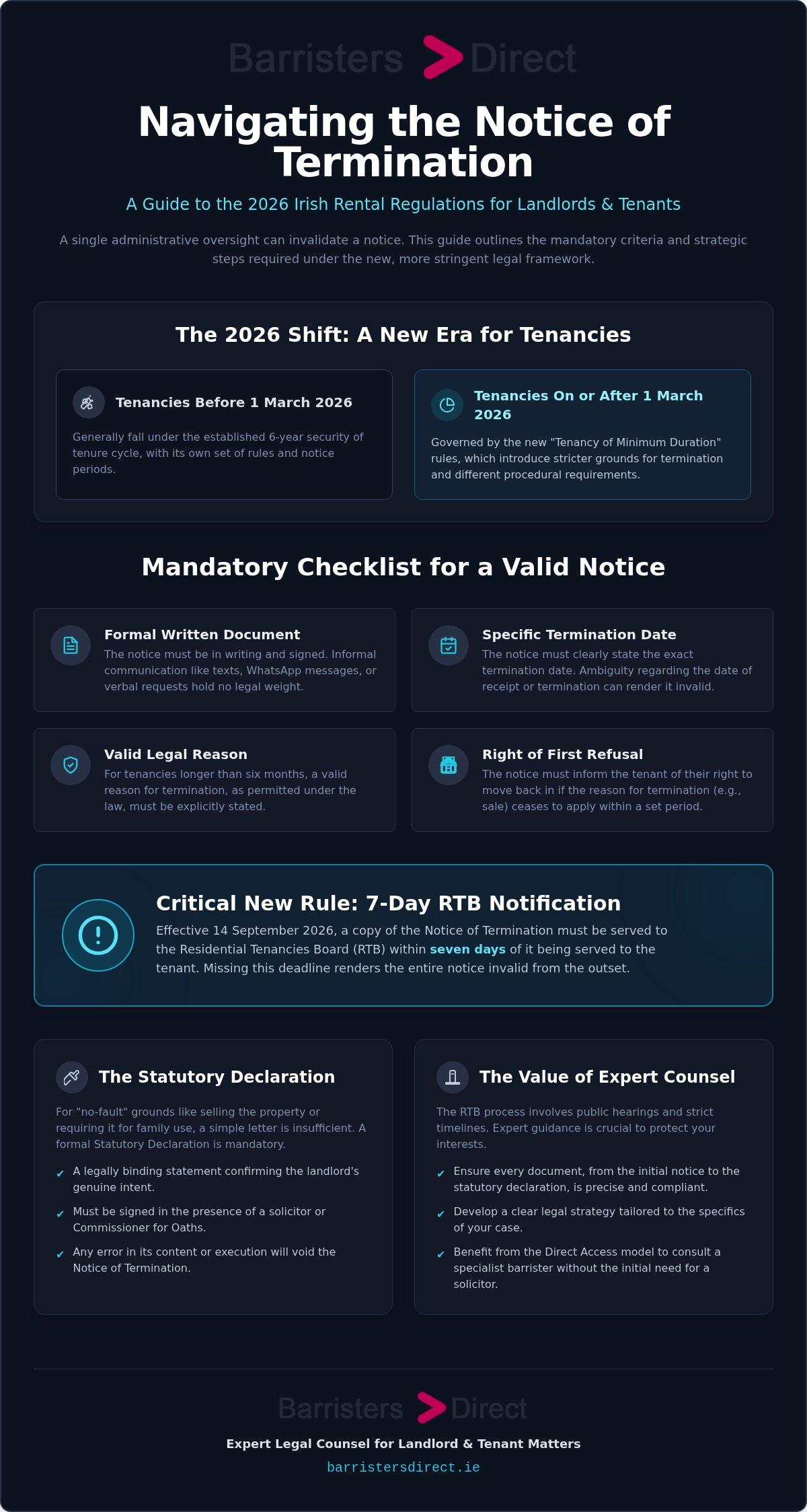
In the Irish legal system, the term "eviction notice" is a colloquialism for the formal Notice of Termination. If you are seeking eviction notice advice ireland, you must understand that this document is the only valid instrument for ending a tenancy. Informal texts, WhatsApp messages, or verbal requests carry no legal weight. The landscape shifted significantly on 1 March 2026, introducing a more regulated environment for both parties. Identifying whether your agreement falls under the older 6-year cycle or the new "minimum duration" rules is the essential first step in any legal assessment.
The complexities of Landlord-Tenant Law mean that even a minor administrative error can invalidate a notice. This often results in landlords losing months of rental income or tenants facing unnecessary uncertainty. Specialist Landlord & Tenant Legal Advice from a barrister helps clarify these obligations before a dispute reaches the adjudication stage. Precision in the initial documentation is non-negotiable.
The 2026 Rental Law Landscape
The Housing and Residential Tenancies (Miscellaneous Provisions) Act 2026 has fundamentally altered security of tenure. For tenancies created on or after 1 March 2026, the new "Tenancy of Minimum Duration" rules apply. This framework restricts the grounds upon which a landlord can terminate a tenancy compared to previous years. Whilst the 6-year cycle still exists for older agreements, newer tenancies are subject to stricter oversight. Larger institutional landlords and smaller private landlords now face different procedural hurdles under these rules, making it vital to know exactly which category governs your property.
Why a "Notice to Quit" is Often Not Enough
Whilst older legal texts might refer to a "notice to quit," modern Irish law requires a highly specific statutory Notice of Termination. A landlord can't simply "ask" a tenant to leave. To be legally binding, the notice must be in writing, signed, and state a valid reason if the tenancy has lasted longer than six months. Since 14 September 2026, landlords must also ensure a copy of the notice is served to the Residential Tenancies Board (RTB) within seven days of serving the tenant. If this timeline is missed, the notice is technically flawed. Furthermore, the 2026 updates prioritise hand-delivery or email service over traditional post to ensure there's no ambiguity regarding the date of receipt. If the paperwork doesn't align with these exact requirements, the RTB is likely to rule the termination invalid.
Mandatory Criteria for a Valid Eviction Notice
A Notice of Termination is a technical document where the smallest administrative slip can lead to a total collapse of your legal position. To be considered valid, the notice must be in writing and signed by the landlord or an authorised agent. It's not enough to simply state you want the property back; the notice must specify the exact date of termination and the specific reason for ending the tenancy. If you've been in the property for more than six months, the landlord's reason must align with the limited grounds permitted under Irish law.
When seeking eviction notice advice ireland, many parties overlook the "right of first refusal" requirement. The notice must explicitly inform the tenant that if the reason for termination ceases to apply within a set period, they have the right to move back in. Omitting this clause is a frequent cause for notices being overturned at adjudication. Securing expert legal guidance from a barrister ensures your documentation includes every mandatory statutory protection, preventing costly delays.
The Role of the Statutory Declaration
If a landlord intends to sell the property or requires it for use by a family member, a standard letter is insufficient. These grounds must be accompanied by a Statutory Declaration. This is a formal statement signed in the presence of a solicitor or a Commissioner for Oaths, confirming the landlord's bona fide intent. It carries significant legal weight. If this declaration is missing or contains errors in its execution, the entire Notice of Termination is rendered void. This requirement is a safeguard designed to prevent "no-fault" evictions under false pretences, and the RTB scrutinises these documents with extreme precision.
Calculating Notice Periods Correctly
Timing is the most common point of failure in tenancy disputes. For tenancies created from 1 March 2026, the notice periods have been significantly extended to provide greater security for tenants. The required duration depends entirely on the length of the tenancy:
- Less than 6 months: 90 days.
- 6 months to 1 year: 152 days.
- 1 to 7 years: 180 days.
- 7 to 8 years: 196 days.
- Over 8 years: 224 days.
You must calculate these dates with absolute accuracy. If the termination date provided in the notice is short by even 24 hours, the notice is invalid. Landlords cannot "correct" a date once the notice is served; they must start the entire process again from day one. This makes the interpretation of the 2026 "minimum duration" rules a critical task for any legal professional assessing your case.
Navigating the RTB Dispute and Adjudication Process
If you believe a Notice of Termination is invalid, the Residential Tenancies Board (RTB) is the statutory body responsible for resolving the matter. Professional eviction notice advice ireland often centres on the strategic decision of when and how to lodge a dispute. Since 14 September 2026, the procedural landscape has become significantly more transparent. All RTB adjudication hearings are now held in public, and the resulting reports are published online. This shift means that the quality of your evidence and the clarity of your legal arguments are subject to public record, making precision more vital than ever.
Once a dispute is lodged, the RTB will issue a Determination Order. This document is legally binding on both parties. You must be prepared for a swift process; the notice period for a tribunal hearing has been reduced to 10 working days. If you're appealing a mediation case to a tribunal, you also have a strict 10-working-day window to act. Failing to meet these shortened deadlines can result in the loss of your right to challenge or defend a notice.
Mediation vs. Adjudication
Mediation is a collaborative process where an independent mediator helps both parties reach a mutual agreement. It's often a pragmatic choice if both sides are willing to compromise on dates or arrears. Adjudication, however, is a formal hearing. An independent adjudicator listens to the evidence and makes a ruling based on the law. Whilst mediation is confidential, adjudication is now public. If your case involves complex interpretations of the 2026 "minimum duration" rules, a specialist barrister can provide the interpretative expertise needed to prepare a robust case for the adjudicator.
The Risks of Overholding
Overholding occurs when a tenant remains in a property after the date specified in a valid Notice of Termination has passed. Whilst some may suggest "staying put" until an RTB hearing concludes, this carries significant legal and financial risks. If the RTB eventually finds that the notice was valid, the tenant may be directed to pay damages for the period of overholding. These costs can be substantial, and a Determination Order against a tenant for overholding can severely impact their ability to secure future rental properties. A barrister's advice helps you balance your right to challenge a notice with your obligation to avoid these costly legal pitfalls.
The Strategic Value of Specialist Legal Counsel
General information guides serve a specific purpose by outlining the basic rules of tenancy, but they cannot provide a strategic path forward tailored to the nuances of your unique dispute. When you require eviction notice advice ireland, the value lies in the interpretation of the law rather than a simple recitation of the statutes. A specialist barrister doesn't just look at what the law says; they analyse how it applies to the specific facts of your case, identifying the strategic levers that can lead to a favourable resolution. This expert interpretation is particularly critical following the 2026 legislative shifts, where procedural windows have tightened significantly.
An expert legal opinion can often uncover subtle flaws in a Notice of Termination that a layperson or even an experienced landlord might overlook. For example, a failure to notify the RTB within the new seven-day window or a minor error in a Statutory Declaration can be the difference between a successful termination and a costly adjudication loss. Early intervention by a barrister often prevents a dispute from escalating. By providing a clear, authoritative assessment of a notice's validity at the outset, parties can often reach a settlement without the need for a full, public tribunal hearing.
Barrister vs. Solicitor: The Specialist Advantage
In the Irish legal system, the relationship between a solicitor and a barrister is often compared to the medical model of a GP and a consultant. A solicitor provides essential, broad-ranging legal services and manages the overall process of a case. A barrister, however, is a specialist consultant who focuses deeply on advocacy and the interpretation of complex legislation. As sole practitioners based amongst their peers in the Law Library of Ireland, barristers provide an independent, high-level perspective on residential and business problems. If your case involves the complexities of the Legal Services Regulation Act or the latest 2026 rental reforms, having a specialist's eye on your documentation is an invaluable safeguard.
Clarity and Transparency in Legal Fees
The traditional "billable hour" model has long been a source of anxiety for those seeking legal help. Modern legal services have moved towards a more transparent approach. By opting for a fixed-fee model, such as the €395 plus VAT consultation offered through our network, you gain certainty from the start. This transparency allows you to focus on the quality of the advice rather than worrying about an escalating clock. There are significant advantages of instructing a barrister directly, as it streamlines the process and provides a clear strategy early in the dispute. If you're facing a complex tenancy issue, you can consult a specialist barrister today to secure an authoritative roadmap for your case.
Direct Access to Expert Counsel via Barristers Direct
Barristers Direct facilitates a modern approach to the Irish legal system by enabling members of the public to consult a specialist barrister directly. Traditionally, accessing a barrister required an initial referral through a solicitor, which could involve significant wait times and additional administrative layers. By utilising the Direct Access model permitted under the Legal Services Regulation Act, we provide a more efficient route to high-level legal expertise. If you are seeking eviction notice advice ireland, this model ensures you receive a specialist's interpretation of your case without delay. Our network includes over 100 barristers, providing you with a depth of experience that was previously difficult to access so swiftly. This service is nationwide, ensuring that expert counsel is accessible regardless of where you are located in Ireland.
The direct access model is built on the principles of being smarter, faster, and more transparent. It strips away the intimidating layers often associated with legal communications, favouring a solution-oriented approach that makes complex systems feel manageable. This expert eviction notice advice ireland allows you to make informed decisions about whether to concede a point or proceed to a full adjudication hearing. By consulting a specialist at the earliest opportunity, you gain a strategic advantage that can prevent a dispute from spiralling into a protracted and public RTB battle. The focus remains squarely on the quality of the advice, ensuring you have a clear understanding of your rights and obligations under the 2026 regulations without the traditional delays of multi-layered referrals.
How the Consultation Process Works
The process is designed for maximum clarity and convenience. You can book your meeting through our simple online platform, selecting a time that fits your schedule. Consultations are conducted virtually via Zoom, Teams, or Google Meet, removing the need for unnecessary travel and allowing for a more flexible interaction. We operate on a transparent fixed-fee structure of €395 plus VAT for a consultation with a barrister. This upfront pricing ensures there are no hidden costs or escalating hourly bills. To ensure you have a permanent record of the strategic advice provided, an AI-generated transcript and a summary are automatically produced. This documentation is strictly confidential, shared only with you and the barrister, allowing you to review the specialist's recommendations at your own pace whenever you need to reference a specific legal point.
Next Steps After Your Consultation
Once the meeting concludes, you'll have a defined strategic path for your dispute. There is no obligation to continue the engagement or commit to further costs beyond the initial fee. If the barrister's assessment suggests that your Notice of Termination is invalid, you can use that expert opinion to inform your next move with the RTB or in negotiations with the other party. Should your case require formal litigation or court representation, which falls outside the direct access scope, we can facilitate a referral to a solicitor to manage those specific proceedings. This collaborative approach ensures that you always have the right level of expertise for every stage of your legal journey. To protect your interests and gain immediate clarity on your legal standing, you should book a Landlord & Tenant consultation to ensure your strategy is sound from the outset.
Securing a Strategic Path for Your Tenancy Dispute
The 2026 rental reforms have introduced a level of procedural complexity that leaves no room for error. Whether you're a landlord ensuring statutory compliance or a tenant challenging an invalid termination, the validity of a notice often hinges on technical details that are easily overlooked. By securing specialist eviction notice advice ireland, you move beyond generic templates and gain a precise strategic roadmap for the RTB adjudication process.
Our nationwide network of over 100 specialist barristers provides the expert interpretation needed to protect your interests. Every consultation is conducted via a secure virtual meeting and includes an AI-generated transcript and summary for your records. With a transparent fixed-fee model, you'll receive high-level legal counsel without the uncertainty of hidden costs. It's about ensuring your position is robust before you enter a public hearing or mediation session.
Book an Expert Landlord & Tenant Consultation for €395 + VAT today to ensure your case is handled with the precision it deserves. Taking proactive, expert-led steps now is the most effective way to resolve your dispute with confidence.
Frequently Asked Questions
Is my eviction notice valid if it was sent via email?
Yes, a Notice of Termination can be validly served via email following the legislative updates on 14 September 2026. The new regulations prioritise email or hand-delivery over traditional post to ensure there is no ambiguity regarding the date of receipt. You should confirm that the email address used is the one specified in your tenancy agreement. If the landlord fails to serve a copy to the RTB within seven days of emailing you, the notice may be invalidated.
Can I talk to a barrister directly in Ireland without a solicitor?
Yes, you can consult a barrister directly in Ireland without first retaining a solicitor under the Legal Services Regulation Act. Barristers Direct provides a platform where members of the public and businesses can book a consultation with a specialist for early-stage advice. This direct access model allows for a faster, more transparent assessment of your case. If your matter eventually requires formal court proceedings or litigation, a solicitor must then be engaged to manage the process.
What happens if I stay in my home after the eviction notice expires?
Remaining in a property after a valid notice expires is known as overholding and carries significant legal risks. If the RTB determines the notice was valid, you may be ordered to pay damages to the landlord for the period of unauthorised occupation. This can also lead to a Determination Order against you, which is a public record and may complicate your ability to secure future tenancies. It's essential to seek professional eviction notice advice ireland before the expiry date passes.
How much does a legal consultation with a barrister cost?
A consultation with a specialist barrister through our network costs a fixed fee of €395 plus VAT. If the matter is contentious and you require a solicitor to attend the meeting as well, the fee is €595 plus VAT. These fees are transparent and provide you with a comprehensive review of your case, an audio recording, and an AI-generated transcript. There is no further obligation to continue the engagement after this initial strategic meeting concludes.
What is a Statutory Declaration in an eviction notice?
A Statutory Declaration is a formal, written statement that must be signed in the presence of a solicitor, a Commissioner for Oaths, or a Peace Commissioner. It is mandatory when a landlord terminates a tenancy to sell the property or for use by a family member. This document confirms the landlord's genuine intention to carry out the stated action. If this declaration is missing or incorrectly executed, the entire Notice of Termination is legally void and unenforceable.
How do I challenge a Notice of Termination with the RTB?
You can challenge a Notice of Termination by lodging a dispute with the Residential Tenancies Board (RTB) within 90 days of receiving the notice. The process typically begins with mediation to reach a mutual agreement. If mediation is unsuccessful or unsuitable, the case moves to a public adjudication hearing. You'll need to provide evidence, such as the notice itself and any relevant correspondence, to demonstrate that the notice fails to meet the required statutory criteria.
Can a landlord end a tenancy to sell the property in 2026?
A landlord can still end a tenancy to sell a property in 2026, but the procedural requirements are now stricter. For tenancies created after 1 March 2026, the landlord must provide a longer notice period, which can be up to 224 days depending on the length of the tenancy. They must also provide a Statutory Declaration of their intent to sell. If the property isn't sold within nine months of the termination date, the landlord may be required to offer it back to the tenant.
What are the new "Tenancy of Minimum Duration" rules?
The "Tenancy of Minimum Duration" rules apply to new tenancies created on or after 1 March 2026. These regulations significantly extend the notice periods landlords must provide, ranging from 90 days for short tenancies to 224 days for those over eight years. The grounds for termination are also more restricted compared to older agreements. Understanding these rules is a vital part of obtaining accurate eviction notice advice ireland, as they dictate the baseline security of tenure for modern renters.
Disclaimer
This article does not constitute legal advice. Barristers Direct does not provide legal advice. To obtain legal advice, you should contact a legal practitioner.


