

Could a single boardroom disagreement be the silent catalyst that halts your company's growth entirely? For many directors, internal friction creates an immediate fear of business paralysis. When searching for shareholder dispute advice ireland, it's natural to feel overwhelmed by potential legal fees or the complex roles within the legal profession. You need more than just statutes; you need a strategic path forward that protects your commercial interests without draining your resources.
We understand that clarity is your most valuable asset during a conflict. This guide explains how specialist legal counsel provides an objective assessment of your position, moving you from confusion to a clear roadmap for resolution. If you seek specialist advice at the outset, then you can navigate the complexities of the Companies Act 2014 with confidence. By engaging with expert barristers, you can minimise disruption to your daily operations. We'll outline how a transparent, fixed-fee model, such as €395 plus VAT for a barrister consultation or €595 plus VAT for contentious matters, ensures you receive elite expertise without financial ambiguity. You'll gain a thorough understanding of your legal standing and the most efficient routes to protect your business.
Key Takeaways
- Understand the legal threshold for "unfair prejudice" and shareholder oppression under Section 212 of the Companies Act 2014 to determine the strength of your position.
- Secure expert shareholder dispute advice ireland by consulting a specialist barrister who can provide a clear, strategic roadmap for your specific commercial circumstances.
- Explore the benefits of Alternative Dispute Resolution, such as mediation, to resolve conflicts swiftly whilst preserving vital business relationships and company value.
- Implement immediate protective measures, including meticulous record-keeping of all board meetings and correspondence, to safeguard your legal standing during an escalating dispute.
- Utilise a transparent fixed-fee model for specialist consultations, ensuring you receive elite legal expertise without the financial uncertainty often associated with traditional routes.
Navigating Shareholder Disputes within the Irish Corporate Landscape
Shareholders represent the vital foundation of any private company. A Shareholder holds specific statutory and contractual rights, but these rights frequently become the centre of friction as a business matures. In Ireland, many SMEs operate on the basis of informal understandings or "gentleman's agreements" that eventually clash with the rigid requirements of the Companies Act 2014. If you find yourself in this position, securing specialist **shareholder dispute advice **is the first step toward reclaiming stability. It's essential to distinguish between a simple disagreement over commercial strategy and an actual legal breach. A director's choice to reinvest profits rather than issuing a dividend might be unpopular, but it doesn't always constitute "oppression" in the eyes of the High Court.
Common Causes of Shareholder Conflict
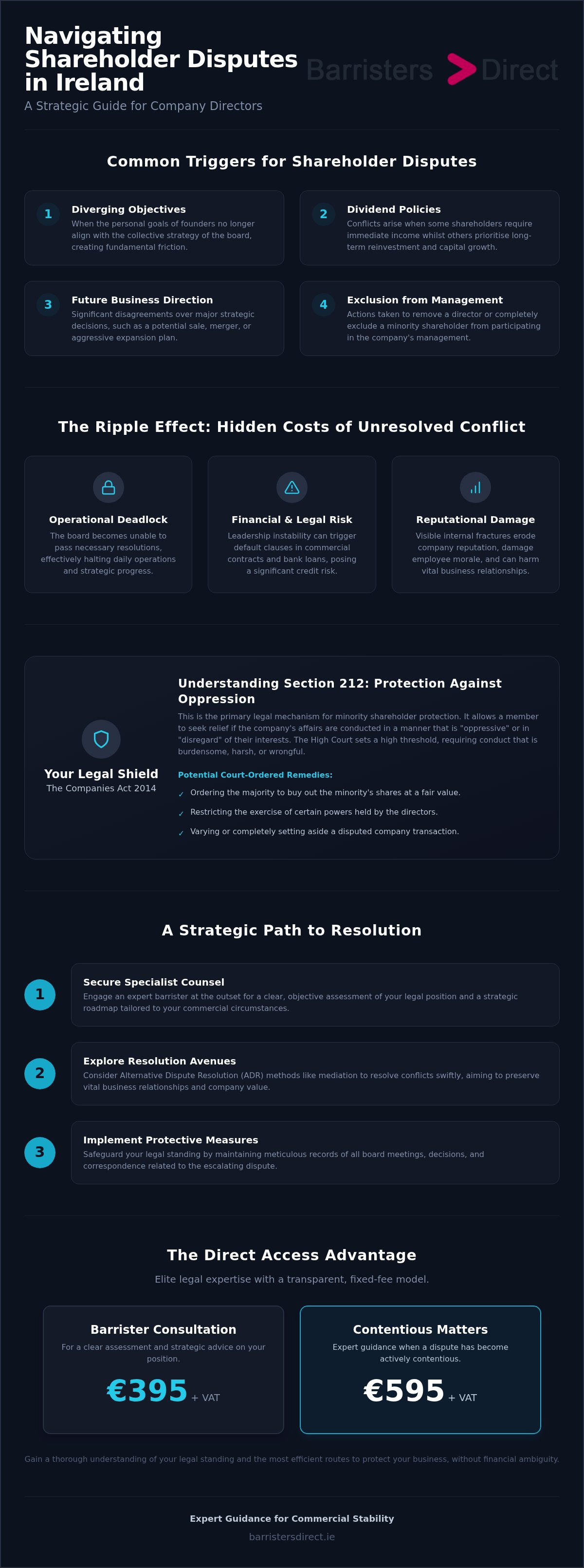
Conflict usually manifests when the personal objectives of founders diverge from the collective goals of the board. Disputes over dividend policies are particularly common; one party may require immediate income whilst another prioritises long-term capital growth. Rifts also emerge regarding the future direction of the business, such as whether to pursue a sale or an aggressive expansion. The most severe cases often involve the attempted removal of directors or the total exclusion of a minority shareholder from management participation. These scenarios often move beyond strategic debate and into the territory of Commercial Dispute Resolution, where the legal standing of each party must be precisely assessed. For early-stage companies where founding team dynamics are particularly fragile, understanding the specific legal risks of a startup shareholder dispute in Ireland is an essential first step before conflict escalates.
The Internal Impact of Unresolved Disputes
An unresolved dispute acts as a corrosive force within a company. It often results in "deadlock", a state where the board is unable to pass necessary resolutions, effectively halting daily operations. This paralysis extends beyond the boardroom; it can trigger default clauses in commercial contracts or bank loan agreements, as lenders typically view leadership instability as a significant credit risk. Beyond the balance sheet, the company's reputation and employee morale often suffer when the leadership is visibly fractured. In family-owned firms, the emotional toll is even more acute, as business disagreements can permanently damage personal relationships. Identifying the specific "dispute type" at an early stage allows you to choose the most efficient legal path and prevents the long-term erosion of your business interests.
The Companies Act 2014: Examining Shareholder Rights and Remedies
The legal framework governing corporate rifts in Ireland is robust, yet it requires a precise understanding of statutory thresholds. The primary statutory framework is established under the Companies Act 2014, which codifies the rights of members and the duties of directors. Whilst many shareholders believe any unfair treatment warrants legal intervention, the Irish High Court maintains a high bar for what constitutes actionable "unfair prejudice". If you are considering a petition, obtaining expert shareholder dispute advice ireland is essential to determine if your case meets the specific criteria set out in Section 212.
Statutory Protection Against Oppression
Section 212 serves as the primary mechanism for minority shareholder protection. It allows a member to seek relief if the company's affairs are being conducted in a manner that is "oppressive" or in "disregard" of their interests. It's vital to understand that the court distinguishes between oppressive conduct and mere commercial disappointment. Oppression typically involves behaviour that is burdensome, harsh, or wrongful, such as the deliberate exclusion from management or the withholding of financial information. If the court finds evidence of such conduct, it possesses broad powers to rectify the situation. These remedies include:
- Ordering the majority to buy out the minority's shares at a fair value.
- Restricting the exercise of certain directors' powers.
- Varying or setting aside a transaction.
- In extreme cases, ordering the winding-up of the company.
Contractual Rights and the Constitution
Beyond statutory rights, the hierarchy of a company's internal documents dictates how conflicts are managed. A Shareholders' Agreement usually sits at the top of this hierarchy, often containing "reserved matters" clauses that prevent major decisions from being made without minority consent. If a conflict arises, this agreement often takes precedence over the company's Articles of Association. These documents define the fiduciary duties of directors, who must act in the best interests of the company rather than a specific shareholder group. If a director breaches these duties, a shareholder may occasionally bring a "derivative claim" on behalf of the company itself, though this remains a complex legal route. Identifying which document has been breached is the first step in building a credible case. Consulting with a specialist barrister through Barristers Direct provides the strategic clarity needed to evaluate these documents and determine your strongest legal standing.
Evaluating Resolution Strategies: Negotiation, Mediation, and Litigation
Selecting the correct forum for resolution is a critical strategic decision. If you default to litigation immediately, you risk significant financial and temporal costs that may outweigh the original dispute. Seeking expert shareholder dispute legal advice allows you to evaluate Alternative Dispute Resolution (ADR) as a viable, private alternative to the High Court. These methods are designed to resolve rifts with greater speed and confidentiality than traditional court proceedings.
The Role of Mediation in Corporate Conflict
Mediation is frequently the preferred route for businesses that wish to maintain their "going concern" value. A neutral third party facilitates a dialogue between the parties, aiming to structure a commercial settlement or a clean exit strategy. Unlike a court judgment, mediation is entirely confidential; no public record of the dispute is created. This is particularly beneficial for companies that need to protect their reputation amongst lenders and clients. If the parties are willing to engage, mediation can often reach a conclusion in weeks rather than years. This process is a cornerstone of modern Commercial Dispute Resolution, providing a flexible environment where creative commercial solutions, such as share buy-backs, can be organised without judicial imposition.
Arbitration within the Irish jurisdiction offers another robust alternative. It provides a binding decision similar to a court judgment but within a private setting. For complex disputes, arbitration can be conducted in the English language and often adheres to a predictable timeline, such as a 30-day window for resolution once the arbitrator is appointed. This level of certainty is rarely available in the public court system.
When Litigation Becomes Necessary
There is often a "point of no return" where negotiation fails and court intervention becomes the only viable path. This typically occurs when there is a fundamental breach of fiduciary duty or a complete deadlock that threatens the company's existence. Litigation in the High Court, particularly within the Commercial List, is procedurally complex and carries a significant entry fee of €5,000. Case law, such as Mascarenhas v Karim, illustrates the potential for litigation to span several years before a final judgment is delivered.
Before initiating such a process, obtaining a specialist barrister's opinion is a vital safeguard. A barrister can provide an objective assessment of the merits of your case, potentially preventing you from pursuing costly, meritless litigation. This expert assessment ensures that if you do proceed to court, your strategy is based on a precise understanding of the law. Through Barristers Direct, you can access this level of specialist intelligence via a fixed-fee consultation of €395 plus VAT, or €595 plus VAT for contentious matters where a solicitor's presence is required. This transparency allows you to weigh the risks and rewards of litigation before committing to a long-term legal battle.
Practical Guidance for Managing Conflict and Protecting Share Value
If a boardroom rift transitions from a strategic disagreement to a legal conflict, your immediate actions dictate the strength of your future position. You must move quickly to protect the value of your shares by securing objective shareholder dispute advice ireland. Precision at this early stage often prevents a minor rift from becoming a terminal business failure. If you wait until a petition is filed to organise your records, you may find that critical evidence has already been lost or obscured.
Documentary Evidence and the Audit Trail
A verifiable audit trail is the backbone of any successful claim for unfair prejudice. You must gather and categorise all board minutes, audited financial statements, and internal email correspondence. Relying on informal "handshake" agreements is a high-risk strategy that often fails under the scrutiny of the High Court. If you proceed to formal litigation, you will be subject to the process of discovery. Discovery is the legal mechanism where each party must disclose all documents relevant to the dispute, ensuring that no critical evidence is withheld from the court. Maintaining a contemporaneous record of events allows your counsel to build a timeline that demonstrates a pattern of oppressive behaviour rather than a single, isolated incident.
Exercising Statutory Rights
You possess inherent rights under the Companies Act 2014 that allow you to inspect certain records and request formal meetings. If you are being excluded from management, you should formally request access to the register of members and the minutes of general meetings. The Company Secretary has a legal duty to facilitate these requests and maintain the company's statutory books. If the board refuses these requests without a valid legal reason, their behaviour may strengthen a future claim of oppression. Understanding the difference between solicitors and barristers is useful here; whilst a solicitor might manage the initial correspondence and requests, a barrister provides the specialist opinion on whether the information gathered supports a claim of oppression. To secure a high-level strategic assessment of your current evidence and legal standing, you can book a fixed-fee consultation with an expert barrister through our platform.
The Direct Access Advantage: Specialist Counsel for Shareholder Conflicts
Traditionally, accessing a barrister's expertise required a multi-layered process. Barristers Direct simplifies this by providing a platform where businesses can engage specialist counsel directly for a strategic assessment. If you are navigating a complex boardroom conflict, then obtaining expert shareholder dispute advice ireland at the earliest possible stage is paramount. This direct access model allows you to receive a high-level opinion on the merits of a Section 212 claim before committing to an expansive litigation strategy. It is a modern, efficient way to understand your legal standing without the traditional delays often associated with corporate legal services.
Smarter, Faster, and More Transparent Advice
The value of a barrister lies in their role as an independent specialist advocate within the Law Library of Ireland. Because they are sole practitioners, they provide an objective, unvarnished view of your case. Our platform enhances this expertise with modern technology to ensure maximum clarity for the layperson. Every consultation includes an AI-generated transcript and a concise synopsis. This ensures that all participants have a precise record of the strategy discussed. By using a fixed-fee model of €395 plus VAT for a barrister-only consultation, you eliminate the anxiety of open-ended hourly rates. This transparency allows you to focus entirely on the quality of the advice provided by our network of over 100 barristers.
Next Steps: Booking Your Consultation
The transition from identifying a conflict to receiving a roadmap for resolution is designed to be seamless. Consultations are conducted online via Zoom or Microsoft Teams, which allows for a swift response to escalating rifts regardless of your location. If your matter is already contentious and requires the presence of a solicitor, then the fixed fee is €595 plus VAT. This collaborative approach ensures that you have the necessary legal support whilst benefiting from the barrister's specialist insight into High Court procedures. You do not have to navigate these complexities alone. Book your specialist shareholder dispute consultation today to secure a strategic path forward and protect your business interests.
Securing Your Company's Future Through Strategic Action
Navigating a boardroom rift requires a swift transition from emotional reaction to calculated legal strategy. You've seen how the Companies Act 2014 provides specific protections against oppression, but achieving a successful resolution depends on the quality of your initial assessment. By prioritising a clear audit trail and exploring Alternative Dispute Resolution, you can protect your commercial interests whilst minimising operational paralysis. Accessing expert shareholder dispute advice ireland through a direct model ensures you receive specialist insight without the traditional barriers to entry.
If you require a definitive roadmap for your business conflict, then you should instruct a specialist barrister for a fixed-fee consultation. With direct access to over 100 specialist barristers and consultations starting from €395 plus VAT, you gain the strategic intelligence needed to resolve disputes with precision and transparency. This modern approach provides the expert advice on the strategic path forward that your business deserves. Taking the right steps now ensures your company remains a viable, thriving concern for the future.
Frequently Asked Questions
What are the first steps I should take in a shareholder dispute?
You should immediately gather all relevant documentation, including board minutes, financial statements, and email correspondence. It's vital to avoid making informal "handshake" agreements during an escalation, as these are difficult to prove in court. Securing expert shareholder dispute advice ireland at this stage allows you to understand the legal strength of your position. This early assessment helps you determine whether a commercial settlement or a formal petition is the most appropriate path forward for your business.
Can I remove a director during a shareholder conflict in Ireland?
You can remove a director by following the strict procedural requirements set out in Section 146 of the Companies Act 2014. This process requires an ordinary resolution and the delivery of "special notice" to the company. If the director is also a shareholder, their removal may trigger a claim of oppression or a dispute over the fair value of their shares. A barrister can provide an objective opinion on whether your proposed process meets all statutory obligations.
What is the cost of getting expert legal advice on a shareholder dispute?
Accessing elite legal expertise is structured through a transparent, fixed-fee model. A consultation with a specialist barrister costs €395 plus VAT, whilst a session involving both a barrister and a solicitor for contentious matters is €595 plus VAT. This approach ensures you receive high-level shareholder dispute advice ireland without the financial uncertainty of open-ended hourly rates. You'll receive a clear roadmap for your case, along with an AI-generated transcript and synopsis of the discussion.
How long does it typically take to resolve a shareholder dispute?
The duration of a dispute depends heavily on the chosen resolution method. Mediation can frequently structure a settlement or exit strategy within a matter of weeks. Conversely, full litigation in the High Court Commercial List can span several years before a final judgment is delivered. Engaging a specialist barrister early in the process helps you identify the most efficient route to resolution, potentially avoiding the prolonged timelines and significant costs associated with a full court hearing.
What is a Section 212 petition and when is it used?
A Section 212 petition is a legal mechanism used when a shareholder believes the company's affairs are being conducted in an "oppressive" manner. It's typically filed when a minority member's interests are being disregarded or when they're unfairly excluded from management decisions. The High Court has broad discretion to rectify this "unfair prejudice". Remedies can range from ordering the majority to buy out the minority's shares at a fair valuation to changing the company's constitution.
Do I need a solicitor to talk to a barrister about my case?
You don't need to retain a solicitor before speaking with a specialist barrister for an initial assessment. Under the Legal Services Regulation Act, businesses and individuals can now engage barristers directly for expert opinions and strategic advice. This allows you to evaluate the merits of your case with a specialist advocate first. If your matter eventually requires formal litigation or the management of client funds, a solicitor can then be introduced to handle those specific procedural requirements.
Can a shareholder dispute lead to the winding up of a company?
A shareholder dispute can lead to the winding up of a company, but the High Court generally views this as a last resort. Under Section 212, the court prefers remedies that maintain the company as a "going concern", such as ordering a share buy-out. However, if a deadlock is so severe that the business can no longer function, a winding-up order may be granted. A specialist barrister can assess if your case meets the high threshold for such an order.
How does mediation differ from litigation in corporate disputes?
Mediation is a confidential, voluntary process where a neutral facilitator helps parties reach a commercial agreement. It's often faster and preserves business relationships by avoiding a public court record. Litigation is an adversarial process in the High Court where a judge delivers a binding decision. Arbitration within the Irish jurisdiction offers another private alternative, providing a binding outcome within a set timeframe, such as 30 days, once an arbitrator is appointed.
Disclaimer
This article does not constitute legal advice. Barristers Direct does not provide legal advice. To obtain legal advice, you should contact a legal practitioner.


