

The moment a commercial relationship turns into a debt recovery exercise, the focus must shift from negotiation to strategic intelligence. If you're facing cash flow disruption, it's natural to hesitate over taking unpaid invoice legal action in Ireland for fear that legal fees will simply compound your losses. You aren't alone in wanting to avoid the "good money after bad" trap, especially when the Irish legal system appears complex and opaque.
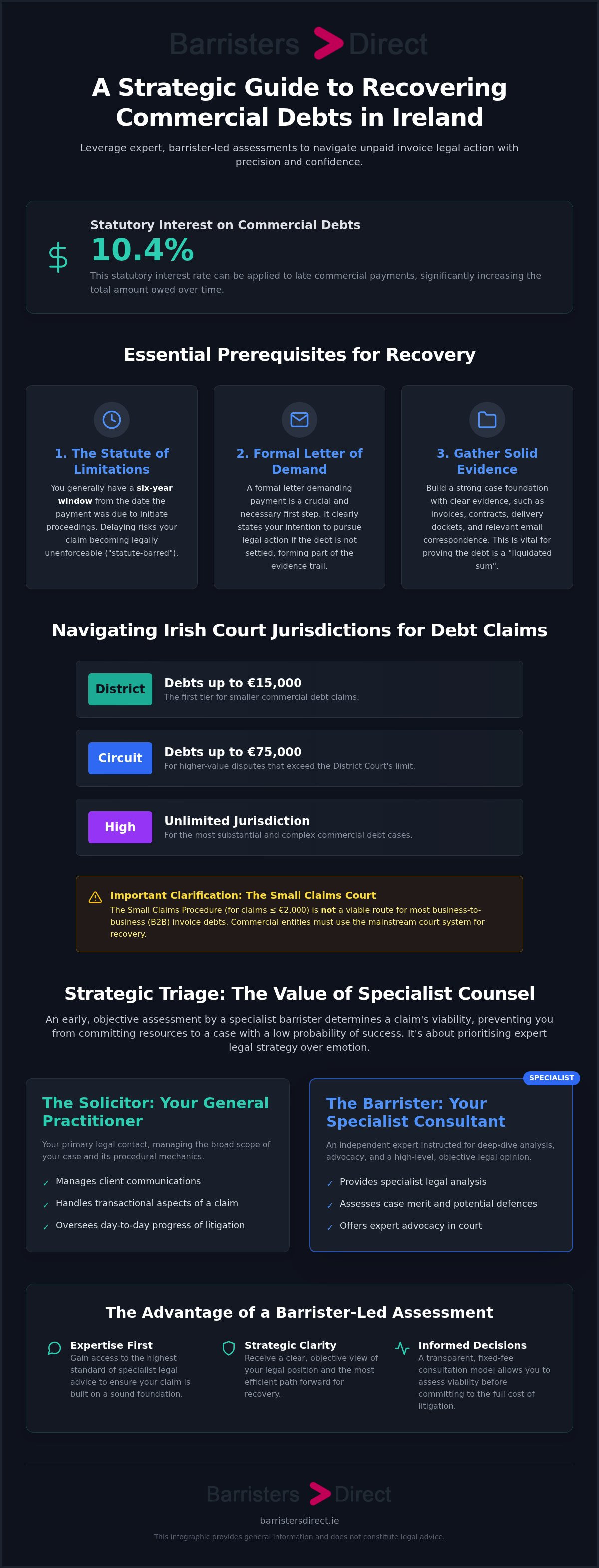
This guide provides a clear map for recovering what you're owed by leveraging expert, barrister-led assessments to determine the viability of your case. You'll learn how to navigate the various court jurisdictions, from the District Court's current €15,000 limit to the unlimited reach of the High Court, while understanding the impact of the 10.4% statutory interest rate on commercial debts. We'll explore how a strategic triage approach ensures you select the most efficient path forward, providing the specialist insight needed to resolve disputes with precision and confidence.
Key Takeaways
- Understand the essential prerequisites for recovery, including the six-year Statute of Limitations and the necessity of a formal Letter of Demand.
- Identify which court jurisdiction matches your claim, from the District Court for debts up to €15,000 to the Circuit Court for higher-value disputes up to €75,000.
- Learn how to gather the necessary evidence to support unpaid invoice legal action in Ireland, ensuring your case is built on a solid factual foundation.
- Discover the value of a "Strategic Triage" assessment by specialist barristers to determine the viability of your claim before proceeding with litigation.
- Gain access to high-standard expert advice through a transparent fixed-fee consultation model, providing professional clarity for your debt recovery strategy.
Understanding Unpaid Invoice Legal Action in Ireland
Initiating unpaid invoice legal action in Ireland is often the only way to compel a recalcitrant debtor to pay. It's the formal process of using the state's judicial machinery to recover a specific, liquidated sum of money. In a commercial context, this debt arises when a party fails to honour the payment terms of a contract for goods or services. Whilst many businesses attempt to resolve these issues through internal credit control, the transition to legal action marks a shift from negotiation to enforcement.
One common misconception is that the Small Claims Procedure is a viable route for business-to-business (B2B) debt. In reality, the Small Claims Court is limited to claims of €2,000 or less and specifically excludes debts based solely on an unpaid invoice. For commercial entities, recovery requires a more robust approach through the mainstream court system, where judges have the power to issue enforceable judgments against a debtor's assets.
The Legal Basis for Debt Recovery
At its core, a debt claim is an action for breach of contract. When an invoice remains unpaid past its due date, the debtor has failed to perform their contractual obligation. To succeed in court, you must demonstrate that a contract existed and that the amount claimed is a "liquidated" sum. This means the figure is fixed or easily calculated, such as a specific invoice total, rather than an estimated loss that requires the court to assess damages.
Expert advice from a specialist barrister is often required at this stage to ensure the claim is pleaded correctly. If a debtor provides a written acknowledgement of the debt, it can sometimes reset the legal clock. A barrister's assessment will identify these nuances, ensuring that your pursuit of unpaid invoice legal action in Ireland is built on a sound evidentiary foundation.
The Statute of Limitations Trap
Timing is a critical factor in any legal proceeding. Under the Statute of Limitations Act 1957, a creditor generally has a six-year window from the date the cause of action accrued to initiate proceedings. In debt recovery, this usually begins on the date the payment became overdue.
Waiting until the fifth or sixth year is a high-risk strategy. Evidence, such as delivery dockets or email chains, can easily be lost as staff move on or IT systems are updated. If you miss this window, your claim becomes "statute-barred," meaning it's legally unenforceable regardless of how much money is owed. A specialist barrister provides the strategic oversight needed to assess if a claim remains viable. This early triage prevents you from committing resources to a case that the court will inevitably strike out.
Strategic Triage: The Value of Specialist Legal Counsel
Effective recovery of business debts requires more than just persistence; it requires high-level strategic assessment. Think of the Irish legal profession through a medical lens. Your solicitor acts as a general practitioner, managing the broad scope of your legal health and handling the procedural mechanics of a case. A barrister is the specialist consultant called in to provide a deep-dive analysis of specific legal complexities. This collaborative structure ensures that when you pursue unpaid invoice legal action in Ireland, your strategy is underpinned by specialist expertise.
Instead of relying on aggressive debt collection tactics that may yield little result, early triage allows you to identify cases with a low probability of success before significant costs are incurred. This objective evaluation by a specialist barrister determines whether the debtor has a valid defence or if the claim is legally sound. It's a proactive step that moves beyond the 'what' of a debt to the 'how' of its recovery. Prioritising expert legal strategy ensures you're making decisions based on evidence rather than frustration.
Barrister vs Solicitor: Complementary Roles
Solicitors are your primary point of contact. They handle the transactional aspects of a claim, manage client communications, and oversee the day-to-day progress of litigation. Barristers, however, are independent sole practitioners who specialise in advocacy and legal opinion. By instructing a barrister for an initial consultation, you gain an objective, high-level view of your position. Understanding the difference between solicitors and barristers helps you utilise the strengths of each professional to build a robust path toward repayment.
Assessing Case Merit and Strength
A critical part of any recovery strategy is anticipating the debtor's response. They might raise a dispute over the quality of goods or services to delay payment. A specialist barrister evaluates these potential defences to see if they hold weight. Whilst the small claims procedure is an option for consumer debts under €2,000, commercial disputes often require a more sophisticated assessment of proportionality. You must determine if the likely recovery justifies the investment in litigation. Legal merit is the objective likelihood that a court will find in your favour based on the evidence and current law. Accessing a specialist consultation early ensures you don't throw good money after bad on a case that lacks this essential foundation.
Navigating Irish Court Jurisdictions for Debt Claims
Selecting the correct venue is a pivotal decision when initiating unpaid invoice legal action in Ireland. The Irish court system is structured hierarchically, with each tier defined by a specific monetary ceiling. Choosing the wrong jurisdiction can lead to significant delays or cost penalties if a judge determines the case should have been heard in a lower court. Understanding the Irish court jurisdictions for debt claims ensures that your recovery strategy is both procedurally correct and financially proportionate.
The District Court currently handles claims up to €15,000. It's designed for efficiency, offering a relatively swift path to judgment for smaller commercial debts. If the debt falls between €15,001 and €75,000, the case moves to the Circuit Court. For debts exceeding €75,000, or those involving exceptionally complex legal questions, the High Court has unlimited jurisdiction. Whilst the High Court offers the most robust legal scrutiny, it also carries higher costs and longer wait times, making it a choice reserved for high-value or strategically vital disputes.
District and Circuit Court Procedures
In the lower courts, many debt recovery cases proceed via "Summary Judgment". This is a streamlined process used when the debtor has no credible defence to the claim. Instead of a full plenary trial with witnesses, the barrister presents the case based on affidavit evidence. If the judge is satisfied that the debt is clearly owed, they can grant a court order for payment immediately. This avoids the need for a lengthy trial, which can otherwise take 12 to 18 months depending on the court's schedule.
A barrister's role in these jurisdictions is to draft precise legal arguments that anticipate and neutralise common delay tactics. They ensure the grounding affidavit is watertight, as any procedural flaw can give the debtor an opening to have the case remitted for a full trial. This level of specialist drafting is essential for maintaining the momentum of your claim and securing a prompt resolution.
High Court Litigation and Complexity
When a debt involves international elements, complex points of commercial law, or sums exceeding €75,000, the High Court becomes the necessary forum. These cases often require the involvement of senior counsel to navigate intricate legal frameworks. High Court litigation is a more intensive process, requiring detailed pleadings and comprehensive discovery of documents. It's the primary arena for significant Commercial Disputes where the stakes justify the increased investment in legal resources. In this environment, the quality of expert advice determines not just the outcome, but the ability to enforce a judgment against sophisticated debtors who may have assets across multiple jurisdictions.
Essential Steps Before Commencing Legal Action
Before you initiate unpaid invoice legal action in Ireland, you must satisfy specific procedural requirements. Litigation is a serious step that requires meticulous preparation to avoid unnecessary delays or cost penalties. If you jump straight into a court application without following the correct pre-action protocols, a judge may view your claim as premature. A structured approach ensures that if the matter does reach the courtroom, your position is irreproachable and your evidence is ready for scrutiny.
Whilst the desire for a swift resolution is natural, the strength of your claim rests on the steps taken before the first court document is filed. This includes formal communication with the debtor and the careful collation of a factual record. Seeking an expert assessment of your position at this stage allows you to move forward with professional confidence, knowing that your strategy is built on a sound legal foundation.
The Formal Demand Letter
A "Letter of Demand" is the standard prerequisite for debt recovery proceedings. This document must clearly state the exact sum owed, the relevant invoice numbers, and a firm deadline for payment, typically seven to fourteen days. If a letter is professionally drafted, it signals to the debtor that you've moved beyond internal credit control and are prepared to escalate the matter. This letter should also reference your entitlement to late payment interest and compensation for recovery costs, which, as of July 2026, starts at a minimum of €40 for invoices under €1,000. Avoid making empty threats; if you set a deadline, you must be prepared to act once it expires.
Evidence Gathering and Case Preparation
Winning a debt claim requires a comprehensive paper trail that proves both the existence of the contract and the delivery of the service. You should organise all relevant documentation into a logical sequence, including:
- Signed contracts or confirmed terms of business.
- Purchase orders and delivery dockets.
- Email correspondence acknowledging the debt or discussing payment plans.
- Records of any disputes raised by the debtor and your responses.
A specialist barrister reviews this evidence to ensure it meets the required burden of proof. They identify potential weaknesses that a debtor might exploit, such as vague terms or unsigned documents. This level of scrutiny is similar to the preparation required in other complex areas, such as Partnership Dispute Legal Advice, where the strength of the documentation often dictates the outcome. To ensure your evidence is sufficient for a court claim, you can arrange a consultation with a specialist barrister who can provide an expert assessment of your case strength.
Finally, consider Alternative Dispute Resolution (ADR) or mediation. Irish courts increasingly expect parties to have at least considered mediation before proceeding to a full hearing. If the debtor is willing to engage, ADR can often resolve the dispute faster than a court schedule allows, whilst still protecting your commercial interests. Internal business disputes, such as those requiring shareholder dispute advice Ireland, similarly benefit from early expert assessment to determine whether mediation or litigation is the most appropriate path forward. The same principle applies across all areas of Irish law; for instance, parents seeking child custody legal advice Ireland are equally well served by obtaining a specialist barrister's assessment early to determine whether mediation or court proceedings represent the most effective route.
Fixed-Fee Consultations via Barristers Direct
The traditional route to unpaid invoice legal action in Ireland often feels slow and opaque. Barristers Direct offers a modern alternative through the Direct Access model, which allows you to engage with specialist counsel for an initial assessment without the immediate need for a solicitor. This approach prioritises expert intelligence, giving you a clear understanding of your case's strengths before you commit to the formal litigation process. It's a method designed for efficiency, stripping away the intimidating layers often associated with legal communications in favour of a transparent, solution-oriented service.
By bypassing the procedural hurdles of traditional entry points, you can access the specialised knowledge of the Bar at the very start of your recovery journey. This doesn't replace the vital role of a solicitor in the litigation phase; rather, it ensures that when a solicitor is instructed, they're working from a strategy that has already been validated by specialist counsel. This creates a more streamlined, purposeful approach to debt recovery that benefits all parties involved.
How the Direct Access Process Works
Matching your specific debt recovery issue with a barrister from a network of over 100 experts ensures you receive advice tailored to your industry. For a fixed fee of €395 plus VAT, you can book a private consultation conducted via Zoom, Microsoft Teams, or Google Meet. This "no further obligation" rule means you aren't tied into long-term legal contracts; you're paying for a specific, high-level strategic assessment. This triage service helps both the client and any potential future solicitors by clarifying the legal issues at the outset. If you've already engaged a solicitor, you can also opt for a joint consultation for €595 plus VAT, ensuring all parties are aligned on the strategy.
Expert Advice for Smarter Dispute Resolution
Transparency in budgeting is essential for any business facing cash flow disruption. A flat-fee structure allows for precise financial planning whilst ensuring you receive the highest standard of advice from senior or junior counsel. Following the consultation, the introduced barrister provides a clear path forward based on the merits of your claim. You'll receive a synopsis of the advice and a recording of the session, providing a definitive map for your Debt Recovery strategy.
If the advice indicates that court representation or formal litigation is required, you can then transition to a solicitor with a clear set of instructions and a validated legal position. This ensures that every step you take is calculated, professional, and focused on results rather than tradition for tradition's sake. It's about navigating a complex system in a more direct, modern way, ensuring that your pursuit of an unpaid invoice is both strategically sound and professionally managed.
Securing Your Commercial Interests
Successful debt recovery is built on a foundation of specialist knowledge and procedural precision. By identifying the correct court jurisdiction and maintaining a robust evidentiary paper trail, you transform a frustrating dispute into a manageable legal process. The transition toward taking unpaid invoice legal action in Ireland should never be a gamble; it should be a calculated move supported by authoritative legal insight. This approach ensures that your resources are focused on claims with genuine merit, protecting your business from the costs of unproductive litigation.
Through Barristers Direct, you gain immediate access to a network of over 100 specialist barristers who provide the high-level triage necessary to assess case viability. This modern approach strips away the complexity of the legal system, offering a transparent and direct route to expert analysis. You can book a fixed-fee consultation with a specialist barrister today for exactly €395 plus VAT to secure a definitive synopsis of your position and a clear strategic path forward.
Proactive intelligence is the most effective tool in resolving commercial disputes. By choosing a path led by expertise, you ensure your business is protected and your outstanding invoices are addressed with professional confidence.
Frequently Asked Questions
How long do I have to sue for an unpaid invoice in Ireland?
Under the Statute of Limitations Act 1957, you generally have six years from the date the debt became overdue to initiate legal proceedings. If you wait beyond this period, the debt becomes "statute-barred" and is legally unenforceable. It's advisable to act much sooner to ensure evidence remains intact and staff who can verify the transaction are still available. Early assessment helps determine if the claim remains viable.
Can I sue for an unpaid invoice without a solicitor?
You can seek expert advice directly from a barrister through the Direct Access model for an initial assessment of your case. However, for formal litigation and representation in court, you must engage a solicitor. A barrister-led consultation is an effective way to validate your position before committing to the full court process. This ensures your unpaid invoice legal action in Ireland is built on a solid strategic foundation.
What is the difference between a barrister and a solicitor in debt recovery?
Solicitors are your primary point of contact and handle the procedural mechanics, such as holding client funds and managing documentation. Barristers are independent specialists who provide objective legal opinions and courtroom advocacy. Think of it as the relationship between a GP and a consultant; a solicitor handles the broad case management, whilst a barrister is brought in for high-level strategic advice and representation in complex disputes.
How much does a legal consultation with a barrister cost?
Through the Barristers Direct platform, a consultation with a specialist barrister costs exactly €395 plus VAT. If you wish to have your solicitor attend the session as well, the fee is €595 plus VAT. This flat-fee model provides budget transparency and covers the expert's time to review your case and provide a clear strategic path forward. Every session includes an automatically generated recording and synopsis for your records.
What happens if a debtor still refuses to pay after a court order?
If a debtor ignores a court order, you must move to the enforcement stage. This may involve instructing the Sheriff to seize assets, securing a judgment mortgage against the debtor's property, or seeking an attachment of earnings order. A barrister can advise on the most effective enforcement method based on the debtor's known assets. This ensures the court's decision is translated into actual recovery of your funds.
Is a verbal agreement for an invoice legally binding in Ireland?
Verbal agreements are legally binding in Ireland, provided the essential elements of a contract are present. However, they are significantly more difficult to prove in court than written contracts. You'll need to provide secondary evidence, such as email chains, delivery dockets, or witness testimony, to confirm that the service was performed and payment was expected. A specialist barrister can assess whether your supporting evidence is sufficient to meet the burden of proof.
Can I recover the legal costs of suing for an unpaid invoice?
In most cases, the court has the discretion to award legal costs to the successful party, meaning the debtor may be ordered to pay your reasonable legal expenses. Additionally, for commercial transactions, you're entitled to statutory late payment interest (currently 10.4% per annum) and a fixed sum of compensation for recovery costs. This compensation starts at €40 for debts under €1,000 and increases depending on the invoice value.
What is the "triage service" offered by barristers?
The triage service is a strategic assessment where a barrister evaluates the strength and merits of a case at an early stage. This assists solicitors by identifying which claims have a high probability of success and which are likely to face significant legal hurdles. By conducting this assessment before formal litigation begins, businesses can avoid unnecessary costs and focus their resources on viable unpaid invoice legal action in Ireland.
Disclaimer
This article does not constitute legal advice. Barristers Direct does not provide legal advice. To obtain legal advice, you should contact a legal practitioner.


