

Holding a minority stake in a private company should never mean surrendering your voice, yet many investors find themselves abruptly sidelined by majority directors. When you are excluded from strategic decisions, denied access to statutory accounting records, or forced to watch profits vanish into executive remuneration whilst dividends remain frozen, securing specialist legal advice for minority shareholders becomes critical. It is entirely reasonable to feel frustrated and cautious, especially when faced with the anxiety of escalating dispute costs and the prospect of protracted courtroom litigation.
You do not have to accept unfair prejudice as the cost of doing business. In this guide, you will discover how Irish company law protects minority shareholders, how to identify actionable shareholder oppression, and how to obtain specialist legal guidance before positions harden. We examine the statutory protections available under Section 212 of the Companies Act 2014, provide a practical framework to assess breaches of fiduciary duty, and outline how early counsel can help you achieve an effective commercial resolution.
Key Takeaways
- Understand your statutory protections under Section 212 of the Companies Act 2014 and how Irish law identifies actionable shareholder oppression.
- Discover how exercising statutory inspection rights early allows you to secure contemporaneous company records and build a robust evidentiary base.
- Evaluate alternative dispute resolution mechanisms such as mediation to resolve internal disputes confidentially without the immediate risks of court litigation.
- Learn how obtaining specialist legal advice for minority shareholders from an independent barrister provides an objective, early assessment of your case merits.
- Implement a structured five-step strategic roadmap designed to replace reactive conflict with methodical, results-driven commercial negotiation.
Understanding Minority Shareholder Oppression and Statutory Rights in Ireland
Irish corporate governance rests on the principle of majority rule. In standard commercial operations, decisions made by the majority of voting shareholders or the board of directors bind the entire enterprise. However, majority rule doesn't grant majority owners absolute authority to abuse their power. When dominant stakeholders use their control to subjugate or unfairly sideline non-controlling investors, Irish company law intervenes. Securing timely legal advice for minority shareholders ensures you establish whether an action is merely an unwelcome business decision or actionable oppression.
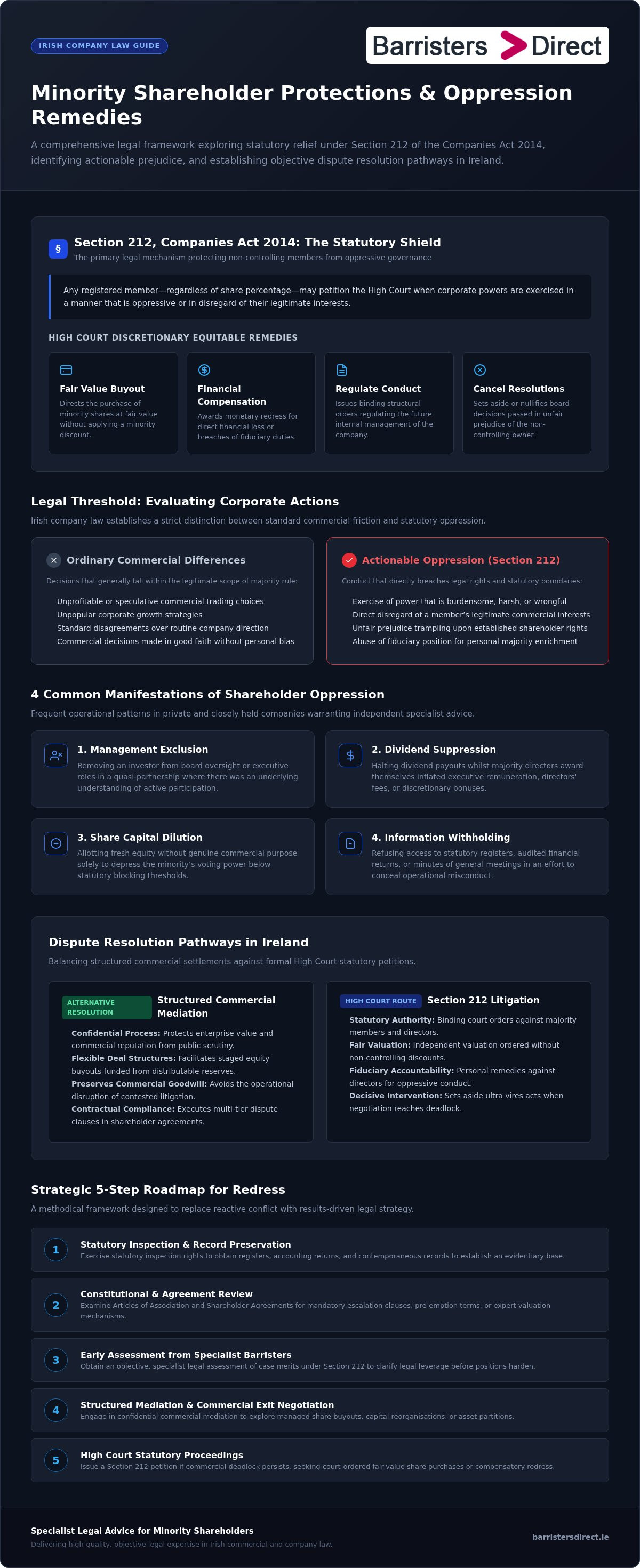
Corporate law draws a sharp line between ordinary commercial differences and illegal conduct. An unprofitable trade choice or an unpopular business strategy rarely amounts to unfair prejudice. In contrast, shareholder oppression occurs when the powers of the company are exercised in a manner that is burdensome, harsh, or wrongful, directly trampling upon a member's legal rights or legitimate interests.
Key Protections Under Section 212 of the Companies Act 2014
Section 212 of the Companies Act 2014 serves as the primary statutory shield for non-controlling investors. Under this provision, any registered member, regardless of their share percentage, can petition the High Court if the company's affairs are conducted in an oppressive manner or in disregard of their interests. The court holds expansive discretionary powers to fashion an equitable remedy. Rather than merely penalising conduct, the court can direct a purchase of the minority member's shares at fair value without a minority discount, order compensation, regulate future corporate conduct, or cancel prejudicial board resolutions.
Common Manifestations of Shareholder Oppression and Prejudice
Oppressive behaviour takes many forms, particularly within private, closely held enterprises. The most frequent patterns warranting independent legal advice for minority shareholders include:
- Management exclusion: Removing an investor from board oversight or executive duties in a quasi-partnership where there was an underlying understanding of participation.
- Dividend suppression: Halting dividend distributions while majority directors award themselves excessive executive salaries, bonuses, or director fees.
- Share capital dilution: Issuing fresh equity without legitimate commercial necessity solely to depress the minority's voting threshold below statutory blocking levels.
- Information withholding: Refusing access to statutory registers, audited financial returns, or minutes of general meetings to conceal operational misconduct.
Evaluating Dispute Resolution Pathways: Commercial Settlement Versus Court Remedies
Resolving a shareholder impasse rarely requires an immediate courtroom battle. When positions become entrenched, litigating a private company dispute in the High Court risks draining cash reserves, distracting leadership, and destroying enterprise value. Before initiating contentious proceedings, members must examine their constitutional framework. A well-crafted shareholder agreement often dictates mandatory escalation procedures, such as private conciliation or independent expert determination. Obtaining objective legal advice for minority shareholders enables investors to evaluate these contractual terms early, establishing firm leverage without inciting operational collapse.
Informal Commercial Negotiation and Structured Mediation
Preserving capital requires exploring structured commercial avenues before issuing proceedings. Direct negotiation frequently centres on designing a managed exit, allowing the enterprise or majority members to acquire the minority equity. In Ireland, commercial mediation provides a confidential, swift alternative to public litigation. A mediator assists parties in structuring practical settlements that courts cannot easily impose, such as staged share redemptions funded from distributable reserves, restructuring dividend policies, or dividing distinct corporate assets. This approach resolves governance deadlocks while protecting underlying trade goodwill.
Statutory Court Remedies and Section 212 Petitions
If consensual discussions break down, formal litigation becomes the necessary recourse. A petition under Section 212 invites the High Court to intervene, most frequently resulting in an order requiring majority shareholders to purchase the petitioner's stake at fair market value. In cases of proven oppression, the court typically refuses to apply a minority discount, ensuring the exit valuation reflects the uncompromised value of the enterprise. In terminal situations where mutual trust has evaporated completely and the business is deadlocked, the court retains the power to order a just and equitable winding up.
Deciding whether to pursue an amicable exit or statutory litigation requires an unvarnished assessment of legal merits. Engaging experienced counsel through Barristers Direct provides an independent legal consultation to test the strength of your evidence, helping you clarify settlement boundaries before incurring substantial litigation costs.
Evidentiary Requirements: How to Build and Preserve Your Legal Position
Successful shareholder dispute resolution hinges on documentary evidence, not subjective grievance. Asserting that majority directors acted unfairly means very little in Irish courts without contemporaneous written records demonstrating prejudice. Prematurely confronting board colleagues before establishing your evidentiary foundation often leads to deleted correspondence, retrospectively altered minutes, or blocked database credentials. Obtaining early legal advice for minority shareholders helps you establish what records are required and how to gather them lawfully before tensions escalate into open confrontation.
Securing Corporate Records and Financial Statements
Irish company legislation provides specific statutory mechanisms to inspect critical company books. Under the Companies Act 2014, members hold absolute statutory rights to inspect the register of members, directors' service contracts, and minutes of general meetings, as well as receive full financial statements. Scrutinising these records often uncovers irregular director loans, uncommercial inter-company fund transfers, or excessive executive management charges. In cases where financial disclosures indicate fiduciary misconduct, review our detailed guide on director duties and liability to understand the governance obligations directors owe to the company.
Documenting Exclusion and Governance Breaches
Proving oppression under Section 212 requires clear proof of systematic misconduct. Non-controlling investors must build a disciplined, chronological evidentiary log. Key documentation to assemble includes:
- Exclusion trails: Emails, text messages, or internal memos showing deliberate omission from operational discussions, management meetings, or strategic decisions.
- Procedural non-compliance: Defective board notices, short-served extraordinary general meeting notices, and unrecorded minority dissents. If majority conduct warrants formal removal steps, consult our analysis on how to remove a director.
- Financial discrepancies: Written requests for management accounts alongside formal written refusals or evasive explanations from the board.
- Commercial diversion: Evidence that company opportunities, client contracts, or tangible assets were redirected to entities controlled privately by majority directors.
Once you compile this contemporaneous record, seeking specialist legal advice for minority shareholders enables legal counsel to evaluate your position objectively and plan your next commercial steps.
Selecting the Right Legal Route: Solicitors, Barristers, and Specialist Advice
Resolving an internal corporate deadlock requires a clear understanding of how legal expertise is structured in Ireland. The Irish legal architecture relies on two distinct yet complementary professions: solicitors and barristers. Both play vital roles in protecting shareholder interests, but their functions differ significantly in practice. If you require specialist legal advice for minority shareholders, identifying which professional to engage at each stage of a dispute ensures your strategy remains focused, proportionate, and commercially viable.
Distinct Roles of Solicitors and Independent Barristers
Solicitors act as the primary managers of legal proceedings. They manage general client relationships, take witness statements, oversee extensive document discovery, handle client monies, and coordinate litigation from inception to conclusion. Barristers, who practice as independent sole practitioners through the Law Library, focus on objective legal opinions, complex statutory interpretation, and courtroom advocacy. This dynamic mirrors the relationship between a general medical practitioner and an expert surgical consultant. While solicitors deliver essential ongoing case administration and client representation, barristers provide independent, unvarnished assessments of how the High Court will interpret specific legal issues. For a detailed breakdown of these complementary roles, explore our guide on the difference between solicitors and barristers.
Direct Access for Early Strategic Assessment
Traditionally, obtaining an independent barrister's formal opinion required an initial referral through a solicitor's firm. While this established pathway remains standard for formal, multi-party court litigation, modern regulatory frameworks allow businesses and private investors direct access to specialist counsel for strategic consultations. Securing this objective guidance early enables non-controlling members to test the strength of their position before committing to extensive legal steps.
An early consultation with independent counsel strips away the emotional strain of shareholder conflict, focusing squarely on the legal merits and financial risks of the dispute. Reviewing the advantages of instructing a barrister directly demonstrates how early clarity empowers better commercial negotiation. To evaluate your statutory remedies under the Companies Act 2014, book a consultation through Barristers Direct to speak directly with an experienced independent commercial barrister.
Step-by-Step Strategic Roadmap for Minority Shareholders Seeking Legal Redress
Navigating an escalating boardroom confrontation requires discipline and emotional restraint. When majorities abuse their numerical dominance, reactive outbursts or informal threats often compromise your commercial leverage. Adopting a methodical five-step plan protects your financial stake whilst positioning you for a structured exit or fair settlement. To understand the wider statutory mechanisms governing high-stakes corporate standoffs, review our comprehensive analysis of commercial dispute resolution in Ireland.
Conducting an Initial Internal Position Audit
Every effective shareholder strategy begins with rigorous internal analysis before taking external action. Follow this three-part initial audit:
- Constitutional review: Audit the company's constitution, articles of association, and any executed shareholder agreements. Note all pre-emption clauses, drag-along or tag-along rights, and mandatory dispute resolution provisions.
- Documentary collation: Gather all contemporaneous evidence of financial prejudice, such as unexplained director loans, selective dividend freezes, or formal refusals to provide management accounts.
- Objective definition: Establish your primary goal clearly. Are you seeking a buyout of your equity at fair market value, or do you require the reinstatement of management oversight and corporate governance standards?
Arranging an Independent Consultation with Specialist Counsel
Once your factual foundation is secure, seeking timely legal advice for minority shareholders prevents tactical errors. The final stages of this strategic roadmap ensure you test your legal merits through qualified, independent counsel:
- Direct consultation booking: Rather than waiting weeks for formal legal correspondence, you can arrange an early strategic consultation directly with an independent commercial barrister. Through the Barristers Direct platform, individuals and businesses nationwide can connect directly with over 100 specialist independent barristers from the Law Library via video call or telephone.
- Strategy implementation: Following the consultation, you receive an automated audio recording and a detailed written summary of the discussion. This objective analysis gives you a definitive view of your statutory standing under Section 212 of the Companies Act 2014, allowing you to enter commercial negotiations or mediation with absolute clarity on your case merits.
Securing high-calibre legal advice for minority shareholders early ensures your next move is dictated by legal precision rather than emotion.
Take Decisive Action to Protect Your Corporate Interests
Minority shareholders do not have to accept unfair prejudice or operational exclusion. Irish company legislation establishes robust statutory protections under Section 212 of the Companies Act 2014, ensuring that majority control cannot override commercial fairness. By building an objective evidentiary record and understanding your constitutional framework, you can evaluate whether a structured commercial exit or formal High Court intervention offers the best path forward.
Securing expert legal advice for minority shareholders early provides the strategic leverage required to negotiate effectively. Through Barristers Direct, businesses and investors nationwide can connect directly with over 100 specialist independent barristers for clear, objective analysis before committing to extensive litigation. Every consultation concludes with an automated audio recording and a written synopsis to guide your strategy. Arrange a consultation with a specialist commercial barrister today and protect your corporate equity with total confidence.
Frequently Asked Questions
What qualifies as minority shareholder oppression under Irish company law?
Under Section 212 of the Companies Act 2014, oppression occurs when corporate affairs are conducted in a manner that is burdensome, harsh, or wrongful to a member, or in disregard of their interests. It doesn't require illegal activity. Typical examples include freezing out a member from management where an informal partnership existed, deliberately withholding dividends whilst awarding excessive executive pay, or manipulating share issues to dilute voting rights.
Can majority shareholders force a minority shareholder out of an Irish company?
Majority shareholders cannot unilaterally expel a minority shareholder simply by voting to do so, unless the company constitution or a valid shareholders' agreement explicitly grants drag-along or compulsory transfer rights. Attempting to force an investor out without constitutional authority, or manipulating company rules to seize equity at undervalue, constitutes actionable oppression. If faced with an unlawful exit attempt, obtaining specialist legal advice for minority shareholders ensures your property rights remain protected under Irish corporate law.
What remedies can the High Court grant under Section 212 of the Companies Act 2014?
The High Court holds broad discretionary powers under Section 212. The most frequent remedy is an order requiring the majority shareholders or the company itself to purchase the minority investor's shares at fair market value. The court may also order financial compensation, amend company articles, reverse improper board resolutions, or regulate future management conduct. In extreme scenarios where mutual confidence has broken down irretrievably, the court can direct a just and equitable winding up.
How is a minority shareholding valued during an oppression dispute buy-out?
In standard commercial transactions, non-controlling equity often suffers a minority discount due to lack of operational control. However, where the High Court finds oppression under Section 212, it generally orders a valuation based on a pro-rata proportion of the entire company's value without applying a minority discount. An independent corporate finance expert or forensic accountant is typically appointed to determine the fair enterprise value, often calculating value immediately prior to the oppressive conduct taking place.
Can a minority shareholder obtain legal advice directly from a barrister in Ireland?
Yes. Modern regulatory frameworks allow individuals and commercial clients across Ireland to consult directly with independent barristers. Through platforms like Barristers Direct, shareholders can access specialist legal advice for minority shareholders without retaining a solicitor for the initial strategic consultation. Independent counsel assesses the factual merits of your position, identifies statutory remedies, and provides objective clarity. The consultation concludes with an automated audio recording and written synopsis to guide your next commercial decisions.
What is the difference between consulting a barrister and hiring a solicitor for shareholder disputes?
Solicitors and barristers perform complementary roles in Ireland. Solicitors manage ongoing client matters, handle transactional procedures, hold client funds, and oversee the formal administration of litigation. Barristers act as independent sole practitioners specialising in legal opinions, statutory interpretation, and courtroom advocacy. Consulting a barrister provides an objective, early assessment of your case's legal merits, whereas instructing a solicitor is essential when issuing formal court proceedings, conducting documentary discovery, and managing daily litigation logistics.
What documents should I gather before consulting a legal professional about shareholder oppression?
Before your consultation, assemble the company constitution, any shareholder agreements, and recent annual audited accounts alongside relevant management accounts. Compile contemporaneous records evidencing your grievance, including board notices, minutes of general meetings, dividend payment histories, and correspondence illustrating management exclusion or unanswered requests for information. Presenting an organised chronological timeline of corporate communications allows counsel to evaluate whether the documented conduct meets the statutory threshold of shareholder oppression under Irish law.
Disclaimer
This article does not constitute legal advice. Barristers Direct does not provide legal advice. To obtain legal advice, you should contact a legal practitioner.


