

If a company faces insolvency, the assumption that the corporate veil provides absolute protection for your personal savings and property is a dangerous misconception. Under the Companies Act 2014, the boundary between corporate debt and personal liability can dissolve rapidly if fiduciary duties are neglected. Directors often seek specialist company law advice for directors to navigate these complex statutory requirements, particularly whilst managing the daily pressures of a business in transition. You likely recognise that staying compliant is non-negotiable, yet the dense layers of legislation often make it difficult to identify your specific obligations during a dispute or a period of financial strain.
Mastering the intricacies of your role is the only way to protect your professional standing and your assets with precision. This article provides the expert legal insights needed to understand your fiduciary duties, avoid the pitfalls of reckless trading, and secure a strategic path forward. We will examine the eight core duties codified in Section 228, the heightened scrutiny from the Corporate Enforcement Authority, and the practical steps you must take to insulate your personal reputation from corporate risk. Through the clarity of specialist counsel, you can transform legal uncertainty into a clear, actionable strategy for your boardroom decisions.
Key Takeaways
- Learn the eight codified fiduciary duties under the Companies Act 2014 to ensure your boardroom decisions remain legally compliant.
- Identify the specific statutory triggers that can pierce the corporate veil and expose your personal assets to company creditors.
- Discover how to navigate the complexities of near-insolvency by securing specialist company law advice for directors to mitigate risks of reckless trading.
- Understand the critical distinction between de jure, de facto, and shadow directors to clarify your personal exposure and legal responsibilities.
- Gain a strategic advantage by accessing direct consultations with specialist barristers for an objective, fixed-fee assessment of your legal position.
Understanding Director Duties under the Companies Act 2014
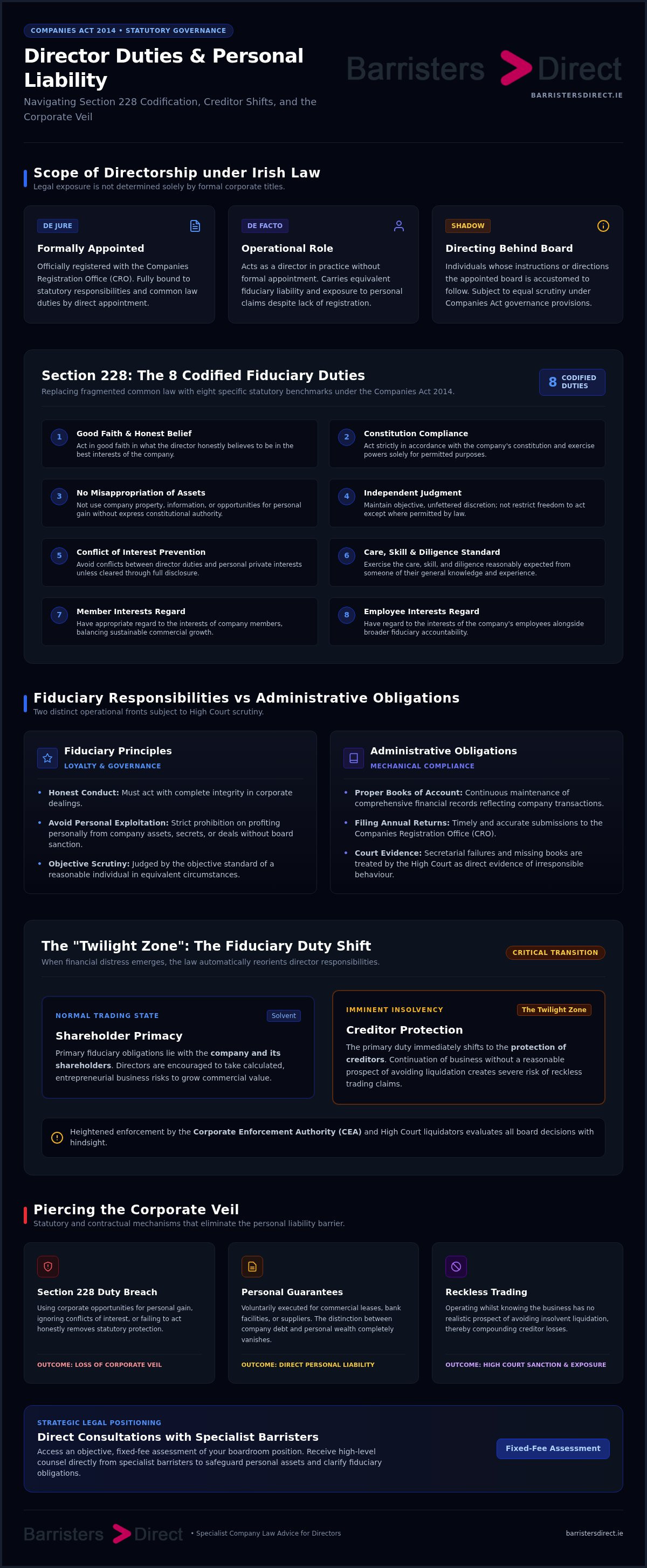
The Companies Act 2014 serves as the primary pillar for Irish corporate governance. It replaced a fragmented system of common law with a clear statutory code that governs how every director must behave. If you hold a board position, you aren't just an employee; you're a fiduciary with significant legal exposure. This exposure isn't limited to "de jure" directors formally registered with the Companies Registration Office. It extends to "de facto" directors who perform the role without a formal appointment and "shadow" directors whose instructions the board typically follows. Securing specialist company law advice for directors is often the only way to determine your exact status and associated risks before a dispute arises.
The Act aims to balance the necessity of entrepreneurial risk with the protection of creditors. It acknowledges that directors must take risks to grow a business, but it sets clear boundaries to prevent these risks from becoming reckless. If you fail to maintain this balance, the protection of the corporate veil may be withdrawn. Managing commercial disputes effectively requires a clear understanding of these boundaries. Precision in your professional conduct ensures that your personal assets remain protected whilst you pursue corporate growth.
The Eight General Duties of a Director
Under Section 228 of the Act, common law principles are now codified into eight distinct statutory duties. You must act in good faith and in what you honestly believe to be the best interests of the company. This requires exercising a level of care, skill, and diligence that a reasonable person would expect from someone with your specific knowledge and experience. Avoiding conflicts of interest is equally paramount. If you use company property, information, or opportunities for personal gain without full disclosure, you've breached your fiduciary duty. These rules aren't designed to stifle innovation; they're designed to ensure transparency and accountability at the highest level of the business.
Fiduciary Responsibilities vs Administrative Obligations
While fiduciary duties focus on your loyalty to the company, administrative obligations are the mechanical requirements for staying on the right side of the law. You're personally responsible for the maintenance of proper books of account and the timely filing of annual returns. If a company fails to organise its secretarial matters correctly, the High Court can view this as evidence of irresponsible behaviour during liquidation proceedings. When a business enters a period of financial distress, your duty shift is significant. If insolvency is likely, your primary fiduciary obligation moves from the shareholders to the creditors. Navigating this "twilight zone" requires strategic intelligence. Seeking expert corporate insolvency insights early can prevent the catastrophic consequences of personal liability for company debts.
Personal Liability and the Corporate Veil
In Irish law, the principle of separate legal personality ensures that a company is a distinct entity from its directors. This corporate veil usually protects your personal wealth from the business's creditors. However, this protection is conditional. If you breach your fiduciary duties under Section 228, that shield can be removed. Directors often seek company law advice for directors when they realise that their personal assets, such as the family home or savings, might be at risk due to corporate insolvency or litigation. You shouldn't assume the veil is impenetrable; it's a flexible barrier that the courts can pull aside in specific circumstances.
Personal guarantees are the most common way the corporate veil is bypassed in a commercial context. Banks and landlords frequently require directors to sign these documents as a condition for credit or leases. Once signed, the distinction between your finances and the company's debts effectively vanishes for that specific obligation. Protecting your assets whilst managing a struggling entity requires a proactive approach. You must ensure that every transaction is documented and that company funds are never used for personal expenses. If the company's financial health declines, your decisions will be scrutinised with the benefit of hindsight.
Piercing the Corporate Veil in Ireland
The courts are generally reluctant to ignore the company's separate identity, but they'll do so if the corporate structure is used to conceal fraud or evade existing legal obligations. If you fail to maintain clear boundaries between personal and business finances, a liquidator may argue that the company is a mere sham. Additionally, the "single economic entity" theory allows courts to treat a group of companies as one unit in specific, limited circumstances. Clarity on these judicial interpretations is vital for anyone managing complex corporate structures. Precision in your record-keeping is your primary defence against such claims.
Statutory Breaches Leading to Personal Liability
Statutes create specific pathways for personal liability that bypass the corporate veil entirely. For instance, directors can be held personally responsible for unpaid taxes or PRSI contributions if the failure to pay was due to a deliberate act or omission. Senior executives also face personal exposure for environmental damage or serious health and safety failings within the workplace. Engaging in Commercial Dispute Resolution early can help mitigate these risks by addressing potential breaches before they escalate into formal enforcement actions. If you're concerned about your personal exposure, an initial consultation with a specialist can provide the strategic intelligence needed to safeguard your professional standing.
Navigating Insolvency: Reckless and Fraudulent Trading
When a company's financial health deteriorates, your legal priorities must shift. Insolvency in Ireland is determined by two distinct tests. The cash flow test asks if the company can pay its debts as they fall due. The balance sheet test examines whether total liabilities exceed the value of the company's assets. If either test is met, you're operating in the "twilight zone" where your primary duty is to creditors rather than shareholders. Obtaining company law advice for directors during this phase ensures you understand the nuances of the Companies Act 2014 and avoid steps that could lead to personal liability.
Reckless trading under Section 610 occurs if you're knowingly a party to carrying on business in a way that creates a substantial risk of serious loss to a creditor. Unlike fraudulent trading, which requires a specific intent to defraud, reckless trading is often judged by an objective standard of "reasonableness." The Corporate Enforcement Authority guidance for directors highlights that ignorance of the company's financial state is no defence. Fraudulent trading is even more severe. It constitutes a Category 1 offence, potentially carrying up to 10 years’ imprisonment and fines of up to €500,000. Precision in your financial monitoring is non-negotiable when the viability of the business is at stake.
Defending Reckless Trading Allegations
To defend an allegation of reckless trading, you must demonstrate that you acted honestly and responsibly. This involves proving that you had a reasonable expectation that the company could survive its difficulties. Engaging a barrister to provide a specialist opinion on the "reasonableness" of your actions can be a decisive factor. Their independent evaluation provides the strategic weight needed to counter claims from liquidators or the Corporate Enforcement Authority. Early intervention is key. Waiting until the company is in liquidation often leaves you with fewer defensive options and higher risks of personal exposure. Specialist company law advice for directors helps you document your rationale whilst the decisions are being made.
Restriction and Disqualification Orders
If a company fails whilst insolvent, the High Court must restrict a director unless they prove they acted responsibly. A Section 819 restriction lasts for five years. During this time, the individual can only act as a director for companies that meet minimum paid-up share capital requirements, currently €100,000 for a private company. A Section 842 disqualification is far more severe. It often results from persistent defaults or fraud and prevents the individual from acting as a director or secretary of any Irish company for a specified period. Navigating these risks is a core component of Corporate Insolvency strategy. Protecting your future professional life requires a clear understanding of these statutory sanctions.
When to Seek Specialist Company Law Advice for Directors
Recognising the exact moment when routine business challenges transition into personal legal risks is a critical skill for any board member. You might notice subtle indicators first: a persistent disagreement over dividend policy or a sudden enquiry from the Corporate Enforcement Authority. These are not merely administrative hurdles; they are "red flag" situations where the quality of your next move determines your professional future. Seeking specialist company law advice for directors at this stage allows you to address board disputes or shareholder disagreements before they escalate into destructive litigation. An independent, specialist perspective from a barrister provides the strategic intelligence necessary to evaluate your position without the influence of internal company politics.
Preparing for potential litigation or regulatory investigations requires a shift in mindset. You're no longer just managing a business; you're protecting your standing within it. If a dispute arises, the ability to access high-level legal strategy quickly can be the difference between a resolved conflict and a protracted court battle. Whilst many directors are accustomed to traditional legal hierarchies, the modern landscape allows for more direct engagement with specialist counsel. This ensures that the advice you receive is focused entirely on the technical legal merits of your specific situation.
Five Steps for Directors Facing Legal Challenges
If you find yourself at the centre of a corporate dispute, a methodical approach is essential. If you follow these five steps, you'll be better positioned to defend your actions:
- Step 1: Review the company constitution and shareholder agreements to clarify your specific powers and limitations.
- Step 2: Document all board decisions and professional advice received to create a clear audit trail of your conduct.
- Step 3: Assess the company’s solvency position with financial experts to ensure you are meeting your duties to creditors.
- Step 4: Engage a specialist barrister for a strategic consultation to gain an objective, high-level view of the legal landscape.
- Step 5: Formulate a clear path forward that prioritises the protection of your personal assets and reputation whilst fulfilling your fiduciary duties.
Barrister vs Solicitor: Choosing the Right Specialist
Understanding the Difference Between Solicitors and Barristers is vital for efficient problem-solving. Solicitors provide indispensable transactional and administrative support, managing the ongoing legal health of the business and handling complex documentation. However, when you require a definitive opinion on a technical point of law or need a strategic roadmap for potential courtroom advocacy, a barrister is essential. Traditionally, accessing a Senior Counsel required a lengthy referral process. Today, you can bypass these hurdles by instructing a specialist directly for an initial consultation. If you are facing a specific dispute, you can book a consultation with a specialist barrister to secure the expert strategy you need today.
The Direct Access Advantage for Irish Directors
Bridging the gap between a complex business problem and a precise legal solution requires a modern approach to instruction. Whilst traditional routes to specialist counsel often involve multiple layers of referral, the Barristers Direct platform enables the direct instruction of independent barristers for an initial consultation. This direct access ensures that you receive high-level company law advice for directors at the moment it is most needed. By removing unnecessary barriers, you can engage directly with a legal professional who possesses the specific expertise required for your commercial dispute or regulatory challenge. This model prioritises the quality of strategic foresight, ensuring your boardroom decisions are informed by the highest level of legal intelligence.
Confidentiality and clarity are essential when discussing sensitive corporate matters. Every consultation facilitated through the platform includes an automatically generated audio recording and a detailed synopsis. These resources are distributed exclusively to the participating client and the legal professional, providing a clear record of the strategic evaluation. Having a written summary allows you to revisit the specialist’s insights as you implement your path forward. It transforms a complex discussion into a tangible roadmap, ensuring that no detail of the barrister’s assessment is lost in translation.
Fixed-Fee Strategic Consultations
Uncertainty regarding legal costs often prevents directors from seeking the early intervention necessary to protect their professional standing. The Barristers Direct model addresses this by providing clear, fixed-fee structures for initial consultations. For a barrister-only consultation, the fee is set at €395 plus VAT. If the matter is particularly contentious or requires a broader perspective, a €595 plus VAT model is available, where both a barrister and a solicitor attend the session. This approach allows you to focus entirely on the quality of the expert advice rather than worrying about escalating hourly rates. It provides a transparent mechanism for securing specialist strategy during the critical early stages of a dispute.
Nationwide Expertise for Complex Matters
Geography is no longer a barrier to accessing the best legal minds in Ireland. With a network of over 100 specialist barristers, the platform provides nationwide coverage for directors, regardless of where their business is based. Consultations are conducted via Zoom, Microsoft Teams, or Google Meet, offering maximum efficiency for busy professionals. This digital-first approach ensures that you can secure a strategic consultation without the need for extensive travel or downtime. You can explore the Advantages of Instructing a Barrister Directly to understand how this modern framework supports better governance and more robust asset protection. Whether you are facing a shareholder disagreement or an insolvency risk, the right expertise is now just a few clicks away.
Securing Your Professional Future through Specialist Strategy
Protecting your professional standing requires more than just a general awareness of the Companies Act 2014; it demands a precise application of the law to your specific circumstances. We have explored how the corporate veil is not an absolute shield and why your fiduciary duties must shift to prioritise creditors at the first sign of financial distress. Identifying these "red flag" moments early is the most effective way to insulate your personal assets from corporate risk. Precision in your conduct today prevents the catastrophic consequences of restriction or personal liability in the future.
When you require definitive company law advice for directors, the ability to bypass traditional referral delays is a significant strategic advantage. Accessing senior or junior counsel directly ensures that your boardroom decisions are backed by the highest level of legal intelligence. Through Barristers Direct, you can book a fixed-fee consultation with a specialist barrister today for €395 plus VAT. This direct engagement provides you with an objective evaluation of your position, supported by a confidential synopsis and recording to guide your next steps. Taking proactive control of your legal exposure is the most reliable way to ensure a stable path forward for both your business and your reputation.
Frequently Asked Questions
Can I be held personally liable for my company’s debts in Ireland?
You can be held personally liable for company debts if you breach your fiduciary duties or engage in reckless or fraudulent trading. Whilst the corporate veil usually protects directors, the High Court can pierce this shield if the company is used to evade legal obligations. Seeking specialist company law advice for directors early helps you identify these risks. Personal liability often arises during insolvency when a director fails to act in the best interests of the creditors.
What is the difference between reckless and fraudulent trading?
Reckless trading involves carrying on a business whilst knowingly taking risks that a reasonable person wouldn't take. It's judged by an objective standard of reasonableness. Fraudulent trading is more severe as it requires a specific intent to defraud creditors or other parties. Under the Companies Act 2014, fraudulent trading is a Category 1 criminal offence. It can lead to imprisonment for up to 10 years and significant fines, unlike the civil liability associated with reckless trading.
Do I need a solicitor to speak with a barrister about company law?
You don't need a solicitor to arrange an initial consultation with a barrister. The Legal Services Regulation Act allows businesses and individuals to instruct a barrister directly for specialist legal opinions and strategic advice. This direct access model enables you to secure high-level expertise quickly. However, if your matter requires formal court proceedings or the management of client funds, you'll still need to engage a solicitor to handle those specific administrative and representative functions.
What happens if I am issued a director restriction order?
A director restriction order under Section 819 prevents you from acting as a director or secretary of any company for five years. There's an exception if the company meets specific minimum paid-up share capital requirements, which is currently €100,000 for a private company limited by shares. These orders are typically issued if you can't prove you acted honestly and responsibly whilst managing an insolvent company. This restriction significantly impacts your ability to lead future business ventures.
How much does a consultation with a specialist barrister cost?
A consultation with a specialist barrister through our platform costs €395 plus VAT for a barrister-only session. If your matter is contentious and requires a solicitor to be present, the fee is €595 plus VAT. These are fixed fees that cover the specialist’s time to review your case and provide a strategic path forward. This model ensures you receive elite legal intelligence without the uncertainty often associated with traditional hourly billing rates for initial advice.
Can a barrister help resolve a shareholder dispute without going to court?
Yes, a barrister can be instrumental in resolving shareholder disputes before they reach the courtroom. By providing an independent and objective evaluation of the legal merits, a barrister helps all parties understand the likely judicial outcome. This expert perspective often facilitates early settlements and avoids the high costs of protracted litigation. Specialist company law advice for directors provides the strategic roadmap needed to negotiate from a position of strength during complex internal disagreements.
What duties do I owe to company creditors when the business is insolvent?
When a company becomes insolvent, your fiduciary duties shift from the shareholders to the creditors. You must act to protect the creditors' interests and avoid any behaviour that prejudices their ability to be repaid. This includes a duty to avoid reckless trading and to ensure that company assets aren't dissipated. Failing to recognise this shift in loyalty is a primary reason why directors face personal liability or restriction orders during liquidation proceedings.
How does Barristers Direct ensure the confidentiality of my consultation?
Confidentiality is maintained through a secure consultation process and restricted distribution of meeting records. After your session, an automatically generated audio recording and a detailed synopsis are created. These files are shared exclusively with you and the participating barrister. No third parties have access to these documents. This ensures you have a clear, private record of the specialist advice received, which you can use to inform your subsequent boardroom decisions and legal strategy.
Disclaimer
This article does not constitute legal advice. Barristers Direct does not provide legal advice. To obtain legal advice, you should contact a legal practitioner.


