

If you believe that a courtroom is the only place to achieve a binding resolution for your business conflict, you might be overlooking the most strategic path available. Most directors and business owners rightly fear the Irish court system's inherent delays and the public nature of litigation which can damage a hard-earned reputation. It's a common anxiety that the legal process will spiral out of control before a solution is reached. This guide demonstrates that resolving commercial disputes out of court isn't just about avoiding costs; it's about leveraging the precision of specialist barrister counsel to secure a legally enforceable settlement on your own terms.
By choosing a modern way to organise your legal strategy, you can access the weight of a specialist legal opinion without the need for a traditional solicitor-led retainer. We will examine how early intervention from independent sole practitioners and alternative dispute resolution methods can settle conflicts efficiently. This approach ensures your business moves forward with clarity and certainty while keeping sensitive matters away from the public record.
Key Takeaways
- Learn why modern businesses should view the High Court as a last resort and how to settle contractual impasses whilst preserving commercial relationships.
- Understand how mediation and arbitration serve as confidential, binding alternatives to the public and often lengthy Irish court system.
- Discover the strategic weight that early specialist barrister intervention adds to resolving commercial disputes out of court.
- Follow a practical roadmap for auditing evidence and assessing the legal strengths of your position before escalating a conflict.
- Access a transparent and modern path to expert legal strategy from a network of over 100 specialists for a fixed fee of €395 plus VAT.
The Strategic Case for Resolving Commercial Disputes Out of Court
For a modern enterprise, the High Court should be viewed as a last resort rather than a primary destination. The reality of litigation in Ireland often involves public scrutiny and significant delays that can paralyse business operations. Choosing a path focused on resolving commercial disputes out of court allows you to maintain control over the outcome. It provides a mechanism to resolve underlying contractual impasses whilst preserving the commercial relationships that are vital to your long-term success.
Public litigation exposes sensitive commercial data, pricing structures, and internal behaviours to competitors and the media. By utilising alternative dispute resolution, you ensure that the details of the conflict remain strictly confidential. This 'specialist first' approach, where expert counsel is engaged at the outset, changes the negotiation dynamic immediately. It signals to the opposing party that your position is built on solid legal foundations, often encouraging a settlement before formal proceedings even begin.
Cost and Time Efficiency in the Irish Legal Landscape
The Irish legal landscape is known for its thoroughness, but High Court proceedings can span several years. A structured out-of-court settlement can often be achieved in a fraction of that time. Under the Legal Services Regulation Act, businesses now have more flexible pathways to access specialist counsel directly. This prevents the 'escalation of costs' typically seen in traditional models, where expenses mount long before a case reaches a courtroom. Early specialist advice clarifies the merits of your position, allowing you to focus resources on a resolution rather than a protracted battle.
Risk Management and Reputation Protection
A court-imposed judgement is inherently uncertain. No matter how strong a case appears, the final decision rests with a judge whose interpretation may differ from your own. Controlled negotiation removes this volatility. It allows you to maintain a professional centre during the dispute, ensuring your brand reputation remains intact. Expertly managed commercial dispute resolution serves as a vital risk mitigation tool. It provides a legally enforceable result without the reputational hazards of a public trial.
Alternative Dispute Resolution (ADR) Mechanisms in Ireland
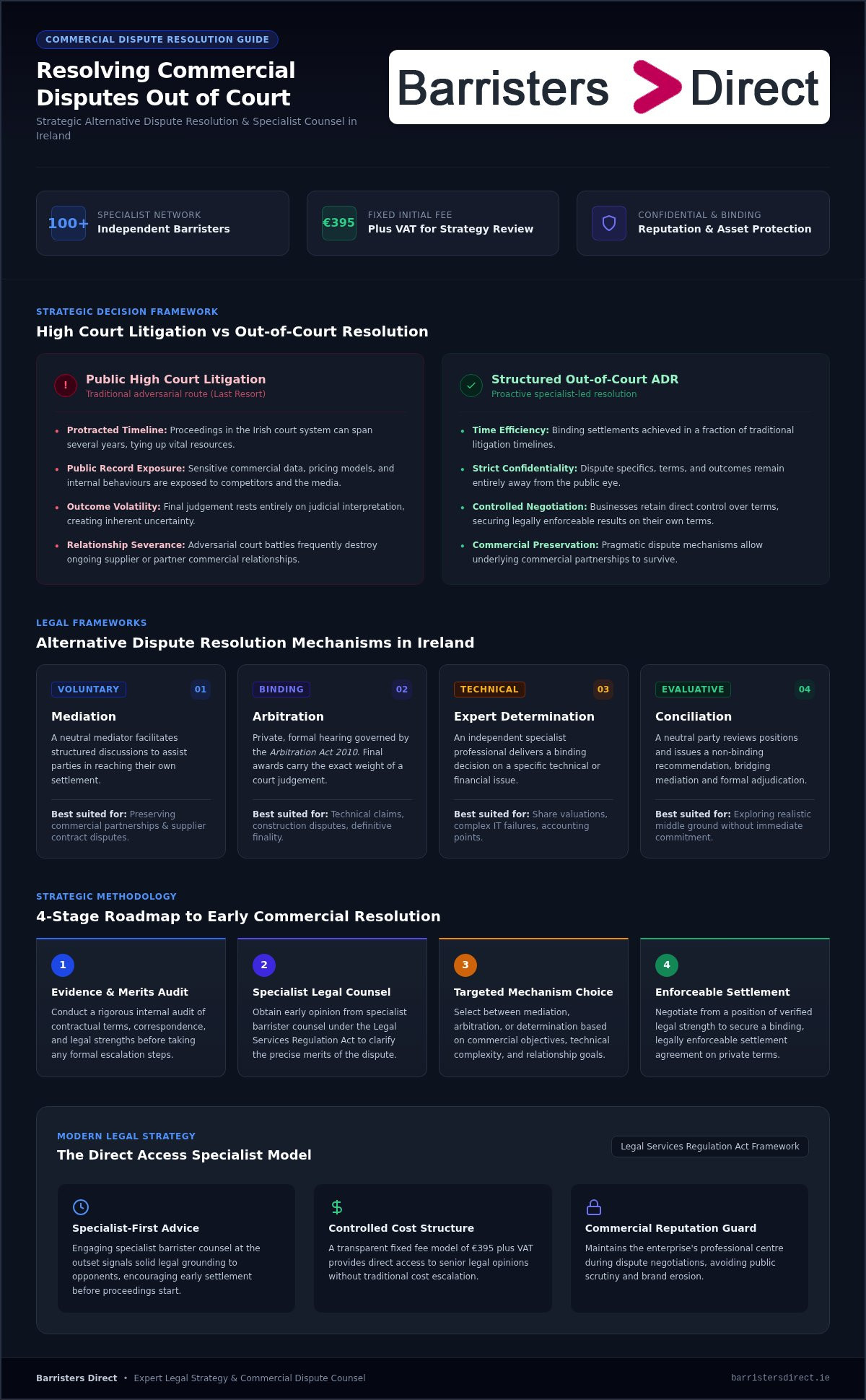
The Irish legal system provides several formal pathways for businesses to settle conflicts without entering a courtroom. These mechanisms, collectively known as Alternative Dispute Resolution in Ireland, offer a degree of flexibility and technical expertise that traditional litigation often lacks. When resolving commercial disputes out of court, selecting the correct mechanism is the first step toward a successful outcome. This shift away from adversarial litigation reflects a modern preference for efficiency and privacy.
Mediation is perhaps the most common voluntary process. A neutral mediator facilitates discussions to help parties reach their own agreement. It's strictly confidential and focuses on pragmatic business solutions rather than just legal rights. Conversely, Arbitration is a private, binding alternative to court. It's frequently utilised in construction claims where a specific technical understanding is required. In Dublin, Ireland, arbitration awards carry the same weight as a court judgement, making it a powerful tool for finality.
For highly technical or financial disagreements, Expert Determination allows a specialist professional to make a binding decision on a specific point. This is particularly effective for share valuations or assessing complex IT delivery failures. Finally, Conciliation involves a neutral party who provides a non-binding recommendation. It often acts as a bridge between mediation and more formal processes, allowing parties to see a potential middle ground without being legally committed to it from the start.
Choosing Between Mediation and Arbitration
Deciding which path to take depends on the nature of the conflict. If you're managing a supplier contract dispute, mediation might preserve the partnership, whereas arbitration provides a definitive end to the matter. Under the Arbitration Act 2010, the arbitrator's decision is final and enforceable. Specialist counsel can evaluate the merits of each path, ensuring that your approach to resolving commercial disputes out of court aligns with your long-term commercial objectives.
The Role of Adjudication in Construction Disputes
The construction sector operates under unique statutory rules. The Construction Contracts Act 2013 introduced statutory adjudication to resolve payment disputes swiftly. This "pay now, argue later" principle protects cash flow by providing a temporary but binding decision. Because the timelines in adjudication are extremely tight, early barrister consultation is vital to prepare a robust response. For those seeking clarity on these complex processes, engaging with specialist legal strategy early can prevent minor frictions from becoming permanent failures.
The Strategic Advantage of Specialist Barrister Counsel
Barristers operate as independent sole practitioners, which allows them to provide a level of objective scrutiny that's often difficult to achieve within a business's internal structure. When your focus is on resolving commercial disputes out of court, you require an expert who can predict how a judge might interpret your evidence. This 'Specialist Advocacy' model isn't just for the courtroom; it's a strategic tool. Because barristers see the end result of failed negotiations daily, they know exactly which pitfalls to avoid during early-stage discussions. This foresight allows you to build a strategy that's both realistic and legally robust.
A critical component of this strategy is the early merit assessment. It's vital to determine the strength of your position before committing significant resources to a dispute. For example, understanding if a contract can be broken in Ireland involves a precise analysis of specific legal thresholds. A specialist barrister provides this assessment directly, giving you the confidence to either settle quickly or stand your ground based on expert legal opinion. This objective view prevents businesses from pursuing weak claims or defending the indefensible, saving both time and reputation.
Direct Access vs. The Traditional Solicitor Referral
The relationship between a business and its legal counsel is evolving. A useful analogy is the medical model: while a GP provides excellent general care, a specialist consultant is required for complex issues. Direct access allows you to consult a barrister for a specific strategic impasse without a solicitor-led retainer. This modern approach ensures you receive elite expertise early in the process. It streamlines the route to a resolution and ensures that the quality of advice remains the primary focus, all whilst providing a more efficient way to organise your legal affairs.
Expertise in Commercial and Civil Litigation
Specialist barristers in Ireland are uniquely positioned to offer high-level dispute strategy. Their involvement is often the catalyst for successful Alternative Dispute Resolution in Ireland. When you're committed to resolving commercial disputes out of court, having a specialist's weight behind your position changes the negotiation dynamic. Beyond general commercial conflicts, they offer targeted expertise in areas like debt recovery and corporate insolvency. Every consultation is governed by a strict professional code, ensuring the advice you receive is impartial and strategically sound.
A Practical Roadmap to Early Dispute Resolution
Success in resolving commercial disputes out of court depends on a structured, evidence-led approach. It's not merely about negotiation; it's about rigorous preparation. If you follow a methodical roadmap, you reduce uncertainty and increase the likelihood of a favourable settlement. This progression ensures that every action taken is purposeful and legally sound.
- Step 1: Document Audit. Collate all relevant evidence. This includes written contracts, email chains, and contemporaneous notes of verbal agreements.
- Step 2: Specialist Consultation. Engage an independent barrister to assess the legal strengths and weaknesses of your position.
- Step 3: Formal Notice. Issue a "Letter of Claim" or "Notice of Dispute" drafted with expert oversight to signal professional intent.
- Step 4: Structured ADR. Enter into mediation or negotiation with a clear strategy based on your specialist's merit assessment.
- Step 5: Settlement. Finalise a legally binding agreement that protects your interests and provides finality.
Evaluating Your Legal Position Early
The evidential hurdle is often the most significant challenge in any conflict. For instance, proving a breach of verbal contract requires a precise reconstruction of events and corroborating data. Beyond the facts, you must assess liability and quantum, which is the actual financial value of the claim. Understanding these figures allows you to identify the "Settlement Zone". This is the range where both parties' interests overlap, making a resolution possible without further escalation. Defining this zone early prevents you from over-investing in a case with limited recovery potential.
Engaging Specialist Support for Negotiations
A barrister’s written opinion serves as powerful leverage during settlement discussions. It demonstrates that your strategy is informed by courtroom expertise, which often encourages the opposing party to reconsider their stance. All such communications should be conducted on a "Without Prejudice" basis. This ensures that offers made during negotiations cannot be used against you if the matter eventually goes to trial. While the primary goal is resolving commercial disputes out of court, a barrister can advise when it's time to transition to a solicitor if formal litigation becomes unavoidable. To define your path forward with expert insight, you can organise a specialist consultation to secure a clear legal strategy.
Direct Access: A Modern Path to Expert Legal Strategy
Traditional legal routes often involve multiple administrative layers that can delay the path to specialist insight. Barristers Direct bridges the gap between businesses and expert counsel by providing a streamlined, direct path to senior and junior barristers. This model allows you to bypass the complexities of traditional firm structures and speak directly with an independent sole practitioner who specialises in commercial disputes. By prioritising the quality of advice at the earliest stage, you gain a strategic advantage in resolving commercial disputes out of court.
The process is built on transparency and precision. Every initial consultation is provided at a flat fee of €395 plus VAT, ensuring you know exactly what the cost will be before you begin. This isn't just about financial predictability; it's about providing immediate access to elite legal intelligence. To enhance this experience, we utilise modern technology to provide an AI-generated transcript and a concise synopsis of every meeting. This ensures you have a permanent, accurate record of the specialist's view, which you can use to inform your next commercial move.
The Barristers Direct Service Model
Our network includes over 100 specialist barristers across Ireland, accessible through a secure, nationwide platform. Consultations are conducted online via Zoom, Microsoft Teams, or Google Meet, offering the flexibility that modern business requires. If you need a specialist opinion on a complex contractual impasse, you can book a session that fits your schedule. There's no further obligation beyond the initial meeting; you have the complete freedom to agree on any additional work directly with the barrister if you choose to proceed with their strategy.
Smarter, Faster, and More Transparent Advice
Early intervention is the most effective way to prevent a minor disagreement from becoming a protracted legal battle. By consulting a barrister first, you receive a definitive assessment of your legal standing. This clarity is essential for resolving commercial disputes out of court before costs escalate or reputations are damaged. As a trusted national brand, we're dedicated to modernising how legal strategy is organised in the 21st century. We provide a professional, elite resource that's accessible to every business owner, ensuring that expert legal strategy is no longer confined by traditional barriers.
Secure Your Commercial Future with Expert Strategy
The path to resolving commercial disputes out of court is built on early, objective analysis from those who understand the eventual courtroom risks. By leveraging alternative dispute resolution mechanisms and specialist advocacy, your business can avoid the public nature of litigation whilst maintaining control over the final settlement. A modern approach to legal strategy prioritises the quality of expert opinion at the outset, ensuring that disputes are settled based on merit rather than momentum.
You can now access this elite level of expertise directly. Barristers Direct provides a transparent gateway to over 100 independent sole practitioners across Ireland. For a fixed fee of €395 plus VAT, you can receive a definitive strategy for your conflict via a secure online consultation, complete with an AI-generated transcript and summary for your records. This ensures you have a precise, actionable roadmap to follow.
Don't let an impasse dictate your business's direction or drain its resources. Book a fixed-fee consultation with a specialist barrister today to gain the clarity and strategic weight needed for a swift resolution. We are here to help you move forward with confidence and certainty.
Frequently Asked Questions
Can I resolve a commercial dispute in Ireland without going to court?
Yes, it is entirely possible to settle conflicts through Alternative Dispute Resolution (ADR) mechanisms such as mediation or arbitration. These pathways are specifically designed for resolving commercial disputes out of court to avoid the public nature and delays of the High Court. By engaging a specialist barrister early, you receive a definitive assessment of your legal position, which often serves as the catalyst for a successful settlement before formal proceedings are even initiated.
How much does a barrister consultation fee cost for a commercial dispute?
We provide transparent, flat-fee access to expert legal strategy. A consultation with an independent specialist barrister costs €395 plus VAT. If the matter is contentious and you require a solicitor to attend the meeting alongside the barrister, the fee is €595 plus VAT. This fixed-fee model ensures there are no hidden costs for the initial strategic review, allowing you to access elite legal intelligence with complete financial certainty from the outset.
What is the difference between mediation and arbitration for businesses?
Mediation is a voluntary and confidential process where a neutral facilitator helps parties reach their own agreement. In contrast, arbitration is a private, formal process where an arbitrator makes a binding decision that carries the same weight as a court judgement. For businesses in Ireland, arbitration is often used for technical conflicts, such as construction claims, and any such proceedings are typically settled by arbitration in Dublin, Ireland, conducted in English.
Do I need a solicitor to talk to a barrister about a business dispute?
No, you do not need a solicitor for an initial strategic consultation. Under the Legal Services Regulation Act, members of the public and businesses can now engage a barrister directly for expert advice on their position. While a solicitor is still required if the matter proceeds to formal court litigation, this direct access model allows you to gain specialist insight and organise your legal strategy more efficiently during the early stages of a conflict.
Is an out-of-court settlement legally binding in Ireland?
Yes, a settlement reached through negotiation or mediation becomes a legally binding contract once the parties sign a formal Settlement Agreement. Similarly, an award made during arbitration is enforceable under the Arbitration Act 2010. These outcomes provide the same finality as a court order but are achieved in a private setting, ensuring that sensitive commercial data and business reputations remain protected throughout the process of resolving commercial disputes out of court.
What happens if a commercial dispute cannot be resolved through ADR?
If ADR mechanisms fail to produce a settlement, the dispute may proceed to formal litigation in the Irish court system. In such instances, the early advice provided by your specialist barrister ensures your case is already well-organised and your evidence is robustly audited. If formal representation is required, Barristers Direct can facilitate a seamless transition by referring you to a solicitor who can manage the procedural requirements of the court case.
How long does alternative dispute resolution typically take compared to court?
Alternative dispute resolution is significantly faster than the traditional court system. While High Court proceedings in Ireland can often span several years, a structured mediation or negotiation process can frequently be concluded within weeks or months. This speed is a primary benefit of resolving commercial disputes out of court, as it allows businesses to resolve impasses quickly and return their focus to operational growth rather than protracted legal battles.
Can I sue for breach of a verbal commercial contract in Ireland?
Yes, verbal contracts are generally as legally binding as written ones in Ireland, provided the essential elements of a contract exist. However, proving a breach involves significant evidential hurdles. You will need to provide corroborating evidence such as email chains, witness accounts, or contemporaneous notes. A specialist barrister can conduct a merit assessment to determine if your evidence is strong enough to support a claim or a successful out-of-court settlement.
Disclaimer
This article does not constitute legal advice. Barristers Direct does not provide legal advice. To obtain legal advice, you should contact a legal practitioner.


