

The greatest hazard in an international contract breach is rarely the core commercial dispute; it is the rapid, costly descent into procedural gridlock. When transactions span jurisdictions, navigating cross-border commercial disputes often leaves business leaders wrestling with conflicting national laws, ambiguous forum selection clauses, and mounting international expenses. If you feel anxious about whether an eventual court judgment or arbitral award can actually be enforced abroad, that caution is entirely justified.
Securing an effective resolution demands early strategic clarity before substantial capital is committed across multiple jurisdictions. This guide explains how to manage jurisdictional conflict under current international conventions, weighs the practical merits of commercial litigation against international arbitration, and details how asset enforcement operates across borders. We also examine how obtaining early, independent legal advice from specialist barristers in Ireland establishes decisive clarity on contractual exposure long before formal proceedings begin.
Key Takeaways
- Mastering the distinction between governing law and jurisdictional clauses is essential when navigating cross-border commercial disputes to prevent parallel foreign proceedings.
- The 2019 Hague Judgments Convention and Brussels I Recast Regulation establish distinct legal routes for reciprocal court judgment enforcement across European and international boundaries.
- International commercial arbitration provides broad enforcement advantages across more than 170 jurisdictions under the New York Convention, alongside procedural confidentiality.
- Adopting an enforcement-first mindset ensures counterparty asset locations are identified and evaluated before committing substantial resources to contentious litigation.
- Direct consultations with independent Irish barristers deliver early, objective merits assessments, establishing clear contractual exposure prior to instructing solicitors for formal litigation.
Understanding Cross-Border Commercial Disputes: Jurisdiction and Contractual Exposure
A cross-border commercial dispute arises whenever a contractual disagreement, operational breach, or liability claim emerges between corporate entities domiciled in different sovereign legal jurisdictions. For Irish enterprises operating across international markets, navigating cross-border commercial disputes requires managing the complex mechanics of private international law. Modern digital trade, software licensing, and interconnected supply chains have heightened these risks. An unexpected supply failure or defective consignment does not merely cause commercial friction; it tests whether contractual protections withstand judicial scrutiny across separate borders.
Failing to audit contractual dispute provisions before asserting formal claims can create severe commercial exposure. If a company initiates proceedings without verifying forum selection clauses, it risks immediate jurisdictional challenges, costly anti-suit injunctions, and parallel litigation abroad.
Key Drivers of International Commercial Disagreements
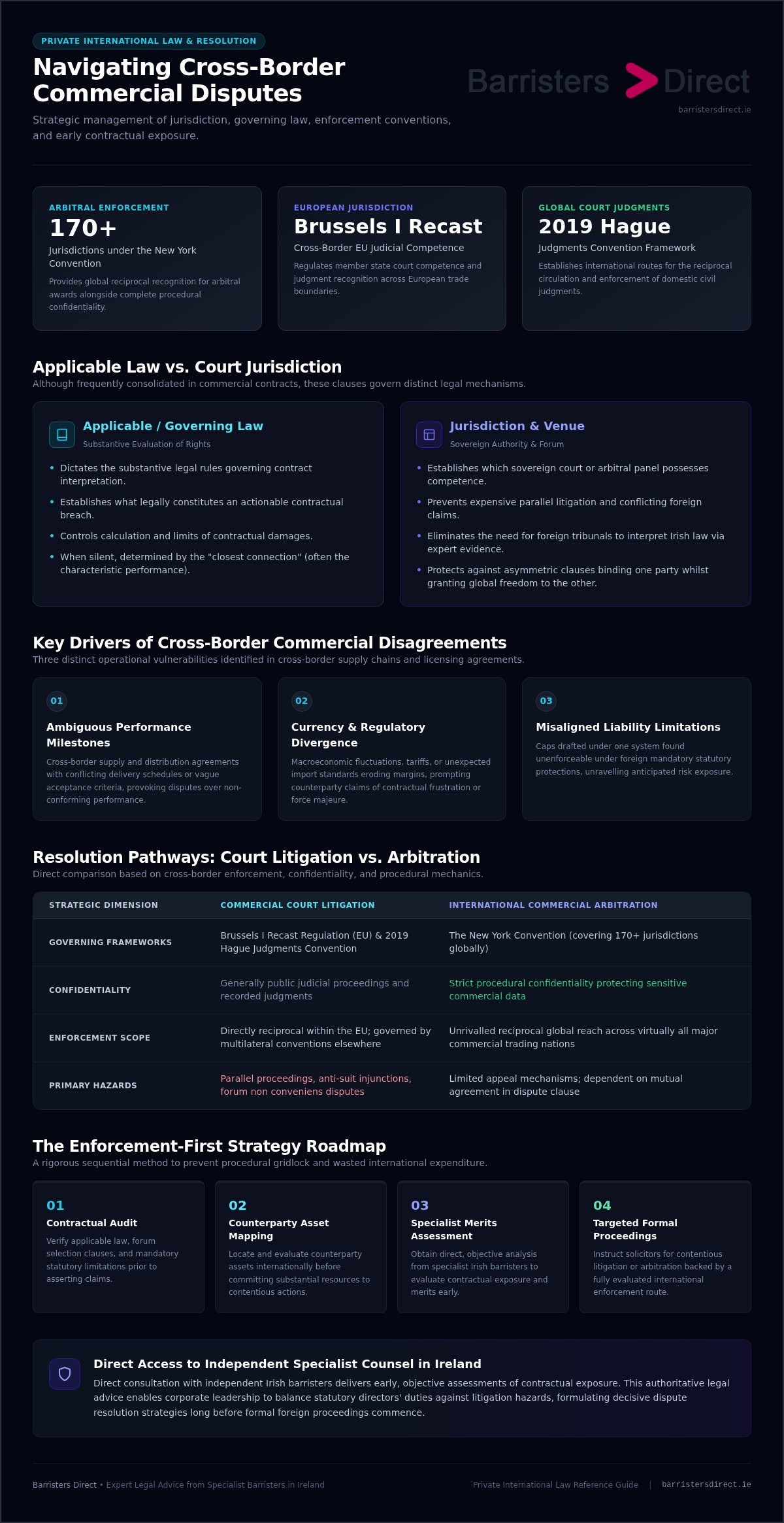
Cross-border commercial friction typically stems from three operational vulnerabilities:
- Ambiguous performance milestones: Cross-border supply contracts and distribution agreements often feature conflicting delivery schedules or vague acceptance criteria, leading to early disputes over non-conforming performance.
- Currency volatility and regulatory divergence: Rapid macroeconomic shifts, tariffs, or changing import standards can disrupt profit margins, prompting one counterparty to claim contractual frustration or invoke force majeure.
- Misaligned liability caps: Businesses frequently discover that limitations of liability drafted under one legal system become unenforceable or subject to conflicting interpretations when evaluated under another nation's mandatory statutory protections.
The Crucial Difference Between Applicable Law and Jurisdiction
Commercial contracts often treat governing law and jurisdiction within a single clause, yet they govern distinct legal mechanisms. Applicable law dictates the substantive rules used to interpret the contract, determine breach, and assess damages. Jurisdiction establishes which domestic court or tribunal possesses the sovereign authority to hear the case.
If an agreement specifies Irish law but assigns exclusive jurisdiction to a foreign court, that international court must interpret Irish common law through expert evidence, creating substantial expense and delay. Equally, asymmetric jurisdiction clauses, which permit one party to sue globally whilst binding the other to a single domestic venue, introduce severe tactical disadvantages. Securing early specialist advice on commercial dispute resolution allows leadership teams to isolate these contractual vulnerabilities before initiating formal proceedings.
Determining Governing Law and Court Competence in Cross-Border Matters
Establishing which court possesses jurisdictional competence forms the immediate operational priority when navigating cross-border commercial disputes. If a contract lacks an explicit dispute resolution clause, domestic private international law rules dictate the outcome. For corporate leadership, miscalculating these mechanisms risks wasted expenditure in an inappropriate forum. Company officers must also balance statutory corporate duties against litigation exposure, ensuring their defensive strategies align with standard company law advice for directors before pursuing international enforcement.
When agreements remain silent on governing law, courts identify the jurisdiction with the closest connection to the transaction, typically the principal place of business of the party performing the characteristic obligation. Where parties include an express dispute resolution mechanism, international statutory frameworks regulate whether that clause is respected.
Cross-Border Claims Within the European Union
Within the EU, judicial competence is primarily governed by the Brussels I Recast Regulation. This framework offers substantial legal certainty:
- Lis pendens rule: Prevents competing, parallel proceedings across member states by obliging any court second-seised to stay its proceedings until the court first-seised confirms jurisdiction.
- Exclusive forum protection: Overrides default first-to-file tactics if the parties have designated a specific member state's court within a valid choice of court agreement.
- Automatic recognition: Enables judgments delivered in one EU member state to be recognized and enforced in another without requiring an intermediate declaration of enforceability (exequatur).
Managing Disputes Involving Third Countries Post-Brexit
Disputes involving counterparties in the United Kingdom or other non-EU countries require a different procedural approach. Following the UK's departure from the EU, the Brussels Recast regime and the Lugano Convention no longer govern jurisdiction between Ireland and the UK. Litigants must instead navigate domestic common law rules governing service out of the jurisdiction.
International conventions bridge some of this divide. The 2005 Hague Choice of Court Convention mandates that contracting states honour exclusive jurisdiction clauses in business-to-business agreements. Crucially, the 2019 Hague Judgments Convention, which entered into force for the EU on 1 September 2023 and for the UK on 1 July 2025, establishes reciprocal enforcement of judgments in civil or commercial matters without review of the underlying merits. Where contracts lack clear exclusive clauses, parties face acute risks of competing foreign proceedings. While many international agreements refer to the UNCITRAL Model Law on International Commercial Arbitration for private dispute resolution, court litigation demands rigorous, early jurisdictional verification. Reviewing contractual provisions early through specialist support on Barristers Direct provides definitive legal clarity before costly jurisdictional battles escalate.
International Commercial Arbitration versus Court Litigation
Choosing between domestic litigation and institutional arbitration shapes your entire procedural strategy when navigating cross-border commercial disputes. According to a 2025 Queen Mary University of London survey, 87% of respondents prefer international arbitration for resolving cross-border disputes, citing confidentiality and procedural flexibility as principal advantages. Despite this preference, domestic commercial courts provide powerful alternatives that warrant careful evaluation.
In Ireland, the Commercial Court, a dedicated division of the High Court, provides robust case management and rapid determinations for disputes exceeding one million euros. While state court proceedings remain inherently public, they offer decisive interim relief, strict procedural timetables, and structured avenues of appeal that private arbitral tribunals cannot match.
The Enforceability of Arbitral Awards Globally
Arbitration derives its international appeal from the 1958 New York Convention, which facilitates reciprocal enforcement across more than 170 countries. National courts in signatory states must recognize and enforce arbitral awards, subject only to strictly limited statutory exceptions such as lack of proper notice, invalid arbitration agreements, or public policy violations. In contrast, enforcing court judgments outside the EU or Hague conventions remains reliant on bilateral treaties or complex domestic common law actions.
Weighing Procedural Costs, Confidentiality, and Evidence
Financial and operational considerations heavily influence forum selection:
- Institutional cost frameworks: Major bodies employ distinct pricing structures. The International Chamber of Commerce updated its Arbitration Rules on 1 June 2026, setting a US$5,000 non-refundable filing fee and raising its automatic expedited procedure threshold to US$4 million. Conversely, the London Court of International Arbitration bills hourly, requiring a £1,950 registration fee and arbitrator rates typically spanning £250 to £650 per hour.
- Reputational confidentiality: Unlike open court hearings, arbitral proceedings protect commercially sensitive intellectual property, proprietary financial arrangements, and trade relationships from public disclosure.
- Documentary production limits: Arbitration significantly limits broad, adversarial discovery common in common law litigation, curtailing extensive disclosure exercises in favour of targeted document requests under established rules like the IBA Rules on the Taking of Evidence.
Balancing these distinct procedural mechanisms requires careful analysis. If an enterprise prioritises global asset recovery across non-convention jurisdictions, arbitration remains the standard. When immediate judicial remedies or domestic assets form the battleground, specialized commercial court proceedings frequently offer greater efficiency.
A Strategic Roadmap for Navigating Cross-Border Commercial Disputes
A successful international dispute strategy begins long before issuing formal proceedings. When navigating cross-border commercial disputes, commercial organisations must adopt an enforcement-first roadmap. Missteps taken during initial communications can inadvertently compromise contractual standing or surrender tactical leverage. Following a structured sequence ensures your business protects its assets, preserves critical evidence, and establishes genuine leverage early.
Conducting an Early Contractual and Evidentiary Review
Before issuing contentious correspondence, leadership teams must execute an exacting forensic audit of the governing contract. Look for multi-tiered dispute escalation clauses, mandatory conciliation windows, and strict notice provisions. Failing to deliver formal notice in the precise manner or timeframe stipulated can invalidate a legitimate claim or delay urgent relief.
Securing contemporary documentation is equally vital. Issue immediate internal document holds across international operational hubs, capturing technical logs, messaging threads, and executive email chains. Specialist counsel must examine past correspondence to confirm whether operational staff inadvertently waived contractual terms, conceded liability, or compromised agreed jurisdictional boundaries during commercial negotiations.
Asset Tracing, Solvency Assessment, and Commercial Mediation
Securing a court judgment or arbitral award represents only half the challenge; recovery is the ultimate measure of success. Initiating proceedings without verifying a counterparty's solvency or the territorial location of their unencumbered assets invites hollow victories. Conducting early asset tracing across known operating jurisdictions confirms whether formal action justifies the required expenditure.
Where counterparties remain solvent but commercial impasses persist, structured international mediation provides a pragmatic alternative. Confidential mediation preserves trading relationships, curtails protracted international friction, and allows parties to negotiate creative commercial settlements that courts cannot order. Evaluating targeted options for commercial dispute resolution before serving legal proceedings protects your enterprise from unrecoverable international outlay. To assess your dispute strategy and contractual merits with independent counsel, schedule a specialist consultation today.
Accessing Specialist Counsel for Strategic Cross-Border Advice
When navigating cross-border commercial disputes, commercial survival hinges on rapid, objective legal evaluation. Traditional approaches often involve lengthy delays before companies receive definitive analysis on contractual merits. Through the direct access model facilitated by Barristers Direct, corporate organisations across Ireland can consult independent barristers directly via telephone or online video conferences. This provides an immediate, authoritative appraisal of jurisdictional risk, contractual liability, and potential recovery routes.
Following each consultation, participants receive an automatic audio recording and a structured written summary. This documentation serves as a permanent strategic blueprint, allowing boards and executive teams to weigh risk exposure with complete internal transparency before allocating capital to international dispute proceedings.
The Value of Independent Senior and Junior Counsel
Consulting independent counsel early delivers focused, unbiased assessment. Because barristers specialise in courtroom advocacy and the rigorous testing of legal arguments, they evaluate disputed clauses through a judicial lens. Their strategic review clarifies critical pressure points:
- Choice-of-law conflicts: Assessing how Irish courts or foreign tribunals will interpret contentious liability exclusions and performance standards.
- Jurisdictional challenges: Determining whether forum non conveniens applications or jurisdictional stays will succeed before proceedings are launched.
- Enforcement viability: Establishing whether foreign assets can be frozen or seized under applicable international frameworks.
Collaborative Progression Between Barristers and Solicitors
Direct counsel consultations work alongside the established legal profession rather than replacing it. Understanding the difference between solicitors and barristers helps clarify how commercial matters transition smoothly into formal litigation. While independent barristers deliver specialist advisory opinions and courtroom advocacy, instructing solicitors remain indispensable for managing day-to-day litigation, drafting and filing court pleadings, conducting formal discovery, and handling client monies.
If contentious cross-border proceedings become necessary, the business instructs a solicitor to run the case. That solicitor builds the procedural framework and instructs counsel for continued representation. This seamless division of responsibilities ensures commercial clients obtain the highest calibre of objective legal guidance early, followed by rigorous solicitor-led litigation management whenever court action is required.
Securing Decisive Clarity in International Commercial Disputes
Resolving jurisdictional conflict, confirming international enforceability, and adopting an enforcement-first strategy protect your enterprise from protracted overseas exposure. Successfully navigating cross-border commercial disputes requires rigorous, objective scrutiny from the outset, ensuring you don't commit vital capital to procedural deadlocks or uncollectable foreign judgments.
Barristers Direct delivers nationwide coverage across Ireland, connecting commercial organisations directly with qualified, independent specialist barristers for confidential online or telephone consultations. Every consultation provides an automated session recording alongside a clear written synopsis, equipping your executive team with an authoritative strategic record before instructing a solicitor for contentious court proceedings. Take control of your contractual position today: book a consultation with an experienced commercial barrister to protect your international operations with complete confidence.
Frequently Asked Questions
What defines a commercial dispute as cross-border?
A commercial dispute is classified as cross-border whenever the contracting entities are domiciled in different sovereign states or contractual obligations are performed across international boundaries. These conflicts involve competing national legal systems, distinct regulatory regimes, and disparate procedural rules. Successfully navigating cross-border commercial disputes requires establishing which substantive laws govern contractual performance and determining where formal proceedings can legitimately be instituted.
Which country's courts have jurisdiction if the contract contains no forum clause?
When a contract omits an express jurisdiction clause, court competence is decided by private international law rules. Within the European Union, the Brussels I Recast Regulation generally assigns jurisdiction to the courts where the defendant is domiciled or where the characteristic performance took place. In disputes involving non-EU counterparties, domestic common law rules governing service outside the jurisdiction determine which national court possesses authority to hear the claim.
Can an Irish court judgment be enforced against assets in another country?
Yes, an Irish court judgment can be enforced abroad through established international conventions. Within the EU, judgments circulate automatically under the Brussels I Recast Regulation without requiring a declaration of enforceability. Across non-EU signatory nations, including the United Kingdom, reciprocal enforcement operates under the 2019 Hague Judgments Convention. Where no convention applies, judgment creditors must initiate separate common law enforcement proceedings in the local foreign court.
Why is international arbitration often preferred over cross-border court litigation?
International arbitration is widely preferred because arbitral awards enjoy streamlined global enforcement across more than 170 countries under the 1958 New York Convention. Unlike open court proceedings, arbitration ensures strict confidentiality, shielding sensitive commercial terms and reputations from public exposure. It also allows counterparties navigating cross-border commercial disputes to appoint tribunals with specialized industry expertise and neutral procedural rules.
What is the difference between governing law and jurisdictional competence?
Governing law identifies the substantive legal system used to interpret contractual provisions, evaluate potential breaches, and calculate financial remedies. Jurisdictional competence determines which sovereign court or arbitral body holds the legal authority to hear the action. An agreement can select Irish substantive law whilst assigning jurisdiction to an overseas tribunal, requiring that foreign forum to interpret Irish common law through expert evidence.
Can a business consult a barrister directly regarding cross-border contractual disputes?
Commercial enterprises across Ireland can consult independent barristers directly under modern direct access rules. Barristers Direct facilitates direct telephone or online consultations with independent counsel specialising in commercial dispute resolution. This initial access delivers an early, objective merits assessment regarding contractual exposure and jurisdictional risks. Participants receive an automated recording and written synopsis, providing a lasting strategic record before deciding on further action.
What role does an instructing solicitor play if a cross-border dispute goes to court?
Instructing solicitors play an indispensable operational role whenever contentious commercial disputes proceed into formal court litigation. While independent barristers deliver specialist advisory opinions and courtroom advocacy, instructing solicitors manage the overarching proceedings. Solicitors issue proceedings, handle formal court filings, execute witness statements, manage documentary discovery, and hold client funds. This complementary division of duties ensures rigorous casework management alongside specialist advocacy.
Disclaimer
This article does not constitute legal advice. Barristers Direct does not provide legal advice. To obtain legal advice, you should contact a legal practitioner.


