

If your business partnership is currently defined by silence or heated arguments rather than strategic growth, how long can your operations actually survive the deadlock? It's a stressful position to be in, especially when the threat of business paralysis or spiralling legal fees starts to feel inevitable. You likely feel trapped by the uncertainty of the Partnership Act 1890 or the daunting complexity of the Irish courts. It's common to fear that a disagreement between partners will lead to a permanent breakdown of the firm you've worked hard to build.
This guide provides the strategic clarity you need by explaining how to access specialist partnership dispute legal advice ireland to protect your interests and restore momentum. Discover how to navigate complex conflicts with specialist legal insight and strategic clarity. We'll examine your legal standing, the mechanisms for avoiding public litigation, and the direct route to expert counsel that bypasses traditional, slower methods of dispute resolution. By the end of this article, you'll have a clear strategic path forward that prioritises practical results over tradition for tradition's sake.
Key Takeaways
- Learn how to identify whether your conflict stems from a breach of fiduciary duty or management exclusion to establish a firm legal footing.
- Understand the default rules of the Partnership Act 1890 and how securing partnership dispute legal advice ireland allows you to manage a "partnership at will" situation effectively.
- Compare the privacy and speed of mediation and arbitration against traditional court litigation to find the most efficient path to resolution.
- Identify the critical documents and evidence needed to prepare a comprehensive timeline that supports your case during a specialist consultation.
- Discover how to use direct access to specialist barristers for a fixed-fee strategic opinion that provides clarity on your case strength.
Identifying the Legal Basis of Your Partnership Dispute
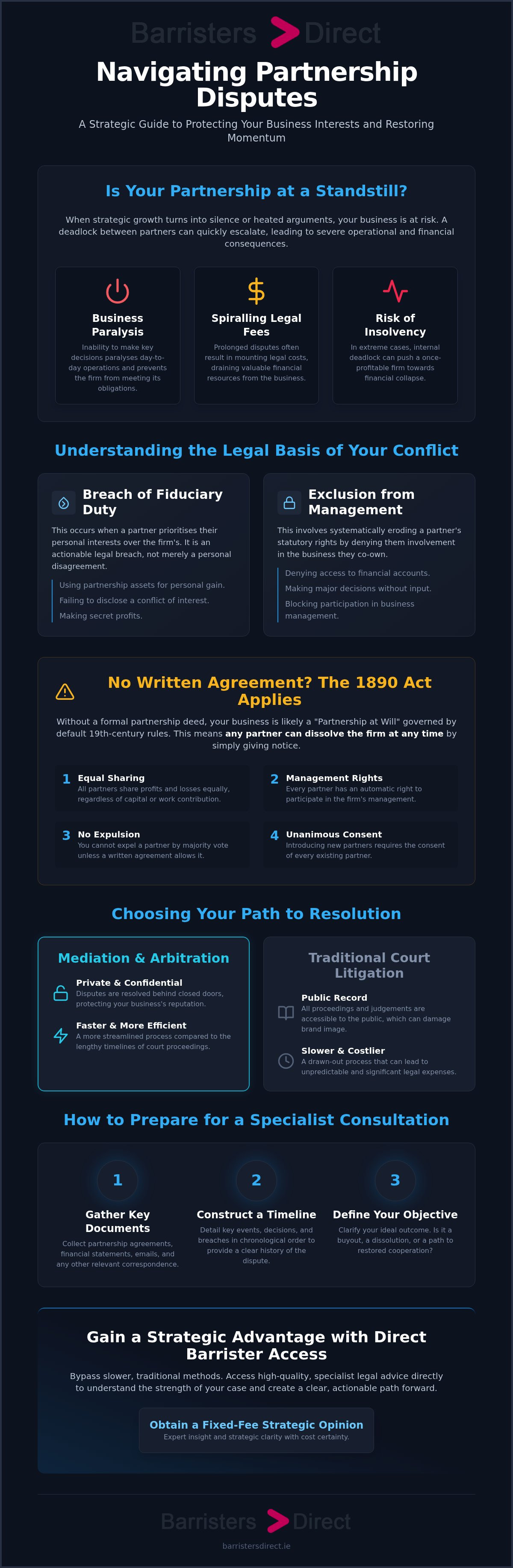
Determining whether a conflict is a personal clash or a technical breach of contract is the first step towards resolution. In Ireland, a Partnership is fundamentally built on mutual trust and agency, meaning each partner has a legal obligation to act in good faith. If you suspect a partner is prioritising their own interests over the firm's, you aren't just dealing with a personality clash; you're facing a potential breach of fiduciary duty. This distinction is critical because personal grievances rarely hold weight in court, whereas actionable legal breaches provide the leverage needed to force a resolution.
Exclusion from management is another severe trigger that often necessitates partnership dispute legal advice ireland. If you are being denied access to financial accounts, or if major decisions are being made without your input, your statutory rights are being systematically eroded. Under Irish law, every partner is entitled to participate in the management of the business unless a written agreement specifically states otherwise. When this right is ignored, the partnership's legal structure is compromised, often leading to a total breakdown of the commercial entity. Identifying these specific breaches early allows you to move from a position of frustration to one of strategic advantage.
Common Triggers for Commercial Conflict
Most commercial disputes within partnerships arise from three main areas: breach of trust, financial disagreements, and competitive behaviour. A breach of trust occurs when a partner fails to disclose a conflict of interest or uses partnership assets for personal gain. Disagreements regarding capital withdrawal or excessive remuneration are equally common, especially when one partner feels they are contributing more effort for less reward. Finally, violations of non-compete clauses, where a partner begins working for a rival or sets up a competing firm, represent an immediate threat to the business's viability and require urgent legal intervention to protect the firm's intellectual property and client base. If your business has since incorporated, similar conflicts can arise in a corporate context, and seeking shareholder dispute advice ireland may be equally relevant to protecting your commercial interests.
The Consequences of Internal Deadlock
Deadlocks are particularly dangerous in 50/50 partnerships where neither party holds a casting vote. If you cannot agree on basic operational matters, the resulting stalemate can paralyse day-to-day operations and prevent the firm from meeting its obligations. This paralysis often leads to financial drainage, as management time is consumed by infighting rather than revenue generation. In extreme cases, a prolonged deadlock can push a profitable firm toward insolvency. Early triage by a specialist is essential here. By identifying the legal strength of your position early, you can decide whether to pursue mediation or prepare for a more formal dissolution before the business's value is entirely depleted.
Navigating the Partnership Act 1890 and Written Agreements
If you operate a business in Ireland without a signed partnership deed, your relationship is governed by a 19th-century statute that may not reflect your current commercial reality. The Partnership Act 1890 is the primary legislation governing partnerships in Ireland where no contrary agreement exists. Operating under this Act often creates what's known as a "partnership at will." This is a precarious legal state because any partner can dissolve the entire firm at any time simply by giving notice to the others. This lack of security makes seeking partnership dispute legal advice ireland a priority if you wish to prevent a single disagreement from ending the business entirely.
Default Rules Under the 1890 Act
The Partnership Act 1890 is the primary legislation governing partnerships in Ireland where no contrary agreement exists. Without a written deed to override them, the following default rules apply to your business:
- Equal Sharing: All partners are presumed to share profits and losses equally, regardless of who contributed the most capital or who does the bulk of the work.
- Management Rights: Every partner has an automatic right to take part in the management of the firm, which frequently leads to the deadlocks discussed in earlier sections.
- No Expulsion: You cannot expel a partner by a majority vote unless that power was specifically granted in a written agreement.
- Unanimous Consent: New partners cannot be admitted without the consent of every existing partner.
The Power of the Partnership Deed
A formal Partnership Deed acts as a private constitution for your business, allowing you to bypass the rigid defaults of the 1890 Act. It provides the necessary framework to manage retirements, terminations, and ownership transitions without triggering a full dissolution. For instance, a deed can include non-compete clauses that prevent a departing partner from poaching your clients or setting up a rival firm nearby. Whilst a solicitor typically drafts these documents, understanding the difference between solicitors and barristers is helpful; a barrister is often the best person to advise on how these clauses will actually be interpreted if a dispute reaches a hearing.
While Irish courts do recognise verbal agreements, they are notoriously difficult to prove. If you rely on a handshake, your legal position depends on the court's interpretation of your past behaviour and correspondence. If your current arrangement feels unstable, obtaining partnership dispute legal advice ireland from a specialist advocate can help you document your standing and protect your commercial interests before a conflict escalates.
Evaluating Resolution Strategies: From Mediation to Arbitration
Resolving a partnership conflict doesn't always require a judge. In fact, most commercial entities benefit from keeping disputes away from the public record. If you are seeking partnership dispute legal advice, your priority should be finding a mechanism that balances speed, cost, and confidentiality. While the Irish court system is robust, the transparency of litigation can damage a firm's reputation and client relationships. Choosing the right path is a commercial decision as much as a legal one.
The Advantages of Alternative Dispute Resolution (ADR)
Mediation is often the preferred route for partners who wish to continue working together or who want a clean, private break. It's a voluntary process where a neutral third party facilitates a settlement. Unlike a court order, a mediated agreement is reached by mutual consent, making it more likely to be honoured by both sides. If mediation fails, arbitration offers a more formal alternative. Under the Arbitration Act 2010, which aligns with international standards, an arbitrator's decision is legally binding. The Chartered Institute of Arbitrators Ireland provides a framework for these proceedings, ensuring they are handled with professional precision. Getting specialist advice early helps you identify which ADR path offers the highest probability of a favourable outcome without the volatility of a trial.
When Litigation Becomes Necessary
Sometimes, the breach of duty is so severe or the deadlock so absolute that only a court order can resolve the matter. Complex commercial disputes often end up in the High Court, where the specialist advocacy of a barrister becomes indispensable. Navigating the Irish court system requires a dual approach. You'll need to engage a solicitor for the formal administration of the case, but the strategic "heavy lifting" and courtroom representation are the domain of the barrister. Before proceeding, it's vital to conduct a cost-benefit analysis. A full trial can take years and cost tens of thousands of Euro. In many cases, obtaining a high-level legal opinion early allows you to leverage a settlement before costs escalate. You can explore commercial dispute resolution services to understand how this strategic triage works in practice.
How to Prepare for a Specialist Legal Consultation
Arriving at a consultation without a structured case is a recipe for wasted fees and strategic confusion. To get the most from partnership dispute legal advice in Ireland, you need to treat your first meeting like a strategic briefing. A barrister's role is to provide a high-level legal opinion on the strength of your case, but that opinion is only as good as the data you provide. Proper preparation ensures that the advice you receive is grounded in the specific realities of your business rather than general legal principles.
Document Gathering and Evidence
Every claim needs a paper trail. Start by locating your Partnership Deed, or if one doesn't exist, gather evidence of the "partnership at will" behaviour discussed in previous sections. Financial records, including profit and loss statements and capital account histories, are vital for disputes involving profit distribution or allegations of financial mismanagement. You should also preserve all relevant correspondence, such as emails, meeting minutes, and even digital messages that document disagreements or admissions of liability. Organise your evidence by date to facilitate a more efficient specialist review. Clear evidence allows a barrister to identify specific breaches of fiduciary duty quickly, saving you both time and money. If your dispute also involves outstanding payments owed to the partnership, understanding your options for unpaid invoice legal action in Ireland can help you recover commercial debts as part of a comprehensive resolution strategy.
Defining Your Desired Outcome
Before your consultation, you must decide what a successful resolution looks like for you. Are you seeking a "buy-out" strategy where you take control of the firm, or is a "winding-up" petition the only way to protect your remaining assets? Perhaps you simply want compensation for a breach of duty whilst maintaining the business structure. Defining these objectives early prevents you from drifting into expensive, aimless litigation that could damage your professional reputation. You should also prepare specific questions regarding your personal liability for the firm's debts and your ongoing duty of care to the partnership. Understanding the advantages of instructing a barrister directly can help you see why this specialist triage is the most efficient way to validate your standing. If your business operates as a limited company rather than a traditional partnership, the same principles of early specialist engagement apply, and exploring shareholder dispute advice ireland can provide a comparable strategic framework for resolving boardroom conflicts under the Companies Act 2014.
If you are ready to move from deadlock to a clear strategic path, you can arrange a fixed-fee consultation with a specialist barrister today to gain the clarity your business requires.
Obtaining Expert Barrister Advice Through Direct Access
Traditionally, accessing the expertise of a barrister required an indirect and often opaque route through a solicitor. This tiered system frequently added layers of cost and time to an already stressful situation. However, the Legal Services Regulation Act has modernised the Irish legal landscape, allowing businesses and individuals to engage specialist counsel directly for certain services. If you're seeking partnership dispute legal advice in Ireland, this direct access model provides a transparent way to obtain a high-level strategic opinion without the initial overhead of a full-service law firm.
The Barristers Direct platform facilitates this connection, matching your specific case with a barrister from a nationwide network of barristers who specialises in commercial law. By consulting a sole practitioner of the Law Library, you benefit from an independent and objective view of your dispute. It's a pragmatic approach to conflict resolution; you get the specialist "triage" you need to determine if your case is worth pursuing before you commit to the complexities of the court system.
The Direct Access Model in Ireland
Bypassing the need for a solicitor for an initial strategic consultation is a significant advantage for partners facing a deadlock. This model allows for flat-fee access to both senior and junior counsel, ensuring you receive the same high standard of advice usually reserved for large corporations. A consultation with a barrister alone is available for a fixed fee of €395 + VAT. This transparency removes the anxiety of escalating legal bills whilst you're still trying to understand your legal standing. If your case is strong, this initial triage identifies the most viable path forward; if it's weak, it saves you from the financial drainage of a doomed litigation attempt.
Transparency and Professional Standards
Modern legal services should be as efficient as the businesses they serve. When you use direct access through a structured platform, you aren't just getting an opinion; you're getting a record of that expertise. Every consultation includes an automatically generated recording and a written synopsis of the barrister's views. This ensures you have a clear, permanent reference point for the strategy discussed. It maintains the elite professional standards of the Irish Bar whilst delivering them in a format that's accessible to the layperson. By choosing this direct route, you ensure that your partnership dispute is handled with precision, strategic intelligence, and a focus on practical commercial results.
Secure a Clear Strategic Path Forward
Navigating a commercial deadlock requires more than just persistence; it demands a precise understanding of your legal standing. By identifying the specific breaches in your partnership and evaluating the most efficient resolution strategies, you move from a position of uncertainty to one of control. Whether your situation involves a breach of fiduciary duty or a disagreement over profit distribution, the right partnership dispute legal advice ireland ensures your interests are protected without unnecessary escalation.
The modern direct access model removes the traditional barriers to expert counsel. You can now access a nationwide network of over 100 independent specialist barristers to gain an objective, high-level opinion on your case. This smarter, faster approach provides the strategic clarity needed to avoid public litigation whilst maintaining professional standards. If you're ready to resolve your conflict with transparency and precision, you can instruct a specialist barrister for a fixed-fee partnership dispute consultation for €395 + VAT. Taking this proactive step today is the most effective way to restore momentum to your business and secure your professional future.
Frequently Asked Questions
Can I get legal advice on a partnership dispute without a solicitor?
Yes, you can engage a specialist barrister directly for strategic advice without first instructing a solicitor. This is permitted under the Legal Services Regulation Act, which allows businesses to access the independent expertise of the Law Library. By choosing this route, you obtain a specialist opinion on your standing and the most efficient path forward. It's a pragmatic way to secure partnership dispute legal advice ireland before committing to the administrative costs of a full legal team.
What is the difference between a barrister and a solicitor in a partnership case?
In partnership disputes, solicitors often manage the ongoing administration, document discovery, and the formal steps of litigation. Conversely, barristers act as specialist advocates and advisers, providing high-level opinions on case strength and representing clients in court. Whilst solicitors are your primary point of contact for case management, a barrister offers the strategic "triage" necessary to interpret complex points of law and fiduciary duties within the Irish legal system.
How much does a consultation for a partnership dispute cost in Ireland?
A strategic consultation with a specialist barrister through the Barristers Direct platform costs a fixed fee of €395 + VAT. If you require a joint consultation involving both a barrister and a solicitor to provide a comprehensive view of your situation, the fixed fee is €595 + VAT. These transparent costs allow you to understand your legal position and case strength without the fear of hidden charges or escalating hourly rates common in traditional legal models.
What happens if we do not have a written partnership agreement?
If no written deed exists, your business is governed by the default rules of the Partnership Act 1890. This creates a "partnership at will," meaning any partner can dissolve the firm by giving notice. Profits and losses are shared equally regardless of capital contribution, and no partner can be expelled by a majority vote. This lack of structure often leads to the deadlocks that require specialist partnership dispute legal advice ireland to resolve effectively.
Can a barrister represent me in court for a partnership dispute?
Whilst direct access allows you to consult a barrister for an expert opinion, representation in the Irish courts usually requires a solicitor to be formally on record. The barrister provides the specialist advocacy and courtroom representation, but the solicitor handles the procedural requirements of the court. If your dispute moves to litigation, the barrister you consulted can work alongside your solicitor to ensure your case is presented with maximum precision and strategic intelligence.
Is the advice I receive during a direct access consultation confidential?
All advice provided by a barrister during a consultation is strictly confidential and protected by professional privilege. To ensure full transparency and provide you with a permanent record, the Barristers Direct platform provides an automatically generated synopsis and a recording of the session. This allows you to review the specialist's strategic recommendations in your own time, ensuring you have clear, expert validation of your legal standing as you move toward a resolution.
What is the Partnership Act 1890 and does it still apply?
The Partnership Act 1890 remains the primary legislation governing partnerships in the Republic of Ireland. It applies to any business relationship where two or more people carry on a business in common with a view to profit without a formal written agreement. Because its rules are often ill-suited to modern commerce, such as the automatic dissolution of the firm upon a partner's death, most businesses use a deed to override these statutory defaults.
How long does it take to resolve a partnership dispute through arbitration?
Arbitration is generally faster than traditional court litigation, though the exact duration depends on the complexity of the dispute. A significant milestone in this process is the appointment of an arbitrator, which typically occurs within a 30-day timeline. Unlike the public court system, which is subject to significant backlogs, arbitration allows for a private, binding decision to be reached on a schedule that prioritises the commercial continuity of your business.
Disclaimer
This article does not constitute legal advice. Barristers Direct does not provide legal advice. To obtain legal advice, you should contact a legal practitioner.


