

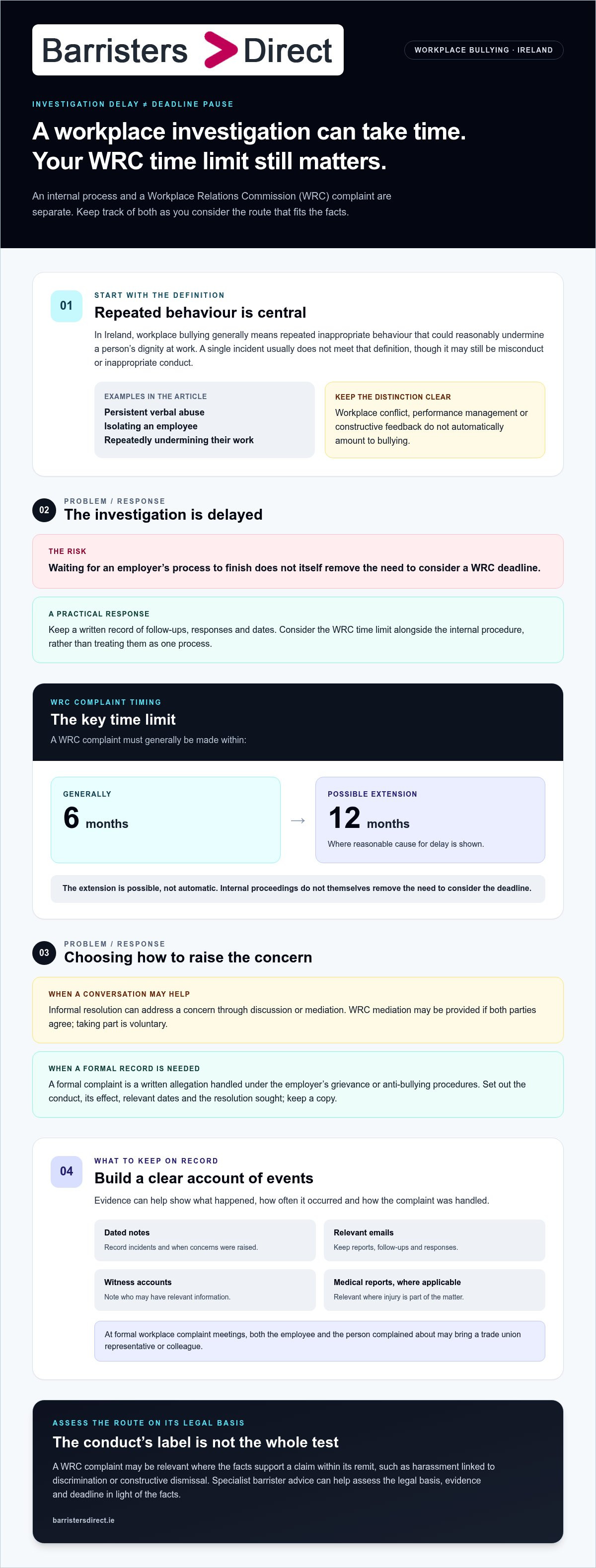
A workplace investigation can stall, but the next step may still depend on a legal deadline. In Ireland, bullying generally means repeated inappropriate behaviour that could reasonably undermine a person’s dignity at work; a single incident usually does not meet that definition. The legal options for bullying in the workplace in Ireland can include an internal grievance and, in appropriate cases, a complaint to the Workplace Relations Commission (WRC). A WRC complaint must generally be made within 6 months, with an extension to 12 months possible where reasonable cause for delay is shown.
It is understandable to expect an employer to investigate a complaint promptly and fairly. Uncertainty can grow when the process takes time, but a delayed workplace investigation and a WRC time limit are separate issues. Understanding the definition, workplace policies and possible routes can help you decide what to do next.
This article explains what conduct may count as bullying, how the Irish Code of Practice and an employer’s policy apply, and how WRC complaints relate to other legal options. It also considers what investigation delays may mean for your decisions, so you can assess the next steps more clearly.
Key Takeaways
- Keep clear records of incidents, including dates, locations, witnesses and relevant emails, to help you explain what happened.
- Use your employer’s anti-bullying policy to understand the available reporting and grievance procedures.
- Distinguish bullying from workplace conflict, performance management and constructive feedback when assessing the behaviour.
- Consider whether a WRC complaint is relevant if the issue involves discrimination or constructive dismissal.
- If an investigation is delayed, keep a written record of follow-ups and consider how the delay affects your next steps.
What Is Workplace Bullying?
In Ireland, workplace bullying involves repeated inappropriate behaviour that could reasonably undermine a person’s dignity at work. A single incident usually does not meet this definition, although it may still be misconduct or inappropriate conduct. Examples include persistent verbal abuse, isolating an employee, or repeatedly undermining their work.
Section 8 of Ireland’s Safety, Health and Welfare at Work Act 2005 requires employers to prevent improper conduct or behaviour likely to put employees’ safety, health and welfare at risk, according to the Irish Statute Book. Section 13 (1) (e) also requires employees not to engage in improper conduct likely to endanger safety, health or welfare at work. These duties make workplace behaviour a health and safety concern, not solely an internal relationship issue.
Employers must identify workplace hazards, assess risks and set out preventive measures in a Safety Statement under section 20 of the Act. The reasonable and practicable measures described in Section 2(6) also relate to protecting employees at work. For bullying concerns, an employer’s code of practice and policy should provide a route for reporting and addressing allegations.
Training can help employees recognise inappropriate conduct and understand how to raise concerns under their employer’s policy. Useful training explains reporting channels, how to record incidents and who handles complaints. For example, an employee facing repeated verbal hostility should know where to report it and what information to provide. Training does not make every disagreement bullying: repeated behaviour and its effect on dignity remain relevant.
Workplace bullying may lead to a personal injuries claim where it causes physical or psychological harm and the employer failed to prevent that harm. A claim needs evidence of injury, such as medical reports; stress or humiliation alone is not sufficient common-law damage without a demonstrable psychological effect or condition. The Supreme Court’s decision in Ruffley v The Board of Management of St Anne’s School, [2017] IESC 33, states there is no separate tort of bullying.
You can raise a workplace health and safety concern with the Health and Safety Authority (HSA). The HSA monitors whether employers and employees meet their duties under the Safety, Health and Welfare at Work Act 2005. Its role concerns compliance with those duties; an employee should distinguish that route from seeking compensation or pursuing an employment complaint.
If an employer ignores a complaint, follow up in writing, escalate it or make a formal grievance under the applicable workplace procedure. Keep copies of reports, emails and responses, and note when you raised each concern. If the issue remains unresolved, legal advice can help assess whether a Workplace Relations Commission complaint or another route fits the facts.
Workplace Relations Commission complaints
The Workplace Relations Commission (WRC) is a route for certain employment claims connected with workplace bullying. An internal complaint process and a WRC case are separate, so consider the relevant legal options for bullying in the workplace in Ireland alongside any ongoing investigation.
Informal Complaint Resolution
Informal resolution addresses a workplace concern through discussion or mediation before a formal complaint is determined. It can clarify the behaviour, the change sought and whether the parties can agree on practical steps. The WRC may provide mediation if both parties agree. If you feel safe raising the issue directly, describe the conduct clearly and say what could help resolve the immediate workplace problem.
Mediation is voluntary and depends on both parties agreeing to take part. It can provide a way to discuss the effects of the behaviour and possible working arrangements without treating the meeting as a formal decision. Keep a note of any agreed actions and who will carry them out. If informal discussions do not address the concern, use the employer’s formal procedure.
Formal Complaints and Investigations
A formal complaint is a written allegation handled under the employer’s grievance or anti-bullying procedures. It gives the employer a defined issue to investigate and creates a record of the response. Set out the conduct, its effect, relevant dates and the resolution you are seeking. Keep a copy and follow the stated procedure if the employer does not respond or the behaviour continues.
You can make a WRC complaint where the facts support a claim within its remit, such as harassment linked to discrimination or constructive dismissal. A complaint must generally be made within 6 months; the time limit can extend to 12 months if reasonable cause for delay is shown. Internal proceedings do not themselves remove the need to consider that deadline. The legal options for bullying in the workplace in Ireland depend on the legal basis of the complaint, not just the conduct’s label.
At formal workplace complaint meetings, both the employee and the person complained about may bring a trade union representative or colleague. If progress stalls, follow up in writing and record the date, response and any next step provided. This creates a clear account of how the employer handled the concern, which can help you explain the process if you later make a WRC complaint.
Evidence for a Bullying Complaint
Evidence helps show what happened, how often it occurred and how the complaint was handled. Keep dated notes, relevant emails, witness accounts, medical reports where applicable, and copies of reports to management. Organise records chronologically and distinguish what you witnessed from what others told you. This can clarify the pattern and connect specific evidence to the issue raised.
For a WRC complaint, link each record to the employment claim you rely on. Correspondence may show when management learned of the concern and how it responded. Understanding the legal options for bullying in the workplace in Ireland can help you decide what advice is relevant to your circumstances.
Definition and examples of workplace bullying
The Irish test focuses on the pattern, nature and likely effect of workplace behaviour. Applying it carefully helps distinguish bullying from difficult but appropriate management or disagreement.
The Irish Workplace Bullying Definition
The recognised Irish definition describes repeated inappropriate behaviour that could reasonably undermine a person’s dignity at work. The Supreme Court identifies repetition, inappropriateness and the effect on dignity as key factors in Ruffley v The Board of Management of St Anne’s School, [2017] IESC 33.
Context matters when applying the test. A manager’s isolated criticism may be unwelcome, but it does not automatically amount to bullying. Repeatedly humiliating an employee in front of colleagues, by contrast, may require closer examination of its pattern and effect. An employee’s account should identify specific conduct rather than rely only on a label.
The Supreme Court also stated that Irish law recognises no separate tort of bullying. An employer’s responsibilities may be relevant when considering workplace bullying. This distinction matters when considering an employment law complaint or civil claim: the relevant legal basis and evidence depend on the facts and alleged harm.
Examples of Workplace Bullying
Examples may include repeatedly excluding an employee from information needed for their role, persistently undermining their work, or subjecting them to demeaning remarks. The key question is not simply whether the behaviour feels unfair. Consider whether it is repeated, inappropriate and reasonably capable of undermining dignity.
Keep your account specific. Record what was said or done, who was present and how the conduct relates to earlier incidents. For example, describe repeated public ridicule by a manager through its separate occurrences, rather than as one general claim of unfair treatment. A clear chronology helps show whether there is a continuing pattern.
Not every difficult interaction meets the test. The Irish Code of Practice identifies performance management, constructive feedback, differences of opinion, workplace conflict and professional disagreements as conduct that does not, by itself, constitute bullying. A legitimate performance discussion can still be assessed in context, particularly if the manner or repeated treatment becomes inappropriate.
Bullying and Harassment Definitions
Workplace harassment has a distinct meaning under the Employment Equality Acts 1998-2015: it is unwanted conduct related to one of the 9 grounds of discrimination. Those grounds include gender, age, race, disability, religion and sexual orientation. Unlike the bullying test, this definition turns on the connection between unwanted conduct and a protected ground.
Bullying and harassment can overlap, but they are not interchangeable. Repeated conduct may undermine dignity without relating to a protected ground; harassment may relate to a ground even when the conduct does not form a repeated pattern. Identify the behaviour, its frequency and any link to a protected ground before deciding which complaint route fits.
Anti-bullying policies and the Code of Practice
An employer’s policy and Ireland’s Code of Practice set out ways to prevent and address bullying at work. They can help employees understand where to report conduct and what to expect from the complaint process.
Workplace Bullying Policies
An anti-bullying policy explains how a workplace prevents, reports and responds to alleged bullying. Use it to identify the correct reporting route, who receives a complaint and how an investigation is handled. For example, the policy may explain how to submit a written complaint and whom to contact if the concern involves a manager.
Employers should take reasonable steps to prevent bullying and have a policy for handling complaints. Check whether your workplace policy explains informal and formal procedures, how information is considered and how an outcome is communicated. If a step is unclear, ask the designated workplace contact for an explanation and keep a record of the response.
The Code of Practice
Ireland’s Code of Practice for Employers and Employees on the Prevention and Resolution of Bullying at Work provides guidance on handling workplace complaints. It was introduced under S.I. No. 674/2020 and became effective on 23 December 2020. The Health and Safety Authority and Workplace Relations Commission developed it jointly, giving employers and employees a shared reference for prevention and resolution.
The Code describes a Contact Person as a first point of contact for someone concerned about possible bullying. That person can help clarify the experience and consider possible action. The Code also addresses hazard identification and risk assessment under section 19 of the Safety, Health and Welfare at Work Act 2005. Failure to follow the Code is not itself an offence, but it can be admitted as evidence in criminal proceedings under section 61 of that Act.
Dignity at Work Policies
A Dignity at Work policy sets out workplace expectations for conduct and explains how concerns about dignity are handled. It gives colleagues a route to report behaviour, including harassment, and helps clarify who will receive and consider a complaint. If you believe you are being bullied, use the policy to identify the appropriate contact and reporting process.
Read the policy alongside the Code, rather than treating either document as a guarantee of a particular outcome. Note the required complaint format, internal stages and how the employer records the process. A Contact Person can help clarify the procedure; keep your own dated notes of reports and responses.
Policies also help distinguish prevention from complaint handling. A workplace can use them to explain expected conduct, identify reporting channels and assess risks before a dispute escalates. If the written procedure is not followed, record which step was missed and when. This can help you explain the concern when seeking legal advice about your options.
Delays in workplace bullying investigations
A delayed investigation can leave behaviour unresolved while evidence becomes harder to assemble. In Ireland, the employer’s internal process and any complaint to the Workplace Relations Commission (WRC) are separate matters, so track both rather than waiting for one to finish.
The Code of Practice expects bullying allegations to be investigated promptly and fairly. If progress stops, write to the person handling the complaint and ask for an update, the reason for the delay and the next step. Keep the message factual. For example, refer to when you submitted your formal complaint and identify any repeated conduct since then.
Delay can affect both the investigation and your choices. Colleagues may find it harder to recall conversations, and emails or other records may become more difficult to locate. Meanwhile, ongoing behaviour can affect your wellbeing or working arrangements. Record each new incident separately, including its date, location, witnesses and nature, and retain relevant correspondence.
Use a written record to make follow-up precise. Note:
- When you raised the informal or formal complaint, and who received it.
- Each response, meeting, promised update or missed step in the procedure.
- Any repeated behaviour during the investigation, with dates and witnesses.
- How the delay affects your work, including any changes to duties or contact with colleagues.
If the employer does not respond, escalate the issue through the grievance procedure or make a formal complaint under the workplace policy. Ask for the process and next steps in writing. The employee and the person complained about may bring a trade union representative or colleague to formal complaint meetings. A written record can show what action you requested and how the employer responded.
Do not assume an internal investigation pauses a WRC time limit. A complaint must generally be made within 6 months, and an extension to 12 months requires reasonable cause for delay. If the workplace process is still ongoing, consider the relevant legal route and deadline alongside it. The WRC may offer mediation where both parties agree, but mediation is distinct from a formal decision on a complaint.
Choose the next step according to the cause of the delay: a missing response calls for written follow-up; an unaddressed complaint may require escalation; a deadline approaching calls for prompt legal advice. If you need help assessing how a delay affects your position, seek advice on your legal options.
Barristers Direct: Commercial Dispute Resolution
Barristers Direct connects individuals and businesses with a specialist barrister for an Employment Law Consultation when a workplace bullying complaint raises questions about employment rights or the next legal step. The fixed-fee initial consultation can help you understand the legal issues and possible way forward. If an investigation delay or unresolved complaint forms part of a wider business dispute, Commercial Dispute Resolution may be relevant to that separate issue.
The right advice depends on the nature of the complaint, the evidence, the employer’s response and any applicable deadline. A specialist barrister can explain the legal issues and outline a practical way forward, while a solicitor may remain an important part of your wider legal support where appropriate.
Contact Barristers Direct to discuss your situation and the advice you need.
Take a Clear Next Step
Choosing among bullying in the workplace legal options in Ireland means deciding what you need to resolve, not simply naming what went wrong. Consider whether your priority is to stop the conduct, challenge how your complaint was handled, or understand whether a formal legal claim fits your circumstances. Being clear about your objective can make a discussion with a legal adviser more focused.
Before seeking advice, write down the decision you face and the questions that remain unanswered. For example, you may need to understand how an ongoing internal process affects your position, or whether the facts support a particular employment claim. A specialist legal assessment can consider the relevant circumstances and explain the available route without assuming that every case calls for the same response.
If you’re ready to discuss your circumstances and get expert legal advice, contact Barristers Direct for advice. A considered next step can help you move forward with greater clarity and confidence.
Frequently Asked Questions
What Should You Do if You Are Being Bullied at Work?
Prioritise your immediate wellbeing, make a clear record of what is happening and consider your employer’s reporting process. Note the effect on your work and any response from a manager, as this can clarify what action you may need. If the situation is affecting your health, seek medical support. Legal advice can also help you understand which route fits your circumstances and what to consider before taking formal action.
Can Bullying at Work Lead to a Constructive Dismissal Claim?
Yes, an employee who leaves because bullying makes their job unbearable may be able to claim constructive dismissal under the Unfair Dismissals Acts 1977-2015. Leaving is a significant step, so consider the consequences before resigning. Keep records of what made continuing work untenable, how you raised the issue, and the employer’s response. Advice on the facts and any relevant deadline can help you assess the claim before deciding what to do.
Can I Bring a WRC Claim for Bullying or Harassment?
You can bring a WRC complaint where the alleged conduct connects to a claim within its remit, such as harassment related to a protected ground or constructive dismissal. A complaint about bullying alone is not automatically a standalone WRC claim. Identify the legal basis, the events relied upon and the outcome sought. If both parties agree, WRC mediation may offer an informal way to address the dispute.
What legally counts as workplace bullying in Ireland?
Workplace bullying generally involves repeated inappropriate behaviour that could reasonably undermine a person’s dignity at work. A single incident usually does not meet this definition, though it may still be inappropriate conduct. In Ruffley v The Board of Management of St Anne’s School, [2017] IESC 33, the Supreme Court identified repetition, inappropriateness and the effect on dignity as key factors. Describe the pattern and context, rather than relying on a label alone.
How is workplace bullying different from harassment or discrimination under Irish law?
Bullying focuses on repeated inappropriate behaviour capable of undermining dignity at work. Under the Employment Equality Acts 1998-2015, harassment is unwanted conduct related to one of the 9 discrimination grounds. Discrimination concerns less favourable treatment connected with a protected ground. The categories can overlap, but not every bullying complaint involves discrimination. Identify whether the conduct relates to a protected ground, as that connection may affect the complaint route.
What steps should an employee take to report bullying under an Irish employer’s grievance procedure?
Start by locating the current grievance or Dignity at Work procedure and identifying its named recipient. Submit a clear complaint through the stated channel, explain the conduct and its effect, and say what response you are seeking. Keep a copy and note any acknowledgement or meeting date. If the complaint concerns the person normally responsible for receiving it, use the alternative route set out in the procedure.
What must Irish employers do under the Code of Practice on the Prevention and Resolution of Bullying at Work?
Employers should take reasonable steps to prevent bullying, maintain a policy for handling complaints, and address allegations promptly and fairly. The Code also provides a framework for prevention and complaint procedures. Employees can use it to understand how a concern should be handled, including the role of a Contact Person as an initial point of contact. The Code guides practice; failing to follow it is not itself an offence.
What are the time limits for bringing a workplace bullying or related employment claim in Ireland?
A bullying-related WRC complaint must generally be made within 6 months. The period can extend to 12 months if the complainant shows reasonable cause for delay. Related claims may rely on different legislation, so identify the legal basis before calculating the relevant deadline. An ongoing internal investigation does not itself remove the need to consider WRC time limits. Record key dates, including when the conduct occurred and when you complained.
Disclaimer
This article does not constitute legal advice. Barristers Direct does not provide legal advice. To obtain legal advice, you should contact a legal practitioner.


