

What if a tenant’s insolvency doesn’t automatically end the lease, but changes what you can do next? For landlords, advice on landlord rights in tenant insolvency starts with identifying the process involved and checking the lease. These facts can shape whether rent arrears may be recovered, what happens to future rent and whether steps to regain possession are available.
It’s understandable to want a clear answer quickly, particularly if the tenant remains in occupation or payments have stopped. But examinership, SCARP and liquidation can affect a landlord’s options in different ways. This guide explains what to establish first, which documents to review and what questions to address before taking action.
Start with the lease, rent records and any notices or documents relating to the insolvency process. Then consider how that process may affect enforcement, occupation and claims for unpaid or future rent. If the position is complex, Barristers Direct can arrange a paid consultation with a qualified barrister with relevant landlord and tenant or commercial insolvency expertise. The barrister can discuss your circumstances and possible next steps.
Key Takeaways
- Distinguish financial distress from a formal insolvency process, as the process can shape the landlord’s available options.
- Review the lease and identify the insolvency office-holder, if one has been appointed, before deciding what steps to take.
- Assess rent already due separately from future obligations. Don’t assume either can be recovered without reviewing the circumstances.
- Keep the lease, payment records, notices and relevant communications together so the key facts are clear.
- Advice on landlord rights in tenant insolvency can help clarify lease, arrears and possession questions. Barristers Direct arranges paid consultations with qualified barristers.
Advice on landlord rights in tenant insolvency: what changes first?
Unpaid rent, a tenant still occupying the property and uncertainty about the lease can put a landlord under pressure to act quickly. But taking steps before establishing the facts may narrow your options. A tenant’s financial difficulty is not, by itself, proof that a formal insolvency process has begun or that the lease can be ended.
Tenant insolvency can mean the tenant is experiencing serious financial difficulty or is subject to a formal process dealing with its debts. The distinction matters. A tenant might say it cannot pay rent, request more time or stop trading, but those events do not necessarily establish which legal process, if any, applies. Advice on landlord rights in tenant insolvency therefore begins by identifying the tenant’s status and the documents or communications that support it.
Is the tenant financially distressed or in a formal insolvency process?
Record exactly what you have been told and by whom. A message from the tenant’s director, an accountant or an insolvency practitioner may each have a different significance. Check whether the person says they are acting in a formal capacity and whether they identify a process such as examinership, SCARP or liquidation. Don’t treat a warning of financial trouble as confirmation that a process has commenced.
Look for formal notices, court documents or written communications identifying the process and any appointed office-holder. Keep copies, note when they arrived and avoid assuming that a missed payment alone gives you a right to terminate the lease. The legal effect depends on the circumstances and the applicable process.
Why the lease and tenant’s legal identity matter
Confirm who the tenant is under the lease: a company, an individual or another legal entity. A trading name may not be the contracting party. Compare the tenant named in the lease with the entity in the insolvency communications, then identify any guarantor, security and other parties to the agreement. These details help frame questions about rent, occupation and responsibility, but don’t determine the answer on their own.
Gather the signed lease and variations, rent schedule, payment records, guarantees and relevant notices. Check provisions dealing with default, assignment, guarantees and insolvency, while recognising that a lease clause must be considered alongside the law and the tenant’s actual status. For example, if the lease names a subsidiary but communications relate to its parent company, that difference may need careful review.
Treat the issue as a fact-specific review, not an automatic route to termination or recovery. The Landlord and Tenant Legal Advice page explains how to access a qualified barrister for a paid consultation. Specialist input can help you assess the lease, the tenant’s identity and the stated insolvency process before deciding what to do next.
How the insolvency process and commercial lease affect landlord options
Once you’ve identified the tenant and the process, consider how they interact with the lease. Liquidation, examinership and receivership are distinct arrangements, not interchangeable labels. A company may also enter SCARP, a restructuring process for eligible small and micro companies. The process in place, the documents establishing it and the role of any office-holder all affect which questions need answering.
Which insolvency process is involved?
Confirm the process from formal notices or other reliable documents, rather than relying on a general statement that the tenant is “insolvent”. Establish whether a liquidator, examiner, receiver or SCARP process adviser is involved and what their stated role is. The legal effect on a lease, landlord enforcement and the office-holder’s powers can differ. For a high-level overview, see Thomson Reuters Practical Law’s Restructuring and Insolvency in Ireland.
Use the process name to frame your enquiries, not to assume the answer. A restructuring process and a winding-up may raise different questions about continued occupation, rent accruing during the process, lease termination and claims for losses. The Irish legal effect in the specific circumstances should be assessed before you act.
What the commercial lease may need to be checked for
Read the lease alongside any variations, guarantees and security documents. Look for clauses dealing with rent and arrears, tenant default, termination, assignment, occupation and security. A guarantee or other supporting document may raise further questions, but its wording and legal effect need individual assessment. Keep the relevant documents together with the insolvency notices and payment history.
The table below lists practical issues to investigate. It does not describe automatic rights or outcomes:
| Issue | Question to investigate |
|---|---|
| Process and office-holder | What formal process is under way, and what is the appointed person’s role? |
| Rent | Which sums were due before the process, and what rent or other charges have fallen due since? |
| Occupation and termination | What does the lease say, and are there process-related restrictions or steps that need legal review? |
| Security and guarantees | What documents exist, who gave them, and what do their terms require? |
For further context, see Barristers Direct’s page on corporate insolvency. If the lease and process documents leave important questions unresolved, a paid consultation with a qualified barrister gives you an opportunity to discuss the specific facts and possible next steps. Advice on landlord rights in tenant insolvency can help distinguish issues that require action from those that need closer legal analysis first.
Rent arrears, possession and lease termination: questions to assess
Once you know which insolvency process is involved, focus on the practical questions it raises. The lease and insolvency process need to be considered together: neither arrears nor an insolvency event alone gives a complete answer about recovery, termination or possession.
Can a landlord recover rent arrears?
Establish what is claimed and how it is calculated. Separate unpaid rent and other charges by period, then compare the figures with the lease, invoices, receipts and bank records. Note any disputed sums, part-payments, concessions or correspondence that could affect the account. Keep rent that fell due before the formal process separate from amounts accruing afterwards.
Then consider how the tenant’s process affects the claim and which steps are available. The route and prospects of recovery depend on the tenant’s legal position, the documents and applicable procedures. A claim for arrears does not guarantee recovery, and the process may affect how or when it can be pursued. The Citizens Information Board’s overview of landlord rights and responsibilities provides general background, but a commercial lease in an insolvency context calls for specific assessment.
Can insolvency end the tenancy or allow possession?
Separate two issues: whether the lease has been validly terminated, and what lawful steps are available to recover possession. Insolvency does not, on its own, settle either question. Examine the lease wording, formal process and any restrictions affecting the tenant or an office-holder together before taking action.
If the tenant remains in occupation, don’t assume that changing locks, entering the premises, removing goods or otherwise taking matters into your own hands is lawful. These steps can raise serious legal issues, particularly where the tenant is subject to a formal process. Have any proposed action reviewed against the lease and current circumstances first. The same careful analysis applies if the tenant or office-holder proposes a surrender, disclaimer or other route to bring the lease to an end.
Before deciding what to do, consider:
- Which rent and other charges are outstanding, and for what periods?
- What does the lease say about default, termination and possession?
- Has the insolvency process affected enforcement or the tenant’s occupation?
- What formal route, if any, is available to recover the premises?
Advice on landlord rights in tenant insolvency can help assess these questions against the specific lease and process without assuming a particular result. Barristers Direct arranges paid consultations with qualified barristers, where you can discuss the lease, arrears records and relevant communications. Explore access to a qualified barrister for a focused discussion of the legal issues and possible next steps.
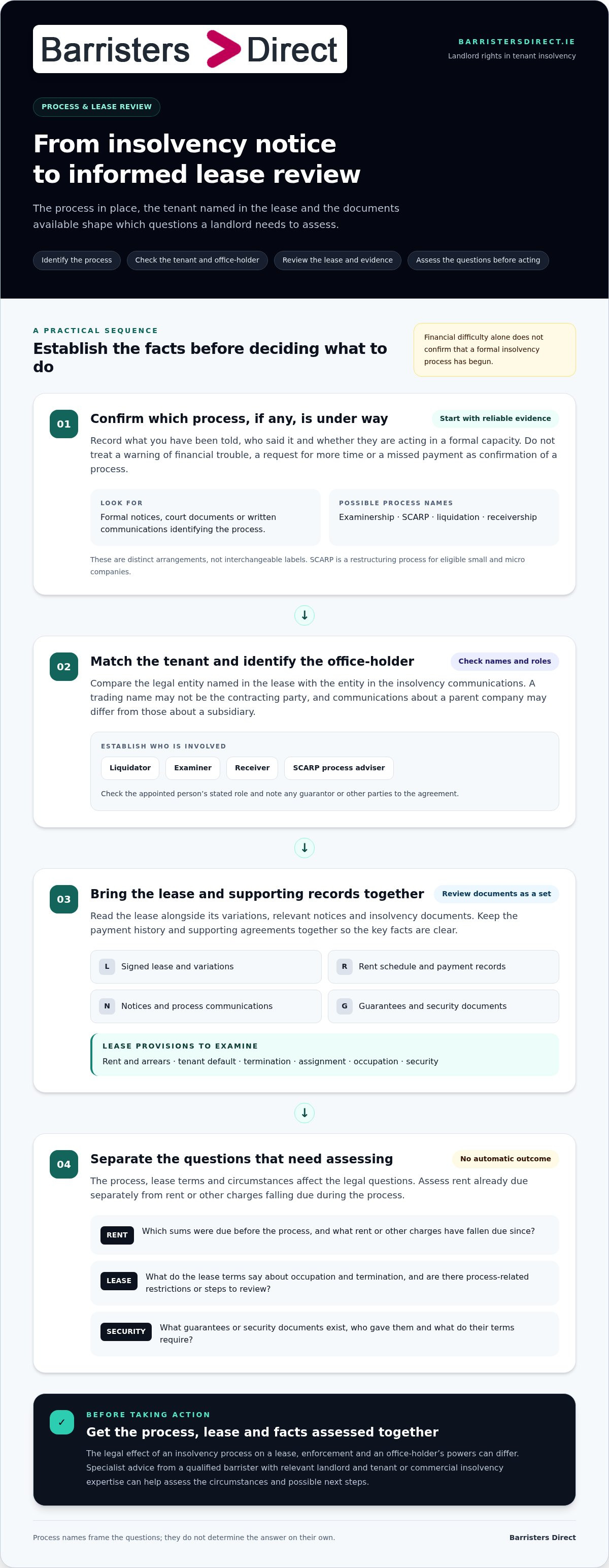
What landlords should do when a tenant becomes insolvent
A clear record of events can help you assess the situation and explain it accurately when seeking advice. Work through these steps in order, updating your file as new information arrives. Avoid irreversible action until you understand how the lease and the tenant’s stated insolvency process may affect your position.
- Confirm the process. Check formal correspondence and establish whether a process has commenced, what it is called and who is acting in an official capacity. Record the source and date of each communication.
- Assemble the relevant documents. Bring together the lease, variations, guarantees, security documents, rent account, payment records and any notices. Keep originals safe and organise copies by date or topic.
- Record events and occupation. Note missed payments, contact with the tenant or an office-holder, visits or changes at the premises, and whether the property remains occupied. Distinguish what you have directly observed from what someone has reported.
- Identify the decisions that need attention. List immediate concerns about arrears, continued occupation, security or a proposed step under the lease. If a notice gives a deadline, record it and seek advice on its significance rather than assuming what it means.
Documents and facts to assemble
Keep the signed lease and every variation together, alongside guarantees, security documents and a rent ledger showing charges, payments and outstanding sums. Add notices, emails, letters and notes of telephone conversations, including who took part and what was said. Record the property’s current occupation and identify any formal correspondence, its sender and the stated role of an appointed office-holder. An organised file makes inconsistencies easier to spot.
Questions to resolve before taking action
Before sending a demand, relying on a lease clause or taking steps concerning the premises, clarify which process applies and what the relevant documents say. Ask how arrears are calculated, what is happening with occupation, whether security or guarantees are relevant and what response is being considered. Keep communications factual and measured. Avoid assuming a right or outcome before it has been assessed.
If the rent account also includes a separate unpaid invoice or another distinct debt, that issue may need to be considered separately from rent under the lease. For questions about the insolvency process, lease rights or a proposed response, Barristers Direct can arrange a paid consultation with a qualified barrister. The barrister provides any advice, and the consultation gives you an opportunity to discuss the documents and specific facts.
For advice on landlord rights in tenant insolvency, organise your file and use Barristers Direct to access a qualified barrister for a paid consultation about the issues and possible next steps.
When specialist advice on landlord rights in tenant insolvency can help
Specialist input may be useful when the documents or process leave you unsure whether the tenant can remain in occupation, how to approach rent arrears or what the lease allows you to do next. It can also help before you respond to a proposed surrender, rely on a termination clause or take a step that may be difficult to reverse. The aim is to assess the specific lease and insolvency context, not to assume one remedy fits every case.
Advice on landlord rights in tenant insolvency is particularly relevant if the tenant’s status is unclear, an office-holder has contacted you or the lease and insolvency correspondence appear to raise competing issues. A qualified barrister with relevant landlord and tenant or commercial insolvency expertise can discuss the legal questions and possible routes in light of your documents and circumstances.
What a landlord can prepare for a consultation
A concise, organised file helps make a discussion more focused. Bring, or be ready to describe:
- the tenant’s legal identity and any information about the insolvency process or appointed office-holder;
- the signed lease, variations, guarantees and security documents;
- a rent account showing amounts claimed, payment dates and any disputed items;
- formal notices and relevant communications with the tenant or office-holder; and
- the property’s current occupation and the decisions you need to make.
Write down the questions you need answered, such as how to address arrears, whether the tenant’s occupation can continue or what legal steps may be available under the lease. A consultation can take place online or by telephone, so you can discuss the issues without an in-person meeting.
How Barristers Direct arranges access to specialist counsel
Barristers Direct arranges a paid consultation with a qualified barrister in the relevant area of law. Barristers Direct arranges access; the barrister provides any advice. Any subsequent engagement or contract is between you and that barrister. The consultation gives you an opportunity to put your specific lease, insolvency documents and questions before a legal specialist, without implying a guaranteed outcome.
If you’re ready to discuss your circumstances, arrange a consultation with a specialist barrister.
Take your next step with a clear view of the facts
A tenant’s insolvency doesn’t, by itself, answer whether rent can be recovered or whether the lease can be ended. The process involved, the tenant’s position and the lease terms all matter. Keeping the relevant documents organised can help you identify the questions that need a considered answer before you act.
For advice on landlord rights in tenant insolvency, specialist input can help you examine the specific lease and insolvency context and understand possible next steps. Barristers Direct arranges a paid consultation with a qualified barrister in the relevant area of law. Any advice is provided by the barrister, and any further engagement is between you and that barrister. Consultations can take place online by Zoom, Microsoft Teams or Google Meet, or by telephone.
If you’re ready to discuss your circumstances with a specialist, arrange a consultation with a qualified barrister. With the relevant documents and focused advice, you can approach the next decision with greater clarity.
Frequently Asked Questions
What rights does a landlord have if a tenant becomes insolvent in Ireland?
A landlord’s options depend on the insolvency process, the lease and the tenant’s circumstances. A landlord may have a claim for unpaid rent, but its treatment and prospects of recovery can vary. In processes such as examinership, restrictions may affect enforcement, while liquidation raises different questions about claims and the lease. Check the formal process and relevant documents before acting. Insolvency does not give every landlord the same rights or remedies.
Can a landlord terminate a commercial lease when the tenant becomes insolvent?
Possibly, but insolvency alone does not establish that a landlord can terminate a commercial lease. Consider the lease terms alongside the process and any restrictions on enforcement. For example, examinership can restrict a landlord from taking enforcement steps without court permission, and lease repudiation may involve a court application. Before serving a notice or relying on an insolvency clause, get advice on how it applies to the specific process and facts.
Can a landlord recover rent arrears from an insolvent tenant?
A landlord can assess and submit a claim for arrears, but full recovery is not assured. The amount, period, supporting records and insolvency process all matter. In examinership or liquidation, pre-process arrears may be treated as an unsecured debt, with recovery depending on the process and available assets. Separate rent already due from charges accruing during the process, and have the claim and appropriate steps reviewed against the relevant documents.
What should a landlord do first when a tenant enters insolvency?
First, establish whether a formal insolvency process has commenced and identify any office-holder and their stated role. Then organise the signed lease, variations, rent account, payment records, notices and communications. Record the property’s current occupation and note decisions that may be approaching, such as responding to a proposal or addressing arrears. Don’t assume that a missed payment or report of financial difficulty establishes a right to terminate or recover possession.
Does tenant insolvency automatically end a commercial lease?
No. A tenant’s insolvency does not, by itself, automatically end a commercial lease. The lease may contain relevant clauses, but their effect must be assessed alongside the formal insolvency process and any restrictions that apply. The lease might continue while questions about occupation, rent or termination are addressed. Before treating the premises as available or taking steps to recover possession, check the tenant’s status and get advice on the specific circumstances.
Can a landlord change the locks if an insolvent tenant owes rent?
Don’t assume that unpaid rent allows you to change the locks. Locking a tenant out may raise legal issues about the lease, possession and any restrictions connected with the insolvency process. The answer depends on the circumstances and any steps already taken to end the tenancy. Before entering, changing locks or removing goods, seek specialist advice on the proposed action and the lawful route to possession.
When should a landlord get specialist legal advice about tenant insolvency?
Seek specialist input if you’re unsure which process applies, whether enforcement is restricted, how to approach arrears or what steps may recover possession. Advice on landlord rights in tenant insolvency can help assess the lease and process together. Barristers Direct arranges a paid consultation with a qualified barrister in the relevant area of law. The barrister provides any advice, and any further engagement is between you and that barrister.
Disclaimer
This article does not constitute legal advice. Barristers Direct does not provide legal advice. To obtain legal advice, you should contact a legal practitioner.


