

Could a disappointing result after cosmetic surgery amount to negligence, or might it be a recognised complication? A poor outcome alone doesn’t answer that question. When researching cosmetic surgery negligence claims Ireland, the key issue is whether the care fell below the appropriate standard and caused harm. This guide explains the distinction without assuming either that negligence occurred or that it did not.
You’ll learn what information may help a specialist assess your situation, including treatment records, correspondence and details of any ongoing physical or emotional effects. We’ll also outline possible next steps, while recognising that these depend on the individual facts. Barristers Direct arranges paid consultations with qualified barristers in the relevant area of law. The platform arranges the consultation; any legal advice is provided by the barrister. Separate solicitor involvement may be relevant if formal court proceedings are required.
Key Takeaways
- A distressing or unexpected result doesn’t automatically establish negligence. The circumstances and standard of care require individual assessment.
- For cosmetic surgery negligence claims Ireland, relevant records and details of the alleged harm can help a barrister consider the issues.
- Organise what you can: procedure dates, communications, symptoms and follow-up care can help clarify the sequence of events.
- A specialist barrister consultation can provide an early, focused view of your concerns without predicting the outcome of a claim.
- Barristers Direct arranges a paid consultation with a qualified barrister. The platform itself doesn’t provide legal advice or legal services.
Cosmetic Surgery Negligence Claims in Ireland: When Is a Poor Outcome a Legal Concern?
A distressing or unexpected result after cosmetic surgery can leave you asking what happened and whether the care you received was appropriate. That uncertainty is understandable, but dissatisfaction alone doesn’t establish negligence. A result, however disappointing, is not proof of negligence: the question is whether the care fell below the appropriate standard and whether that failure caused harm.
That distinction matters in cosmetic surgery negligence claims Ireland. A complication or outcome that was among the risks discussed before treatment may be upsetting without, by itself, showing negligent care. A legal concern may arise if there is evidence that care fell below the required standard and caused injury. A general explanation of what constitutes medical malpractice can provide context, but it cannot determine whether a particular case meets the relevant Irish legal test.
What may make a cosmetic procedure a negligence concern?
An assessment may consider the care provided, the harm alleged and whether the care caused that harm. For example, a patient might raise concerns about an alleged error during treatment or a failure in aftercare. These are examples of issues that may need examination, not proof of negligence. A specialist legal assessment considers the individual circumstances and relevant medical evidence before reaching a view.
A complication can occur even where care was appropriate. Equally, describing an outcome as a known risk does not settle every question about how care was provided. The facts matter. A barrister can consider the legal issues raised by your account and available records, without treating an early view as a prediction of success.
Does an unwanted cosmetic surgery result automatically mean negligence?
No. An unwanted result, a need for further treatment or a difference between expectation and outcome does not automatically prove that care was negligent. The circumstances require individual assessment by a qualified legal professional. That assessment considers whether the care was appropriate and whether any alleged shortcoming caused harm, rather than relying on the outcome alone.
The impact can be physical, emotional, or both. You may feel distressed, uncertain or concerned about what comes next. Those feelings deserve to be taken seriously, but they don’t, on their own, establish a legal claim or entitlement to compensation. The distinction between an unsatisfactory outcome and an alleged breach can arise in other areas too, including construction claims, although each area has its own facts and legal considerations.
How a Barrister May Assess a Cosmetic Surgery Negligence Concern
An initial assessment is a reasoned review, not a forecast of whether a claim will succeed. A barrister may consider your account alongside available records and the harm you say followed the procedure. The discussion can help identify the issues that need closer examination, what information may be missing and whether further specialist input could clarify the medical aspects.
For cosmetic surgery negligence claims Ireland, questions about the care provided and its connection to the alleged harm need to be considered in the context of the particular case. The applicable legal standards, including how consent and clinical practice are assessed, should be checked against current Irish law and authoritative guidance. The Medical Council guidelines offer context on professional conduct and ethics, but don’t by themselves determine whether negligence occurred.
An initial legal view can clarify the questions and evidence that may matter, but it cannot guarantee the outcome of a claim.
Which questions may matter when reviewing the care received?
The discussion may cover the procedure and what was explained beforehand, the care provided during treatment, and what happened afterwards. For example, a barrister may ask what information you recall receiving about the procedure, how your concerns were addressed and what follow-up care took place. These are practical topics for discussion, not a complete or legally prescribed test. Their relevance depends on the facts.
Where appropriate, the assessment may also consider whether medical evidence is needed to understand the care and alleged harm. The need for, and role of, expert evidence depends on the circumstances; it shouldn’t be assumed from the outset.
How can records and the timeline assist an initial assessment?
A clear chronology makes it easier to identify gaps or points that need explanation. Organise material already available to you, such as appointment details, procedure or follow-up records, written communications and notes about symptoms or treatment afterwards. There is no fixed list of documents that applies to every concern, and not having a particular record doesn’t, on its own, determine whether a claim can be assessed.
Record events as accurately as you can, distinguishing what you remember from what a document says. Include dates where known, what was communicated, when symptoms began or changed, and any subsequent care. If details are uncertain, mark them as uncertain rather than guessing. This gives the barrister a clearer account to consider alongside the records.
If you want an early, focused discussion of the legal issues, Barristers Direct arranges consultations with qualified barristers. The platform arranges the paid consultation; legal advice is provided by the barrister, not by Barristers Direct.
Cosmetic Surgery Negligence Claims: Complications, Harm and Evidence Compared
A complication, an unexpected result and an allegation of negligent care are not interchangeable. An event may prompt questions, but it doesn’t settle whether care was appropriate or whether any shortcoming caused harm. The table offers a starting point for organising those questions, not a decision about an individual case.
| Event or outcome | What it may indicate | What requires professional assessment |
|---|---|---|
| A risk discussed before the procedure occurs | The outcome may be a recognised or disclosed risk, though that fact alone doesn’t resolve every concern. | What was explained, what care was provided, and how the particular outcome arose. |
| The result differs from what was expected | There may be a need to understand the procedure, recovery and any further care. | Whether the difference reflects a complication, an issue with care, or another explanation, based on the available evidence. |
| A patient alleges an error in treatment or aftercare | This raises a question about the care provided, rather than establishing that it was negligent. | Whether the alleged shortcoming can be supported and whether it caused the harm described. |
How is a recognised complication different from alleged negligent care?
A complication can occur without negligent care. Equally, calling an outcome a known risk doesn’t automatically answer whether the care in a particular case was appropriate. The assessment needs to consider the circumstances, relevant records and, where needed, medical evidence. For cosmetic surgery negligence claims Ireland, a specialist legal professional can help identify which questions matter without treating the complication itself as proof either way.
The table isn’t a checklist or a legal test. Each situation turns on its own facts, and an adverse outcome alone doesn’t establish a claim.
What kinds of harm and loss may need to be discussed?
Describe the effects as clearly as possible. These may include physical symptoms, changes to day-to-day activities, further treatment or recovery needs, and emotional impact. If there are related expenses or effects on work or personal life, note what happened and keep any relevant material you already have. This information may help explain the consequences you say followed the procedure.
Whether an effect is legally relevant, whether it can be linked to the care, and whether it may be recoverable depend on the facts and applicable law. Those questions require individual assessment. A complication or distressing result doesn’t, by itself, mean compensation is due, and an award cannot be predicted from the outcome alone. Setting out the impact helps a qualified professional understand the situation without assuming a particular legal conclusion.
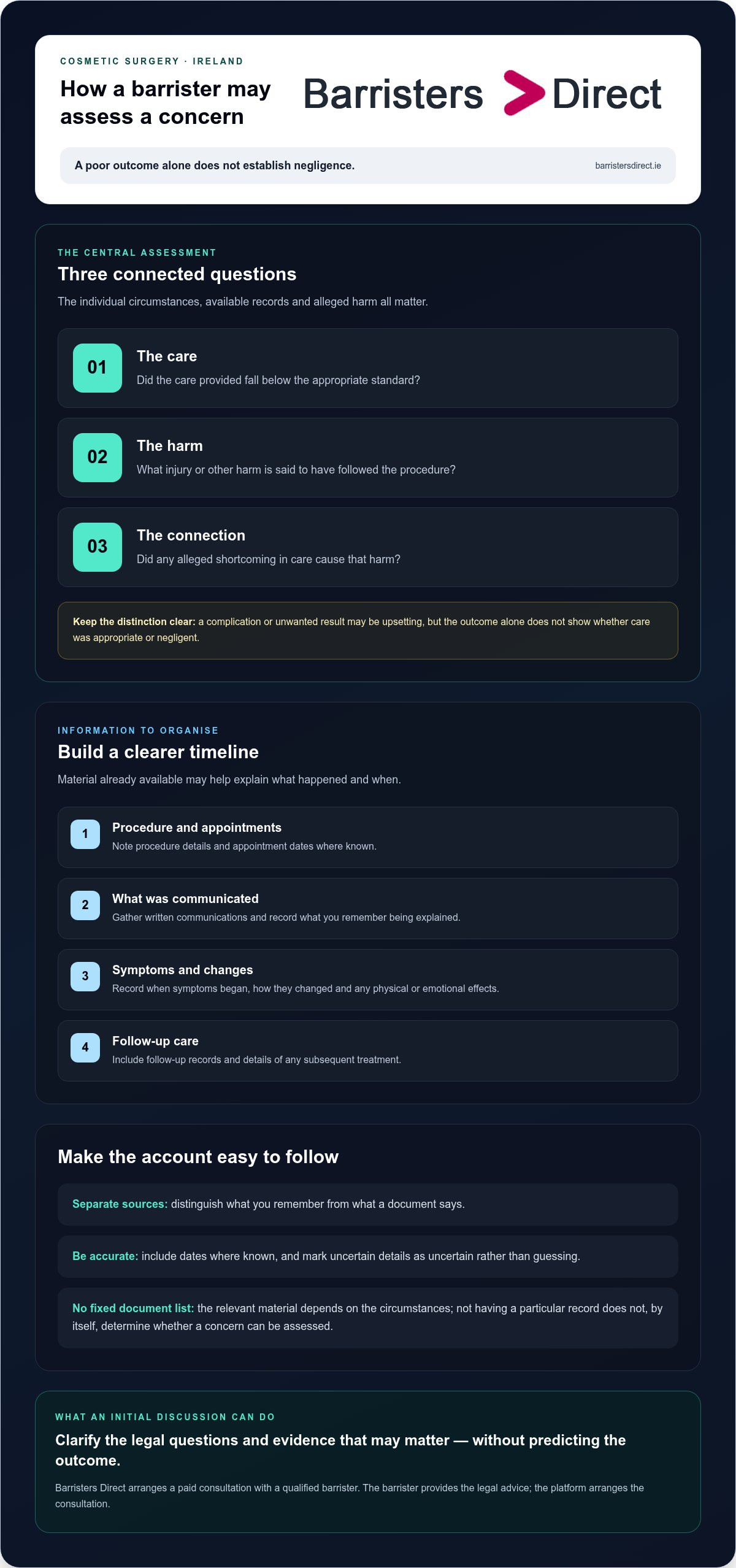
What to Prepare Before Seeking Advice About a Cosmetic Surgery Claim
A little organisation can make an initial discussion more focused. You don’t need to build a complete case or have every document before seeking an assessment. For cosmetic surgery negligence claims Ireland, the aim is to give a qualified barrister a clear account of what happened, the concerns you have and what you hope to understand.
Which information is useful to organise before a consultation?
Prepare a short, factual summary and collect relevant material already available to you. Keep your account clear and separate what you remember from what records show. Missing documents don’t, by themselves, decide whether your concern can be assessed.
- Set out the sequence. Note the procedure date, appointments before it and any follow-up care. If you’re unsure about a date, say so rather than guessing.
- Summarise communications. Record what you recall being discussed about the procedure, concerns you raised and responses you received. Include relevant messages or letters you already have.
- Describe what followed. Note symptoms, changes over time, further treatment and how the situation has affected daily life. Keep the description measured and factual.
- Write down your questions. You might want to understand which aspects of the care need closer review, what evidence may help, or what options could follow an initial view.
This is a preparation aid, not a legally prescribed evidence list. Avoid posting medical records or sensitive personal details in public forums or article comments. Share relevant information through an appropriate private channel for your consultation.
What should readers understand about timing and next steps?
Legal time limits can matter, and the deadline and any procedural steps should be checked against current Irish law for your circumstances. Don’t assume that time is available simply because treatment or discussions are ongoing. If you’re concerned about timing, raise it at the outset so it can be addressed in the legal assessment.
An early discussion can help clarify the issues and possible next steps, but it doesn’t commit you or the barrister to further work. If you’d like to understand the approach, read about the advantages of instructing a barrister directly. Barristers Direct arranges a paid consultation with a qualified barrister; the platform itself doesn’t provide legal advice or legal services.
To discuss your concerns with a specialist barrister, arrange a consultation through Barristers Direct. Any advice is provided by the barrister, and further steps can be considered in light of that discussion.
Getting Specialist Barrister Input on a Cosmetic Surgery Negligence Concern
If you want a focused legal view of your concerns, Barristers Direct can arrange a paid consultation with a qualified barrister whose expertise is relevant to the issue. For people considering cosmetic surgery negligence claims Ireland, this provides an opportunity to discuss the circumstances with a specialist without assuming that a claim will be accepted or succeed.
The consultation may take place online through Zoom, Microsoft Teams or Google Meet, or by telephone. Barristers Direct arranges the consultation after payment of the advertised fee. The platform itself doesn’t provide legal advice or legal services. Any advice given, and any barrister-client relationship, is directly between you and the barrister.
What can an initial barrister consultation help clarify?
You can use the discussion to explain what happened, raise questions about the care and its consequences, and understand what issues may need further consideration. The barrister’s view will depend on the information discussed and any material available. It’s an initial assessment, not a guarantee about the strength or outcome of a claim.
If you’re unsure how a barrister’s role differs from a solicitor’s, read this guide to the difference between solicitors and barristers. Their roles can be distinct yet complementary, depending on the advice or assistance required.
How does direct access work, and when might a solicitor be needed?
The platform’s role is to arrange the paid consultation. If you and the barrister discuss any work beyond that meeting, the terms and relationship are directly between you and the barrister. A consultation doesn’t automatically include ongoing advice, representation or steps to bring a claim.
If formal court proceedings become relevant, separate solicitor involvement may be needed. The appropriate arrangements depend on the case and the procedural steps involved, so they should be clarified through case-specific legal advice. A barrister’s initial view can help you understand questions to consider; it doesn’t replace advice on any subsequent process.
To explore an initial discussion with a qualified barrister, find out about arranging a consultation through Barristers Direct. The consultation is an opportunity to obtain specialist input, not a promise of a particular legal outcome.
Take a Clear Next Step
A distressing result after cosmetic surgery deserves careful consideration, but dissatisfaction alone doesn’t prove negligence. The key questions are what care was provided, what harm followed and whether the evidence supports a connection. A clear timeline, relevant records and notes about symptoms or follow-up care can help a specialist understand the concern. Legal time limits may also matter, so seek current advice about timing and possible next steps.
If you’re weighing cosmetic surgery negligence claims Ireland, a focused discussion with a qualified barrister may help clarify the issues without promising a particular outcome. Barristers Direct arranges paid consultations with a barrister in the relevant area of law, online or by telephone. The platform arranges the consultation; it doesn’t itself provide legal advice or legal services. Any advice is directly from the barrister.
Explore a consultation with a specialist barrister to discuss your concerns and clarify the questions to ask.
Frequently Asked Questions
Can I make a cosmetic surgery negligence claim in Ireland if I am unhappy with the result?
Being unhappy with the result alone doesn’t establish negligence or determine whether you can bring a claim. An assessment would consider what happened, the care provided and whether you experienced harm that may be connected to it. A recognised complication and an alleged shortcoming in care are different issues. A qualified legal professional can consider the particular facts and evidence, but eligibility can’t be predicted from dissatisfaction alone.
What counts as cosmetic surgery negligence in Ireland?
Cosmetic surgery negligence describes an allegation about the care provided, not simply an adverse or disappointing result. A concern might involve an alleged error during treatment or an issue with aftercare, but neither allegation proves negligence. The applicable Irish legal test, including how the standard of care and any connection to harm are assessed, should be checked against current law and considered in light of the individual facts.
How do I prove cosmetic surgery negligence?
There’s no single evidence checklist that proves every case. A legal assessment may consider your account, available medical records, a timeline of events, the harm you describe and whether evidence links that harm to the care received. The relevant requirements depend on the case and current Irish law. A specialist barrister can help identify the questions that arise and whether further information or medical evidence may be relevant.
What evidence should I keep after a cosmetic procedure goes wrong?
Organise material already available to you, such as appointment or procedure records, follow-up information and relevant messages or letters. Write a factual timeline with dates where known, symptoms, communications and subsequent treatment. Note uncertainties rather than guessing. This isn’t a mandatory or exhaustive list, and not having a particular document doesn’t automatically rule out an assessment. Keep sensitive medical details private and share them through an appropriate channel.
How much compensation can I claim for cosmetic surgery negligence in Ireland?
No reliable compensation amount can be given without a case-specific assessment, and no outcome can be guaranteed. The effects you describe, any further treatment and other relevant consequences may need consideration, but their legal relevance and recoverability depend on the facts and applicable Irish law. A qualified legal professional can explain which factors may matter in your circumstances after reviewing the information available.
Can I speak to a barrister directly about a cosmetic surgery negligence concern?
Yes. Barristers Direct arranges a paid consultation with a qualified barrister whose area of law is relevant to your concern. The consultation may take place online or by telephone. Barristers Direct arranges the meeting, but the platform itself doesn’t provide legal advice or legal services. Any advice is provided by the barrister, and any subsequent engagement is directly between you and that barrister.
Do I need a solicitor to discuss a cosmetic surgery negligence claim?
You can discuss your concern in an initial consultation with a barrister arranged through Barristers Direct; that discussion isn’t the same as formal litigation representation. If court proceedings or other formal steps are required, separate solicitor involvement may be needed. The appropriate arrangements depend on the case and current Irish procedure, so obtain case-specific advice rather than assuming one route applies to every claim.
Disclaimer
This article does not constitute legal advice. Barristers Direct does not provide legal advice. To obtain legal advice, you should contact a legal practitioner.


