

The simplest way to leave a commercial lease may not be the option that carries the least risk. If you’re considering terminating a commercial lease early in Ireland, your options depend on the lease, your circumstances and the landlord’s position.
Rent and other obligations may continue even after you stop using the premises. A break clause, assignment, subletting or negotiated surrender may be worth exploring, but don’t assume a route is available or suitable until you’ve checked the details.
This guide explains which lease terms to review, how the main exit routes differ and what to prepare before seeking advice. It also outlines questions to resolve about possible ongoing liabilities and any conditions attached to an exit.
If you need early-stage input, Barristers Direct can arrange a paid consultation with a barrister in the relevant area of law. The barrister can discuss the issues and help you consider questions to resolve before deciding what to do next.
Key Takeaways
- Check the exact wording, conditions and timing in your signed lease and any later variations before seeking an early exit.
- Compare a break clause, negotiated surrender, assignment and subletting. Each depends on the lease terms and the parties involved.
- Moving out may not end your obligations. Identify potential continuing rent and other liabilities before choosing a route.
- Gather the lease, notices, payment records and relevant correspondence. Note your preferred exit date and the questions you need answered.
- If the wording or your options are unclear, a paid consultation with a relevant barrister can help you discuss the issues and possible next steps.
Terminating a Commercial Lease Early: Start With the Lease and Your Objective
Moving out doesn’t, by itself, end a commercial lease or the obligations it creates. Before terminating a commercial lease early, decide what outcome you need, then check whether the lease and applicable Irish law provide a route to achieve it.
What does ending a commercial lease early mean?
Early termination can mean ending occupation, ending the lease, or both before the agreed end date. These are not necessarily the same thing. A business might vacate the premises but remain responsible under the lease, depending on its terms and what has been agreed with the landlord.
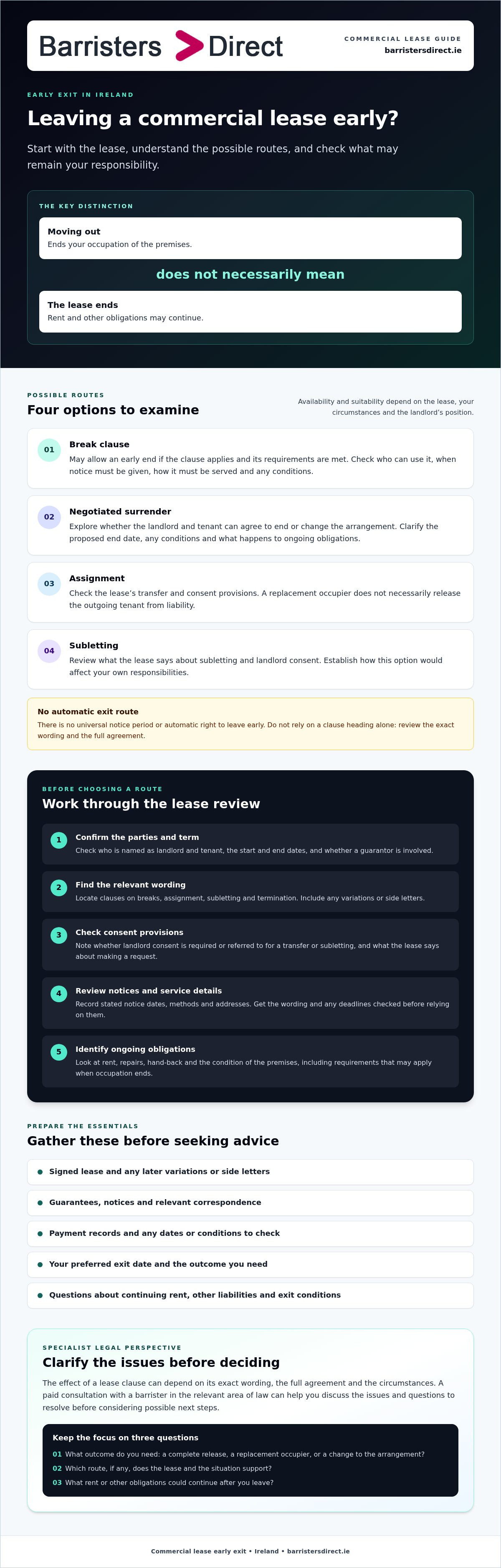
The lease and applicable Irish law determine which options may be available. There is no universal notice period or automatic right to leave early. A break clause, for example, may allow a party to end a lease if specified conditions are met. Its effect depends on the exact wording, including who can use it, when and how notice must be given, and whether other requirements apply. This general explanation of a break clause offers background, but the clause in your own lease needs careful review.
What should you establish before considering an exit?
Start by identifying your role and objective. A tenant may want to leave or reduce its commitment; a landlord may be considering a request to end or change the arrangement; a guarantor may need to understand whether a proposed exit affects their exposure. If you’re advising a business, clarify who can make decisions and what outcome the business is seeking.
Separate the outcome you want from the route you might use. Do you need a complete release from future obligations, a replacement occupier, or a negotiated change to the existing arrangement? Those aims may point to different options. Finding a replacement occupier does not necessarily release the outgoing tenant from liability.
For instance, a tenant that needs to vacate quickly may still need to address its contractual responsibilities. A business that can remain temporarily might have more time to explore a negotiated change. These are starting points, not conclusions about what a particular lease permits.
Review the signed lease, any variations and relevant correspondence before approaching the landlord or committing to a course of action. For broader context, see this guide to commercial property law in Ireland. Next, examine the lease terms that may shape your options.
How to Check Your Commercial Lease for an Early-Exit Route
A focused lease review can show which routes are worth investigating, but a clause heading alone won’t establish your rights. Read the exact wording alongside any changes to the agreement, and ask an Irish commercial property law specialist to assess its legal effect before relying on it.
Which lease clauses and documents should you locate?
Gather the signed lease, any variations or side letters, guarantees and correspondence about the premises or possible changes to the tenancy. Then work through this sequence:
- Confirm the parties and term. Check who is named as landlord and tenant, the start and end dates, and whether a guarantor is involved.
- Find the relevant wording. Look for clauses on breaks, assignment, subletting and termination. A break clause may set conditions for ending a lease early.
- Check consent provisions. Note whether the lease requires or refers to landlord consent for a transfer or subletting, and what it says about making a request.
- Review notices and service details. Record any stated notice dates, methods and addresses. Don’t assume a deadline or method is legally effective without specialist review.
- Identify ongoing obligations. Check provisions on rent, repairs, hand-back and the condition of the premises, including any requirements that may apply when occupation ends.
Keep a list of deadlines and conditions, but don’t assume they are valid, satisfied or exhaustive. Their significance can depend on the full agreement and the circumstances.
How can you assess a break clause without guessing?
Check who can exercise the clause, whether it applies on a particular date or within a window, how notice must be served, and whether the clause sets conditions that must be met. For example, it may specify a notice procedure and obligations to address before the break date. Whether those terms have been complied with, and the consequence of a mistake, requires review of the actual wording and relevant Irish law.
Don’t assume that a clause labelled “break” gives an unrestricted right to leave. Equally, don’t conclude that a technical error invalidates a notice without advice. A specialist should review the clause, notice requirements and compliance before you rely on them.
Citizens Information’s guidance on valid reasons for ending a tenancy concerns residential tenancies. Don’t apply it as a statement of commercial lease rules. Your commercial lease and the law relevant to it need separate assessment. You can also read about landlord and tenant legal advice. Barristers Direct can arrange a paid consultation with a relevant barrister, giving you an opportunity to discuss the lease and the questions you need to resolve.
Compare Possible Ways to End a Commercial Lease Early
No route is automatically available. Whether a break, surrender, assignment or subletting is possible depends on the lease, the circumstances and applicable Irish law. Check the relevant terms and seek specialist advice before treating any route as a way to end rent or other liabilities.
Use this comparison to frame the questions, not to decide the legal effect. Timing, conditions and the parties’ positions can all affect what is practical.
| Route | What to check | Other party involvement | Questions for counsel |
|---|---|---|---|
| Break clause | Who can use it, the date or window, notice method and any stated conditions. | Notice may need to be given to the other party in the way the lease specifies. | Does the clause apply, and have its requirements been met? |
| Negotiated surrender | Whether the landlord is willing to agree, the proposed terms, liabilities and any required legal formalities. | Both parties need to agree to the proposed end of the lease. | What must the agreement address, and how should it be documented? |
| Assignment | Whether the lease permits a transfer, any consent requirements and possible continuing obligations. | A proposed incoming tenant and, where required, the landlord are involved. | Would the transfer release the outgoing tenant or leave any potential liability? |
| Subletting | Whether all or part of the premises may be sublet, and what restrictions or consent terms apply. | The tenant, landlord and prospective subtenant may all have a role. | Which obligations remain with the original tenant under the head lease? |
Could a break clause or agreed surrender fit your situation?
A break clause may offer a route on a specified date, but only if its wording and any stated conditions support that outcome. A negotiated surrender is different: it depends on the landlord agreeing to end the lease, and its terms and legal formalities should be checked. Neither route guarantees a particular timeline or result. Compare the proposed date, the likelihood of agreement and the treatment of outstanding obligations before deciding which option to explore.
Could assignment or subletting be considered instead?
An assignment transfers the tenant’s interest in the lease to another party. Subletting gives another occupier use of the premises under a separate arrangement, while the original tenant remains party to the head lease. The precise rights, consent requirements and possible continuing liabilities depend on the lease and applicable law. If discussions with the landlord become contentious, see this guide to commercial dispute resolution.
Before taking steps to terminate a commercial lease early, ask an Irish commercial property law specialist to assess the proposed route against the lease and your intended outcome.
A Practical Checklist Before You Seek an Early Lease Exit
Good preparation makes it easier to explain your situation and helps a specialist assess the lease against your intended outcome. Before taking steps towards terminating a commercial lease early, assemble the documents and separate what you know from what still needs checking.
What information helps a specialist assess your position?
Gather the documents that show how the lease was agreed and how the arrangement has developed. Keep copies together, including:
- The signed lease, variations, side letters and any guarantee.
- Notices already sent or received, with relevant delivery or service records.
- Rent and service-charge records, invoices and payment correspondence.
- Communications with the landlord or tenant about the premises, proposed changes or a possible exit.
- Documents relating to repair or hand-back concerns, if relevant.
Prepare a short timeline of key events and identify any deadline you’ve found in the documents. Note the relevant clauses, but distinguish the wording from your interpretation. For example, record a repair issue as a question to check against the lease, rather than assuming it permits you to leave or withhold payment.
Summarise the commercial position too: your preferred exit date, the business reason, the route you want to explore and your main concerns. These might include potential ongoing rent, service charges, repair obligations or a proposed replacement occupier. Separate confirmed facts from assumptions, and keep relevant records rather than relying on memory or informal summaries.
How should you approach the landlord or tenant?
If you decide to make contact, keep your communication professional, specific and consistent with the lease and any specialist guidance. A neutral written proposal can explain the outcome you’re seeking, the route you’d like to discuss and any practical points that may need agreement. Avoid making admissions or asserting legal conclusions before they have been reviewed.
Keep a dated record of proposals, responses and follow-up discussions. An informal conversation may help you find out whether the other party is open to a solution, but don’t treat it as a completed lease exit. Confirm what has actually been agreed and get advice on any necessary legal documentation before acting on it.
Before discussing your options, gather: the lease and related documents; relevant notices and payment records; a timeline and any identified deadline; your preferred exit date and business reason; and questions about rent, service charges, repairs and continuing liabilities.
If a deadline appears urgent or the documents are unclear, seek specialist review promptly rather than relying on a general timeframe. Barristers Direct can arrange a paid consultation with a relevant barrister to discuss the lease and the questions you’ve prepared.
When Specialist Advice Can Clarify Your Commercial Lease Exit
Specialist review can be useful if the lease wording is unclear, the landlord disputes a consent request, a possible breach affects your plans, or several exit routes seem possible. Each option may have different implications for timing and continuing obligations. Before terminating a commercial lease early, a focused discussion with a commercial property barrister can help identify the questions that need answering and assess the lease in context.
Barristers Direct arranges a paid consultation with a barrister in the relevant area of law. You can raise your concerns and proposed next steps with the barrister. Barristers Direct arranges the consultation; any advice and subsequent professional relationship are between you and the barrister.
What can you prepare for a barrister consultation?
Bring the signed lease and any variations, relevant correspondence, key dates and a concise summary of your business objective. Explaining what you hope to achieve can help focus the discussion. Prepare questions such as:
- Which routes appear worth examining under the lease?
- What conditions, risks or ongoing obligations should be checked?
- How should a proposed discussion or notice be approached?
- Could a solicitor be needed for further steps or formal proceedings?
You may also find it useful to read about the advantages of instructing a barrister directly before your consultation. This provides background on direct access to specialist input, while your barrister can address legal questions about your particular lease.
What happens after early specialist input?
Next steps depend on the advice you receive, the lease and your circumstances. You may need to clarify a clause, consider how to approach the other party, or explore whether a proposed route is practical. A consultation can help you understand issues and options, but it cannot guarantee that a landlord will agree to a proposal or that a particular outcome will follow.
If the matter progresses, any further work is agreed separately with the relevant professional. Formal litigation may require a solicitor, whose role remains important in taking proceedings forward. The appropriate next step depends on the advice and the nature of the matter.
If you’re ready to discuss your lease and possible next steps, arrange a specialist consultation through Barristers Direct.
Make Your Next Lease-Exit Decision With Clarity
Terminating a commercial lease early starts with the agreement, not simply leaving the premises. Review the exact wording and related documents, then compare possible routes such as a break clause, surrender, assignment or subletting without assuming one is available. Your preferred outcome, potential continuing obligations and any relevant deadlines should all inform your next step.
If the wording is unclear, consent is disputed or several routes may fit, specialist input can help you understand the issues and prepare questions about your options. Barristers Direct can arrange a paid consultation with a barrister matched to the relevant area of law. Consultations can be held online or by telephone. Any advice and subsequent professional relationship are between you and the barrister.
Bring the lease, variations, correspondence and a concise summary of your objectives to focus the discussion. Arrange a paid consultation with a specialist barrister to discuss your lease and possible next steps.
Frequently Asked Questions
Can I terminate a commercial lease early in Ireland?
Possibly, but it depends on the lease, the circumstances and applicable Irish law. Check whether the agreement provides a break clause or whether the landlord may agree to a surrender. Assignment or subletting may be alternatives, subject to the lease and any consent requirements. Don’t assume you have an automatic right to leave or that giving up the premises ends your contractual obligations. Have the relevant wording reviewed before acting.
Does a break clause mean I can leave whenever I want?
No. A break clause provides an exit only on the terms it sets out. Check who can use it, any specified date or window, how notice must be served and whether conditions apply. For example, the clause may require notice in a particular form or compliance with stated obligations. The precise wording matters, so get specialist advice before relying on the clause or assuming a notice has been effective.
Can a landlord refuse to let me end a commercial lease early?
It depends on the route you’re proposing. A landlord needn’t agree to a negotiated surrender, so discussions don’t guarantee an early release. If the lease has a break clause, its wording and conditions determine whether it can be used. Assignment or subletting may involve consent; Irish law may affect whether consent can be withheld, depending on the circumstances. Ask an Irish specialist to assess the lease and any refusal.
Can I transfer or sublet my commercial lease instead of ending it?
Possibly, if the lease and applicable law allow it. Assignment transfers your lease interest to another occupier; subletting grants another party use of the premises under a separate arrangement. Check the lease for restrictions, consent requirements and any conditions. Subletting doesn’t necessarily release you from obligations to the landlord, and an assignment may not automatically remove every potential liability. Ask a specialist to assess the documents before proceeding.
What happens if I leave the premises before the lease ends?
Leaving doesn’t necessarily end the lease or your obligations under it. Depending on the agreement and any later arrangement, rent and other responsibilities may continue even if the premises are empty. Check the term, exit provisions, payment records and communications with the landlord. Don’t assume handing back the keys or moving out is enough to end the contract. Seek advice on your position before treating the lease as terminated.
What documents should I gather before seeking advice about ending a lease?
Collect the signed lease, any variations or side letters, guarantees, notices, payment records and relevant correspondence. Note key dates, any deadline you’ve identified, your preferred exit date and the business reason for seeking an exit. Mark the clauses you’re unsure about, but distinguish their wording from your assumptions about what they mean. A concise timeline and clear questions can help a specialist understand the issue and focus the discussion.
Can a barrister advise me directly about a commercial lease dispute?
A barrister can provide advice in a consultation. Barristers Direct arranges a paid consultation with a barrister matched to the relevant area of law; Barristers Direct does not itself provide the legal advice. Any advice and subsequent professional relationship are between you and the barrister. If the matter proceeds to formal litigation, a solicitor may be needed. You can discuss appropriate next steps for your circumstances during the consultation.
Disclaimer
This article does not constitute legal advice. Barristers Direct does not provide legal advice. To obtain legal advice, you should contact a legal practitioner.


