

What if a single clause in a commercial lease could affect your costs, property use or business plans? When navigating commercial property law in Ireland, it can be difficult to know which terms, records and events matter most, particularly if you’re weighing a decision or responding to a dispute.
Commercial property questions may involve lease obligations, rent reviews, a proposed transaction or disagreements between landlords and tenants. The documents can be complex, and the right next step depends on the facts. This guide explains common issues to recognise without treating general information as legal advice.
You’ll learn what information to organise, which questions to prepare and how specialist input may help clarify your options. That might include arranging a paid consultation with a barrister whose expertise is relevant to your question. Solicitors also play an important role in property transactions and ongoing legal work; if formal litigation or further legal services are needed, a solicitor may be required. The aim is to help you approach the issue with a clearer picture of the facts and a more focused sense of what to ask next.
Key Takeaways
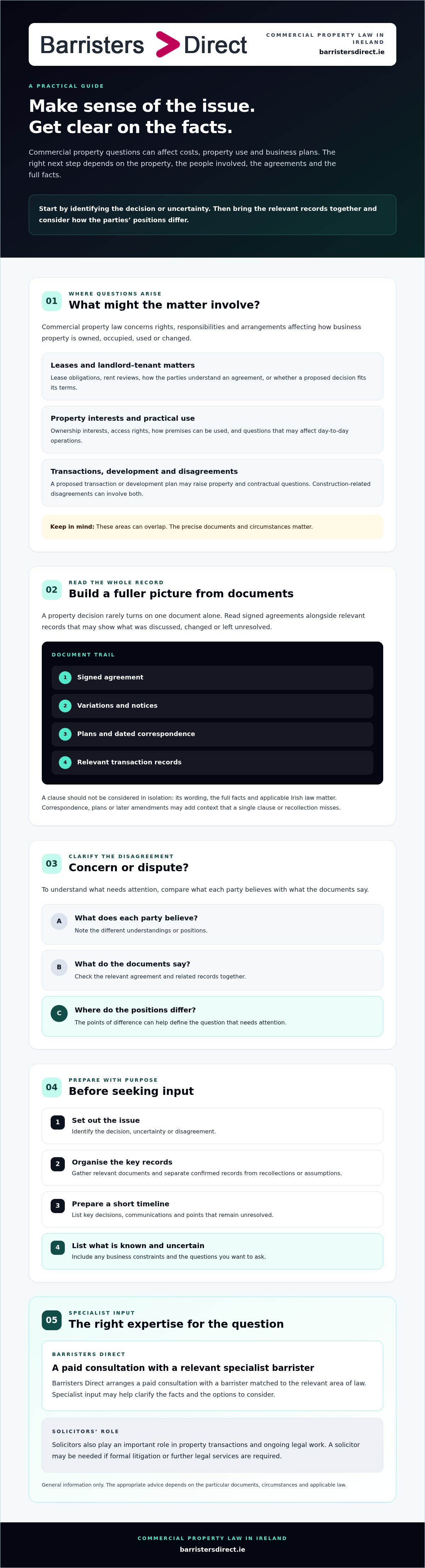
- Navigating commercial property law starts with identifying the decision or uncertainty, then checking how the property, parties and agreements shape the issue.
- Read signed agreements alongside relevant correspondence, plans and transaction records to build a more complete picture.
- To distinguish a concern from a dispute, note what each party believes, what the documents say and where their positions differ.
- Prepare a timeline, organise key records and list what you know, what remains uncertain and any business constraints before seeking input.
- Barristers Direct arranges a paid consultation with a barrister matched to the relevant area of law; a solicitor may be needed for litigation or further legal work.
Navigating commercial property law: what issues can arise?
Commercial property law covers the legal questions that arise around business premises, interests in property and agreements connected with them. In plain English, it concerns the rights, responsibilities and arrangements that affect how business property is owned, occupied, used or changed.
The relevant questions depend on the property, the parties involved, the documents and the intended transaction. A tenant considering a change to its premises may need to examine different issues from an investor assessing an ownership interest or a landlord responding to a disagreement. Ireland’s property system also has a long history. The history of Irish Land Acts offers background on land ownership and tenure, but it doesn’t determine the answer to a modern commercial property question.
Broad areas to consider include leases, ownership interests, access rights, development plans and disputes connected with property. These categories can overlap. For example, proposed works may raise questions about rights to alter or access premises as well as what a lease or other agreement says. This guide provides general information only, not advice on a particular transaction or dispute.
Which commercial property matters commonly need attention?
Landlord and tenant concerns may involve how the parties understand their agreement or whether a particular decision fits its terms. This is not a full guide to lease disputes: the wording and circumstances need to be considered together.
Other questions may focus on who holds an interest in a property, how premises can be used, whether access is available, or what should be considered before development proceeds. Construction-related disagreements can involve both property questions and contractual issues, such as what the parties agreed about works. The precise documents and facts matter.
Who may be affected by a property-law issue?
Business owners, landlords, tenants, investors and people responsible for property decisions may all be affected. One issue can influence day-to-day operations, the relationship between parties, or decisions about an important business asset. A disagreement about access, for instance, may have practical consequences as well as raise questions about the relevant rights and agreements.
If a disagreement has developed, the facts and documents can help clarify what needs attention. Barristers Direct arranges paid consultations with barristers matched to the relevant area of law. For information about its commercial dispute resolution offering, see commercial dispute resolution. A solicitor may be needed if formal litigation or further legal work is required.
How commercial property documents shape decisions and risks
A property decision rarely turns on one document alone. A signed agreement may set out the parties’ arrangement, whilst later correspondence, plans or transaction records may help explain what was discussed, changed or left unresolved. Read them together, rather than relying on a summary or a single clause.
The agreement’s purpose and the practical detail are not always the same thing. For example, a lease may describe an obligation, but the question at hand could depend on how that wording relates to an amendment, a plan or later communications. The legal effect of any clause depends on its wording, the full facts and applicable Irish law. It shouldn’t be assumed without proper review.
The full document trail can reveal context that a single clause or recollection may miss. That is why navigating commercial property law often begins with establishing what records exist and how they relate.
What should you gather before discussing a property matter?
Bring together the records that relate to the question, such as the signed agreement, any variations, notices, plans and dated correspondence. Add relevant transaction records where available. If you’re researching comparable lease information, you can search the Commercial Leases Register, while keeping in mind that a register entry does not replace reviewing the documents for your own matter.
Prepare a short timeline of key decisions, communications and points still unresolved. Separate confirmed documents from recollections, assumptions or information you have not yet located. This makes it easier to see where the record is complete and where clarification may be needed.
How can lease and property records affect the analysis?
Wording, amendments and surrounding records may all be relevant. A lease might address matters such as repair, permitted use or access, but those are examples only. Whether a particular term applies, and how it relates to the circumstances, calls for specialist legal interpretation. Don’t treat a clause in isolation as a definitive answer.
Once the core documents are organised, note the specific question they raise and any practical impact on the business. If the matter involves a disagreement, you can read more about commercial lease and asset disputes. Where specialist input may help, Barristers Direct arranges a paid consultation with a barrister matched to the relevant area of law.
How to distinguish a commercial property concern from a dispute
A commercial property concern is often a question that still needs clarification: what an agreement means, whether a proposed step fits its terms, or which records explain the parties’ position. A dispute is more likely where the parties have reached opposing views about their rights, obligations or what should happen next. The distinction can help you decide what information to gather and what kind of input may be useful.
Not every disagreement calls for court proceedings or a barrister. Clarifying the documents or discussing the issue may be appropriate in some situations. If the parties remain at odds, negotiation, specialist advice or formal proceedings may be considered, depending on the facts. None is an automatic outcome. For more on possible approaches, see this guide to commercial dispute resolution in Ireland.
When is a property question not yet a formal dispute?
Uncertainty about an obligation, a proposed action or a document may be a reason to check the facts before taking a firm position. For example, a party might be unsure whether planned works are covered by the agreement. Reviewing the relevant wording and correspondence early can help avoid assumptions becoming entrenched or communications giving an incomplete account. Keep the focus on the question that needs answering.
When might specialist advice help assess the next step?
If the parties disagree about what an agreement requires, a specialist barrister may be able to assess the legal question in a separately arranged consultation. Barristers Direct arranges a paid consultation with a barrister matched to the relevant area; the service itself does not provide legal advice. A solicitor may be involved where further legal work or litigation is required.
Use this simple framework to organise the issue. It is a starting point, not a decision about the legal merits or outcome.
| Situation | Information to check | Possible professional input |
|---|---|---|
| You’re unsure what a document requires. | The signed wording, any variations and related communications. | Clarification from an appropriate legal professional. |
| The parties disagree about a proposed action. | The relevant agreement, plans, correspondence and each party’s stated position. | Specialist advice on the issue and possible next steps. |
| The disagreement remains unresolved. | The timeline, key records and practical impact on the business. | Advice on available options; a solicitor may be needed for further legal work or litigation. |
When navigating commercial property law, describe what is known, what remains uncertain and where the parties’ positions differ. That gives a professional a clearer basis for considering the issue, without assuming that one route will suit every matter.
What practical steps can help you navigate a property-law issue?
A clear preparation process can help you explain the issue and make better use of professional input. It won’t determine the legal answer or prescribe a strategy. The right approach depends on the facts, the documents and what you need to decide.
- Identify the decision. State what you need to decide or respond to, and by when, if a date is relevant.
- Gather the records. Collect the agreements, variations, notices, plans and correspondence that relate to the issue. Keep copies together and note anything missing.
- Build a timeline. Record key events, communications and decisions in date order. Distinguish what happened from what you understood or assumed at the time.
- List your questions. Put the most important points first. Note what you know, what remains uncertain and what information may help resolve the uncertainty.
- Seek appropriate input. Take the organised facts to a qualified professional who can consider the specific circumstances and discuss possible next steps.
Deadlines and formal requirements can depend on the particular matter. Ask a qualified professional to verify what applies rather than relying on general guidance. No single route suits every commercial property issue.
How should you prepare for a specialist discussion?
Prepare a brief factual summary, the key documents and a prioritised list of questions. Identify the decision you face and the information you still need. It can also help to label the issue clearly: does it concern a lease, access, ownership, development or an existing disagreement? Include relevant business constraints, such as operational needs, without assuming they determine the legal position.
What should you clarify before taking action?
Check who the relevant parties are and which documents record their arrangements. Then describe the practical outcome you’re seeking, while recognising that it may not be achievable or legally available. If you’re dealing with an existing lease disagreement, information about commercial lease dispute resolution may be relevant; if the issue is different, avoid treating it as a lease dispute.
Navigating commercial property law is more focused when your account separates confirmed facts from assumptions and identifies the question you need help answering. Barristers Direct arranges paid consultations with barristers matched to the relevant area of law. If specialist input would help you consider your options, arrange a consultation with a relevant barrister. The service arranges access to the barrister and does not itself provide legal advice; a solicitor may be needed for further legal work or litigation.
Where specialist barrister input fits in navigating commercial property law
A commercial property question can turn on detailed wording, a particular transaction or the relationship between several documents. If you’ve organised the key facts but remain unsure what they mean, a consultation with a barrister whose expertise matches the issue may help you examine the legal question and consider possible next steps.
Barristers Direct arranges a paid consultation with a barrister matched to the relevant area of law. Once the advertised fee has been paid, the consultation can take place online or by telephone. The service arranges access to the barrister; it does not itself provide legal advice or legal services.
What can an initial barrister consultation help clarify?
You can explain the issue, outline the decision you face and raise questions about the relevant documents or the parties’ positions. The barrister may provide specialist input and discuss possible ways forward in light of the information you share. The consultation can help you understand the question more clearly, but it can’t guarantee a particular conclusion, outcome or litigation result, and it doesn’t promise an ongoing engagement.
Any advice given is between you and the barrister. If further advice or work is needed after the consultation, any additional arrangement is also between you and that barrister. Preparing a concise summary and prioritised questions can help keep the discussion focused on the points that matter to your decision.
How does a consultation fit alongside a solicitor?
Solicitors have an important role in working directly with clients and supporting property transactions and other legal work. A barrister consultation can offer focused specialist input on a particular legal question, but it doesn’t replace a solicitor where further legal work or formal proceedings are required. The right professional support depends on the matter and what needs to happen next. For a general explanation of professional roles, read about the difference between solicitors and barristers.
Specialist input may be useful whether you’re seeking clarity before making a decision or trying to understand an existing disagreement. It won’t settle the issue automatically, but it can help you assess the question and consider your options with relevant expertise. To explore the consultation process, explore how to access specialist legal expertise.
Take a clearer next step with your property matter
Navigating commercial property law is more manageable when you identify the decision at hand, bring the relevant agreements and correspondence together, and separate confirmed facts from unanswered questions. The documents and circumstances matter: a concern that needs clarification is not automatically a formal dispute, and no single response fits every situation.
If the issue is complex, specialist input may help you understand the legal question and consider possible next steps. Barristers Direct arranges a paid consultation with a barrister matched to the relevant area of law. Consultations can take place online or by telephone. The service arranges access to the barrister; any advice is provided by the barrister directly to you. A solicitor may also be needed for further legal work or formal proceedings.
If you’re ready to explore specialist input, explore access to specialist legal expertise. With an organised account of the facts and the right professional guidance, you can approach your next decision with greater clarity.
Frequently Asked Questions
What does commercial property law cover in Ireland?
Commercial property law covers legal issues involving business premises, property interests and related agreements. The question might concern a lease, who holds an interest in a property, access, proposed development or a disagreement between parties. The relevant documents and circumstances shape the issue, so a clause shouldn’t be interpreted in isolation. General information can help you identify what to check, but it isn’t legal advice on a particular transaction or dispute.
When should I seek advice about a commercial property issue?
Consider seeking advice if you’re unsure what an agreement requires, are considering a property-related decision, or disagree with another party about what should happen. Early input may help clarify the question before you act or take a firm position. If a deadline or formal requirement may apply, ask a qualified professional to verify it for your specific matter rather than relying on general guidance.
What documents should I gather for a commercial property consultation?
Gather the signed agreement and any variations, notices, relevant plans, transaction records and dated correspondence. Include documents that help explain what was agreed or what has changed. A concise timeline of important events can make the sequence easier to follow. Separate confirmed records from recollections, assumptions or missing information, and note any practical effect the issue is having on your business or property decision.
Can a barrister advise me directly about a commercial property matter?
Yes, you can arrange a consultation directly with a barrister for specialist input on a commercial property question. Barristers Direct helps match users with a barrister based on the relevant area of law and arranges a paid consultation. The barrister provides any advice directly to you; Barristers Direct arranges access and doesn’t itself provide legal advice. Any further work or engagement is a separate arrangement between you and the barrister.
Do commercial property disputes always go to court?
No. A disagreement doesn’t automatically mean court proceedings are necessary. Depending on the facts and the parties’ positions, clarification, discussion or negotiation may be considered, and specialist advice can help you understand possible options. Formal proceedings are a separate possibility, not a guaranteed next step. If litigation or further legal work is required, a solicitor may be needed to assist with that work.
How can I prepare for a commercial property law consultation?
Start by stating the decision you need to make and identifying whether the issue concerns a lease, access, ownership, development or a disagreement. Bring the key documents and a short timeline, then list your most important questions. Note what’s confirmed, what remains uncertain and any relevant business constraints. This preparation can make navigating commercial property law more focused, while leaving the barrister to assess the legal issues in context.
Disclaimer
This article does not constitute legal advice. Barristers Direct does not provide legal advice. To obtain legal advice, you should contact a legal practitioner.


