

What if a relative played a troubling role in a loved one’s final days, but the will was signed while they appeared mentally capable? Contesting a will due to undue influence in Ireland is not about proving that someone was persuasive, forceful or close to the person who made it. The central question is whether pressure overcame the testator’s free will.
It is understandable to seek answers when a vulnerable person’s will changes suddenly, particularly if a beneficiary was involved in their affairs or limited their contact with others. Those circumstances may raise questions, but they do not prove coercion on their own. The evidence and context matter, and unsupported allegations can have serious consequences.
This guide explains what undue influence may mean in an Irish will dispute, how it differs from ordinary persuasion or lack of testamentary capacity, and which documents, witnesses and events may be relevant. It also considers why timing can matter before a Grant of Probate is issued, and what to discuss with a wills and probate specialist. A paid consultation with a relevant barrister can help you assess the evidence and understand possible next steps. The barrister provides advice directly to you, not Barristers Direct.
Key Takeaways
- When contesting a will due to undue influence, assess the events and evidence rather than relying on family disagreement alone.
- Review available communications, records of involvement in making the will, and anything documenting the person’s own wishes.
- Undue influence, testamentary capacity, and knowledge and approval are separate issues, each requiring its own legal assessment.
- Organise records into a chronology, note potential witnesses, and seek qualified advice before confronting relatives or making allegations.
- A paid consultation with a relevant barrister can help identify evidence gaps and questions to investigate. The barrister provides advice directly to you.
What does undue influence mean when contesting a will in Ireland?
A changed or unexpected will can raise understandable questions for loved ones, particularly if the person depended on someone else or had limited contact with family. But an unwelcome outcome is not, by itself, proof that the will was improperly made.
In an Irish will dispute, undue influence generally means coercion that overcomes the testator’s free will and causes them to make a will they would not otherwise have made. The focus is on whether pressure displaced the person’s independent decision-making, not simply whether someone influenced their thinking. This is a demanding allegation: the person challenging the will must provide evidence of actual coercion, which can be difficult to establish when events took place privately. The broader concept of undue influence is discussed internationally, but its general description should not be treated as a substitute for the Irish legal test.
When can pressure become undue influence?
Ordinary persuasion may include expressing a view about inheritance or discussing a proposed change. Pressure may cross the line if it becomes coercion that overpowers the testator’s ability to decide freely. An Irish wills specialist should assess the precise legal threshold and terminology against the facts of the case.
Care, practical assistance, dependence or a close family relationship can provide context, but none proves undue influence on its own. The question is how the will came about and whether the testator’s own choice was overcome. A forceful personality or an unequal relationship may prompt further enquiry, but neither automatically establishes coercion.
Why an unexpected inheritance is not proof by itself
A will may distribute an estate in a way that surprises relatives or differs from what they understood the deceased’s wishes to be. That difference may give family members a reason to ask questions, but it does not explain how the will was prepared or signed. A beneficiary receiving a larger share, or another relative receiving less than expected, does not alone show that anyone exerted undue influence.
Focus on evidence about the will-making process rather than assuming a beneficiary’s motive. Relevant circumstances might include what the testator said about their wishes, who was involved in arranging the will, and whether there are records of communications around the change. Consider each detail in context. Only an assessment of the evidence and applicable law can clarify whether a concern may support contesting a will due to undue influence. No single circumstance determines the outcome.
What circumstances and evidence may support an undue influence concern?
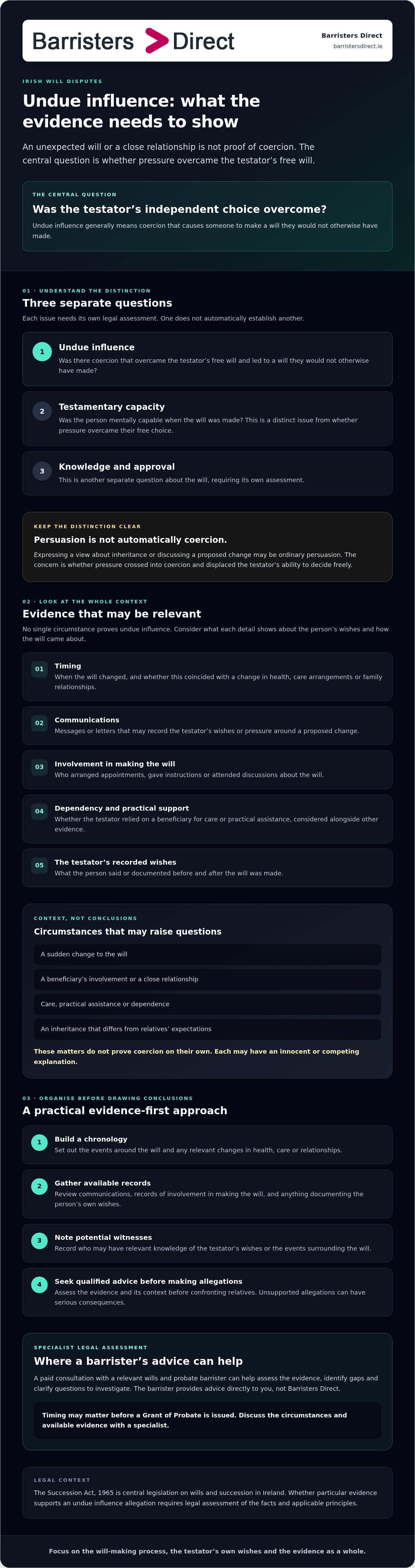
When contesting a will due to undue influence, the issue is not simply whether a change seems unusual. The useful question is what the available evidence shows about the testator’s wishes, the events surrounding the will and the people involved. No single circumstance proves coercion, and each fact may have an innocent or competing explanation.
Potentially relevant matters to review include:
- Timing: when the will changed, and whether that coincided with a change in health, care arrangements or family relationships.
- Communications: messages or letters that may show the testator’s wishes or pressure around the proposed change.
- Involvement: who arranged appointments, gave instructions or attended discussions about the will.
- Dependency: whether the testator relied on a beneficiary for care or practical support, considered alongside other evidence.
- Recorded wishes: what the testator said or documented before and after the will was made.
A sudden change, dependency, a beneficiary’s involvement or an unequal gift may raise questions, but only evidence that supports a legal finding of coercion, assessed in context, can establish a case. Consider the evidence as a whole, including facts that may point to a different explanation. The Succession Act, 1965 is central legislation on wills and succession in Ireland, but whether particular evidence supports an undue influence allegation requires legal assessment of the facts and applicable principles.
Documents, messages, and the timeline of events
Preserve relevant material you already hold or are entitled to access, such as correspondence, earlier wills, instructions or records of discussions. Do not try to obtain private records without proper authority. A dated chronology can help you organise the information: note changes in relationships, health or care alongside known will-making events, and flag any uncertain dates or details. Keep original records intact and distinguish what they show from your interpretation.
Witness accounts and the will-making process
Identify people who personally observed relevant conversations, decisions or changes in the testator’s expressed wishes. Record what each person actually saw or heard, when it happened, and whether their account is based on direct knowledge or something they were told later. Solicitors’ or other professional records may also be relevant, but their availability and significance depend on the circumstances and need legal assessment.
If you have gathered material but are unsure what it means, a consultation with a relevant barrister can help you consider the evidence and identify questions to investigate. Barristers Direct can help you find a barrister with wills and probate expertise by arranging a paid consultation. The barrister provides advice directly to you.
How is undue influence different from capacity or knowledge and approval?
These are separate questions that may arise from the same circumstances, but they are not interchangeable legal grounds. A person’s vulnerability or a relative’s suspicion does not, on its own, determine which issue applies. When contesting a will due to undue influence, the concern is pressure that overcame the testator’s free choice. Capacity asks whether they could make a will; knowledge and approval concerns whether they understood and approved its contents.
| Issue | The question in broad terms | Potentially relevant evidence |
|---|---|---|
| Undue influence | Was the testator coerced into making a will contrary to their free will? | Events and communications surrounding the will, including the nature of another person’s involvement. |
| Testamentary capacity | Could the testator make a will, applying the relevant legal test? | Evidence about their understanding and decision-making at the time, which may include medical records considered in context. |
| Knowledge and approval | Did the testator understand and approve the will’s contents? | Evidence about how the will was prepared, explained and executed, and the testator’s understanding of it. |
This is a high-level distinction, not a substitute for applying Irish law to the facts. The tests and evidence differ, and a wills specialist can assess which issue or issues are relevant in a particular case.
Undue influence compared with testamentary capacity
Capacity concerns the person’s ability to make a will, rather than whether somebody pressured them into a particular decision. A person may have capacity yet still be alleged to have been coerced; conversely, questions about capacity do not themselves establish undue influence. Age or illness alone is not conclusive proof of incapacity. Medical or other records need to be considered in context, including when they were created and what they show about the person at the relevant time.
Undue influence compared with knowledge and approval
Knowledge and approval concerns whether the testator understood and accepted the will’s contents as their own decision. That differs from asking whether pressure overcame their free will. The same fact, such as another person’s involvement in arranging the will, may prompt more than one question, but does not answer either automatically. Check the relevant legal test and any applicable evidential rules with an Irish specialist.
For broader context on wills and estate administration, see a specialist guide to probate in Ireland. If you are unsure which concern your evidence raises, organise the facts around each question separately before seeking advice. This helps a specialist assess the issues without treating suspicion, vulnerability or an unexpected outcome as proof of any one ground.
What practical steps can you take if you suspect undue influence?
If you are considering contesting a will due to undue influence, organise the information before drawing conclusions. A clear account of what happened can help an Irish wills specialist identify which facts need further investigation and what steps may be appropriate.
Organise the information before seeking advice
Start with material you lawfully hold or can access. Keep originals safe and prepare copies for discussion. A useful working file may include:
- the will and any earlier versions available to you;
- relevant correspondence or messages about the testator’s wishes or the will-making process;
- a dated chronology of relationship, health, care and will-making events;
- names of people who may have witnessed relevant conversations or decisions; and
- a list of unanswered questions, noting which details you observed yourself and which were reported to you.
Keep fact and interpretation separate. For example, record the date someone attended an appointment if you know it, and separately note any uncertainty about why they attended. Do not access another person’s private records without proper authority. Share sensitive material through appropriate channels and avoid confronting relatives or making public allegations before you understand the evidence and potential consequences.
Check timing and the probate position
Deadlines and procedural requirements may apply, and the status of probate can affect what needs urgent attention. In Ireland, there is no single, specific statutory limitation period for an undue influence will challenge; a general six-year limit may apply, but the practical deadline may be before a Grant of Probate issues. A solicitor or specialist barrister can advise whether urgent steps, such as lodging a caveat, may be appropriate. Do not rely on a general timeframe to decide how long you can wait.
Ask specifically about the time limits for challenging a will in Ireland, your role in relation to the estate, and whether a Grant has issued. If your concern is the executor’s conduct, rather than how the will was made, make that distinction clear when seeking advice. It may raise a separate issue, and a specialist can assess whether it affects your position or requires a different approach. A dispute may also involve distinct grounds, so explain all relevant concerns rather than assuming they are interchangeable.
To prepare for that discussion, bring your chronology, the documents available to you and your questions. Arrange a paid consultation with a relevant wills and probate barrister through Barristers Direct. The barrister provides advice directly to you and can discuss the evidence and possible next steps.
How can a specialist barrister consultation help clarify a will dispute?
Undue influence allegations can be difficult to assess because key conversations may have taken place privately, and individual facts can have more than one explanation. A consultation with a barrister experienced in wills and probate can help you examine the evidence against relevant Irish legal principles, identify gaps and decide what questions need further investigation.
This can be useful before taking a formal step. A barrister may help you distinguish evidence that raises concern from evidence that could support a legal case, and discuss whether other issues, such as capacity or knowledge and approval, may also need assessment. They can also consider procedural questions, including the status of probate and whether timing calls for urgent advice. The assessment depends on the facts and does not guarantee a particular result.
Questions to take to a wills and probate barrister
Bring your chronology, relevant documents and a short list of questions. For example, ask:
- Which facts may support or weaken the concern that pressure overcame the testator’s free will?
- What additional evidence might be relevant, and how could it properly be obtained?
- Could another legal ground be relevant, and what procedural issues or immediate steps need individual assessment?
These questions can help focus the discussion. If you are considering contesting a will due to undue influence, be candid about facts that may not support your concern as well as those that do. A balanced account gives the barrister a clearer basis on which to advise you.
What the direct consultation route does and does not provide
Barristers Direct helps users find a barrister with relevant expertise and arranges a paid consultation after payment of the advertised fee. The consultation may take place online or by telephone. Barristers Direct does not provide the legal advice. The barrister gives advice directly to you, and any further engagement or resulting professional relationship is between you and that barrister.
A consultation is an opportunity to discuss your circumstances, the strength and limits of the available evidence, and possible next steps. It is not a promise that a claim will succeed, nor does it itself provide direct litigation representation. Depending on the matter, further work may involve other legal professionals, including a solicitor. The barrister can explain what they can advise on and whether further steps require separate arrangements.
If you are ready to discuss your circumstances with a relevant specialist, Explore a consultation with a relevant barrister.
Take an informed next step
Contesting a will due to undue influence requires more than showing that its terms were unexpected or that a beneficiary had a close relationship with the person who made it. The central concern is whether the evidence supports coercion that overcame the testator’s free choice. Capacity and knowledge and approval are separate issues, even where some facts overlap.
Preserve records you can properly access, organise events into a clear chronology, and note what you know first-hand. Because timing and the probate position may affect the practical options, seek advice promptly rather than relying on assumptions about deadlines or the strength of a claim.
Barristers Direct arranges paid consultations with barristers who have relevant expertise. A consultation may take place online or by telephone. The barrister provides advice directly to you, and no particular outcome is guaranteed. Explore a consultation with a relevant barrister to discuss the evidence and possible next steps.
With a clear account of the facts and specialist guidance, you can approach a difficult family and legal situation with greater understanding.
Frequently Asked Questions
What counts as undue influence when contesting a will in Ireland?
Undue influence concerns pressure that may have affected a person’s freedom to make a will. When contesting a will due to undue influence, the exact Irish legal test and its application depend on the evidence and circumstances. Family disagreement, an unexpected inheritance or a close relationship does not prove the allegation by itself. A qualified wills specialist can assess whether the facts may support a legal challenge.
Can you contest a will if a family member pressured the person who made it?
A concern about pressure may justify seeking advice, but it does not automatically make a will invalid. The nature, timing and effect of the conduct may matter, as may evidence about how the will was prepared and the testator’s wishes. Preserve relevant information that you lawfully hold, and get an assessment of the Irish legal position before deciding what steps to take or making allegations.
What evidence can help show undue influence in a will dispute?
Potentially relevant material may include messages, earlier wills, a timeline of events, witness accounts and records about how the will was prepared. No single document or account automatically proves undue influence, and evidence may have more than one interpretation. Note what you know first-hand and distinguish it from what others have told you. A wills specialist can advise which material may be relevant and how it can properly be obtained.
Is an unexpected or unfair will enough to prove undue influence?
No. A will may surprise relatives or distribute an estate unequally without showing that the testator was improperly influenced. The important question is what the evidence indicates about the person’s decision-making and the circumstances in which the will was made. Avoid assuming a beneficiary’s motive from the inheritance alone. A qualified Irish specialist can help distinguish understandable concern from evidence that may support a legal challenge.
How is undue influence different from lack of testamentary capacity?
They are distinct potential grounds. Undue influence concerns pressure affecting a person’s decision, whilst testamentary capacity concerns their ability to make a will under the applicable legal test. The same facts may prompt questions about either or both, but one does not automatically establish the other. Age or illness alone is not conclusive proof of incapacity. An Irish wills specialist can assess the relevant tests and evidence.
How long do you have to contest a will due to undue influence in Ireland?
There is no single, specific statutory limitation period for every undue influence challenge. A general six-year limit may apply, but the practical deadline may be before a Grant of Probate issues. Delay can make matters more difficult, particularly if the estate is administered. Seek qualified Irish advice promptly about the probate position, any applicable deadlines and whether a caveat may be appropriate in your circumstances.
Can I speak to a barrister directly about suspected undue influence?
Yes. Barristers Direct helps you find a barrister with relevant expertise and arranges a paid consultation after payment of the advertised fee. The consultation may take place online or by telephone. The barrister provides any legal advice directly to you, and any further engagement is between you and the barrister. A consultation can help assess the evidence and possible next steps, but no particular outcome is guaranteed.
Disclaimer
This article does not constitute legal advice. Barristers Direct does not provide legal advice. To obtain legal advice, you should contact a legal practitioner.


