

Could the deadline for challenging a will start months after the death, or could delay put a validity challenge at risk even when there is no single fixed deadline? The answer to “challenging a will time limit Ireland” depends on the legal basis of the claim. Identifying the right route is essential before you calculate time.
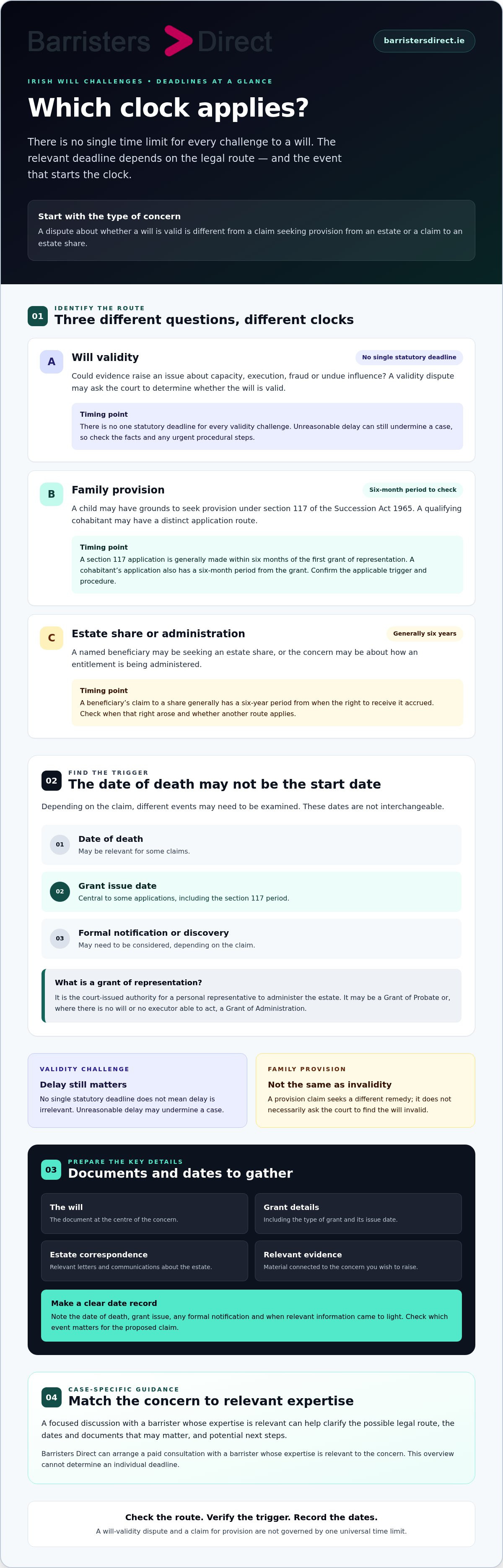
If you’re unsure whether your concern is about the will’s validity or provision for a family member, you’re not alone. Different claims can have different deadlines and starting points. For example, a child’s claim under section 117 generally must be made within six months of the Grant of Probate or Administration being issued. A will-validity challenge, such as one alleging lack of capacity or undue influence, has no single statutory deadline, but unreasonable delay can still undermine a case.
This guide explains which types of challenge may fit your circumstances, which dates and documents to gather, and why it can matter if probate or estate administration is under way. It also explains how a consultation arranged through Barristers Direct can connect you with a barrister whose expertise is relevant to your concern. A focused discussion can help clarify possible next steps.
Key Takeaways
- The challenging a will time limit Ireland depends on the legal route. A will-validity dispute and a claim for family provision are different types of challenge.
- Some claims have specific deadlines, and the clock may start when a grant is issued rather than on the date of death. Check the trigger for your situation.
- A section 117 application has a six-month period to consider, but this is not a universal deadline for contesting a will. Confirm the relevant grant date and statutory wording.
- Gather the will, grant details, estate correspondence and relevant evidence. Record important dates so a barrister can focus on the issues that may matter.
- Barristers Direct can arrange a paid consultation with a barrister whose expertise is relevant to your concern, dates and possible next steps.
Challenging a will in Ireland: why there is no single time limit
The applicable deadline depends on the type of claim. A challenge to whether a will is legally valid differs from an application seeking provision from an estate. Each route raises separate questions about the legal basis, remedy and relevant dates. The phrase “challenging a will time limit Ireland” therefore has no single answer that applies to every person or dispute.
Irish succession law is principally governed by the Succession Act 1965, alongside other legislation. Identifying a relevant law is only a starting point: the facts and the particular remedy being sought matter. Disagreeing with the inheritance outcome, on its own, does not establish grounds to challenge it.
What does challenging a will mean?
A challenge may question whether a will is valid, what a particular clause means, or whether someone may seek provision from the estate through a separate legal route. A validity dispute might concern the deceased’s capacity when making the will or alleged undue influence. By contrast, a family-provision claim does not necessarily ask the court to find the will invalid. It seeks a different remedy, based on the applicant’s circumstances and the applicable legal requirements.
The distinction matters because evidence relevant to one route may not answer the central question in another. A barrister with relevant expertise can consider what concern the facts may support, if any, and discuss which procedure may need to be considered.
Which event can start a deadline?
Depending on the claim, the date of death, issue of a grant, formal notification or discovery of relevant information may need to be examined. These dates are not interchangeable. Don’t assume that a particular event starts the clock without checking the rule for the proposed claim.
A grant of representation is the court-issued authority that enables the personal representative to administer the deceased’s estate. It may be a Grant of Probate or, where there is no will or no executor able to act, a Grant of Administration. For some applications, the grant’s issue date is central. Obtain the grant details rather than relying on the date of death alone.
No universal deadline applies to every will challenge in Ireland: any applicable time limit depends on the legal route and may run from the grant, death, notification or another relevant event. Delay can also affect a validity dispute. This overview cannot determine your deadline. If probate has started or you’re unsure which route fits, gather the key documents and dates and seek case-specific advice promptly.
Which Irish will-challenge claims have different deadlines?
The relevant deadline depends on the claim, not simply on whether someone objects to a will. A validity challenge, an application for provision and a claim about an estate share involve different legal tests and may require different procedures. Use the table to identify what to check, not to determine your deadline.
| Possible route | Question and possible remedy | Deadline trigger to verify |
|---|---|---|
| Will validity | Is there evidence raising an issue about capacity, execution, fraud or undue influence? The court may be asked to determine whether the will is valid. | There is no single statutory deadline for every validity challenge. Delay may matter, so obtain advice on the claim and any urgent procedural steps. |
| Family provision | Does a child have grounds to seek provision under section 117 of the Succession Act 1965? A qualifying cohabitant may also have a distinct application route. | For a section 117 application, the period is generally six months from the first grant of representation. A cohabitant’s application also has a six-month period from the grant. Confirm the applicable trigger and procedure. |
| Estate share or administration | Is a named beneficiary seeking an estate share, or is the concern about how an entitlement is being administered? The remedy depends on the right being asserted. | A beneficiary’s claim to a share generally has a six-year period from when the right to receive it accrued. Verify when that right arose and whether another route applies. |
Will validity: evidence matters
Suspecting pressure or questioning a person’s decision does not, by itself, establish a legal ground to set aside a will. Relevant evidence may include information about the circumstances in which the will was made, the deceased’s capacity at the time, or how the document was executed. A barrister with relevant expertise can consider whether the available facts may support a validity challenge and discuss possible steps. Don’t assume that a general limitation period gives you a safe window to wait.
A child’s application under section 117
Section 117 concerns an application by a child of the deceased alleging that the parent failed in their moral duty to make proper provision. The commonly cited period is six months from the date the first grant of representation is issued, rather than from the date of death. Check the primary text of the Succession Act 1965, including the current wording of section 117(6), and ask a legal professional to confirm the grant date and procedural requirements.
Other routes have their own rules. For example, a surviving spouse or civil partner’s election for a legal right share has a different calculation involving notification and the grant date. If you’re uncertain which route applies, Barristers Direct can arrange a consultation with a relevant barrister to discuss the claim type, evidence and dates.
The six-month section 117 period: what applicants should check
The six-month period under section 117 is a specific deadline for a child applying for provision from a parent’s estate. It is not a general time limit for every will challenge or for every beneficiary who believes an inheritance is unfair. The date of death alone may not tell you how much time remains: the relevant starting point is generally the issue of the first grant of representation.
Under Section 117 of the Succession Act 1965, a child may apply to the court if they say their parent failed in the moral duty to make proper provision for them. Whether the legal test is met depends on the individual circumstances. Being a child of the deceased does not automatically mean an application will succeed. This route is also different from asking the court to find a will invalid.
How to establish the relevant grant date
Locate the Grant of Probate or Grant of Administration and record its issue date. Estate correspondence may help you find the grant or understand what has happened, but check the grant itself rather than relying only on a letter or the date you were told about it. If you’re unsure whether a document is the first grant, or whether later estate events affect the calculation, seek legal advice promptly.
Use this checklist to prepare for a prompt review:
- 1. Find the grant document and note its type and issue date.
- 2. Check whether it is described as the first grant of representation.
- 3. Keep relevant estate correspondence, including notices and communications from the personal representative.
- 4. Ask a qualified legal professional to confirm the statutory wording, deadline calculation and procedural requirements for your circumstances.
What section 117 does not automatically mean
Section 117 concerns a child’s application; it does not give every beneficiary a general right to contest a will or guarantee a particular share. A complaint about the will’s validity, an alleged failure to make proper provision and a dispute about estate administration may call for different legal analysis. The challenging a will time limit Ireland question must therefore be assessed against the claim you may actually bring, not answered by applying the six-month period to every concern.
If you need context on the grant’s role in administering an estate, review guidance on understanding the probate process in Ireland. For your own position, have the grant date, relevant documents and circumstances considered by a qualified legal professional promptly, especially if the six-month period may be running.
What to do now if you wish to contest a will
Start by turning your concern into a clear, documented account. The deadline for challenging a will in Ireland depends on the legal route, so don’t rely on general online guidance to calculate how much time you have. Organise the records available to you and seek a prompt legal assessment, particularly if a grant has issued or estate administration is under way.
Documents and dates to assemble
Gather what you have, even if some records are missing. Separate confirmed dates from estimates, and note where you need more information.
- Identify the concern. Note whether it relates to the will’s validity, provision from the estate, the interpretation of a clause or estate administration.
- Collect key documents. Find the will or any available copy, grant details and estate correspondence, including notices and communications from the personal representative.
- Build a chronology. Record the date of death, the grant’s issue date if known, when you received relevant notices and when you first learned facts that caused concern. Include dates of important conversations or documents where they may be relevant.
- Preserve relevant evidence. Keep records that may help explain the circumstances, such as letters, emails or other documents connected to the will or your concern. Note the source and date of each item.
- Arrange a legal assessment promptly. Ask a qualified legal professional to identify the possible claim, check the applicable deadline and explain what further information or steps may be needed.
If you can’t locate the grant or aren’t sure whether a date is accurate, mark it as unconfirmed rather than treating it as fact. Estate correspondence may help you track down missing records, but it shouldn’t replace checking the grant itself. Don’t wait until every document is assembled before seeking guidance: follow up on missing information while getting advice.
Choosing the right professional input
A specialist barrister can consider the legal issue alongside the documents and chronology, then discuss possible next steps. Barristers Direct arranges a paid consultation with a barrister in the relevant area of law. Any legal advice is provided by the barrister. If you’re weighing the roles of different legal professionals, read about the difference between solicitors and barristers.
To discuss your concern, key dates and evidence with a relevant barrister, arrange a consultation through Barristers Direct.
Getting specialist guidance on an Irish will challenge
Once you’ve identified your concern and assembled the key dates, have the possible claim considered promptly. The question of a challenging a will time limit Ireland cannot be answered reliably without knowing the legal route, relevant trigger date and supporting evidence. A specialist discussion can help focus on those issues before you decide what to do next.
What a specialist consultation can help clarify
Barristers Direct can arrange a paid consultation with a barrister whose expertise is relevant to wills and probate. You can discuss whether your concern relates to the will’s validity, a claim for provision or another estate issue, and ask which evidence and deadline questions need closer examination. The consultation may take place online or by telephone.
Barristers Direct arranges the consultation; any legal advice is provided by the barrister. The discussion can help you understand possible next steps, but it cannot guarantee an outcome or replace any further legal work that may be needed. If court proceedings or estate administration require additional support, a solicitor may also have an important role. The appropriate arrangements depend on your circumstances.
How to prepare before making an enquiry
A short, clear summary helps the barrister focus on facts that may affect your position. You don’t need to resolve every uncertainty before seeking guidance. Bring what you have and identify what remains to be checked.
- Write a brief chronology: include the date of death, when you learned about the will or relevant events, and when you received estate notices or correspondence.
- Note grant information: record any known issue date and whether you have seen the Grant of Probate or Grant of Administration. Mark unconfirmed dates as estimates.
- Gather relevant documents: include the will or available copy, grant details, estate correspondence and evidence related to your concern.
- Prepare focused questions: ask which legal route may fit, what deadline trigger needs checking, what evidence may be relevant and what next steps could be considered.
If you’re trying to work out the deadline from general online guidance, don’t let that delay a case-specific assessment. The correct time limit may turn on details a general guide cannot resolve.
Arrange a specialist barrister consultation to discuss your concern, relevant dates and evidence with a barrister in the appropriate legal area.
Take the next step with clear, case-specific advice
The key point is that the challenging a will time limit Ireland depends on the legal route and the date that starts the clock. A will-validity dispute differs from a claim for provision, and the six-month period under section 117 applies to a specific type of application, not every challenge. Gathering the will, grant details, correspondence and a clear chronology can help a legal professional consider what may apply to your circumstances.
If you’re uncertain about the claim type, deadline or evidence, seek specialist guidance promptly rather than relying on a general guide to decide how much time remains. Barristers Direct can arrange a paid consultation with a barrister in the relevant area of law, online or by telephone. Any advice is provided by the barrister, and the consultation cannot guarantee an outcome.
Arrange a specialist barrister consultation to discuss your concern and possible next steps.
Frequently Asked Questions
How long do I have to challenge a will in Ireland?
There’s no single deadline for every will challenge. The applicable challenging a will time limit Ireland depends on the legal route, the remedy sought and the event that starts time running. For example, a child’s section 117 application is commonly associated with six months from the first grant of representation. Other claims may follow different rules. Gather the relevant dates and documents, then seek case-specific advice promptly.
Is there a six-month time limit for contesting a will in Ireland?
Six months is commonly cited for a child’s application under section 117 of the Succession Act 1965, seeking provision from a parent’s estate. It isn’t a universal deadline for challenging a will’s validity or for every beneficiary’s complaint. Before relying on that period, ask a qualified legal professional to confirm the current statutory wording, relevant grant date, whether you may bring that type of application and any procedural requirements.
When does the time limit for a section 117 claim start?
The period is commonly described as running from the issue of the first grant of representation, rather than simply from the date of death. The grant document can help establish the relevant date, but check the exact trigger and current requirements against the legislation and estate records. If you’re considering an application, obtain the grant details promptly and seek case-specific advice rather than relying on an assumed calculation.
Can I challenge a will after probate has been granted?
A grant of probate doesn’t, by itself, establish whether a particular challenge can proceed or whether a deadline has passed. The answer depends on the legal claim, available evidence, procedural position and relevant dates. Obtain the grant and estate correspondence, then ask a qualified legal professional to consider the possible route and any urgency. Don’t assume probate makes every challenge impossible, or that a challenge can proceed without considering delay.
What happens if I miss the time limit to challenge a will?
Missing an applicable deadline may seriously affect whether a claim can proceed, but the consequences depend on the claim and the rules that govern it. Don’t assume an extension is available or that all late claims are treated alike. If you think time may have passed, write down the key dates, gather the relevant documents and seek an urgent, case-specific legal assessment. A general online guide can’t determine the consequences for your circumstances.
Do I need a solicitor to challenge a will in Ireland?
The professional support you need depends on the issue and whether proceedings or other formal steps are required. A specialist barrister can consider a legal question, while solicitors play an important role in client communication and broader legal work. Barristers Direct can arrange a paid consultation with a barrister in the relevant area. Any advice is provided by the barrister; the consultation doesn’t replace a solicitor where further legal work is needed.
What documents should I gather before seeking advice about a will?
Collect the will or available copy, grant of representation, estate correspondence and documents relevant to your concern. Prepare a chronology showing the date of death, any known grant date, when you received important information and any steps already taken. Mark uncertain dates clearly rather than treating them as confirmed. An organised record can help a barrister consider which legal route and timing issues may need attention during a consultation.
Disclaimer
This article does not constitute legal advice. Barristers Direct does not provide legal advice. To obtain legal advice, you should contact a legal practitioner.


