

Could an estate that appears straightforward expose an executor to personal risk or become a source of conflict between family members? If you’re responsible for administering an estate, understanding the probate process Ireland involves more than completing forms. Decisions about assets, beneficiaries and potential claims can have real consequences, particularly when a will or the distribution of property is disputed.
It’s understandable to feel daunted by unfamiliar legal terms and uncertainty about what to do next. This guide sets out the main stages, from identifying the deceased’s assets and applying for a grant of representation to addressing inheritance tax and distributing the estate. It also explains where delays or disagreements may arise, and how an executor can make informed decisions.
If an estate involves complex assets or a contested claim, a specialist legal opinion can help clarify the issues and available options. Barristers Direct facilitates access to specialist barristers for paid consultations on probate matters, nationwide across Ireland. The sections ahead will help you understand the process and identify when a barrister’s input may be useful.
Key Takeaways
- Understand the difference between a Grant of Probate, where there’s a will, and Letters of Administration, where there isn’t.
- Build your understanding of the probate process in Ireland by learning how asset and liability checks lead into Revenue’s Statement of Affairs (Probate) Form SA.2.
- Commercial property, company shares and complex trusts can raise issues that may call for a specialist legal opinion.
- Learn about potential grounds for challenging a will and the particular considerations involved in a child’s Section 117 application.
- See how direct access to a barrister can provide a specialist probate opinion, alongside the transactional support a solicitor may provide.
What is Probate and When is it Mandatory in Ireland?
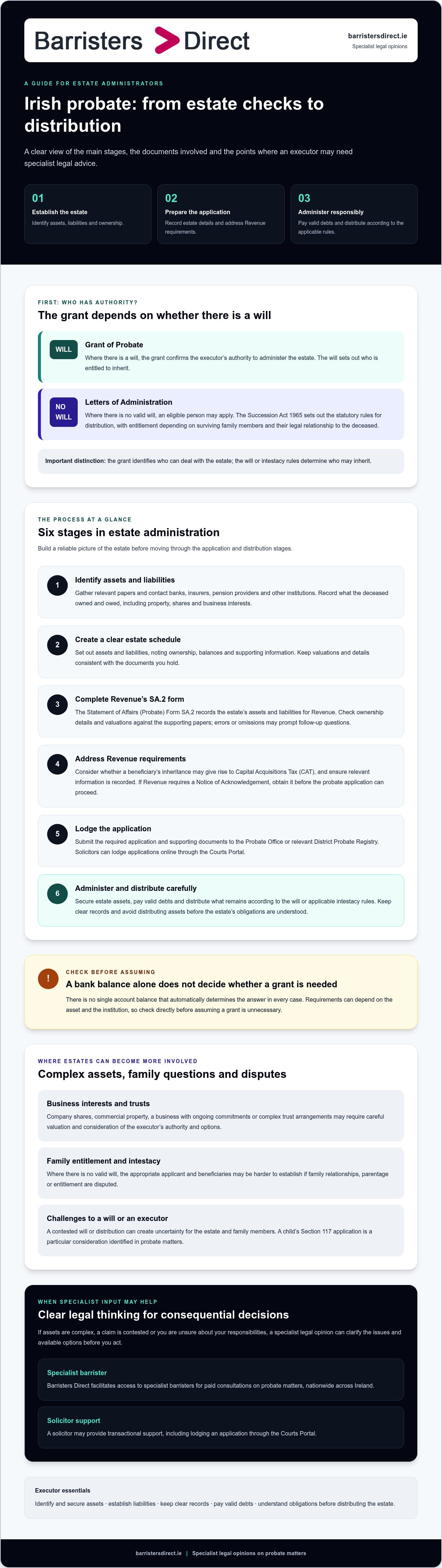
Probate is the legal process that confirms a will and gives the executor authority to administer the deceased person’s estate. That authority is documented in a Grant of Probate. If there is no will, an eligible person may instead apply for Letters of Administration to administer the estate. The distinction matters: the grant identifies who can deal with the estate, while the will or intestacy rules determine who is entitled to inherit.
Probate is commonly needed to transfer property held in the deceased’s sole name or to access assets where a bank or other institution requires a grant. There is no single bank-account balance that automatically determines the answer in every case. Requirements can depend on the asset and the institution, so check directly before assuming a grant is unnecessary. Understanding the probate process Ireland also means recognising that an executor’s responsibilities extend beyond paperwork: they must administer the estate properly, account to beneficiaries and meet relevant obligations to the State.
The Role and Responsibilities of an Executor
An executor must identify and secure estate assets, establish liabilities, pay valid debts and distribute what remains according to the will. Keep clear records, and avoid distributing assets before you understand the estate’s obligations. If an estate is mismanaged or tax liabilities are not properly addressed, an executor may face personal consequences. The specific risk depends on the circumstances, so seek legal advice before acting if you’re unsure about your responsibilities.
Business interests can make administration more demanding. Company shares, commercial property or a business with ongoing commitments may require careful valuation and decisions about how the estate can deal with those assets. If the will also contains complex trust arrangements, a specialist legal opinion can help clarify the executor’s authority and options.
Intestacy: What Happens if There is No Will?
If someone dies without a valid will, they die intestate. The Succession Act 1965 sets out the statutory rules for distributing the estate. Entitlement depends on the surviving family members and their legal relationship to the deceased, so the outcome may differ from what the deceased or relatives expected. A spouse or civil partner and children may have rights under the statutory scheme, but the precise distribution depends on the family circumstances.
A person entitled under the intestacy rules may apply for Letters of Administration. Where family relationships, parentage or a person’s entitlement is disputed, identifying the appropriate applicant and beneficiaries can become more complicated. This is particularly relevant when family arrangements do not fit a straightforward pattern. Specialist advice can help establish the relevant facts and explain the available legal options before the estate is distributed.
A Step-by-Step Guide to the Irish Probate Process
Understanding the probate process Ireland involves tracking two things at once: the estate’s assets and the documents needed to establish who can administer them. The Courts Service explanation of probate outlines the formal process. Careful preparation can help prevent avoidable queries and delays.
- Identify assets and liabilities. Gather relevant papers and contact banks, insurers, pension providers and other institutions to establish what the deceased owned and owed. Prepare a schedule of assets and liabilities, recording ownership, balances and supporting information. Include property, shares and business interests, not just money held in accounts.
- Complete Revenue’s SA.2 form. The Statement of Affairs (Probate) Form SA.2 records the estate’s assets and liabilities for Revenue. Check valuations and ownership details against the supporting documents. Errors or omissions may lead to follow-up questions.
- Address Revenue requirements. If a beneficiary’s inheritance may give rise to Capital Acquisitions Tax (CAT), identify the issue and ensure the relevant information is recorded. Where Revenue requires a Notice of Acknowledgement, it must be obtained before the probate application can proceed. Check valuations carefully, as an incorrect figure can complicate tax reporting and delay administration.
- Lodge the application. Submit the required application and supporting documents to the Probate Office or relevant District Probate Registry. Solicitors can lodge applications online through the Courts Portal, while personal applications remain paper-based.
- Obtain the grant and administer the estate. Once issued, the grant gives the personal representative authority to deal with the estate’s assets. They can then collect or sell assets as appropriate, settle liabilities and prepare accounts showing how the estate was administered before distributing what remains to beneficiaries.
Timeline Expectations: How Long Does Probate Take?
As of 2026, reported waits for a personal applicant’s appointment at the Probate Office have been approximately 10–12 weeks. Reported waits for solicitor applications vary between registries, from around two weeks to 18–20 weeks in some areas. Some applications in an online-filing pilot have been processed in approximately ten working days. These are not guaranteed timeframes. A straightforward estate commonly takes 4–6 months from death to grant, while missing beneficiaries, unclear property titles, incomplete forms or complex assets can extend the process.
Early specialist input may help identify valuation or legal issues before they hold up an application. If an estate raises difficult questions about business assets, entitlement or tax, you can explore access to specialist probate barristers for a focused legal opinion.
Navigating Complexities: High-Value Estates and Business Assets
A practical guide to understanding the probate process Ireland must account for assets that are harder to value, transfer or divide than ordinary bank accounts. Commercial property, company shares and farming interests may involve existing agreements, ongoing business decisions or rights that aren’t obvious from title documents. The official guide to probate in Ireland explains the general process; complex assets may require advice tailored to the estate and its documents.
Company Shares, Directors and Agreements
A deceased person’s shares are part of their estate, but inheriting the shares doesn’t necessarily mean inheriting the deceased’s role or decision-making powers in the company. The company’s articles of association and any shareholders’ agreement may set out what happens to shares, how they can be transferred and how voting rights operate. Review these documents alongside the will and grant. If their terms are unclear or appear to conflict, a specialist barrister’s legal opinion can help the executor understand the issues before taking steps that affect the company or beneficiaries.
The estate may also hold a business interest whose value depends on more than the share certificate. Existing disputes, contractual commitments or competing views about a sale can make administration difficult. Where disagreements arise, advice on resolving commercial disputes in Ireland may help clarify the legal questions and available routes forward.
Farming Land and Agricultural Relief
Farm estates can combine land, buildings, equipment, business interests and entitlements. Before distribution, establish what the deceased owned, how each asset is held and whether access rights or rights of way affect its use or value. Agricultural Relief may be relevant to a beneficiary’s Capital Acquisitions Tax position, but eligibility and the tax outcome depend on the specific circumstances. Don’t assume relief applies without checking the current requirements and the facts of the estate. Specialist counsel can help interpret complex title documents or land access provisions.
Assets Held in Different Countries
If the deceased owned property or other assets abroad, the Irish grant may not by itself be sufficient to deal with them. The applicable process depends on the country, asset type and local requirements. Executors may need to coordinate with professionals in the relevant jurisdiction while keeping the Irish estate records and valuations consistent. This can affect timing, tax reporting and eventual distribution, so identify overseas assets early and seek specialist advice if the applicable rules or documents are unclear.
Resolving Probate Disputes: Challenges to Wills and Executors
A disagreement over a will can delay administration and place pressure on family relationships. Disputes may concern whether the deceased had testamentary capacity, whether someone exerted undue influence, or how a particular gift should be understood. In sibling disputes, the family home may be a central issue: one beneficiary may want it sold, while another hopes to live there or retain it for the family. Understanding the probate process Ireland includes recognising when a disagreement needs legal assessment before positions become entrenched.
A child may apply under Section 117 of the Succession Act 1965 if they say their parent failed in a moral duty to make proper provision for them. The application must be made within six months of the Grant of Probate being issued. This is a strict time limit, so a child considering a claim should seek advice promptly. The merits depend on the evidence and circumstances, not simply on disappointment with the inheritance.
For an overview of potential grounds and deadlines, read Challenging a Will in Ireland: Grounds and Time Limits.
How to Challenge or Remove an Executor
Beneficiaries may be concerned if an executor appears to have seriously mishandled estate assets, failed to account for decisions or caused unreasonable delay. Concern alone does not establish grounds for removal; the conduct and its effect on the estate need to be assessed. An application seeking removal is made to the High Court. The applicant should be prepared to explain the concerns and provide relevant records, correspondence and other evidence. See How to Challenge an Executor: A Guide for Beneficiaries for further context.
Mediation and Specialist Legal Assessment
Before escalating a dispute, beneficiaries can explore whether negotiation or mediation may resolve practical issues, such as a proposed valuation or sale of the family home. Resolution may help preserve estate assets that would otherwise be spent on prolonged proceedings. It won’t suit every case, particularly if urgent protective steps are needed, but an early review can clarify whether it is realistic.
A specialist barrister can assess the legal merits, identify evidential gaps and explain potential routes forward. Direct access can make it possible to obtain that specialist opinion before deciding whether further steps are justified. Barristers Direct arranges paid consultations with barristers; the barrister provides the legal advice. If a probate dispute needs focused assessment, explore access to a specialist legal consultation before committing to a course of action.
Instructing a Barrister Directly for Probate Strategy
Understanding the probate process Ireland may reveal questions that need a specialist legal opinion, particularly if an estate involves a disputed will, complex trusts, business interests or valuable assets. Under the direct access model, you can arrange a consultation with a barrister without first retaining a solicitor. This offers a route to focused legal advice early, while leaving you free to involve a solicitor for other parts of the estate administration.
The roles are complementary. Solicitors commonly manage transactional work, such as preparing applications, correspondence and the movement of funds. Barristers provide specialist advice and advocacy. A solicitor may coordinate the administration, while a barrister can assess a difficult legal issue or explain the strengths and risks of a proposed course of action. For more on how the professions work together, see the difference between solicitors and barristers.
The Fixed-Fee Consultation Model
Barristers Direct arranges fixed-fee consultations with independent barristers across Ireland. The fee is €395 plus VAT for a consultation with a barrister, or €595 plus VAT if a solicitor also attends. The consultation gives you an opportunity to discuss the issue, clarify the relevant legal questions and consider a strategic path forward. It can be conducted online or by telephone. An automatically generated recording and/or synopsis is provided to you and the barrister only.
When to Instruct a Barrister Directly
Direct access may be useful if you need a specialist opinion on a contested inheritance, a complex trust in a will or the proposed treatment of high-value assets. Think of the barrister as a specialist consulted about a difficult legal problem, much as a patient may seek a specialist’s view on a complex medical issue. The consultation doesn’t replace the practical work of administering an estate; it can help you understand the legal position before deciding what steps to take.
If court proceedings become necessary, a solicitor may be needed to manage the related procedural and transactional work. You can discuss appropriate next steps during the consultation, including whether to engage a solicitor. The right approach depends on the dispute, the documents and the needs of the estate. Barristers Direct arranges access to specialist barristers; the barrister provides the legal advice. Any further work and fees are agreed directly between you and the barrister.
Take the Next Step with Confidence
Understanding the probate process Ireland means recognising that careful administration and sound decisions go hand in hand. Executors need a clear picture of assets, liabilities and beneficiary entitlements, while estates involving business interests, complex trusts or family disputes may call for specialist analysis.
If a difficult legal question is holding up progress, an early opinion from a specialist barrister may help clarify the merits and possible next steps. Barristers Direct facilitates direct access to a nationwide network of over 100 barristers. A consultation with a barrister is available for a fixed fee of €395 plus VAT.
Arrange a fixed-fee consultation with a specialist probate barrister to discuss the legal issues affecting the estate. The consultation can help you understand the questions to address and consider a way forward.
Frequently Asked Questions
How long does the probate process take in Ireland in 2026?
A straightforward estate typically takes around 4–6 months from death to grant, although full administration and distribution can take longer. Waiting times vary by registry and application type. Personal applicants may face appointment delays, while solicitor applications can be lodged online through the Courts Portal. Missing documents or beneficiaries, valuation issues and complex assets can add time. These are indicative timeframes, not guarantees, so check current processing information for the relevant Probate Office.
Can I apply for probate myself or do I need a legal professional?
You can make a personal application if you’re entitled to apply; a solicitor isn’t required in every case. Personal applications are paper-based, and you’ll need to prepare the required forms and supporting documents carefully. If the estate includes business assets, unclear property ownership or a disagreement between beneficiaries, professional assistance may help you understand the legal issues and avoid preventable errors. The appropriate approach depends on the estate’s circumstances and your confidence in managing the application.
What happens if a sibling disputes the will during probate?
A sibling’s dispute may delay the grant or distribution, depending on the nature of the objection and any steps taken in response. First identify the precise issue, such as disagreement over the family home, a concern about the will’s validity or uncertainty about a beneficiary’s entitlement. Keep relevant correspondence and documents, and avoid distributing disputed assets before obtaining advice. Negotiation or mediation may help resolve practical disagreements, while a specialist legal opinion can clarify the merits and options.
What is the difference between a barrister and a solicitor in probate?
Solicitors commonly manage the ongoing transactional work of an estate, including applications, correspondence and handling funds. Barristers are specialist legal advisers who can provide opinions on complex questions and advocacy where required. The roles can work together: a solicitor may manage administration and seek a barrister’s view on a disputed will, trust or difficult question of entitlement. Direct access can allow you to arrange a consultation with a barrister without first retaining a solicitor.
How much does a consultation with a specialist barrister cost?
A fixed-fee consultation with a barrister through Barristers Direct costs €395 plus VAT. If a solicitor also attends, the fee is €595 plus VAT. The consultation gives you an opportunity to discuss the relevant documents and receive the barrister’s specialist assessment and strategic advice. These fees apply to the consultation described, not to any separate work that may be agreed directly between you and the barrister afterwards.
Can an executor be held personally liable for mistakes?
An executor can face personal consequences if they mishandle estate assets or fail to address obligations such as unpaid tax. Liability isn’t automatic for every error; it depends on the facts and the effect of the executor’s actions. Keep clear records, establish the estate’s debts and tax position before distributing assets, and seek legal advice if you’re unsure about a decision. If the estate is complex, an early review may help clarify your responsibilities and risks.
What are the grounds for contesting a will in Ireland?
A will may be challenged on grounds such as lack of testamentary capacity, meaning the person may not have had the required mental capacity when making it, or undue influence. A child may also bring a Section 117 application, claiming that a parent failed in their moral duty to make proper provision. That application must be made within six months of the Grant of Probate being issued. The evidence and circumstances determine whether a claim has merit.
How does Barristers Direct help with the probate process?
Barristers Direct arranges paid, fixed-fee consultations with specialist barristers across Ireland. Barristers Direct does not provide legal advice; the barrister does. A consultation may help you assess a complex probate issue, such as a disputed will or high-value asset question, and understand possible next steps. The network includes over 100 barristers. If further legal work is needed, you can discuss arrangements directly with the barrister, including whether to involve a solicitor.
Disclaimer
This article does not constitute legal advice. Barristers Direct does not provide legal advice. To obtain legal advice, you should contact a legal practitioner.


