

What if a delay or decision that feels unfair isn’t, by itself, enough to justify court action? If you’re searching for how to challenge an executor of a will in Ireland, start by identifying the specific concern and gathering evidence. A lack of updates or concern that estate assets are at risk may be serious, but family disagreement alone doesn’t establish misconduct.
It’s understandable to want clear information about an estate and to worry that its administration may be harming beneficiaries. The right response depends on the facts, the executor’s actions and the legal issue involved.
This guide explains what an executor is generally responsible for, what may justify questioning their conduct and how to organise relevant records. It also covers proportionate ways to seek information, why an executor dispute differs from challenging a will’s validity or making a claim under a valid will, and when specialist legal advice may help clarify your options and any relevant time limits.
Key Takeaways
- To understand how to challenge an executor of a will, pinpoint a specific concern about estate administration rather than relying on disagreement with the outcome.
- Build a dated chronology of requests, replies and key events. Organise the will, correspondence and estate information you can lawfully access.
- Keep communications factual and request clarification in writing. The response can help you assess whether further steps may be appropriate.
- Concerns about an executor’s conduct differ from disputes about a will’s validity or interpretation. Identify the issue before deciding how to proceed.
- A specialist consultation may help clarify your questions and options. Barristers Direct can arrange a paid consultation with a qualified barrister in the relevant area. Any advice comes directly from the barrister.
How to challenge an executor of a will in Ireland: first identify the issue
Before deciding how to challenge an executor of a will, define your concern precisely. Challenging an executor usually means questioning a specific aspect of how the estate is being administered. It doesn’t simply mean objecting to the inheritance set out in the will or feeling that the outcome is unfair.
Separate what you know from what you suspect. An unexplained delay, unclear progress information or a disputed estate decision may justify asking questions. Whether it points to a problem depends on the will, the circumstances and the evidence. A delay or disagreement alone doesn’t prove wrongdoing. Family tension, suspicion or receiving less than you hoped for are not, by themselves, evidence of misconduct.
What concerns might justify asking questions about an executor?
Consider what happened, when it happened and why it concerns you. Have reasonable requests for an update gone unanswered? Has a decision appeared inconsistent with the will, or have you received conflicting explanations about the estate? These are reasons to seek clarification, not conclusions about the executor’s conduct.
The relevant documents and context matter. A delay may have an explanation connected with the estate’s circumstances. A decision that seems unclear may make sense once the executor explains it. Focus on specific events and available records rather than assumptions about motive.
Is challenging an executor the same as challenging a will?
No. An executor dispute concerns the administration of the estate. A challenge to a will concerns its validity or what its terms mean. These are distinct issues and may involve different questions and procedures. The Succession Act 1965 is the principal legislation governing succession in Ireland, but a general overview cannot determine how the law applies to an individual estate.
For background on the wider process, see Probate in Ireland: A Specialist Guide for 2026. If your concern is whether a will is valid, rather than how an executor is administering it, Challenging a Will: Time Limits in Ireland (2026 Guide) addresses that separate issue. Don’t assume guidance about challenging a will automatically applies to concerns about an executor’s conduct.
A practical starting point is to identify the concern, record the relevant events and documents, then ask the executor for a clear explanation. If important questions remain unresolved, consider specialist legal advice before deciding whether further action is proportionate.
What evidence should you gather before challenging an executor?
Good preparation makes it easier to explain your concern and assess what remains uncertain. If you’re considering how to challenge an executor of a will, begin by organising material you already have. You don’t need to prove a legal case before asking a focused question, but you should distinguish documented events from assumptions.
Build a clear timeline and record of communications
Create a dated chronology of relevant requests, replies, decisions and events. For each entry, note who was involved, what was raised and what response followed. Keep emails and letters with their attachments, and retain follow-up messages so each exchange is clear in context. Use neutral language: record “no reply received by this date”, rather than assuming why a reply is missing.
A simple evidence file can include:
- The will and any estate updates or correspondence in your possession.
- Your written requests for information, the executor’s replies and any follow-up.
- Records of relevant decisions or events that you can lawfully access.
Mark each point as a confirmed fact, an unanswered question or an assumption. For example, if you requested an update and received no reply by a recorded date, the lack of a reply is a fact. The reason for the silence is not confirmed unless you have evidence. This distinction keeps your concerns measured and credible.
Which estate documents should you review?
Start with the will and relevant estate correspondence already available to you. Note which documents appear relevant but are missing, then frame their absence as a question for the executor or a legal adviser. A document missing from your records does not prove that it doesn’t exist or that you’re automatically entitled to receive it. A beneficiary’s access rights can depend on the circumstances, so check before asserting a right to particular records.
Keep original documents safe and preserve emails in their original format where possible. Don’t edit records, circulate sensitive material unnecessarily or try to access accounts, files or correspondence without authority. Label working notes as notes and keep them separate from original evidence.
The primary legislation on succession is available from the Irish Statute Book. If your concern raises a question about the legal framework, a solicitor or specialist barrister can help explain how it may apply to your circumstances. Barristers Direct can arrange a paid consultation with a qualified barrister in wills and probate. Learn about wills and probate legal advice consultations. Any advice comes directly from the barrister.
What are the options for resolving an executor dispute in Ireland?
The appropriate response depends on what happened, the records available and what you want clarified or addressed. A beneficiary’s objection doesn’t automatically remove an executor. Removal is a formal legal matter, not an automatic consequence of family disagreement or an unfavourable decision. The Irish Examiner outlines considerations involved in seeking to formally remove an executor, but whether that step is available or appropriate in a particular case needs careful legal assessment.
Possible routes include asking the executor for an explanation, obtaining independent legal advice or considering formal action. These approaches aren’t interchangeable. A written query may clear up a misunderstanding, while formal steps can involve different procedures, evidence and risks. Not every concern needs to go to court.
Can you resolve concerns directly with the executor?
If the issue appears to be a gap in information, begin with a concise written request. Identify the decision or point you’re asking about, explain what remains unclear and request a relevant explanation or update. Keep your tone measured and your questions specific. Avoid accusations, and don’t set a response deadline unless you have a sound basis for doing so.
A written request creates a clear record and may resolve a misunderstanding. It may not be enough if the concern is serious, remains disputed or receives no meaningful response. Consider what the reply does and doesn’t address before choosing another route.
When might independent legal advice or formal action be considered?
Independent advice can help you assess the facts, the strength of the available evidence, potential risks and possible next steps. It can also help distinguish an administration concern from a disagreement that doesn’t have a legal basis. Advice is not a promise of a particular outcome.
If you’re considering formal action, get advice on your circumstances before taking steps. The appropriate procedure, forum, evidence and any relevant deadlines depend on the issue and should be checked against current Irish law. Don’t assume that a general account of executor removal applies to your case.
A specialist barrister may be able to advise on the legal issues and possible options. Barristers Direct can arrange a paid consultation with a qualified barrister in the relevant area. Any advice comes directly from that barrister. A solicitor may also have an important role, particularly if the matter progresses and practical or procedural support is required. A measured approach to how to challenge an executor of a will is to clarify the issue first, take advice where needed, then consider formal steps in light of the evidence and options.
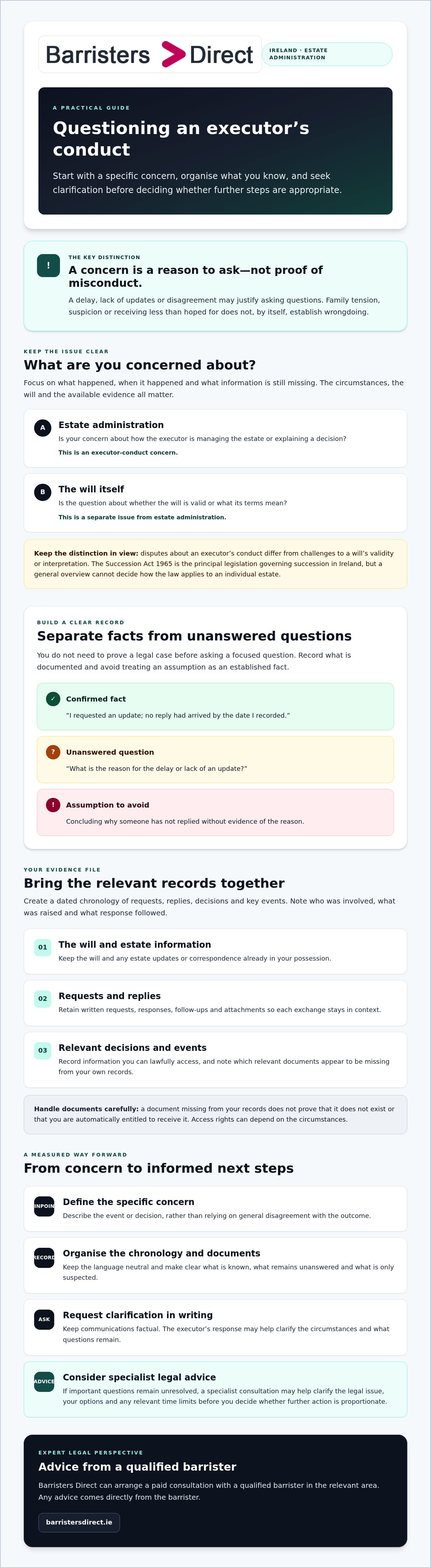
Challenging a will executor: practical steps to take
A clear sequence can help you raise concerns constructively and decide what to do next. Keep each step focused on the executor’s administration, unless the issue is actually about whether the will is valid or what it means.
- 1. Define the concern. Identify the specific decision, omission or information gap. Explain why it matters to the estate’s administration, rather than relying on a general feeling that something is wrong.
- 2. Organise your records. Gather the will, correspondence, estate updates and other relevant documents you already have. Keep a dated chronology and separate confirmed facts from questions or assumptions.
- 3. Request clarification. Write to the executor with concise, relevant questions. Ask for an explanation or information that relates directly to your concern, without alleging misconduct before you have the facts.
- 4. Assess the response. Compare the reply with the questions you asked. Note what has been answered, what remains unclear and whether any new information changes your understanding.
How should you raise concerns with an executor?
Use a factual, measured tone. Identify the decision or missing update, state what you understand so far and ask what information would clarify the position. Keep a copy of your request and any reply, including attachments. If you speak by telephone or meet, make a brief, neutral note afterwards. Distinguish your recollection from written records.
What should you do if the response does not resolve the concern?
Update your chronology objectively. If important questions remain unanswered, the dispute escalates or a decision about estate assets appears imminent, consider seeking tailored legal advice promptly. Don’t assume a general timeline applies. Any relevant deadline or legal implication depends on the issue and should be checked with a solicitor or specialist barrister.
If your concern shifts to the validity of the will itself, treat that as a separate issue. The article Challenging a Will: Time Limits in Ireland (2026 Guide) addresses time limits for will challenges. Seek advice promptly if validity is in question, as timing may matter.
For guidance on the legal issues and possible next steps, explore options for a specialist barrister consultation. Barristers Direct can arrange a paid consultation with a qualified barrister in wills and probate. Any advice comes directly from the barrister. The consultation may help you assess what further steps, if any, are appropriate.
Getting specialist advice about an executor dispute: what happens next?
If you’ve gathered the relevant records but aren’t sure what they mean, a specialist consultation can help you focus on the legal issues. A barrister may review the information you provide and discuss possible next steps, including what further facts or documents may be needed. The value is in informed, case-specific advice, not a guaranteed resolution.
Barristers Direct helps arrange a paid consultation with a qualified barrister in the relevant area of law, including wills and probate. The consultation can be conducted online or by telephone. Barristers Direct does not itself provide legal advice or legal services. Any advice, and any further engagement, is solely between you and the barrister.
What can a specialist barrister consultation help you clarify?
You can explain what the executor has done or not done, ask whether the concern raises a legal issue and consider proportionate options. The barrister can also identify uncertainties in the information you provide. A consultation doesn’t automatically include ongoing representation or formal proceedings. If a dispute progresses, the work required and who should undertake it will depend on the circumstances.
How can you prepare to make the consultation useful?
Prepare a short summary, a dated chronology, the will and relevant correspondence or estate updates already in your possession. Keep documents in order and clearly mark anything you’re unsure about. A focused set of questions can make the discussion more practical. For example:
- What are the main legal issues raised by these facts?
- What further information or documents should I seek?
- What options may be available, and what risks should I consider?
- Could a solicitor be needed if formal steps or broader estate administration work are required?
A barrister’s specialist advice can help clarify legal issues and options, while a solicitor may have an important role in a client’s broader legal and transactional work. If you’re unsure how these roles differ, read The Difference Between Solicitors and Barristers. Formal proceedings may require a solicitor, depending on the matter and the work involved.
If you’re ready to discuss your circumstances with a specialist, arrange a specialist legal consultation. Set out the issue clearly and bring the records and questions that will help the barrister understand what you need advice on.
Take a clear next step with confidence
Knowing how to challenge an executor of a will starts with a specific concern and a clear record of what has happened. Separate confirmed facts from assumptions, ask focused questions and assess the response before deciding whether further action is proportionate. If the issue is about the will’s validity rather than its administration, treat it separately and seek advice promptly if timing may matter.
Where important questions remain, specialist legal advice can help you understand the issues, weigh possible options and identify information that may still be needed. Barristers Direct can arrange a paid consultation with a qualified barrister in the relevant area of law. Consultations can be held online or by telephone, and If formal proceedings are contemplated, a solicitor may also be needed.
Arrange a paid consultation with a specialist barrister to discuss your circumstances and consider your next steps. Organised records and informed guidance can help you approach the issue carefully and constructively.
Frequently Asked Questions
Can a beneficiary challenge an executor of a will in Ireland?
Yes. A beneficiary can raise a specific concern about how an executor is administering an estate. Start by identifying the decision, delay or information gap and asking for clarification in writing. Disagreement with the will’s provisions or an unfavourable inheritance does not, by itself, establish misconduct. If the concern remains unresolved, organise the relevant records and seek advice on whether further steps may be appropriate.
What are valid reasons to challenge an executor?
Potential grounds may include serious mismanagement, a material conflict of interest, inability or unwillingness to act, or significant unexplained delay affecting the estate. The facts and supporting evidence matter. A lack of updates or a disputed decision may justify questions, but doesn’t automatically prove wrongdoing. A specialist legal adviser can assess the will, estate circumstances and available records to help determine whether the concern may justify further action.
Can an executor be removed from an estate?
An executor can be removed only by a court order, and a beneficiary’s objection does not automatically achieve this. A court considers the circumstances and evidence, such as alleged misconduct, serious mismanagement or failure to administer the estate. Removal is a formal step, so get case-specific advice on the appropriate procedure, evidence and potential risks before pursuing it. Disagreement or an unfavourable outcome alone is unlikely to be enough.
What can I do if an executor is not responding?
Send a concise, factual written request identifying the information you need and why it matters. Keep a copy and record when it was sent, along with any reply or follow-up. Avoid assuming why the executor hasn’t responded. If important questions remain unanswered or an estate decision appears urgent, seek legal advice about proportionate next steps. The appropriate response depends on the facts, available evidence and any relevant time limits.
How do I complain about an executor handling an estate?
There isn’t one universal complaints process for every dispute about an executor’s conduct. A practical first step is to put your concern and specific questions in writing to the executor, using neutral language and keeping the correspondence. If the response doesn’t resolve the issue, or you believe the estate is being harmed, seek independent legal advice about available options. Formal action is not automatic and should be considered in light of the evidence.
Can I challenge an executor without challenging the will?
Yes. You can question how an executor is administering an estate without disputing the will’s validity or meaning. Your concern may relate to a delay, a decision or a lack of clear information. These issues are distinct: challenging the executor concerns the administration, while challenging the will concerns its validity or effect. Identify which issue applies, as the relevant steps and time limits may differ.
Is there a time limit for challenging an executor in Ireland?
There isn’t one universal time limit for every executor dispute. It depends on the type of claim. For example, a child’s claim under section 117 of the Succession Act 1965 has a strict six-month deadline from the first Grant of Representation. A claim to an estate share may have a different limitation period, running from when the right accrues. Will-validity challenges raise separate timing issues. Get prompt advice to check the deadline that applies.
Disclaimer
This article does not constitute legal advice. Barristers Direct does not provide legal advice. To obtain legal advice, you should contact a legal practitioner.


