

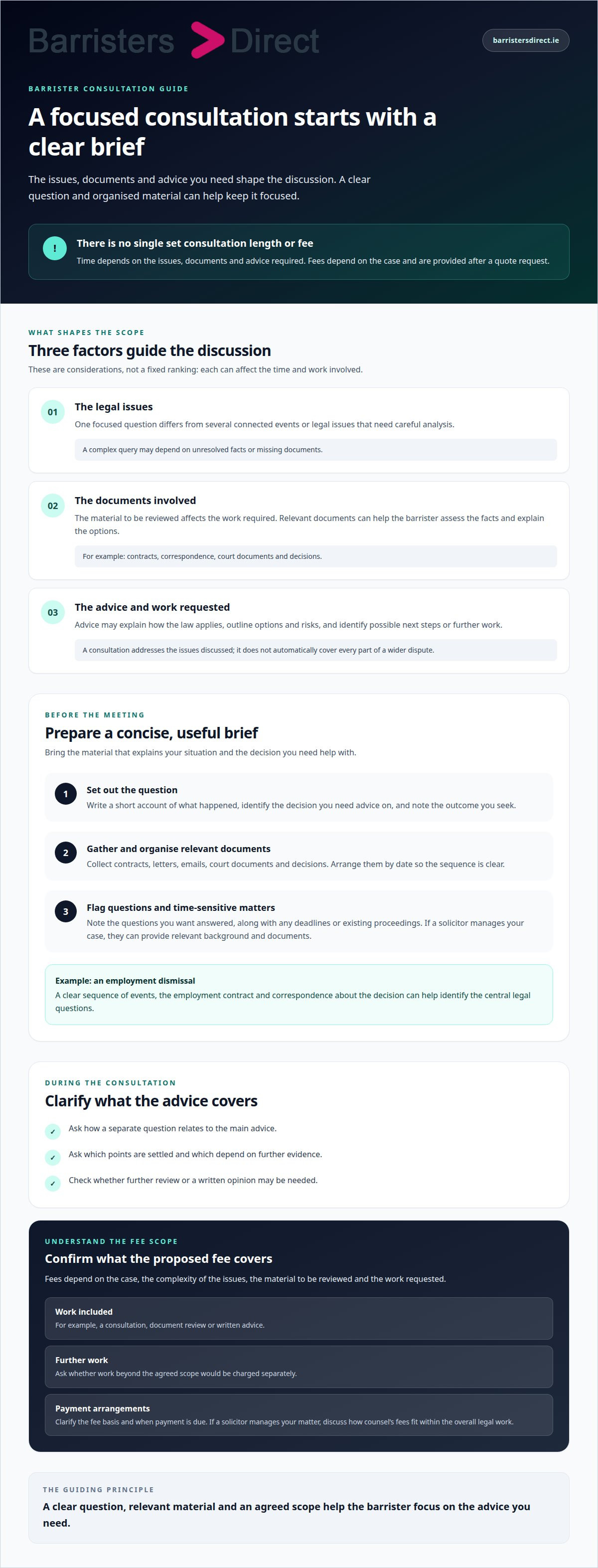
There’s no single set consultation length for barrister legal advice in Ireland: the time needed depends on the issues, the documents involved and the advice you need. Fees depend on the case and are provided after a quote request; the work required, the complexity of the issues and the material to be reviewed all affect the cost.
If you’re unsure how much time a meeting needs or what to prepare, a focused consultation can help clarify your legal position, identify questions that need further work and consider possible next steps.
This article explains what can affect consultation length and fees, what to expect when speaking with a barrister, and how to seek a second opinion if you’re already represented. It also outlines how direct access works and where specialist barrister advice can fit alongside the role of your solicitor.
Key Takeaways
- Consultation time depends on the legal issues, the documents involved and the advice you need, so a clear explanation of your situation helps focus the discussion.
- A barrister can provide specialist legal advice; the solicitor’s role in managing your matter and briefing counsel remains important.
- If you’re already represented, a barrister’s independent view can help you understand your position and consider your next steps.
- The cost of advice depends on the work involved and the complexity of the matter; understand what the proposed fee covers before proceeding.
- Direct access can connect you with a specialist barrister for a fixed-fee initial meeting, including for wills and probate advice.
Consultation length and complex legal queries
The issues, documents and advice required shape a consultation. Discussing one focused question differs from addressing several events or legal documents.
Handling complex legal queries
A complex legal query may involve connected issues that require careful analysis. The distinction matters because unresolved facts or missing documents can affect the barrister’s assessment and the options available.
For example, an employment dispute may involve a dismissal, workplace correspondence and a contract. A barrister can identify the central legal questions, explain how the facts relate to them and outline whether further work is needed. Help keep the discussion focused by setting out the sequence of events and the decision you need help with.
If a question raises a separate issue, ask how it relates to the main advice. This helps distinguish what can be addressed in the consultation from work that may require further review or a written opinion. If a solicitor is managing your case, they can also provide relevant documents and background.
The scope of barrister advice
Barrister advice can analyse the law and explain options, risks and possible next steps. A consultation addresses the issues discussed; it does not automatically cover every aspect of a wider dispute.
Section 2(4)(b) of Ireland’s Legal Services Regulation Act 2015, as amended, sets out what counts as providing legal services as a barrister for the purposes of the Act. In practical terms, the advice may address how the law applies to your circumstances and what further steps could be considered. For context on direct access in Ireland, see information about barrister access.
Before the meeting, identify the decision you need advice on and the documents that explain it. During the consultation, ask the barrister to distinguish settled points from issues that depend on further evidence. A confidential discussion can then focus on the advice you need, whether that concerns a contract, a will or a dispute.
Fees and payment terms are agreed for the particular work. Before proceeding, clarify the fee basis, what work it covers, when payment is due and whether further work would be charged separately.
If you have a problem, raise the issue with the barrister and explain what outcome you seek. For concerns about professional conduct, the Legal Services Regulatory Authority (LSRA) provides the relevant regulatory complaints route. The LSRA’s Code of Practice for Practising Barristers came into effect on 26 September 2024, and breaches of professional conduct may lead to disciplinary sanctions.
Advice is more focused when the question is clear and relevant material is available. Whether you consult directly or through a solicitor, defining the scope helps the barrister address the legal issues and identify any further work that may be needed.
How to access legal support
You can seek legal advice in Ireland through an appropriate legal professional, depending on your needs. The right route depends on whether you need initial advice, ongoing case management or representation.
Irish barristers commonly appear in the High Court, Court of Appeal and Supreme Court, and regularly in the Circuit Court. A consultation is advice, not a promise of court representation; the work and instructions must cover any court appearance.
Finding legal support
Finding legal support means choosing a qualified professional whose expertise matches your issue. This matters because a clear fit helps focus the advice on the decision you face.
A solicitor may help manage your matter and brief counsel where appropriate. For civil legal aid, the Legal Aid Board assesses applicants under means and merits tests. Citizens Information Centres no longer offer face-to-face free legal advice clinics. If you need a solicitor who practises through Irish, the Law Society of Ireland provides contact details.
Costs of barrister advice
The cost of barrister advice depends on the case and is given after a quote request. Factors include the issue’s complexity, the documents to review and the work requested.
Clarify what the proposed fee covers, such as a consultation, document review or written advice. Ask whether further work falls outside that scope and how payment is arranged. If a solicitor is managing your matter, discuss how counsel’s fees fit within the overall legal work. This helps you understand the proposed work before deciding how to proceed.
Preparing for a barrister consultation
Prepare the material that explains your situation and the advice you need. A clear timeline can help the barrister identify key facts and unanswered questions.
Gather relevant contracts, letters, emails, court documents and decisions. Arrange them by date, then write a short account of what happened and what outcome you seek. For example, an employee discussing dismissal could bring the employment contract and correspondence about the decision. Mention any deadlines or existing proceedings, and note the questions you want answered.
Checking qualifications and good standing
To confirm a barrister’s practising status, check their entry on Ireland’s Roll of Practising Barristers. The Roll provides a formal record of practitioners.
The Legal Services Regulatory Authority (LSRA) established the Roll in June 2018. Section 133 of the Legal Services Regulation Act 2015 provides for it, according to the Irish Statute Book. Search the Roll for the barrister’s name and confirm the entry matches the person you plan to instruct. Roll status is a qualification check; it does not, by itself, tell you whether the barrister is suitable for your particular legal issue.
If direct access suits your needs, explore options for accessing barrister advice and consider which documents relate to your question.
What legal advice can a barrister provide in Ireland?
For people seeking barrister legal advice in Ireland, a barrister can explain how the law applies to their circumstances and outline possible options. Advice may concern a dispute, a legal document or a decision. Its scope depends on the barrister’s area of practice and the questions raised during the consultation.
Section 2(4)(b) of Ireland’s Legal Services Regulation Act 2015, as amended, sets out what counts as providing legal services as a barrister for the purposes of the Act. In practice, a barrister may assess legal arguments, interpret relevant documents, draft court documents or represent a client in proceedings. A solicitor may manage the wider matter and formally brief counsel.
Legal analysis connects principles to the facts. For example, a landlord and tenant dispute may involve the tenancy agreement, written communications and each party’s actions. A barrister can identify the legal questions raised, explain possible options and outline what further evidence could affect the assessment.
Different issues call for different legal expertise. Examples include:
- Wills and probate: Advice may address a will’s meaning or questions arising during estate administration.
- Debt recovery: A barrister can assess the basis for a claimed debt and explain potential legal routes for pursuing or defending it.
- Medical negligence: Advice can clarify the legal issues raised by alleged negligent treatment and the evidence relevant to a claim.
- Personal injury: A barrister can analyse legal issues arising from an injury and identify material relevant to a claim.
The subject and facts shape the advice. Interpreting one clause differs from assessing a dispute involving several documents and contested events. The barrister considers the instructions and available material, then identifies where further evidence or specialist input may matter. A focused question helps direct the advice towards the decision you need to make.
Advice can clarify practical choices. A barrister may explain the strengths and weaknesses of a legal position, the risks of different options and the work needed to progress the matter. This analysis supports an informed decision, but does not decide the dispute or guarantee a particular result.
If you already have a solicitor, counsel’s advice can complement their work. Your solicitor may coordinate the matter while the barrister analyses a specific legal question, document or proposed course of action. For example, counsel could consider the legal effect of a clause while your solicitor manages correspondence. Each can address different needs.
A consultation for barrister legal advice in Ireland can help you understand a defined legal issue and consider next steps. The appropriate scope depends on the question, the facts and the work needed to address them.
What is the difference between a barrister and a solicitor in Ireland?
Solicitors and barristers are both legal practitioners in Ireland, but their roles often differ. A solicitor typically maintains direct contact with clients and manages broader legal and transactional matters. A barrister focuses on specialist legal advice and courtroom advocacy, and a solicitor may brief one when a matter calls for that expertise.
For example, in a commercial dispute, a solicitor may gather information, manage correspondence and coordinate the case. They can brief a barrister to assess legal arguments, advise on the issues or prepare court documents. The solicitor manages the matter while the barrister addresses specific legal questions.
Irish barristers commonly appear in the High Court, Court of Appeal and Supreme Court. They regularly appear in the Circuit Court and sometimes in the District Court. The court involved and the work required shape the role counsel plays. A barrister may advise or represent a client in proceedings, but a consultation alone does not automatically include court representation.
Traditionally, members of the public instruct a solicitor, who may then brief a barrister. For certain matters, direct access offers another route to specialist advice. This can help if you need counsel’s view on a defined question, such as how a contract clause affects a dispute. A solicitor remains important where the matter requires ongoing management or formal proceedings.
The professions also have distinct professional bodies. The Law Society of Ireland is the regulatory, educational and membership body for solicitors. The Honourable Society of King’s Inns provides the professional qualification required to practise at the Bar. After qualifying, a newly qualified barrister undertakes pupillage, practical training under an experienced barrister’s supervision.
Barristers traditionally practise as sole traders and may not operate through partnerships or companies. Many have established private offices whilst continuing to practise independently. These arrangements differ from the client-facing solicitor model, but both professions serve clients within Ireland’s legal system.
The cab rank principle generally expects Irish barristers to accept instructions from a solicitor seeking their services, regardless of the client’s size or resources. It applies to instructions from solicitors, not a general obligation to accept every direct approach from a member of the public. This helps explain why solicitors often act as the formal link when engaging counsel.
For a client, the practical distinction is the work needed. If you need ongoing case management or formal proceedings, a solicitor can coordinate the matter and brief counsel where appropriate. If you need focused analysis from a barrister, Barristers Direct arranges a fixed-fee initial consultation for direct access to specialist advice.
How much does it cost to get legal advice from a barrister in Ireland?
There is no single fee that applies to every barrister consultation in Ireland. The amount reflects the work requested, rather than simply the professional title of the person advising you. A brief discussion of one focused legal issue is different from a review involving extensive papers or several connected questions.
Before proceeding, understand what the fixed-fee initial consultation covers. If you need further work, agree its scope and fee separately.
A fixed-fee initial consultation sets the fee for that meeting. It does not include later work. For example, a written opinion or further analysis may require a separate arrangement. Clarify what falls within the initial consultation and what would be additional work.
Consider the scope of the advice, not just the fee. A useful consultation focuses on the legal question and relevant material. If your matter involves several questions, identify which ones you want addressed so you understand the scope of the advice.
Before proceeding, establish the practical payment terms in writing. Ask when payment is due, how it can be made and what happens if you later request additional work. If a solicitor is coordinating the matter, clarify whether the barrister’s fee is invoiced separately or forms part of the wider arrangement. These points help prevent different expectations about responsibility for payment.
For instance, a will query might concern a particular clause, while a broader probate issue could require reviewing correspondence and estate documents. The work depends on the question and material involved, not merely the topic label. Likewise, a debt dispute may raise separate questions about the amount claimed, supporting records and legal options. A clear request helps define what the barrister is being asked to address.
Prepare a concise account of your issue and identify the decision you need to make. Describe the documents available and the advice you seek. This gives the consultation a practical focus. If you need work beyond the initial meeting, agree its scope and fee separately rather than assuming it is included.
For a defined legal question, request a quote for barrister advice based on the work you need.
Barristers Direct: Wills and Probate Legal Advice
Barristers Direct arranges fixed-fee initial consultations with specialist barristers for Wills and Probate Legal Advice. If you need advice about a will or estate administration, a barrister can assess the legal question and explain possible next steps.
You can access a barrister directly for an initial consultation, without needing a solicitor for that meeting. Barristers Direct matches you with a specialist based on your legal issue and arranges a fixed-fee consultation. This can suit you if you want focused advice before deciding how to proceed, or if you already have a solicitor and need a second opinion.
Contact Barristers Direct to discuss your wills or probate legal advice needs.
Choose the next step with clarity
Turn your legal concern into a clear question for counsel. Identify the decision you face, the outcome you seek and any documents that explain the issue. If you’re already represented, consider whether independent barrister advice could help you assess your options alongside your solicitor’s work.
If you need barrister legal advice in Ireland, Barristers Direct arranges fixed-fee initial consultations with specialist barristers in areas including Commercial Dispute Resolution, Employment Law Consultation and Wills and Probate Legal Advice. The service matches your legal issue with relevant expertise, helping you understand your position and possible next steps.
Share your query and take the next step at a pace that suits your circumstances. Contact Barristers Direct to discuss your query.
A well-defined question is a practical starting point for informed legal advice.
Frequently Asked Questions
Can you hire a barrister directly in Ireland without a solicitor?
Yes, you can instruct a barrister directly for certain matters in Ireland. A direct consultation can help clarify a defined legal question, such as how a contract term affects a dispute. Direct access does not mean every legal task can be handled without a solicitor. If formal legal action is needed, a solicitor may be required to manage the proceedings and related work.
How do you find and choose a barrister in Ireland?
Start by identifying the legal issue and looking for a barrister whose practice covers it. For example, a probate question calls for relevant wills and estate expertise, while a workplace dispute needs employment law knowledge. The Legal Services Regulatory Authority maintains Ireland’s Roll of Practising Barristers. Check the practitioner’s entry and consider whether their area of practice fits the advice you need.
How does the Bar of Ireland's Direct Professional Access scheme work?
The Direct Professional Access scheme provides a route for eligible professional clients to instruct a barrister directly, rather than through a solicitor. It is distinct from public direct access, which is available for certain matters under Ireland’s legal services framework. Direct instruction does not itself provide solicitor services or ensure that a barrister can manage every procedural step in a case. Formal proceedings may require a solicitor.
What legal aid is available for barrister advice in Ireland?
The Legal Aid Board is Ireland’s independent statutory body for civil legal aid and advice. Applicants must pass means and merits tests to qualify. Legal aid is separate from a privately arranged direct consultation, and eligibility does not automatically establish that every type of barrister advice or representation is covered. The Board assesses applications and the legal assistance available through its civil legal aid service.
Disclaimer
This article does not constitute legal advice. Barristers Direct does not provide legal advice. To obtain legal advice, you should contact a legal practitioner.


