

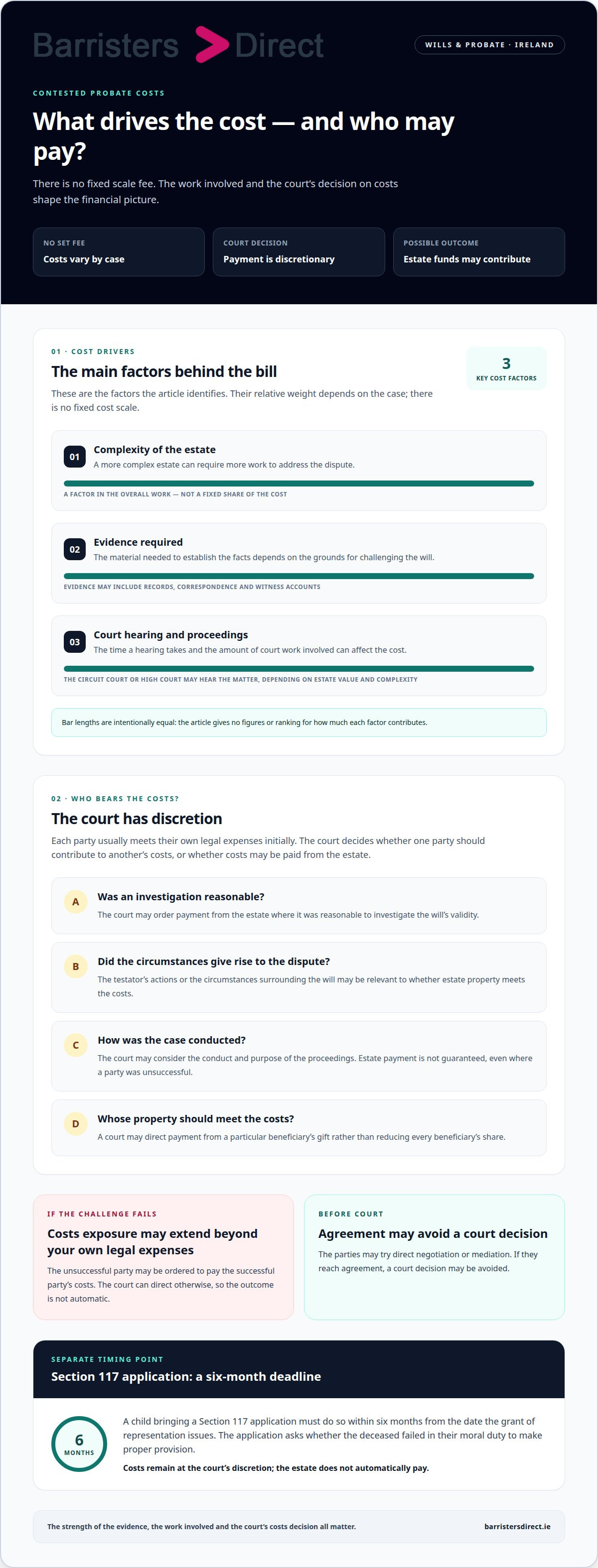
The cost of contesting a will in Ireland has no fixed scale fee. It depends on the complexity of the estate, the evidence required and how long the court hearing takes. A will may be challenged after the testator’s death on grounds such as lack of testamentary capacity, undue influence or improper execution. The court may order costs to be paid from the estate where it was reasonable to investigate the will’s validity and the case was conducted bona fide.
It is understandable to want a clear picture of the financial risk before deciding whether to act. The outcome depends not only on the strength of the challenge, but also on the work needed to establish the facts and how the court exercises its discretion on costs.
This article explains when a will may be contested, what can affect the cost, and when estate funds may cover legal costs. It also sets out what to consider before taking the next step, so you can make a more informed decision about the process.
Key Takeaways
- A will may be challenged on specific legal grounds, but disappointment with its provisions alone does not establish a claim.
- The likely cost depends on the evidence, complexity of the estate and amount of court work involved.
- A court can order costs to be paid from estate property, but this is not automatic and depends on the circumstances.
- Understanding whether a caveat or other protective step is appropriate can help address risks while a dispute is considered.
- Specialist legal advice can help assess the basis for a challenge and the practical choices before proceedings begin.
Grounds for challenging a will
A challenge needs a legal ground supported by evidence, not simply a belief that an inheritance is unfair. In Ireland, a will may be challenged for failing to meet the requirements of the Succession Act 1965, or because the person who made it lacked testamentary capacity when signing. Capacity concerns whether the testator understood the nature and effect of making a will. Undue influence, fraud, forgery and improper execution may also be relevant grounds.
Section 117 of the Succession Act 1965 provides a separate route for a child who claims that a deceased parent failed in their moral duty to make proper provision. The High Court may order provision from the estate if it considers that duty was not met. This is not an automatic entitlement to a share: the circumstances and supporting evidence matter.
Evidence helps establish whether the alleged problem affected the will. Depending on the grounds, relevant material may include medical records, correspondence, earlier wills, witness accounts and documents recording the testator’s instructions. For a capacity claim, evidence close to the date the will was signed may be particularly useful. Gathering evidence can become harder over time if witnesses move or their recollections fade.
A mistake in a will or the discovery of a later document can raise questions about which document governs the estate. The court may consider the dates of the documents, the circumstances in which each was made, and whether the will relied on meets legal requirements. A drafting error alone does not establish that the whole will is invalid. Its effect depends on the issue and the evidence.
What steps are involved in challenging a will in the Irish courts? Proceedings begin when a claim is issued in the court office. The parties then exchange pleadings setting out their positions, before the dispute proceeds to a hearing before a judge. Contested probate matters are heard in the Circuit Court or High Court, depending on the estate’s value and complexity.
An unsuccessful challenge can carry financial consequences. Under section 169 of the Legal Services Regulation Act 2015, according to the Irish Statute Book, an entirely successful party in civil proceedings is entitled to an award of costs against the unsuccessful party, although the court may direct otherwise. That means a claimant may face their own legal costs and an order to pay another party’s costs. The court’s decision on costs depends on the proceedings, so it should be considered alongside the strength of the evidence before a claim is issued.
When a court may order costs to be paid from the estate
Irish courts have discretion over probate costs, so the losing party does not automatically pay every bill. Parties may also try direct negotiation or mediation, which can avoid a court decision if they reach an agreement.
The costs-follow-the-event rule
The costs-follow-the-event rule generally means the unsuccessful party may be ordered to pay the successful party’s costs. Who pays legal costs if you contest a will in Ireland? Usually, each party initially meets their own legal expenses, while the court decides whether one should contribute to the other’s. The court may make a different order, so the likely costs consequences are an important part of deciding whether proceedings are proportionate.
Costs from an estate or gift
Section 168 of the Legal Services Regulation Act 2015 gives the court power to make costs orders against parties and order costs to be paid from estate property, according to the Irish Statute Book. The court may charge costs to the estate where the testator’s actions or the circumstances surrounding the will caused the dispute, or a reasonable investigation was needed. It can also direct payment from a particular beneficiary’s gift, rather than reducing every beneficiary’s share.
In O’Connell v O’Connell and Anor., [2023] IEHC 215, the High Court apportioned the executor’s costs between a nephew’s gift and the estate residue. The decision shows that the source of payment can depend on the parties’ roles and the dispute’s effect on the estate. Estate payment is not an automatic outcome for every claimant or defendant.
Section 117 applications and costs
A child bringing a Section 117 application must do so within six months from the date the grant of representation issues. Missing that deadline can affect the ability to pursue the claim, so timing is a central practical consideration. The application asks the court to assess whether the deceased failed in their moral duty to make proper provision for the child.
Costs in a Section 117 application are at the court’s discretion. The judge may consider how the claim was conducted and its connection to the estate, rather than applying an automatic rule that the estate pays. A claimant should weigh both the deadline and potential costs exposure before proceedings begin.
Court discretion over probate costs
The High Court can consider the conduct and purpose of probate litigation when deciding who should bear the costs. If investigating the will’s validity was reasonable in the circumstances, the court may order payment from the estate. A party’s complete lack of success does not, by itself, guarantee payment from estate funds.
The estate’s size and the effect of legal costs on beneficiaries’ inheritance may also inform the decision. In Vella v Morelli, [1968] IR 11, the court considered estate payment for an unsuccessful party, but costs are not automatically paid from an estate in every probate case. A focused assessment of the issues and financial risks can help shape a proportionate approach; specialist legal advice can help clarify those considerations.
Undue influence, fraud and improper execution
In Ireland, a will’s validity can be challenged if undue influence, fraud or failure to follow execution formalities affected its making. Undue influence involves pressure that overbore the testator’s own decision-making. Physical force is not required for a court to invalidate a will on this ground. For example, evidence that someone controlled the testator’s access to others may be relevant, but the surrounding circumstances must support the allegation.
Fraud or forgery raises a different question: whether the document records the testator’s genuine instructions and signature. A disputed signature, inconsistent documents or evidence that a page was substituted may need investigation. An allegation alone does not establish fraud. The evidence must connect the alleged conduct to the will or provision being challenged, and the parties’ accounts may need to be tested in proceedings.
Due execution is another distinct question. The Succession Act 1965 sets out the signing formalities for a valid Irish will. The testator must sign in the presence of two witnesses, and both witnesses must sign in the testator’s presence. If a witness signed later or was absent when the testator signed, that may raise an execution issue. The effect depends on the document and evidence about how it was signed.
Practical evidence may include the original will, earlier versions, correspondence about instructions and accounts from people present at signing. If capacity or undue influence is also alleged, medical records and communications close to the signing may help explain the testator’s circumstances. A solicitor’s file, if one exists, may record instructions and execution details. Each item needs to be considered in context: a difference between an earlier and later will does not, by itself, prove improper conduct.
The executor is responsible for administering the estate and may need to respond to a challenge affecting the grant or distribution. Beneficiaries whose provision could change may also have an interest in the outcome. Identifying the relevant parties early helps clarify which decisions are disputed and what evidence is needed. A challenge to one clause, for instance, may have a different effect from an allegation that the entire will is invalid.
These distinctions affect the likely scope of the case. A dispute about whether two witnesses signed correctly may require different evidence from allegations involving coercion, forgery and capacity. If several grounds are raised, proceedings may involve more documents and witness accounts. Careful analysis separates facts relevant to validity from family disagreement or disappointment about the distribution, helping keep the legal issues focused.
Caveats and protecting an estate during a dispute
A caveat at the Probate Office can help protect an estate while concerns about a will are examined. It prevents a grant of probate from being issued without notice to the person who lodged it. A caveat does not decide whether the will is valid, so consider it alongside the evidence and the action being contemplated.
A will can still be contested after a Grant of Probate has issued, and some proceedings may need to wait until after the grant. The estate’s position may change while a dispute continues: assets may remain undistributed, and beneficiaries may have to wait for their inheritance until the issues are resolved. A caveat can affect the grant process, but it does not resolve the underlying dispute.
How long does a will dispute usually take in Ireland? There is no fixed duration. Court-list backlogs, the pace of pleadings, the complexity of the evidence and whether the parties reach an agreement outside court can all affect the timetable.
The financial impact can extend beyond legal costs. If litigation expenses reduce the estate, less may remain for distribution; if a grant or payment is delayed, beneficiaries may wait longer for their inheritance. A dispute can also strain family relationships, particularly when executors and beneficiaries take opposing positions. Clear communication about the issues and a realistic assessment of the evidence can help parties consider resolution without a hearing.
Negotiation or mediation may provide a route to agreement outside court. These approaches allow family members to discuss the disputed provision and possible settlement, rather than leaving every issue to a judge. They do not guarantee agreement, but a focused discussion may narrow the questions that remain contested. Solicitors can advise parties on their position and help structure negotiations.
Estate planning can reduce the risk of later disputes by making intentions clear and keeping relevant documents organised. For example, someone who has made promises about an asset should address that intention carefully when planning their estate. A later will that contradicts a relied-upon promise may lead to a proprietary estoppel claim. Reviewing a will as circumstances change can also help keep its provisions aligned with the testator’s intentions.
If a person dies without a will, the Succession Act 1965 governs distribution under intestacy rules. Where the deceased leaves a spouse and children, the spouse receives two-thirds of the estate and the children share one-third. If there is a spouse but no children, the spouse inherits the entire estate. These rules differ from a will-based dispute, so identifying whether a valid will exists is an important early step.
Why contested probate has no fixed price
There is no fixed price for contesting a will in Ireland. The price depends on the case and is given after a quote request; key factors include the evidence, estate complexity, hearing length and court work involved.
Factors behind contested probate costs
Contested probate costs vary because each claim requires different evidence and legal work. A dispute about a single document may be narrower than a case involving several witnesses, medical records and competing accounts of the testator’s instructions. Resolving issues before a hearing also involves different work from taking a claim through a full court hearing.
The court chosen also matters: contested probate proceedings may be heard in the Circuit Court or High Court, depending on the estate’s value and complexity. Court-list backlogs, the pace of pleadings and settlement discussions can affect how long the dispute continues. These factors shape the work required rather than creating a standard scale fee.
The cost of contesting a will
There is no published scale fee for a will dispute in Ireland, so a reliable estimate must reflect the particular claims and evidence. How much does it cost to contest a will in Ireland? It depends on the work needed to assess the document, prepare the case and resolve disputed facts. The likely hearing length and the other parties’ positions also affect the overall financial exposure.
A solicitor must provide written information about legal costs, or how they will be calculated, when instructions are given. If parties disagree about litigation costs, the Office of the Legal Costs Adjudicators can assess what is fair and reasonable in relevant court proceedings. This assessment does not remove the need to understand potential costs as the case develops.
A no-win, no-fee arrangement is not a standard funding route for will disputes. A solicitor may consider such an arrangement, but many firms may not take a case on that basis. In contentious business, fees or other charges cannot be calculated as a percentage or proportion of an award or settlement. Consider the funding terms and any costs exposure carefully before proceedings begin.
The useful takeaway is to assess the case in stages: identify the legal claim, examine the available evidence, then consider the likely court work and resolution options. A strong claim can still involve substantial litigation, while an early settlement may limit further work. Specialist advice can clarify those issues and the costs information relevant to your case. Request advice on a will dispute before deciding how to proceed.
Barristers Direct: Wills and Probate Legal Advice
Barristers Direct offers Wills and Probate Legal Advice for people considering a will challenge or responding to a dispute. If you are unsure whether the evidence supports a claim, a specialist barrister can clarify the legal issues, potential costs exposure and practical options before you decide how to proceed.
Barristers Direct matches you with a specialist barrister for a fixed-fee initial consultation. You can discuss the will, the circumstances around its signing and the outcome you are seeking, then receive expert advice and a clear path forward. The consultation provides advice, not direct litigation representation.
For a focused assessment of your position, book a consultation with Barristers Direct about Wills and Probate Legal Advice.
Choose your next step with a clear view of your objectives
Before taking action, define what a satisfactory outcome would mean for you. It might mean protecting a specific inheritance, clarifying the effect of a disputed provision, or reaching an agreement that allows family members to move forward. Keeping that objective central can help distinguish essential legal work from issues that do not advance your position.
Understanding the cost of contesting a will in Ireland is part of making the decision, but specialist advice can help you assess the legal merits and practical choices together. It can help you weigh the evidence, your preferred outcome and the likely demands of pursuing it, so you can decide how to proceed with greater clarity.
Barristers Direct offers Wills and Probate Legal Advice for people considering or responding to a will dispute. If you would like to discuss your circumstances and possible next steps, contact Barristers Direct. A considered decision can help you move forward with confidence.
Frequently Asked Questions
Can a will be contested?
Yes. A person claiming an interest in an Irish estate may challenge a will after the testator has died. The claim needs a legal basis, such as concerns about capacity, undue influence or signing formalities. Someone who relied on the deceased’s promise of an asset may also have a proprietary estoppel claim to consider. The appropriate route depends on the interest claimed and the facts supporting it.
Can I bring a Section 117 claim if I was estranged from my parent for years?
Estrangement alone does not answer whether a Section 117 claim can succeed. The claim concerns whether the deceased parent failed in their moral duty to make proper provision for a child, and the court assesses the evidence and circumstances. A history of limited contact may form part of that context, but it does not replace the legal test. A claim must be brought within six months of the grant of representation.
What are the typical solicitor fees for a will dispute in Ireland?
There is no published scale fee for Irish will disputes, so a typical figure would not describe every case. The work may involve reviewing the will, considering evidence, preparing pleadings and dealing with negotiations or a hearing. Complexity and the length of proceedings affect the work involved. Under section 150 of the Legal Services Regulation Act 2015, solicitors must provide written information about legal costs or how they will be calculated when instructions are given.
How much do barristers and court fees cost in Irish probate litigation?
The cost of contesting a will in Ireland depends on the work the case requires; there is no single total for barristers and court fees. The issues in dispute, evidence needed, court proceedings and hearing length affect the overall expense. Counsel’s work and court-related charges form different parts of the financial picture. Ask for written cost information at the outset, including how further work and disbursements will be calculated.
Can you recover legal costs if you successfully challenge a will in Ireland?
A successful challenge does not automatically result in full recovery of legal costs. The court decides who pays and may order costs against another party or from estate property. If costs are assessed, an adjudicator can disallow amounts considered unreasonable. The amount recovered therefore depends on the court’s order and the costs allowed, not solely on whether the challenge succeeded.
What are the grounds for contesting a will under Irish law?
Grounds can include lack of testamentary capacity, undue influence, fraud, forgery or failure to comply with signing formalities. A child may also apply under Section 117, alleging that the deceased failed to make proper provision. Separately, proprietary estoppel may arise where someone relied on a promise of an asset. These are distinct legal routes, so the evidence must support the ground relied upon.
What is the time limit for contesting a will in Ireland?
There is no single time limit covering every type of will challenge. A Section 117 application must be brought within six months from the date the grant of representation issues. Claims based on capacity, undue influence or improper execution generally have a six-year limitation period, subject to case-specific complications. The relevant deadline depends on the relief sought, so identify the claim promptly.
What financial risks should you consider before contesting a will in Ireland?
Consider your own legal expenses, the possibility of an order requiring you to pay another party’s costs, and any effect litigation could have on the estate. A court can order costs to come from estate property, but this is not automatic. Costs can also be disallowed if considered unreasonable. Weigh the evidence, likely legal work and possible effect on your inheritance before deciding whether to proceed.
Disclaimer
This article does not constitute legal advice. Barristers Direct does not provide legal advice. To obtain legal advice, you should contact a legal practitioner.


