

A breach does not automatically make court the right first move. Commercial contract dispute advice in Ireland should begin by identifying the obligation, the alleged failure and the evidence; negotiation, mediation, arbitration or litigation may then be assessed against the contract and the business’s objectives. For qualifying business-contract and business-dispute claims or counterclaims, the Commercial Court generally requires a minimum value of €1 million, according to the Courts Service of Ireland.
When payment, delivery or performance goes wrong, you need a clear way to assess the dispute, especially if it affects cash flow or a business relationship. This guide explains what may amount to a breach of contract, what evidence to preserve, and how negotiation, mediation, arbitration and court proceedings differ. It also explains how specialist legal advice can help you assess your position and choose a practical next step before the disagreement escalates.
Key Takeaways
- Identify the contractual term at issue and keep records that show what was agreed and what happened.
- Weigh the business relationship, desired outcome and likely recovery before choosing how to respond.
- Use the contract’s dispute-resolution provisions to inform whether negotiation, mediation or arbitration may fit.
- Assess the value and complexity of a claim before considering whether the Commercial Court is an appropriate route.
- Specialist legal analysis can clarify your options and help you take a considered next step.
Negotiation, mediation and arbitration
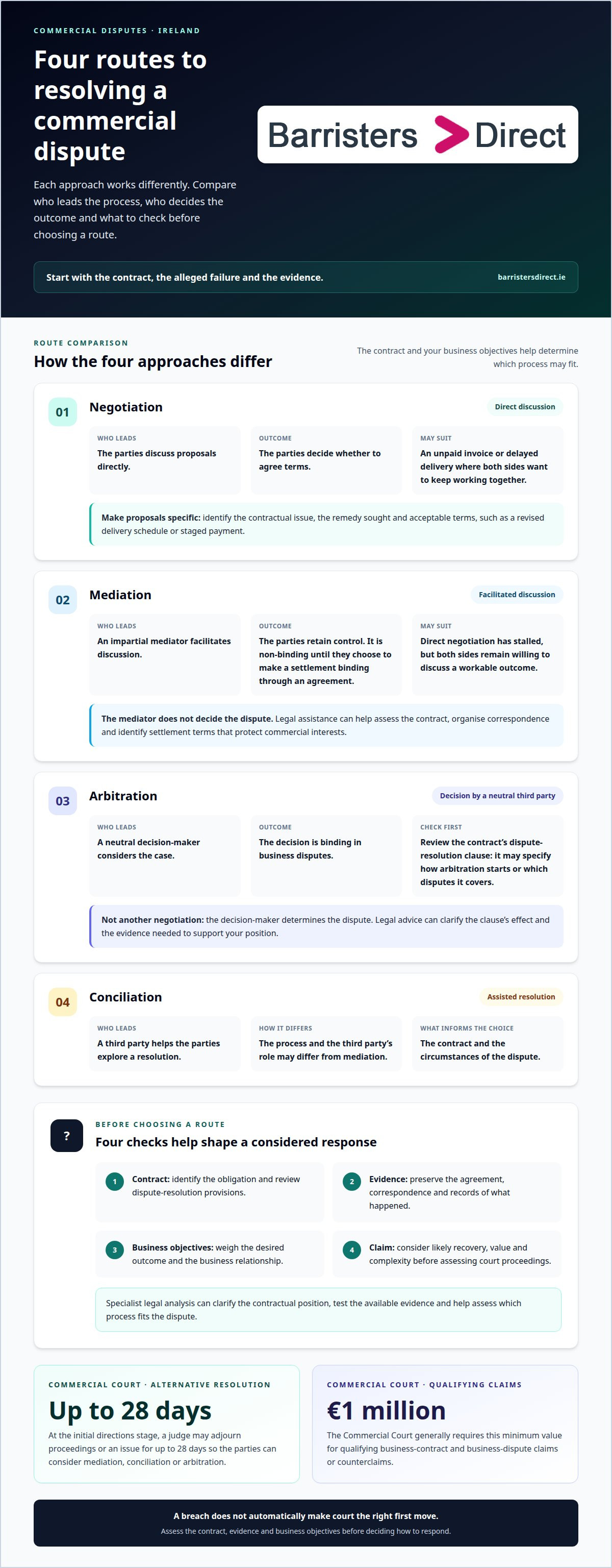
Choose a dispute-resolution method that suits the outcome your business needs. Negotiation may work for an unpaid invoice or delayed delivery when both parties want to continue working together. The parties can propose practical terms directly, such as a revised delivery schedule or staged payment. Before making an offer, identify the contractual issue, the remedy you seek and the terms you could accept. A clear position keeps discussions focused on resolving the problem.
Mediation adds an impartial third party who facilitates discussion but does not decide the dispute. In Ireland, each party can explain its view, test proposals and explore settlement options. The mediator supports the process; the parties retain control of whether they agree. Mediation is non-binding until the parties choose to make their settlement binding through a settlement agreement. It can assist where direct negotiation has stalled, but both sides remain willing to discuss a workable outcome.
Arbitration follows a different process. A neutral third party considers the case and makes a decision that is binding in business disputes. Check the contract’s dispute-resolution clause before proposing arbitration: it may specify how the process starts or which disputes it covers. Legal advice can clarify the clause’s effect and the evidence needed to support your position. Arbitration is not another negotiation: the decision-maker determines the dispute.
Conciliation is also a possible form of alternative dispute resolution. Like mediation, it involves a third party helping the parties explore a resolution, but the process and the third party’s role may differ. The contract and circumstances can influence which approach is suitable. In Ireland’s Commercial Court, a judge may adjourn proceedings or an issue for up to 28 days at the initial directions stage so parties can consider mediation, conciliation or arbitration, according to the Irish Statute Book.
Legal assistance can help you prepare for mediation while leaving the business in control of its decisions. A solicitor can assess the contract, organise relevant correspondence and identify settlement terms that protect your commercial interests. Legal advice can also help distinguish a workable compromise from an offer that leaves a key issue unresolved. Parties are recommended to obtain legal assistance from solicitors for commercial mediation, although they are not legally required to have lawyers assisting them.
Marketing, advertising and media contracts can lead to disputes about campaign delivery, approval rights, payment or agreed use of creative work. For example, an advertiser may say a campaign missed agreed deliverables, while an agency disputes the scope of the brief. Negotiation may resolve a specific delivery issue; mediation can help when the parties disagree about responsibility. Arbitration may be relevant if the contract provides for it. Preserve the brief, approval emails, campaign records and invoices, then seek legal advice on the contract before taking action.
Commercial contract breaches
A contract dispute depends on the agreed obligations, the conduct in question and the remedy sought. These details help determine whether a breach claim is viable and what action may protect your position.
Interpreting commercial contracts
In Ireland, contract interpretation starts with the wording the parties agreed. Read the relevant clause alongside the entire contract, including definitions, schedules and provisions about changes or termination. A delivery dispute, for example, may depend on whether the agreement sets a fixed date or allows the timing to change.
Correspondence and the parties’ conduct can help show how they understood and applied the contract. A lawyer assessing the dispute will consider the wording, commercial context and events that led to it. This helps distinguish a missed obligation from a disagreement about what the obligation required.
Breach of contract claims
A breach may occur when a party fails to perform an obligation or meet a standard set out in the agreement. Examples include non-payment, defective work, delay, failure to deliver agreed goods or services, and breach of a warranty or exclusivity term. To assess a claim, connect the alleged failure to a specific contractual obligation.
Build your case around the contract and the evidence: identify the relevant term, record what happened and show how the failure affected the business. For example, assess an unpaid invoice alongside the payment clause, invoice records and any correspondence disputing the work. The other party’s explanation also matters when weighing the claim and possible remedy.
Time limits for claims
There is no single time limit that applies to every commercial contract claim in Ireland. The relevant deadline depends on the legal basis of the claim and when the right to bring it arose. Establish those points promptly with legal advice.
Do not assume that negotiations extend a deadline. A lawyer can assess the claim type, relevant dates and procedural steps, then advise on a timely course of action. Keep dated contracts, invoices and correspondence organised to help establish the sequence of events.
Risks of termination or withholding payment
Ending an agreement or withholding payment before establishing your contractual position can create another dispute. If the contract does not allow that response, the other party may allege that your business has also failed to perform. For example, withholding an entire payment over one disputed item may conflict with the agreement’s payment terms.
Before acting, review any termination, notice, cure or payment provisions, and document the reason for your proposed step. Consider whether the other party has breached the contract, what responses it permits and what evidence supports your position. Legal advice can help assess the risks before termination or non-payment changes the course of the dispute.
For a focused assessment of contractual obligations, evidence and possible claims, consider seeking commercial dispute advice before taking action that could alter the parties’ position.
Contract disputes and dispute resolution
A sound strategy connects the contract and evidence to the commercial outcome you need. The right resolution route depends on the obligations in dispute, the evidence available and the other party’s ability to meet a remedy.
Enforceability of dispute resolution clauses
Irish commercial contracts may require parties to follow a dispute-resolution process before starting court proceedings. Whether a particular clause is enforceable depends on its wording, how it became part of the agreement and whether the required process is sufficiently clear.
Check which disputes the clause covers, how the process starts and what steps each party must take. A clause providing for arbitration may have a different effect from one requiring negotiation before proceedings. If the contract sets out successive stages, skipping a required step could complicate resolution. Legal advice can assess the specific wording and its effect.
First steps in a contract dispute
Start by mapping the disagreement to the contract. Identify each disputed obligation, the conduct alleged to breach it and the remedy sought. Then organise the signed agreement, amendments, invoices, emails and performance records into a dated chronology. This separates agreed facts from disputed points and gives legal analysis a clear foundation.
Next, assess the commercial objective. A supplier may prioritise completing a delivery, while a customer may need compensation or replacement goods. Consider whether to preserve the business relationship, whether urgent action is needed and whether the other party can pay if a claim succeeds. These factors help you choose between negotiation, alternative dispute resolution and court proceedings.
For a potential High Court claim, assess the claim’s value and subject matter before considering the Commercial Court. Under the rules described for Ireland's Commercial Court, qualifying business-contract and business-dispute claims or counterclaims generally have a minimum value of €1 million, according to the Courts Service of Ireland. Proceedings must be entered into its Commercial List under Order 63A of the Rules of the Superior Courts.
Keep the resolution plan proportionate to the dispute. Order 63A sets the Commercial Court’s objective as handling proceedings justly, expeditiously and in a way likely to minimise costs. A judge may invite parties to consider mediation before a court hearing. If specialist accountancy, valuation, technology or engineering evidence is needed, identify that input early. A focused legal assessment can connect those practical steps to the contract and the outcome sought.
Commercial dispute legal advice
Early legal analysis can turn a business disagreement into a clear decision. It helps identify the issues, assess the evidence and choose a response that reflects your commercial interests. Businesses seeking commercial contract dispute advice in Ireland can use an initial assessment to clarify their priorities.
Commercial disputes may involve more than a written supply contract. They can arise from oral agreements, informal arrangements, business sales, distribution terms, agency commissions, guarantees or commercial leases. Business owners may also dispute control, profit distribution, access to financial information or alleged breaches of duty. The analysis should identify who was involved, what each party agreed and which obligations remain in dispute.
A focused review connects the agreement to what happened. For a disputed service contract, this could mean examining the agreed scope, requested changes, delivery records and the parties’ communications. If a business owner alleges exclusion from decisions, relevant material may include shareholder agreements, board records and financial information. This assessment can distinguish a contractual claim from a disagreement that needs a different legal approach.
Handle evidence carefully. Preserve relevant emails, messages, digital documents, invoices and business-system data, including material that may support the other party’s account. Create a chronology linking key communications to performance, payment and decisions. If records are held across teams, assign responsibility for gathering them and keep the originals intact. This makes it easier to test each account and spot gaps before positions become entrenched.
Some disputes also require specialist analysis. An accounting issue may call for forensic accounting, while a disagreement about business value may require valuation expertise. Data analysis, technology or engineering input can help explain complex performance or system failures. Commercial contract dispute advice in Ireland should connect these questions to the contractual issues and explain how specialist evidence may inform the case.
The right strategy depends on the outcome your business needs. A supplier may want to preserve a customer relationship, while another party may need to recover a debt or stop a recurring breach. Advice should weigh the evidence, available remedies, likely effects on trading relationships and the other party’s ability to pay. Before court proceedings, legal analysis can clarify the claim’s strengths and weaknesses, possible counterclaims and whether litigation is proportionate.
First steps for commercial contract disputes in Ireland
Act promptly, but avoid a response that creates another dispute. A structured initial assessment can establish what the contract requires, what has happened and what outcome your business needs. For commercial contract dispute advice in Ireland, these details also help a legal adviser identify the central issue and recommend a proportionate next step.
Start with the agreement and identify the specific obligation in question. Read the relevant clause alongside schedules, amendments and agreed changes. If a supplier missed a delivery, establish the promised date, any revised schedule and the effect on your operations. Separate confirmed facts from assumptions, then note the other party’s explanation and the points still in dispute.
Preserve records that show how the agreement was made and performed. Gather signed documents, email threads, messages, invoices, delivery records and relevant digital files. Keep them in their original form and note who holds each item. If staff discussed a change by phone, record the date, participants and substance of the conversation. A clear chronology can help pinpoint where accounts differ.
Next, define the business impact and the remedy you want. A customer might need replacement goods, completion of delayed work or compensation for a loss. A supplier may need payment or a workable plan to complete its obligations. Link each requested outcome to the contract and supporting evidence. Distinguish documented losses from estimates, and record how each claimed amount was calculated.
Assess whether the opposing party could pay compensation if your claim succeeds. A strong legal claim may have limited practical value if recovery is unlikely. Consider available information about the other business’s trading position and whether it is still operating. This assessment can help you decide whether settlement discussions or formal proceedings are the more practical way to protect your interests.
Keep communications measured and specific. State the contractual issue, relevant events and response sought without making unsupported allegations. For a disputed invoice, identify the amount challenged, explain why and say what could resolve the disagreement. Preserve each reply. If the contract sets out a notice procedure or dispute-resolution process, review its wording before sending a formal communication.
Finally, assess urgency before stopping performance or ending the agreement. Identify any contractual notice requirements, continuing loss or risk to confidential information. Commercial contract dispute advice in Ireland can help clarify the evidence, assess the claim and weigh the consequences of each proposed step. If specialist accounting, valuation or technical evidence may be relevant, identify that need early.
For a considered assessment of your options, seek advice on your commercial dispute before deciding how to proceed.
Barristers Direct: Commercial Dispute Resolution
Barristers Direct arranges fixed-fee initial consultations with specialist barristers for businesses dealing with commercial disputes. If you need to assess a potential claim, understand the strength of your evidence or weigh settlement against court proceedings, a barrister can analyse the issues and explain a practical path forward.
Barristers Direct matches you with a specialist barrister based on your area of law and arranges direct access for an initial consultation. You do not need a solicitor for that meeting. The barrister can help clarify your contractual position, possible remedies and next steps. If the matter requires formal legal action, you will be advised to engage a solicitor and may be referred to one.
Contact Barristers Direct to discuss your commercial dispute and the legal advice you need.
Make your next decision with clarity
A contract dispute can affect more than the immediate claim. Your response may shape cash flow, trading plans and relationships with customers or suppliers. Before choosing a course of action, decide what a workable resolution would look like and what evidence supports it. This gives your business a clear basis for weighing the legal and commercial consequences.
If you need commercial contract dispute advice in Ireland, specialist legal advice can help you understand your position and available options. That clarity supports a measured decision, whether you aim to preserve a business relationship, seek a remedy or prepare for formal proceedings. You can book an initial consultation with a specialist barrister through Barristers Direct.
Contact Barristers Direct to discuss your dispute and take an informed step towards protecting your business interests.
Frequently Asked Questions
Need Help Resolving a Dispute?
Start with advice focused on the contract, the evidence and the outcome your business needs. Barristers Direct can match you with a specialist barrister for an initial consultation about a commercial dispute. Before the meeting, gather the agreement, key correspondence and a short chronology of events. If formal court proceedings are needed, a solicitor may also be required to manage that process.
Can a Commercial Court Decision Be Appealed?
A Commercial Court decision may be appealed where the applicable rules and legal grounds permit. An appeal is a separate legal step, not simply an opportunity to present the same case again. The decision, the alleged error and the relevant procedural requirements all matter. Prompt specialist advice can help assess whether an appeal is available and what action should follow.
Does Going to the Commercial Court Mean There Will Be a Trial?
No. A Commercial Court case does not necessarily proceed to trial, as parties may settle before a final hearing. More than 50% of commercial disputes in the Court settle. A settlement can resolve the issues by agreement, while a trial is needed if disputed matters remain for a judge to decide. The stage and terms of any settlement depend on the case.
Does an Eligible Case Automatically Enter the Commercial Court?
No. Meeting the eligibility criteria does not itself place a case on the Commercial List. A party must seek entry through the relevant court process under Order 63A of the Rules of the Superior Courts. The application and supporting material should explain why the proceedings meet the applicable criteria. Legal advice can help assess eligibility and prepare the case for that decision.
Should the Business Consider Mediation or Arbitration Instead?
Yes. Assess both options against the contract and your business objective. Mediation may suit parties seeking a negotiated settlement while retaining control of the outcome. Arbitration may be appropriate where the contract provides for it and the parties need a decision from a neutral third party. Consider whether the clause covers the dispute, whether cooperation is realistic and whether preserving the commercial relationship matters.
What Does Commercial Court Litigation Cost?
The overall cost depends on the work required, the complexity of the dispute and whether specialist evidence is needed. The current court fee for a motion seeking entry to the High Court Commercial List is €5,000. That is the fee for the entry motion, not a total litigation budget. Legal work, evidence and the steps a case requires also affect the overall spend.
How Do Irish Mediation, Arbitration and Court Proceedings Compare for Commercial Disputes?
Mediation focuses on reaching an agreement, so the parties decide whether to settle and on what terms. In arbitration, a neutral third party makes the decision, which may be governed by the contract’s arbitration clause. Court proceedings put unresolved issues before a judge and follow court procedures. Compare the methods by who decides, how much control each party retains and the resolution sought.
What Are the Steps and Costs Involved in Bringing a Commercial Contract Claim in Ireland?
First, obtain legal analysis of the contract, claim and evidence. Then assess the appropriate resolution route and prepare the necessary claim documents if proceedings are chosen. For Commercial List entry, a motion seeking entry to the High Court Commercial List carries a €5,000 court fee. This is not the total cost of a claim; legal work and any specialist evidence also shape the overall expense.
Disclaimer
This article does not constitute legal advice. Barristers Direct does not provide legal advice. To obtain legal advice, you should contact a legal practitioner.


