

Ending an Irish commercial lease early usually requires a valid break clause or an agreement between landlord and tenant. A break clause may let either party, or both, end the lease before its agreed term, but the party exercising it must meet the clause’s conditions and serve notice correctly and on time. Commercial lease break clause advice can help you understand what your lease requires before you act.
A break clause can appear to offer a straightforward way out, but a missed deadline or unmet condition may prevent it taking effect. Commercial leases often require six or twelve months’ notice, but the wording of your lease sets the applicable period and procedure.
This article explains how break clauses work, what to consider when negotiating or exercising one, and how a landlord and tenant can agree to end a lease early. It also covers vacant possession, rent and other conditions that may affect your next steps.
Key Takeaways
- An early exit usually depends on a valid break clause or an agreement between the landlord and tenant.
- Review the notice period, service method, break date and conditions carefully before exercising a break right.
- Rent obligations and requirements to give vacant possession can affect whether the break takes effect.
- If there is no suitable break clause, a written agreement can set out how and when the lease will end.
- Identify whether the clause is fixed, rolling, mutual or unilateral, and who has the right to use it.
What is a break clause in a commercial lease?
A break clause gives the landlord, tenant or both a contractual way to end a commercial lease early. Its effect depends on the break date, notice procedure and conditions set out in the lease. Sound commercial lease break clause advice starts with understanding those terms before taking action.
Break notice deadlines and service
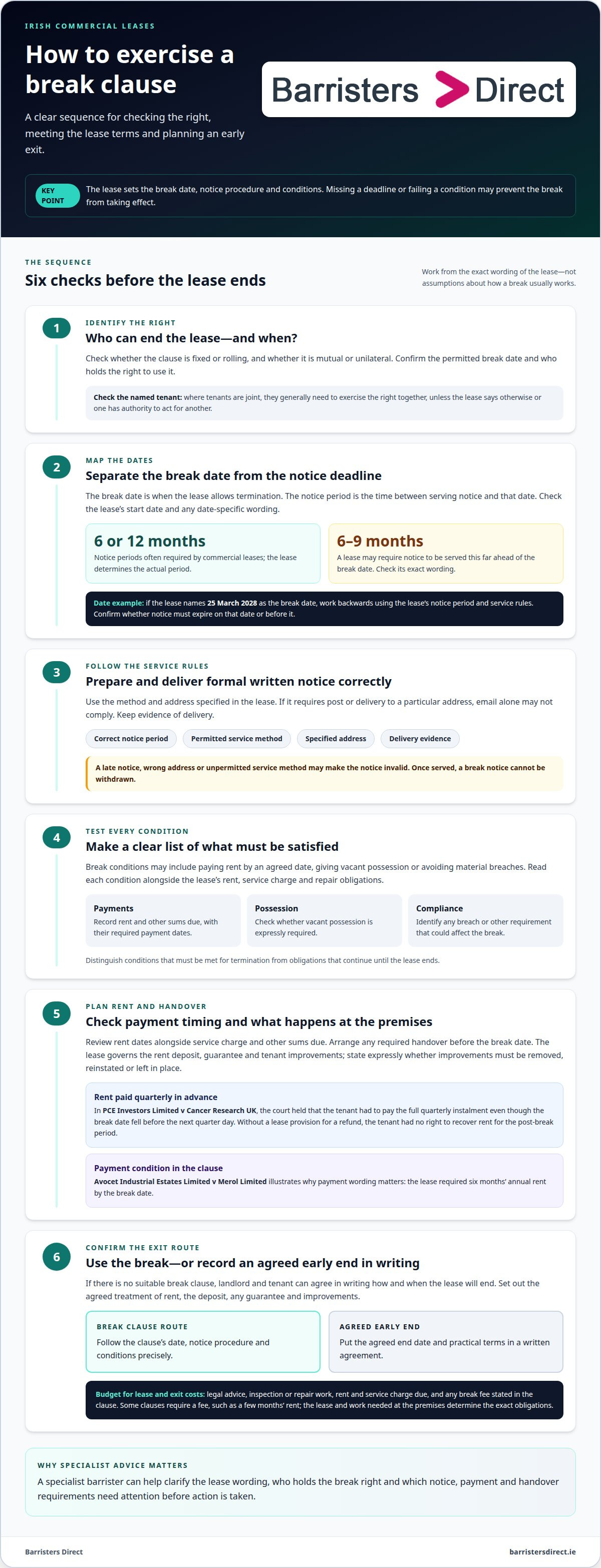
A break notice is formal written notice that a party intends to end the lease on a permitted date. Commercial leases often require six or twelve months’ notice, and the notice may need to be served six to nine months before the break date. The lease sets the exact period and permitted method of service. If it requires post or delivery to a specified address, email alone may not comply.
Serve the notice within the required period and keep evidence of delivery. A notice sent late, to the wrong address or by an unpermitted method may be invalid. Once served, a break notice cannot be withdrawn, so confirm the intended date and follow the specified procedure before sending it.
Identifying break dates and notice periods
The break date is when the lease allows termination; the notice period is the time between serving notice and that date. Find both in the break clause, then compare them with the lease’s start date and any date-specific wording. A lease may allow a break only on a named date, rather than whenever the tenant chooses.
For example, if a lease names 25 March 2028 as its break date, work backwards using its notice period and service rules. Check whether the clause requires notice to expire on that date or before it. A rolling break clause works differently: it can allow termination after a specified period, provided notice is given.
Conditions for exercising a break clause
Break conditions are requirements the terminating party must meet for the clause to take effect. They may require the tenant to pay rent by an agreed date, give vacant possession or avoid material breaches of the lease. Read each condition alongside rent, service charge and repair obligations: a missed payment or unresolved breach may jeopardise the break.
Separate conditions that must be met from obligations that continue until termination. Record payment dates and arrange any required handover before the break date. If termination depends on compliance, assuming a minor issue can be resolved afterwards may put the tenant’s exit at risk.
Break notices and tenant identity
The tenant named in the lease should match the party exercising the break right. If the lease has joint tenants, they generally must exercise the right together, unless the lease says otherwise or one tenant has authority to act for another. A notice from only one joint tenant may therefore fail to end the lease.
Check the lease to see who may exercise the break right, as this can depend on its terms. Check the named parties and any later changes to the tenancy before preparing notice. Anyone seeking commercial lease break clause advice should establish who holds the right and whether the notice is valid before serving it. For landlords, clear drafting should identify who holds the right and when it applies. A reasonable notice period gives time to plan for a replacement tenant and reduces uncertainty for both parties.
Legal advice on negotiating and exercising break rights
Negotiating a break clause means agreeing on the exit date and the conditions for using it. Before serving notice, review how the lease links rent, joint tenants and other obligations to termination. Specialist commercial lease break clause advice can clarify the terms and identify what to address before taking action.
Strict interpretation of break clauses
Exercise a break clause according to its wording, including its notice and payment conditions. Treat each requirement as a separate step: identify who can give notice, calculate the deadline, use the specified service method and meet every condition. In Avocet Industrial Estates Limited v Merol Limited, the lease required six months’ annual rent by the break date. The case illustrates why payment wording matters.
When negotiating, tenants can seek clear, practical conditions rather than making termination depend on every covenant. Landlords can specify a notice period that allows time to plan for a replacement tenant. Both parties benefit from precise wording on the break date, notice process and consequences of non-compliance.
Rent and other break obligations
Rent may remain payable beyond the break date if the lease requires quarterly payment in advance. In PCE Investors Limited v Cancer Research UK, the court held that the tenant had to pay the full quarterly instalment, even though the break date fell before the next quarter day. If the lease provides no refund for the post-break period, the tenant has no right to recover that rent.
Review rent dates alongside service charge and other sums due. Check whether the clause requires vacant possession or compliance with particular covenants, then plan payments and handover around those terms. If tenants are jointly named, ensure they exercise the break together unless the lease allows otherwise or one tenant has authority to act for another.
The lease and any written early-termination agreement govern the rent deposit, guarantee and tenant improvements. Address deposit deductions and release of any guarantee expressly, and state whether improvements must be removed, reinstated or left in place.
Costs of breaking a commercial lease
Budget for the costs arising from the lease and proposed exit. These may include legal advice, inspection or repair work, rent and service charge due, and any break fee stated in the clause. Some clauses require a fee, such as a few months’ rent. The lease terms and work needed at the premises determine the exact obligations.
Irish tenants can seek advice from a solicitor or barrister on the clause, conditions and notice. Specialist commercial lease break clause advice can help assess whether the proposed steps meet the lease requirements. For a dispute over the break or its conditions, commercial lease dispute advice may help clarify the legal issues and available next steps.
Vacant possession and surrendering occupation
Vacant possession means returning the commercial property without occupants or belongings that prevent the landlord from taking it back. A break ends the lease under its clause; assignment transfers the tenant’s interest, while surrender ends occupation by agreement.
Vacant possession and sub-leases
A sub-lease can complicate vacant possession if a subtenant still occupies part of the premises on the break date. Before planning the handover, the head tenant should identify any sub-lease, its end date and who is entitled to enter the property.
If vacant possession is a break condition, a subtenant remaining in occupation may breach that requirement. Arrange the subtenant’s departure and deal with belongings, rubbish and keys before the specified date. This also helps clarify which liabilities remain under the head lease.
In NYK Logistics (UK) Ltd v Ibrend Estates BV [2011], an English court treated failure to give vacant possession on the break date as preventing the break from taking effect. This is an English case, not an Irish ruling, but it illustrates why a tenant should treat possession conditions carefully.
Breaking, assigning or surrendering a lease
Exercising a break clause uses a right set out in the lease. Assignment transfers the tenant’s leasehold interest, while surrender ends the lease by agreement. Each route has different consequences, so the tenant’s circumstances and lease wording should guide the choice.
A tenant considering assignment should check the lease’s assignment provisions and any conditions attached to a transfer. To surrender the lease, the tenant needs the landlord’s agreement to end it early. The agreed terms should state the termination date and what happens to rent, keys and the premises.
For a break, plan the handover around the actual termination date and any specified time. In PCE Investors Limited v Cancer Research UK, the lease required the property to be yielded up at noon on the termination date. This illustrates why timing matters: arrange removal, final access and key return to match the lease wording.
Before leaving, remove the tenant’s equipment and belongings, clear rubbish and return all keys. Record the property’s condition and keep evidence of the handover, including any agreed work. If the landlord later disputes possession or the break, these records can help establish what happened.
A solicitor can advise on the lease terms and the legal effect of a proposed exit. If the break is contested or the parties disagree over liabilities, specialist legal advice can help assess the available options before the tenant gives up occupation.
Ending a lease early by agreement
If an Irish commercial lease has no usable break clause, the landlord and tenant can seek an agreement to end it early. Without a valid break clause or an agreement, the lease continues for its agreed term. Starting discussions does not itself set the termination date or release either party from the lease.
Start by stating the proposed exit date and practical reasons for leaving. A landlord may want time to plan for a new occupier; a tenant may need certainty about rent and the handover. Neither party should assume the other has accepted a proposal until the terms are clearly agreed.
Record the agreement in a document identifying the parties, premises and date occupation ends. State how rent and service charge will be handled up to that date, including any amounts already paid for a later period. If the parties agree to a payment or another condition for early termination, specify the amount or requirement and when it must be met.
Address the property’s condition directly. The lease may contain repair or reinstatement obligations, so distinguish existing responsibilities from any different arrangement the landlord accepts. For example, the parties could record whether specified tenant alterations must be removed or may remain with the landlord’s agreement. Describe the work and who is responsible for completing it.
A complete exit arrangement should also cover the practical handover. Agree when the tenant will remove equipment and belongings, clear rubbish, return keys and give vacant possession. If another occupier is present, specify how that occupation will end. Recording the steps helps both parties understand what remains to be done before termination.
Check how the agreement deals with liabilities that arose before termination. Specify whether outstanding rent, service charge, repair claims or other sums remain payable, and how any dispute about them will be resolved. A general promise to “settle matters” does not clearly allocate responsibility.
Make clear whether the agreement ends the whole lease or changes only particular obligations. If the landlord agrees to release the tenant from future responsibilities, record the scope of that release and when it takes effect. Identify any obligations that continue after the tenant leaves.
Before signing, compare the agreed terms with the lease and related documents, including guarantees or sub-leases. A solicitor can advise on the wording’s legal effect and help identify gaps. Clear documentation gives the landlord and tenant a defined exit plan instead of leaving early termination dependent on informal discussions.
Fixed, rolling, mutual and unilateral break clauses
Commercial leases can set different break rights according to the date, timing and party entitled to act. Identifying the type of clause helps each party understand when notice can be served and whose decision could end the tenancy.
Fixed and rolling break clauses
A fixed break clause permits termination on a particular date. A rolling clause allows termination after a specified period has passed, subject to notice. The distinction affects when the tenant can plan a move and when the landlord may need to prepare for a vacancy.
For a fixed clause, identify the permitted date and work backwards through the notice requirements. For a rolling clause, establish when the specified period ends and how the notice period applies. The wording determines whether notice can take effect on any eligible date or only at a defined point.
Check whether the clause provides one break opportunity or repeated opportunities. A tenant with a single fixed date may lose that option if the deadline passes. A rolling right may offer more flexibility, but its notice requirements and conditions still apply.
Mutual and unilateral break rights
A mutual break clause gives both the landlord and tenant the right to end the lease early; a unilateral clause gives that right to only one party. This distinction matters because the landlord’s break right may affect business plans even if the tenant intends to stay.
Check who can serve notice, the permitted circumstances and any conditions applying to each party. A tenant should not assume the right belongs to them alone simply because they are considering an exit. If the landlord can also break, consider how notice could affect staffing, stock, customer access and investment in the premises.
When drafting, parties can define the eligible dates, notice period and conditions for each right. Clear wording should distinguish the landlord’s right from the tenant’s, rather than referring generally to either party. Landlords can consider whether the notice period allows reasonable time to plan for a replacement occupier.
Before signing, compare the break clause with the lease term and related obligations. Note each date when a right may be exercised, who must serve notice and how it must be served. If the parties have different rights, prepare a separate timeline for each. This helps tenants distinguish their own opportunities from the landlord’s and avoid overlooking a significant landlord break right.
Where the wording leaves uncertainty about who may act or when, legal advice can clarify the effect before either party serves notice. Get advice on your commercial lease position before relying on a break right or making business decisions around it.
Barristers Direct: Commercial Dispute Resolution
Barristers Direct offers Commercial Dispute Resolution for businesses facing a commercial lease dispute or a contested break. If the landlord challenges the notice, disputes whether conditions were met or disagrees about the exit terms, a specialist barrister can help clarify the issues and possible next steps.
Barristers Direct enables individuals and companies in Ireland to instruct senior or junior counsel directly. A specialist barrister is matched to the area of law, and an initial meeting provides expert advice and a clear path forward. Solicitors also play an important role in legal matters; direct access offers another route to counsel for an initial consultation.
If you need advice on a lease dispute, contact Barristers Direct to discuss your situation.
Make your next move with clarity
Base your next decision on the lease wording and the practical outcome you need, not simply the date you hope to leave. Before acting, gather the signed lease, any variations, relevant correspondence and a clear record of discussions with the landlord. This gives a legal adviser the context to assess your position and identify the issues to address.
Focused commercial lease break clause advice can help you weigh the clause against your business plans, particularly if the landlord disputes your interpretation or you are considering an agreed exit. Barristers Direct provides Commercial Dispute Resolution, including for commercial lease disputes. An initial consultation with a specialist barrister can clarify the issues and help you consider your next steps.
Contact Barristers Direct to discuss your situation and take a considered next step.
Frequently Asked Questions
How should a break notice be served, and who must receive it?
Serve notice using the method and at the address specified in the lease, and direct it to the named party. The lease may identify the landlord or an agent and state where formal notices must go. Don’t assume email is valid unless the lease permits it. Keep a copy of the notice and evidence of dispatch or delivery to show what was sent, when and to whom.
What rent, service charges, and other sums are payable up to the break date?
Pay sums due under the lease according to its payment terms; a break date does not automatically cancel an instalment already due. If rent is payable quarterly in advance, the full quarter may remain payable even if the break falls earlier. A refund for the later period depends on an express lease provision. Check service charge and other outstanding sums separately, as their calculation and payment dates may differ from rent.
Must the tenant give vacant possession or meet other conditions on the break date?
Yes, if the break clause makes vacant possession or another requirement a condition of termination. The tenant may need to ensure no subtenant or other occupier remains, remove belongings and return keys in accordance with the lease. For example, leaving equipment that prevents the landlord from taking back the premises could lead to a dispute about possession. Review the clause alongside any repair, payment or handover requirements, and plan each action around the termination date.
What are the consequences of missing a break clause deadline or failing a condition?
If notice is late or a required condition is unmet, the break may not take effect. The lease may then continue on its existing terms, leaving the tenant responsible for obligations such as rent and service charge. Missing the break date may mean waiting for another contractual opportunity or seeking the landlord’s agreement to end the lease. Keep the notice, delivery evidence and records of compliance together if the landlord disputes the attempted termination.
Disclaimer
This article does not constitute legal advice. Barristers Direct does not provide legal advice. To obtain legal advice, you should contact a legal practitioner.


