

Living together does not make a couple spouses under Irish law. For the cohabitants’ redress scheme, a couple may qualify as qualified cohabitants after living together in an intimate and committed relationship for five years, or two years if they have a child together. Legal advice on a cohabitation agreement in Ireland can help clarify how an agreement may set out financial arrangements during the relationship and what happens if it ends.
It’s understandable to assume that sharing a home creates rights similar to marriage, but Irish law treats cohabiting couples differently. A written agreement signed by both partners can help record how they intend to manage joint finances and assets, while independent legal advice helps each person understand its terms.
This article explains what cohabitation means in Ireland, who may qualify as a qualified cohabitant, what a cohabitation agreement can cover and why independent legal advice matters. It also outlines the legal protections that may apply if a relationship ends or a partner dies, so you can see how an agreement fits into the wider picture.
Key Takeaways
- Living together does not give partners the same legal status as spouses, and cohabiting partners are not recognised as common-law husband and wife in Ireland.
- A cohabitation agreement can set out how partners intend to manage shared financial matters and assets if their relationship ends.
- Eligibility for the cohabitants’ redress scheme depends on relationship circumstances, including its duration and whether the couple have a child together.
- Financial support or property-related redress is not automatic: a qualified cohabitant must apply to court and show financial dependence on the relationship.
- A surviving cohabitant does not automatically inherit a share of their partner’s estate if there is no will, so estate planning deserves separate attention.
Differences between cohabitation and marriage
In Ireland, living together does not make partners spouses or “common-law” husband and wife. Cohabitants remain legally distinct from married couples and civil partners, even after a long relationship. That difference matters when considering property, financial support and inheritance. A shared home or joint account does not, by itself, give partners all the legal rights that marriage provides.
For income tax purposes, cohabitants are treated as single people. Social welfare rules treat cohabitants like married couples and civil partners. These distinctions mean a couple’s status can affect different areas of law in different ways. For example, partners may be treated as single for income tax, yet like spouses for social welfare purposes.
A change took effect in July 2025: Ireland’s Bereaved Partner’s Pension was extended to include qualified cohabitants. This is a weekly social welfare payment, and it is not means-tested. A surviving partner may qualify if the relationship had not broken down before the other partner’s death, and both partners meet the relevant PRSI contribution conditions. Eligibility therefore depends on the scheme’s relationship and contribution requirements.
Inheritance remains different. If a cohabiting partner dies without a will, the surviving partner has no automatic entitlement to a share of the estate under the Succession Act 1965. A qualified cohabitant may apply to court for provision, but the award cannot exceed what a spouse would have received. This is a potential route to redress, not the automatic inheritance rights attached to marriage.
A cohabitation agreement differs from a prenuptial or pre-civil partnership agreement because it is made by partners who are cohabiting, rather than before marriage or civil partnership. In Ireland, prenuptial and pre-civil partnership agreements are not legally enforceable, although a court may consider them as a record of the parties’ wishes if both received legal advice before signing.
By contrast, cohabitants can make a written, signed agreement about their financial affairs. It can address arrangements during the relationship, on separation or on death. A completed agreement can be legally binding under Irish law, subject to the applicable requirements. It is therefore a distinct legal tool, not simply a version of a prenuptial agreement.
Neither agreement should be treated as an absolute substitute for considering the legal position. A court may give effect to prenuptial or pre-civil partnership agreements, particularly where the parties consent, when deciding settlements. A court may also vary or set aside a cohabitants’ agreement in exceptional circumstances if enforcing it would cause serious injustice. The terms and surrounding circumstances matter.
Eligibility as a qualified cohabitant
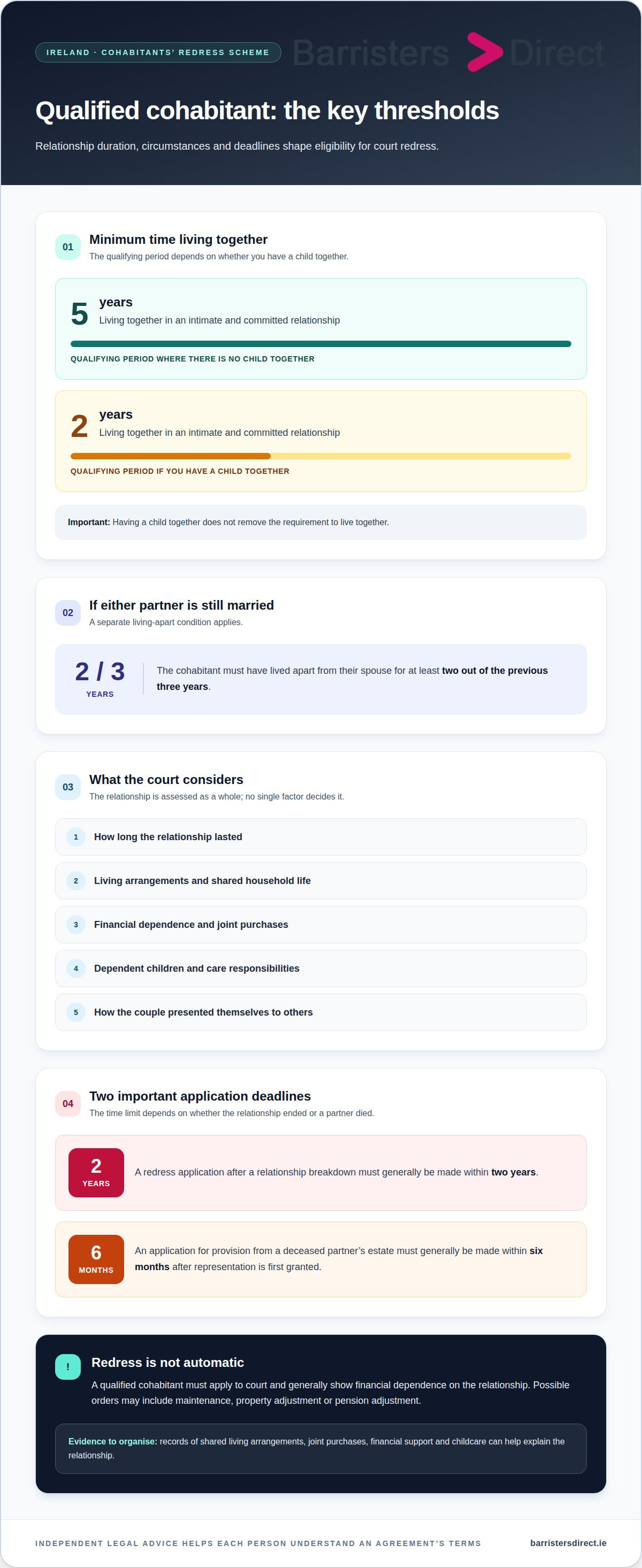
In Ireland, eligibility for the cohabitants’ redress scheme depends on the relationship, its duration and specific circumstances. A couple must have lived together in an intimate and committed relationship for at least five years. If they have had a child together, the qualifying period is two years. Having a child does not remove the requirement to live together.
The court assesses whether two adults were cohabitants by looking at the relationship as a whole. Section 172 of the Civil Partnership and Certain Rights and Obligations of Cohabitants Act 2010 identifies relevant factors. These include how long the relationship lasted, the couple’s living arrangements, financial dependence and joint purchases. The court also considers dependent children, care responsibilities and how the couple presented themselves to others. No single factor replaces this wider assessment.
Marriage can also affect eligibility. A cohabitant who remains married must have lived apart from their spouse for at least two out of the previous three years. This rule matters even if the person has established a new household with a partner. The relationship’s duration and the circumstances of the existing marriage both form part of the eligibility picture.
The redress scheme is set out in the 2010 Act, which became law on 1 January 2011. It applies where the relationship ends after that date, although earlier time living together counts towards the qualifying period. If the relationship breaks down, an application for redress must generally be made within two years of the breakdown.
A qualified cohabitant must apply to court; redress does not arise automatically. The applicant generally must show financial dependence on the relationship. If eligible, available orders can include maintenance, property adjustment or pension adjustment. The court considers the parties’ financial circumstances, dependent children’s needs, contributions and the relationship’s effect on earning capacity. Those factors help shape the outcome, rather than establish an automatic share of property.
A surviving partner faces a separate deadline. An application for provision from a deceased partner’s estate must generally be made within six months after representation is first granted. If the relationship ended two years or more before the death, an application is generally unavailable unless the former partner was financially dependent on the deceased. Timing and financial circumstances therefore matter alongside the relationship history.
For a clear assessment, organise evidence of shared living arrangements, joint purchases, financial support and childcare. These records can help explain the relationship against the section 172 factors. Seeking advice on your legal position can help you understand how those facts relate to the scheme.
Financial arrangements in a cohabitation agreement
A cohabitation agreement is a voluntary written document, signed by both partners, that records their financial arrangements. It may suit an unmarried couple already sharing a home, or planning to live together in a rented or owned property. For couples considering a cohabitation agreement in Ireland, legal advice can help clarify which financial intentions to record.
Section 202 of Ireland’s Civil Partnership and Certain Rights and Obligations of Cohabitants Act 2010 allows cohabitants to make an agreement about their financial affairs during the relationship, when it ends, or on death, according to the Irish Statute Book. This framework lets partners address financial arrangements at different stages of their relationship.
For day-to-day finances, partners might record how they plan to share household expenses. Terms could address joint bank accounts, bills, savings or purchases. For example, they may specify how each intends to contribute to an account used for rent and utilities. Setting this out can distinguish shared spending from each partner’s individual finances.
The agreement can also address a shared home and other joint assets. If partners own a property together, they can record their intentions for its financial treatment if they separate. They may also cover jointly purchased furniture, savings or other assets. Identifying each asset and the intended arrangement can make the document more precise than broad wording alone.
Partners can consider different separation scenarios, including what they intend to happen if the relationship ends within five years. This can help them address shared assets and financial commitments in the event of an earlier separation. Legal advice on a cohabitation agreement in Ireland can help each partner understand how proposed terms relate to their circumstances and intentions.
Because section 202 includes financial affairs on death, partners may also record relevant intentions in the agreement. However, an agreement and a will serve different purposes. If a partner wants to set out who should inherit from their estate, they should consider that separately through estate planning rather than assuming the agreement replaces a will.
Before signing, list the subjects you want addressed: household contributions, joint accounts, the home, shared purchases, separation and death. Then discuss the intended treatment of each item and ensure the wording reflects that arrangement. Independent legal advice about a cohabitation agreement in Ireland can help both partners understand the terms before signing, including clauses that connect one financial arrangement to another.
Independent legal advice for cohabitation agreements
Independent advice gives each partner a separate opportunity to understand an agreement before signing. In Ireland, it must be in writing and signed by both partners. Each must receive independent legal advice, or receive legal advice together and waive the right to independent advice. The general law of contract must also be satisfied. These requirements matter because signing a document alone does not establish that every term is enforceable.
A lawyer can explain how each clause affects the person receiving advice, identify unclear wording and discuss whether the agreement reflects their intentions. For example, if one partner contributes more towards a jointly owned home, advice can clarify how the agreement records that contribution and the proposed arrangements if they separate. Seeking cohabitation agreement legal advice in Ireland helps each partner understand the terms from their own perspective.
Advice also gives each person space to consider the agreement separately, rather than relying only on a shared discussion. A barrister can review the wording with their client, address questions about particular assets or financial commitments, and explain the document’s legal effect. Both partners should understand the terms before signing. This is especially relevant if their financial circumstances or responsibilities differ.
An Irish cohabitation agreement can be changed by agreement between the partners. A court may vary or set it aside in exceptional circumstances if enforcing it would cause serious injustice. This is not a routine process for changing terms after circumstances shift. Clear drafting and informed decisions at signing matter, particularly where partners want the agreement to address a shared home or other significant financial arrangements.
If partners want to change terms, they can identify the affected clauses and record their revised intentions in writing. Each should obtain legal advice on the proposed changes before signing. For instance, an amendment concerning a jointly owned home may need to be considered alongside other clauses that rely on the original wording. A further review can help both partners understand how the new terms interact with the agreement as a whole.
A solicitor’s charge to draft or review an agreement depends on the case and is given after a quote request. Relevant cost factors include the document’s complexity, the financial arrangements involved, and whether the solicitor is preparing new terms or reviewing an existing draft. The extent of the work required also shapes the service provided.
Before an advice meeting, prepare the draft agreement, a summary of relevant assets and debts, and questions about specific clauses. A clear account of contributions to a home or joint account can help the barrister explain how the wording applies. Raise any term that seems unclear or does not reflect your intentions. This preparation makes the discussion more focused and gives the barrister practical context.
For cohabitation agreement legal advice in Ireland, each partner should understand both the wording and its practical effect before signing. If a clause is unclear, asking about it before signing gives the opportunity to consider its meaning and discuss appropriate wording. Informed, independent advice supports a more considered agreement and helps each person make their decision with greater clarity.
Legal status of cohabiting couples in Ireland
Ireland’s cohabitation rules provide specific routes to financial redress, but they do not give unmarried partners the same status as spouses. A written agreement and the statutory scheme can affect what happens to finances, property and inheritance.
Enforceability of Agreements
A cohabitation agreement can be legally enforceable in Ireland if it meets the statutory and contractual requirements. It must be in writing and signed by both cohabitants; each must receive independent legal advice, or receive advice together and waive the right to independent advice. The general law of contract must also be satisfied. These requirements matter because a signed document alone does not establish that every term will be enforceable.
Property and Financial Matters
On separation, ownership of property does not automatically transfer between cohabitants. A qualified cohabitant may apply to court for redress, including maintenance, property adjustment or pension adjustment orders. The applicant generally must show financial dependence on the relationship, and the court considers relevant circumstances, including contributions and financial position. Debts and jointly held assets should be considered separately, with the agreement and ownership arrangements helping clarify each partner’s position.
A cohabitation agreement can set out how partners intend to deal with joint assets and the shared home if their relationship ends. It can also record financial arrangements during the relationship. If no agreement addresses a particular asset, the legal position may depend on ownership and the circumstances around the asset, rather than simply the fact that both partners lived in the home.
Inheritance After a Partner’s Death
An unmarried surviving partner has no automatic entitlement to a share of the deceased partner’s estate under the Succession Act 1965 if there is no will. Under section 194 of the Civil Partnership and Certain Rights and Obligations of Cohabitants Act 2010, a qualified cohabitant may apply to court for provision. The application must generally be made within six months after representation is first granted.
If the relationship ended two years or more before the partner’s death, a former cohabitant generally cannot apply for provision, subject to limited exceptions. A will and a cohabitation agreement serve different purposes, so partners should consider both when recording their intentions for property and inheritance. For advice about estate matters, seek Wills and Probate Legal Advice.
Orders for maintenance or pension adjustment also have defined limits. Under the cohabitation legislation, they end if the recipient marries or enters a civil partnership with another person, or if either cohabitant dies. These rules help distinguish court-ordered redress from an ongoing entitlement attached to marriage.
For a practical review, compare the agreement with property records, joint financial commitments and any will. This can reveal whether the documents address the same assets consistently and whether each partner’s intentions are clearly recorded.
Barristers Direct: Commercial Dispute Resolution
Barristers Direct offers Commercial Dispute Resolution when a disagreement between cohabitants involves shared business interests or commercial assets. This differs from a dispute limited to personal finances or family arrangements, so the nature of the issue matters. If a partner’s death raises questions about estate provision, Wills and Probate Legal Advice may be relevant.
Barristers Direct connects individuals directly with specialist barristers for a fixed-fee initial consultation. A barrister can help clarify the legal issues and practical options in dispute, whether the concern involves a business asset or an estate matter. Where legal action is required, a solicitor must be engaged.
If you would like advice on a dispute involving commercial interests, arrange a fixed-fee initial consultation through Barristers Direct.
Make your next decision with clarity
A written agreement can only serve its purpose if its terms reflect both partners’ intentions and circumstances. Before signing or revising one, consider which questions remain unresolved, such as how a proposed clause affects your financial position or future plans. Cohabitation agreement legal advice in Ireland can help you understand those implications and make an informed decision.
Barristers Direct arranges fixed-fee initial consultations with specialist barristers in areas including Commercial Dispute Resolution, Wills and Probate Legal Advice, and Employment Law Consultation. These areas may be relevant where your concerns extend to a commercial disagreement, estate planning or employment matters. The right advice depends on the legal issue you need addressed.
Contact Barristers Direct for advice about your circumstances and the next steps available. A clear understanding of your options can help you move forward with confidence.
Frequently Asked Questions
What is cohabitation?
Cohabitation generally describes two adults living together in an intimate, committed relationship without being married to each other or in a registered civil partnership. A court assessing whether a couple are cohabitants considers the relationship as a whole. Relevant factors include how they live, their financial arrangements, any dependent children and how they present their relationship to others. Sharing an address alone does not determine every legal question.
What can a cohabitation agreement cover under Irish law?
An agreement can record how partners intend to organise their financial affairs during their relationship, if they separate, or on death. For example, they might clarify how a shared bank account is used or how they intend to treat a jointly acquired asset. They can also address possible separation within five years. Specific, consistent wording helps partners understand what they have agreed, rather than relying on assumptions about shared spending.
What makes a cohabitation agreement valid and how should it be signed in Ireland?
The agreement must be in writing and signed by both cohabitants, and the general law of contract must be satisfied. Each partner must receive independent legal advice, or both may receive advice together and waive the right to independent advice. In practice, both should read the final document, resolve unclear terms and sign the same agreed version. Keeping a copy helps each partner refer to the terms later.
Do both partners need independent legal advice before signing an Irish cohabitation agreement?
Each partner must receive legal advice, but the law allows advice together if both waive their right to independent advice. Separate advice gives each person the opportunity to discuss the terms from their own perspective. For instance, a partner uncertain about a clause concerning a jointly owned home can ask a barrister to explain its effect before signing. Both should understand the agreement and the consequences of its wording.
What rights do cohabiting couples have in Ireland without an agreement?
There is no general automatic entitlement to a partner’s property or estate simply because the couple lived together. A qualified cohabitant may apply to court for redress after a relationship ends, generally showing financial dependence; possible orders include maintenance, property adjustment or pension adjustment. A surviving partner may apply for provision from an estate, subject to statutory conditions and deadlines. A will and the ownership of particular assets can also affect the position.
Disclaimer
This article does not constitute legal advice. Barristers Direct does not provide legal advice. To obtain legal advice, you should contact a legal practitioner.


