

The value of a Legal Opinion depends on who prepares it and how clearly it answers the question at hand. In Ireland, it is a practising legal practitioner’s reasoned view on a specific legal issue, applying the law to the relevant facts. It can identify risks and help you decide what to do before entering a transaction or taking another important step.
If you’re weighing a contract, workplace issue or business decision, you may need more than a quick explanation. A formal opinion can set out the legal position, the material considered and the practical implications, helping you understand what the analysis means for your circumstances.
This article explains how a Legal Opinion differs from other legal advice, who can prepare one, and how confidentiality and privilege may affect its use. It also considers how a clear, focused opinion can support decisions and bring legal risks into view.
Key Takeaways
- Use a formal written opinion when a specific legal question needs a clear, reasoned answer you can rely on for a decision.
- Distinguish a documented view on a defined issue from legal advice given in a less formal format; the right approach depends on the question and intended use.
- Consider who will receive the opinion before sharing it, as disclosure may affect confidentiality and privilege.
- Focus the legal analysis on the relevant facts, documents and risks so you can identify practical next steps before acting.
- Choose a practising legal professional with relevant expertise, particularly where a transaction involves another jurisdiction.
Legal opinions: why are they important?
A legal opinion applies law to particular facts and explains the resulting legal position. In Ireland, this written analysis can clarify what a decision means before you enter a transaction or take action. Its value lies in answering a defined legal question, rather than attempting to cover every issue connected with a wider matter.
A Legal Opinion is a practising legal practitioner’s reasoned analysis prepared for the person who will rely on it. It connects the relevant law with your circumstances, rather than leaving you to interpret an obligation alone. For example, an opinion can identify a risk in a proposed agreement before you sign.
In Ireland, opinions are best understood by the issue they address, rather than as a fixed list of formal types. They may examine property matters, employment rights, contract interpretation or compliance. In commercial transactions, the analysis may address a company’s capacity or whether documents are enforceable. The question determines which law, facts and documents the practitioner needs to assess.
An opinion may be required when a transaction’s terms or a decision-maker make it a condition. A bank, employer, landlord or planning authority may request a formal view. In commercial financing, for example, a lender may seek confirmation of a borrower’s capacity and the enforceability of transaction documents. In some cross-border transactions, the opinion may be required before funds are advanced.
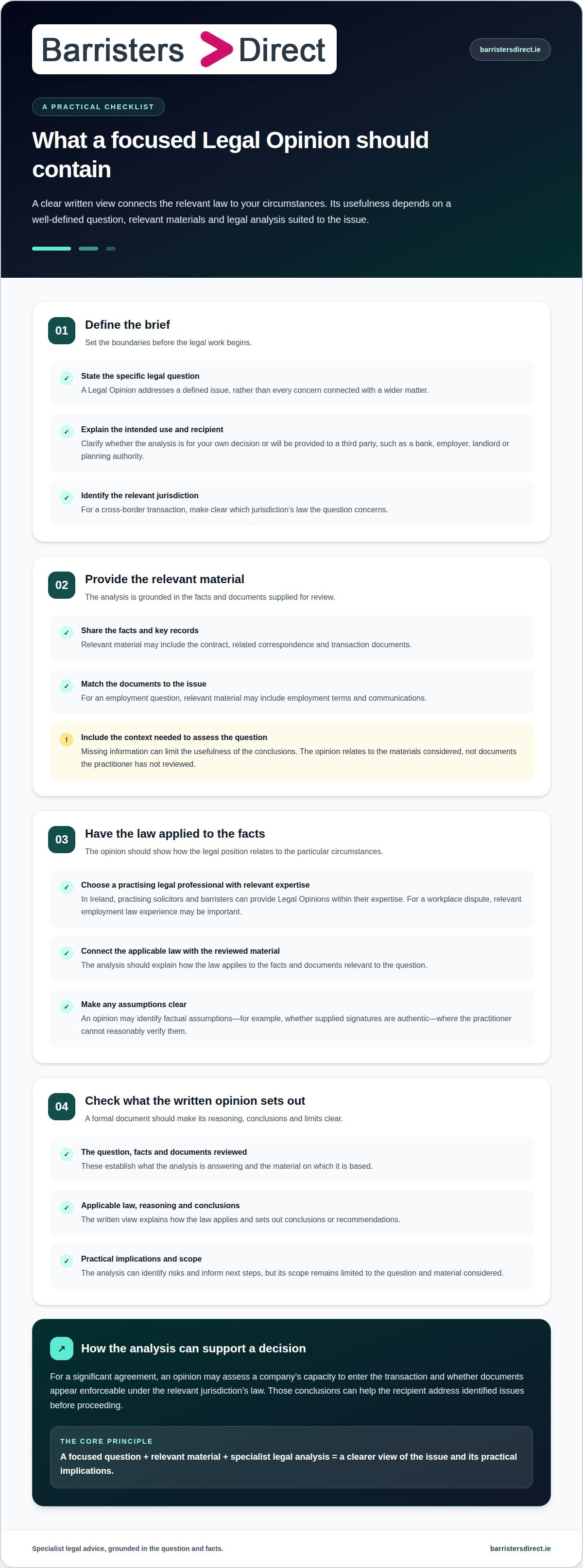
A written opinion typically identifies the legal question, relevant facts, documents reviewed and applicable law. It explains how the law applies and sets out conclusions or recommendations. It may also state factual assumptions, such as whether supplied signatures are authentic, which the practitioner cannot reasonably verify. Its scope is limited to the question and material considered, not every issue affecting the wider transaction.
The time required depends on the question’s complexity and the work needed to assess it. The process starts by defining the issue, then providing relevant facts and documents for legal research and drafting. A focused contract question may need a narrower review than a cross-border transaction involving corporate authority and document execution. Clear instructions and complete materials help the practitioner identify the work involved.
For instance, if a company is considering a significant agreement, a Legal Opinion can assess whether it has capacity to enter the transaction and whether the documents appear enforceable under the relevant jurisdiction’s law. The recipient can use those conclusions to address identified issues before proceeding. This provides a practical basis for a decision, grounded in the specific facts and legal question.
Difference between a legal opinion and legal advice
Legal advice can be given in conversation or writing, while a Legal Opinion is a formal document addressing a defined legal question. This distinction matters if a bank, employer, landlord or planning authority needs a written view to consider. For example, advice about a contract may explain your options; a formal opinion records a lawyer’s analysis and conclusions for a specific purpose.
Written legal advice may take several forms, including a letter or email explaining the law and its effect on your circumstances. A Legal Opinion usually identifies the transaction or issue, the documents reviewed and the question being answered. Its conclusions relate to those materials, so it should not be treated as an assessment of facts or documents the lawyer has not considered.
In Ireland, a written legal opinion is a qualified solicitor’s formal view on a specific legal question, set out on solicitor-headed paper. In England and Wales, as in other common-law countries, “legal opinion” can also mean written legal advice on a point of law prepared by a lawyer. The terminology overlaps, so the requested format and intended use should be clear.
To seek a written analysis, begin by stating the question you need answered. Then provide the facts and relevant records, such as the contract, related correspondence and transaction documents. If the issue concerns employment rights, include the relevant employment terms and communications. The lawyer uses these materials to research applicable law and explain how it applies. Missing context can limit the usefulness of the conclusions.
A qualified legal practitioner should handle the analysis. In Ireland, practising solicitors and barristers can provide legal opinions within their expertise. Choose someone whose knowledge fits the issue, such as a practitioner experienced in employment law for a workplace dispute. If a third party will rely on the document, explain that intended use at the outset so the question and scope are framed appropriately.
Before proceeding, clarify whether you need advice for your own decision or a formal opinion for another recipient. That distinction helps define the question, documents and format required. If you need specialist legal guidance on a defined issue, you can explore legal advice from specialist barristers as a next step.
A written Legal Opinion differs from informal legal advice because it is a formal document setting out a solicitor’s view on a specific question and can be presented to third parties. The label does not mean a court document: “legal opinion” can refer to a lawyer’s written advice, rather than a judge’s written explanation accompanying a court order or ruling. This distinction helps clarify whether the requested document is a lawyer’s analysis or a judicial explanation.
Lawyers may issue legal opinions to assess whether a transaction or matter is legal, or to analyse a product or service against the applicable legal framework. A Legal Opinion typically sets out the transaction background, documents reviewed and searches conducted, because its conclusions are usually based only on those materials. This defined basis clarifies the scope of the lawyer’s view and the material it rests on.
Confidentiality and waiver of privilege
A written opinion prepared by a lawyer is usually covered by solicitor-client privilege and is not public. In Ireland, its contents are generally treated as confidential rather than published for general access. For example, an opinion on a company’s contract is not automatically available to everyone involved in that transaction.
Confidentiality and privilege are related, but they are not identical. Confidentiality concerns keeping information private; privilege protects certain lawyer-client communications from disclosure. The distinction matters when an opinion contains sensitive facts, legal analysis or documents about a business decision. Consider its status and intended audience before circulating it.
The client controls whether to disclose an opinion or waive privilege. If you receive an opinion to inform your own decision, keep the original and consider who needs access before forwarding it. Sending a copy to a business partner, lender or other third party may affect how the document is treated. Understand that consequence before sharing.
Start by identifying the intended recipient and purpose. An opinion prepared to guide a company’s internal decision, for example, may not be drafted for a bank to rely on. If a lender needs to rely on it, explain that purpose before the lawyer prepares the document. The intended audience can affect the opinion’s scope and the wording around reliance.
Documents supplied for analysis also need careful handling. A draft contract, board record or email chain may contain commercially sensitive details alongside the legal points. Keep relevant materials together and share them through an appropriate channel with the lawyer preparing the opinion. Avoid adding unrelated documents, which could expose information without helping answer the legal question.
Cross-border work can add another layer. A foreign lawyer may prepare an opinion on the law of the company’s jurisdiction, while an Irish practitioner considers Irish-law issues. Before circulating the foreign opinion, clarify who may receive it and whether those parties are expected to rely on it. The audience matters particularly when transaction documents will be reviewed across jurisdictions.
Privilege is not a reason to treat an opinion as a public assurance or a guarantee of an outcome. It records legal analysis based on particular facts and materials. If a recipient needs to rely on its conclusions, the lawyer’s instructions should identify that need. This distinguishes an opinion prepared for the client’s private decision from one intended for an identified third party.
Before sharing an existing opinion, consider the recipient, purpose and attached documents. Ask whether disclosure is necessary for the next decision, such as obtaining approval for a transaction. If the document is to be sent outside the original client relationship, seek legal guidance on the implications first. Careful handling helps maintain control over sensitive information and avoid casual circulation.
Decision-making and risk mitigation
The risks of relying on an opinion include acting on incomplete facts, misunderstood assumptions or conclusions limited by qualifications. It reflects the information and law considered when drafted, so its scope matters when you make a later decision.
Start with the precise question the decision depends on. For a corporate transaction, that might be whether the company has authority to enter an agreement or whether particular documents are enforceable. A useful opinion connects the question to relevant facts, explains the legal analysis and recommends practical action. This gives decision-makers a basis for addressing identified risks.
Read the assumptions alongside the conclusions. A lawyer may assume that signatures on supplied documents are authentic, for example, because that fact cannot reasonably be checked through legal research alone. If the assumption is wrong, it may affect the analysis. Identify the factual points that matter to the decision, then distinguish verified information from assumed details.
Qualifications also define the opinion’s limits. In a cross-border transaction, the lawyer may qualify conclusions about how local courts could enforce transaction documents. That qualification does not mean the documents are ineffective. It identifies where the legal analysis cannot provide absolute assurance, helping the recipient decide whether further action is appropriate.
Timing affects how an opinion can be used. In some cross-border transactions, delivery is required before funds are advanced. Issues raised in a draft are generally expected to be resolved before transaction documents are executed and the final opinion is issued, unless the opinion concerns a document already executed and dated. Raising the requirement early allows the parties to plan the work.
Searches also need careful interpretation. In property transactions involving an overseas entity, a foreign lawyer’s searches may need to be supplemented by the purchaser’s own searches. The Companies Office register may not show the full position. Treating a search as complete without considering its limits could leave relevant information undiscovered.
Some professional negligence insurance policies require an opinion of counsel before an insurer must pay a putative claim. Where the opinion must come from leading counsel, the requirement may be called a QC clause. The policy wording determines what opinion is needed, so identify the requirement before relying on an opinion prepared for another purpose.
Use the document as a decision tool, not as a substitute for checking its stated scope. Match each conclusion to the relevant facts, note qualifications and list actions needed before signing or advancing funds. For example, if a draft identifies an execution issue, resolve it before completion and obtain the final opinion on the agreed documents.
Who can provide a legal opinion
A practising legal practitioner with relevant expertise can prepare a formal analysis of a legal question. In Ireland, solicitors and barristers can provide legal opinions within their areas of practice. The right choice depends on the issue: a workplace dispute, for example, calls for knowledge of employment law and the facts of that specific situation.
For an Irish-law question, a solicitor can prepare a written opinion after reviewing the circumstances and researching the applicable law. To find a suitable practitioner, provide a clear outline of the issue and relevant documents or correspondence. Clear instructions help establish the question to be answered and keep the analysis focused on the legal points that matter.
Match the practitioner’s experience to the subject, not just the document format. A contract interpretation question requires careful consideration of the agreement’s wording and relevant law. A property matter may require attention to title documents and searches. The practitioner needs enough information to distinguish the central legal issue from background details that do not affect the conclusion.
Cross-border matters can require expertise from more than one jurisdiction. If a property transaction involves a company incorporated outside Ireland, a lawyer based in that company’s jurisdiction can address local corporate authority and execution requirements. Irish-law questions still need appropriate Irish legal expertise, so define which legal issues each practitioner will cover.
Identify who needs to rely on the document before it is prepared. In a property transaction involving an overseas entity, the parties should consider whether local counsel needs to address the transaction documents. An opinion addressed to one party may not automatically allow others to rely on it, so make the intended recipients and purpose clear from the outset.
An opinion letter may use a precedent, meaning a standard form adapted to a particular transaction. The practitioner should tailor it to the parties, documents and legal questions involved. A company’s jurisdiction or execution process may require changes to the precedent. The format supports consistency, but the analysis must address the specific circumstances.
Ask what law and issue the practitioner will address, who will use the document and which materials are needed. If you need specialist legal advice on a defined matter, a legal opinion may be one option to discuss. You can explore specialist barrister advice as a next step.
For a defined matter, a client can use the Law Society of Ireland’s Find a Solicitor directory and provide basic details and relevant documents or correspondence to seek a written legal opinion in Ireland. In cross-border transactions involving a Luxembourg entity, a Luxembourg law firm may be asked to confirm the entity’s valid incorporation, authorisation and execution of documents, and whether the documents are binding and enforceable.
Barristers Direct: Commercial Dispute Resolution
Barristers Direct offers access to counsel for commercial dispute resolution, helping businesses address disagreements that require specialist legal analysis. If a contract dispute raises questions about your rights, obligations or next steps, a specialist barrister can assess the issue and explain the legal position.
Barristers Direct connects individuals and companies in Ireland directly with Senior Counsel or Junior Counsel, matched to the relevant area of law. The fixed-fee initial consultation gives you the opportunity to discuss the facts, understand the issues and consider a practical way forward. This can help you decide whether you need a formal written opinion or focused advice on the dispute.
If you’re dealing with a commercial dispute, contact Barristers Direct to discuss your situation.
Make your next decision with clarity
The right legal support depends on the decision you need to make. Before instructing a practitioner, define the question, the outcome you need to assess and who may rely on the advice. This gives the discussion a practical starting point and helps keep the analysis focused on your circumstances.
A written Legal Opinion may suit a defined issue that calls for formal analysis. For other matters, a consultation can help you understand your position and consider possible next steps. Barristers Direct connects you with specialist barristers for advice across areas including commercial disputes, wills and probate, and employment law.
If you’re ready to discuss a legal issue, contact Barristers Direct for legal guidance. A clear conversation about the question you face can help you take the next step with greater confidence.
Frequently Asked Questions
What is a legal opinion in Ireland?
In Ireland, a Legal Opinion is a practising legal professional’s reasoned view on a defined point of law, based on the facts supplied. It informs a decision rather than deciding the matter for you. For example, a company considering a supplier agreement could seek analysis of a termination clause, then use that explanation to assess its negotiating position before signing. The opinion’s scope depends on the question and materials examined.
Who can issue a legal opinion in Ireland?
A practising legal practitioner with relevant expertise can issue an opinion in Ireland. For an Irish-law question, a solicitor may prepare a formal written opinion, while a barrister can provide specialist legal analysis. The relevant jurisdiction matters too: for a company incorporated abroad, a lawyer based in its home jurisdiction may be needed to address its authority and execution of transaction documents. The practitioner’s expertise should match the legal question.
What are the main types of legal opinions in Irish law?
In Ireland, legal opinions are defined by the issue they address rather than by fixed formal types. They may cover property matters, employment rights, contract interpretation or compliance.
Disclaimer
This article does not constitute legal advice. Barristers Direct does not provide legal advice. To obtain legal advice, you should contact a legal practitioner.


