

Defending a WRC claim in Ireland starts with identifying the legislation and remedy involved, then preparing a clear response supported by relevant documents and witnesses. Each party generally bears its own costs in WRC proceedings, whatever the outcome. A party has 42 days to appeal a WRC decision to the Labour Court; if a respondent misses the hearing without good cause and then appeals, the appeal fee is €300.
Receiving a complaint can feel like a demand to answer everything at once. First, identify exactly what is alleged, which legal provisions apply and what deadlines govern the response. A focused review helps separate the central issues from surrounding detail.
This guide explains how to identify the claim and possible remedies, organise evidence and witnesses, and track procedural deadlines. It also covers mediation, hearing preparation and appeals, so you can understand the process and the decisions involved.
Key Takeaways
- Identify the legislation and remedy alleged before shaping your response. For unfair dismissal, section 7 allows compensation for financial loss of up to 104 weeks’ remuneration, according to the Irish Statute Book.
- Build a clear timeline and organise relevant records, correspondence and witness evidence around the issues in dispute.
- Keep procedural dates visible, including the deadline for written submissions and the time limit for appealing a decision.
- Plan to attend the hearing: missing it without good cause can have consequences, including a €300 appeal fee in certain circumstances.
- Consider whether mediation could resolve the dispute before adjudication; it requires both parties’ consent.
WRC hearing attendance and Labour Court appeal fees
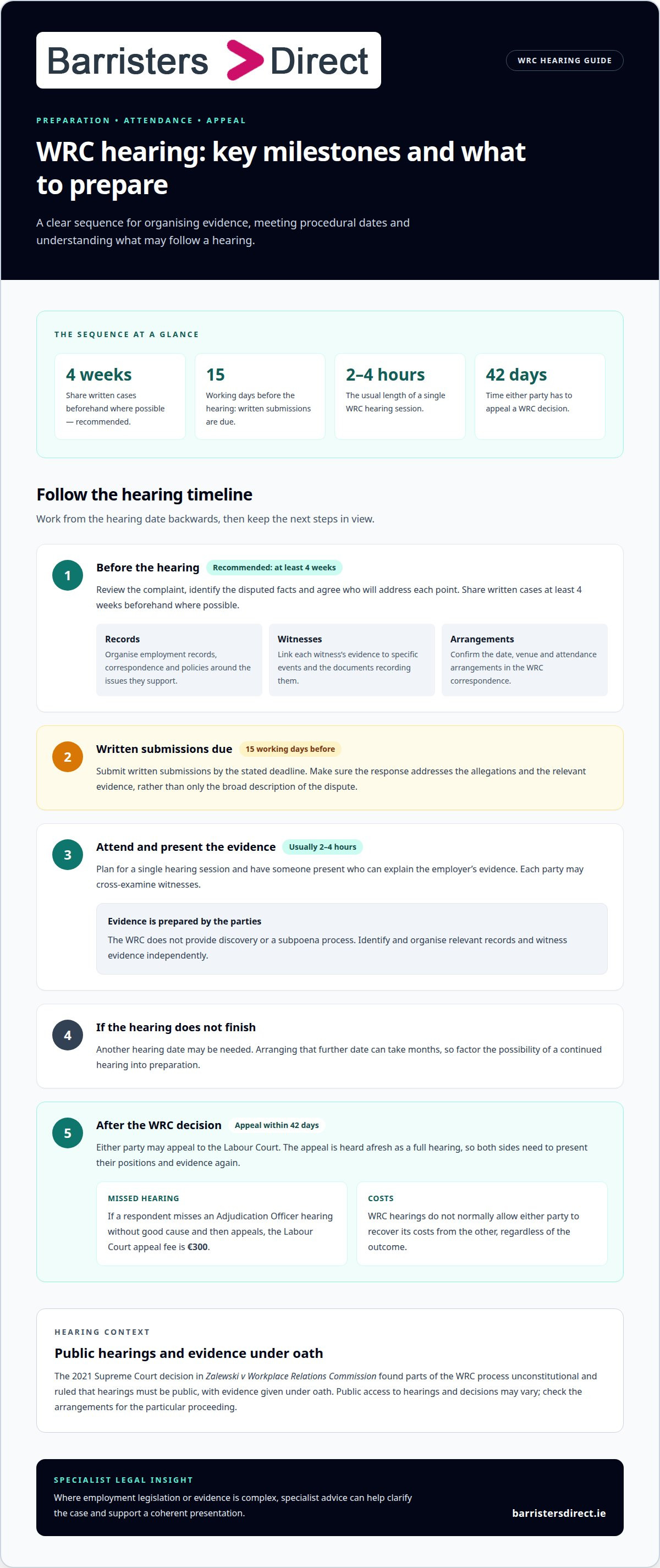
Plan to attend the scheduled WRC hearing and have someone present who can explain the employer’s evidence. WRC hearings are generally assigned a single session of between 2 and 4 hours. If the hearing does not finish, another date may be needed, and arranging it can take months. Review the complaint, identify the disputed facts and agree who will address each point.
What evidence can be submitted in a WRC case, and when must it be exchanged? Relevant evidence can include employment records, correspondence, policies and witness accounts that address the allegations. Written submissions are due 15 working days before the hearing; sharing written cases at least 4 weeks beforehand is recommended where possible.
Prepare management witnesses by linking their evidence to specific events and records. For example, a manager explaining a disciplinary decision should know the process followed and the documents recording it. Each party may cross-examine witnesses, but the WRC does not provide discovery or a subpoena process. Identify and organise relevant evidence independently.
The 2021 Supreme Court decision in Zalewski v Workplace Relations Commission found parts of the WRC process unconstitutional and ruled that hearings must be public, with evidence given under oath. Public access to hearings and decisions may vary, so check the arrangements for the particular proceeding. Understand these different statements when considering publicity and access to evidence in a particular proceeding.
What happens if an employer does not respond to or attend a WRC hearing? A failure to respond leaves the complaint unanswered, and the employer should not assume that silence resolves the dispute. If the employer misses an Adjudication Officer hearing without good cause and then appeals, the Labour Court appeal fee is €300. Attend, or obtain advice promptly if attendance is impossible.
After a WRC decision, either party may appeal to the Labour Court within 42 days. The appeal is heard afresh as a full hearing, so the parties need to present their positions and evidence again. WRC hearings do not normally allow either party to recover its costs from the other, regardless of the outcome. Factor preparation time and the possibility of a further hearing into decisions about how to proceed.
Before the hearing, confirm the date, venue and arrangements in the WRC correspondence. Organise documents around the issues they support, and ensure each management witness knows when and where to attend. If the dispute involves complex employment legislation or contested evidence, specialist advice can clarify the case and help you prepare a coherent presentation.
Identifying the legislation and remedies involved in a WRC complaint
Start with the complaint form: identify each allegation, the legislation named and the remedy sought. The WRC handles complaints under over 40 pieces of employment legislation, so different allegations in one submission may require separate legal analysis. For example, an unpaid-wages complaint and an unfair-dismissal complaint raise different questions. Match each allegation to the events, records and response that address it.
For an unfair dismissal in Ireland, section 7 allows compensation for financial loss of up to 104 weeks’ remuneration, according to the Irish Statute Book. That limit concerns compensation for financial loss; it doesn’t establish that a dismissal was unfair or determine the remedy in a particular complaint. Under section 6(1) of the Unfair Dismissals Acts 1977-2015, a dismissal is deemed unfair unless the employer shows substantial grounds justifying it. Identify the relevant legal test before drafting the employer’s statement.
Other claims have distinct legal tests and remedies. In an Irish discrimination complaint, the complainant must first establish a prima facie case. The burden then shifts to the employer to provide a non-discriminatory explanation. Identify the treatment alleged and its connection to the claimed ground, then gather evidence explaining the decision. The relevant legislation matters: a response focused only on unfair dismissal may not answer a separate discrimination allegation.
Time limits also depend on the type of complaint. Most WRC employment complaints must be lodged within 6 months of the dismissal or alleged breach. Equality complaints generally have a 6-month limit from the last alleged discrimination or victimisation. An unfair-dismissal complaint may be lodged within six months of dismissal, with an extension to twelve months possible where reasonable cause for delay is accepted. Compare the form’s dates with the relevant events, not simply the date the employer received it.
When a complaint is dealt with by adjudication, the WRC acknowledges receipt and forwards the complaint details to the employer or respondent. The complaint and relevant correspondence are shared with the other party. Check that the employer’s response addresses each allegation and document, rather than only the broad description of the dispute. An Adjudication Officer may dismiss a complaint at any time if it is considered frivolous or vexatious. This does not replace a reasoned response to an arguable claim.
Submitting the form begins the formal process, but the wording of each claim shapes what must be answered. Separate the alleged facts, legal basis and remedy in your review, then note any point that needs evidence or clarification. If the legal test or potential remedy is unclear, specialist employment law advice can help assess the complaint and frame a focused response.
Gathering documents and preparing potential witnesses
Build the evidence around each allegation in the Workplace Relations Commission complaint. Start with a chronology, then connect each disputed point to a record or witness. For a discrimination allegation, for example, gather the decision, communications explaining it and records showing how comparable situations were handled. Mark gaps clearly, and do not present unsupported assertions as established facts.
Gather source documents from the workplace, such as contracts, policies, emails, meeting notes, rosters and performance records. Preserve the originals and note where each item came from. A manager’s later summary does not replace a contemporaneous note. If a document includes confidential information about other employees, identify what is relevant to the dispute and handle personal details carefully.
Create a document index that names each item and explains its relevance. Group records by allegation or date instead of sending an unstructured bundle. Check email chains for earlier messages and attachments, and compare meeting notes with the calendar or relevant HR file. If records conflict, note the difference and establish who created each version before relying on it.
A respondent should lodge written Submissions setting out its case or defence and attaching key documents. A useful submission links each allegation to the employer’s position, supporting evidence and the remedy opposed or accepted. Keep legal arguments distinct from factual disputes. For example, explain separately whether a meeting took place and whether the process complied with workplace procedures.
- Chronology: Record the event, date and people involved.
- Document: Identify the source and the allegation it addresses.
- Witness: Note what the person directly saw, heard or did.
Choose witnesses for their first-hand knowledge, not their job title. A line manager may explain a performance review, while an HR representative may describe how workplace procedures were followed. Ask each person to review relevant records and distinguish personal recollection from information learned later. Prepare likely questions, including those that may challenge their account, without scripting answers or encouraging witnesses to adopt a particular version.
Before submitting evidence, check that the written account matches the documents and the witness’s recollection. If an employee’s statement conflicts with an email, investigate the timing and context rather than overlooking the inconsistency. Present the case coherently with a concise submission, organised exhibits and witnesses who can explain their own evidence. This helps the Adjudication Officer follow the employer’s position and assess it against the complaint.
Legal advice and procedural deadlines
Record when the complaint was received and the response dates in WRC correspondence. A deadline register helps track mediation, adjudication and any later appeal separately. Assign responsibility for each filing, then keep proof of what was sent and when. If a deadline is unclear, identify the relevant notice and procedural stage before deciding what action to take.
The respondent should indicate its position on WRC mediation within 10 days of receiving the complaint form when the complainant has expressed willingness to mediate. That response concerns participation, not the merits of the allegations. Keep a copy with the complaint documentation. If the parties do not resolve the dispute through mediation, it proceeds to an Adjudication Officer.
Complaint time limits relate to the claimant’s referral, but they can affect the employer’s response strategy. Most WRC employment complaints must be lodged within 6 months of the dismissal or alleged breach. The usual six-month period may extend to twelve months if the adjudicator accepts reasonable cause for delay. For an objection to an investigation under section 13 of the Industrial Relations Act 1969, the timeframe is 21 days. Check which procedure applies before treating one deadline as relevant to another.
Confirm the respondent’s legal identity early. The employer named in the WRC complaint should match the company name in CRO records. If the complaint names a trading name or related company, establish the correct legal entity and raise the issue in the appropriate response. Accurate identification helps ensure submissions and correspondence address the proper party.
Not every Industrial Relations Act referral uses the WRC e-Complaint Form. A matter referred to the Labour Court under Section 20(1) or Section 20(2) of Ireland’s Industrial Relations Acts 1969 should not be submitted using that form. Identify the statutory route before filing, because the correct process depends on the type of referral. For a WRC adjudication, prepare the employer’s position and supporting documentation for the procedure set out in the case correspondence.
There is no statutory penalty in Ireland for failing to lodge submissions in a WRC claim, but setting out the employer’s case still has practical value. The WRC is independent and cannot provide legal advice. A solicitor or barrister can assess the legislation, evidence and procedural options, including whether to settle or proceed to adjudication.
After a decision, diarise the next step immediately. An unappealed WRC decision must be carried out within 56 days; otherwise, the District Court can enforce it. Keep the decision, payment or compliance records, and related correspondence together. If an appeal is being considered, obtain advice promptly so the applicable appeal deadline is not overlooked.
Can a WRC claim be settled or mediated before an adjudication hearing?
Yes. The Workplace Relations Commission may offer mediation before formal adjudication, but both parties must consent. Mediation gives the complainant and respondent an opportunity to discuss the dispute with a mediator and consider terms for resolution. If either party declines, the complaint proceeds to an Adjudication Officer. The same applies if mediation takes place but does not resolve the issues.
The WRC Mediation Service may offer phone or face-to-face mediation when the claimant elects mediation on the Complaint Form. The respondent should review the form and indicate its position within 10 days of receiving it when the complainant has expressed willingness to mediate. That response is a decision about engaging in mediation, not an admission of liability. Keep the response and any related correspondence with the case file.
Before mediation, identify the points that could help resolve the dispute. These may include whether the employer accepts any factual issue, what remedy the claimant seeks and which terms the respondent could consider. For example, if the complaint concerns a workplace process, the parties can consider whether a practical resolution is possible without an Adjudication Officer deciding the allegations. Prepare a clear account of the employer’s position and the records supporting it.
A settlement reached through WRC mediation is legally binding. Read the proposed terms carefully before agreeing, and ensure they accurately record what each party will do. Check practical details, including the required actions and how completion will be recorded. If the terms do not resolve every issue, identify what remains outstanding before treating the dispute as settled.
Mediation can provide a structured alternative to a hearing, but participation is voluntary. The parties can weigh the strength of the evidence, the remedy sought and the work involved in continuing to adjudication. In 2025, the WRC ran 1,034 mediations, and 54% resolved. Those figures show that resolution is possible, but they don’t determine whether mediation suits a particular dispute.
If mediation is declined or unsuccessful, the complaint is referred to an Adjudication Officer. Continue preparing the defence while mediation is considered, so the employer is ready for the hearing process if no agreement follows. Keep submissions, witness preparation and relevant deadlines in view. Mediation does not settle the allegations unless the parties reach an agreement.
Where the disputed issues or proposed terms carry legal or business consequences, obtain advice before accepting a resolution. Discuss your WRC dispute with a legal professional to assess the allegations, possible remedies and settlement terms before deciding how to proceed.
Barristers Direct: Commercial Dispute Resolution
Barristers Direct arranges specialist legal advice for employers facing a WRC complaint through its Employment Law Consultation. Individuals and companies in Ireland can instruct senior or junior counsel directly for an initial consultation, without needing a solicitor for that meeting. A barrister can review the allegations, explain relevant employment legislation and advise on evidence, procedure and possible next steps.
Consider this advice when a complaint raises complex legal issues, the evidence is contested or proposed settlement terms need careful assessment. For a separate commercial dispute, Barristers Direct also offers Commercial Dispute Resolution. The relevant legal focus depends on the issues, so bring the complaint and key documents to the consultation.
Contact Barristers Direct to discuss advice on your WRC matter.
Make your next move with a clear legal position
The next step is to turn your understanding of the complaint into a considered response. Before deciding how to proceed, clarify the issues, supporting records and practical consequences. This gives you a stronger basis for engaging with the process and assessing whether a proposed resolution addresses the matters that concern you.
Defending a WRC claim can involve detailed questions of employment law and evidence. Specialist advice can help you assess the position, identify issues that need attention and plan a proportionate way forward. Barristers Direct arranges expert legal advice through its Employment Law Consultation.
Contact Barristers Direct for advice about your next steps. A clear plan can make the process more manageable.
Frequently Asked Questions
What is this claim about?
A WRC claim sets out an alleged breach of employment rights and the remedy sought by the complainant. The complaint form identifies relevant events and the legal basis, which may involve dismissal, pay or discrimination. Read each allegation separately. For example, a complaint may challenge both the decision and the process followed, requiring distinct factual responses.
Are WRC hearings held in public?
WRC adjudication hearings are generally conducted in private, while decisions are typically published in anonymised form. The Supreme Court’s 2021 decision in Zalewski v Workplace Relations Commission ruled that hearings must be public and evidence given under oath. These points concern different aspects of proceedings: a published anonymised decision is not the same as public access to a hearing or its evidence.
How am I going to defend this?
Defending a WRC claim starts with matching each allegation to your position and the supporting evidence. Organise the response in a table with one row per allegation, noting the relevant events, records and witnesses. For example, separate a disagreement about what happened from a dispute over whether the employer followed the correct procedure.
How long do I have to respond once a WRC complaint is filed against my business?
There isn’t one general response period that applies to every step after a complaint is filed. Use the dates and instructions in the WRC correspondence, and record the date your business received the complaint. If the complainant has expressed willingness to mediate, the respondent should indicate its position within 10 days of receiving the form. That mediation timeframe isn’t a general deadline for every response.
How much does WRC representation cost?
WRC proceedings generally require each party to bear its own costs, regardless of the outcome. This is separate from the cost of legal advice or representation. Barristers Direct arranges a fixed-fee initial consultation with a specialist barrister, with no further fee for that initial meeting. Any additional work and fees are agreed directly between the client and barrister.
How do you respond to a Workplace Relations Commission (WRC) complaint in Ireland?
Read the complaint form and WRC correspondence, then prepare a clear response to each allegation. For example, if the complaint challenges a disciplinary decision, set out the employer’s account of events and identify supporting records. Keep correspondence and submitted documents together. If mediation is offered, decide separately whether to participate. That choice does not answer the allegations.
What is the deadline for an employer to respond to a WRC claim?
The deadline depends on the specific procedural step, so distinguish a response to a mediation invitation from written submissions for a hearing. The respondent has 10 days to indicate its position on mediation when the complainant has expressed willingness. Written submissions are due 15 working days before the hearing. Use the WRC’s case correspondence to diarise the applicable dates and avoid treating one deadline as a substitute for another.
What information and documents should an employer include in a WRC response?
Set out the employer’s position on each allegation and include documents that directly support it. Depending on the complaint, relevant records may include the contract, policies, correspondence, meeting notes or records of the decision being challenged. Add a brief chronology to show how events fit together. Check that each document relates to a disputed issue and handle confidential details about other employees carefully.
Disclaimer
This article does not constitute legal advice. Barristers Direct does not provide legal advice. To obtain legal advice, you should contact a legal practitioner.


