

A solicitor’s duty of confidentiality is strong, but it is not absolute. If you need breach of confidentiality legal advice in Ireland, the key question is whether disclosure was authorised by the client, required or permitted by law, or justified by a narrow exception, such as preventing serious harm or crime.
It is reasonable to expect information shared with a solicitor to remain private. That duty continues after the solicitor’s work for a client ends. However, not every disclosure is unlawful, and not every piece of information is protected by legal professional privilege.
This article explains whose information the duty protects, when a solicitor may disclose it, and how confidentiality differs from legal professional privilege. It also covers how these issues arise in litigation and employment disputes, what evidence may help show misuse of confidential information, and what legal options may be available in Ireland.
Key Takeaways
- A solicitor’s duty of confidentiality generally continues after the work ends, so former clients’ information can remain protected.
- Disclosure may be permitted or required by law, or made with the client’s consent; serious-harm concerns can also be relevant.
- Confidentiality and legal professional privilege are different protections, and understanding which applies matters in litigation and employment disputes.
- Records showing how information was accessed, used or shared may help establish whether it was misappropriated.
- An employee’s contractual confidentiality obligation binds the parties to that contract, so the terms and circumstances matter.
Solicitors’ duty to protect current and former clients’ confidential information
In Ireland, solicitors must generally keep current and former clients’ information confidential, subject to limited exceptions. This protection can be relevant whenever information is stored, shared or used in a dispute.
Misuse of Confidential Information
A breach of confidence claim concerns confidential information shared in circumstances that create an obligation of confidence, then wrongfully communicated by someone who knew of that obligation. Information must actually be confidential, not merely private or commercially useful. For example, a business might show that a recipient received a proposal on restricted terms and then passed it to another party.
Under the common-law breach-of-confidence regime, mere acquisition is not actionable without further use; trade-secret rules differ. For protection under Ireland’s Trade Secrets Regulations, information must be secret, commercially valuable because it is secret, and subject to reasonable steps to keep it secret. Legal advice in Ireland can help assess which route fits the facts of an alleged confidentiality breach.
Fiduciary Duties and Confidential Information
A fiduciary duty requires someone in a position of trust to act loyally within that relationship, including by avoiding misuse of information obtained through it. Using confidential material to benefit oneself or another party may raise both breach-of-confidence and fiduciary-duty issues.
The distinction matters when considering remedies. A claimant may seek an account of profits if the other party benefited through a breach of fiduciary duty or misappropriation. Records showing access, disclosure, use and resulting benefit can help explain the claim. Legal advice in Ireland can help assess how those records relate to the remedies available for a confidentiality breach.
The duty does not end when a solicitor’s retainer ends. Section 1(3)(e) of the Legal Services Act 2007 identifies confidentiality as a core professional principle. Solicitors must also take reasonable steps to protect client information in stored or maintained records.
A conflict can arise if a solicitor later acts for someone whose interests oppose those of a former client. The central question is whether the solicitor or firm holds material confidential information that could be used or disclosed. The risk is especially serious when that information is relevant to the new matter.
A confidentiality clause is a provision in a contract; a non-disclosure agreement is a separate agreement that sets out confidentiality obligations. In Ireland, a contractual confidentiality obligation binds the parties to that contract, so its wording and the parties involved determine its scope.
There is no single automatic penalty for every disclosure. Depending on the claim and evidence, remedies may include damages, an account of profits or an injunction. A professional-conduct complaint may also result in a finding of misconduct.
GDPR obligations concern the lawful processing of personal data, and the Data Protection Act 2018 applies to solicitors’ handling of confidential information. A breach involving personal data therefore raises data-protection questions alongside whether confidence was breached.
To respond, preserve relevant records, identify what was disclosed and how, and limit further access where possible. If you are affected, keep messages and documents that show the information’s confidential nature, the circumstances of disclosure and any resulting use.
The cost of legal advice depends on the case and is given after a quote request. Factors include the information involved, alleged recipient, available evidence and remedy being considered.
When disclosure is permitted by law or with client consent
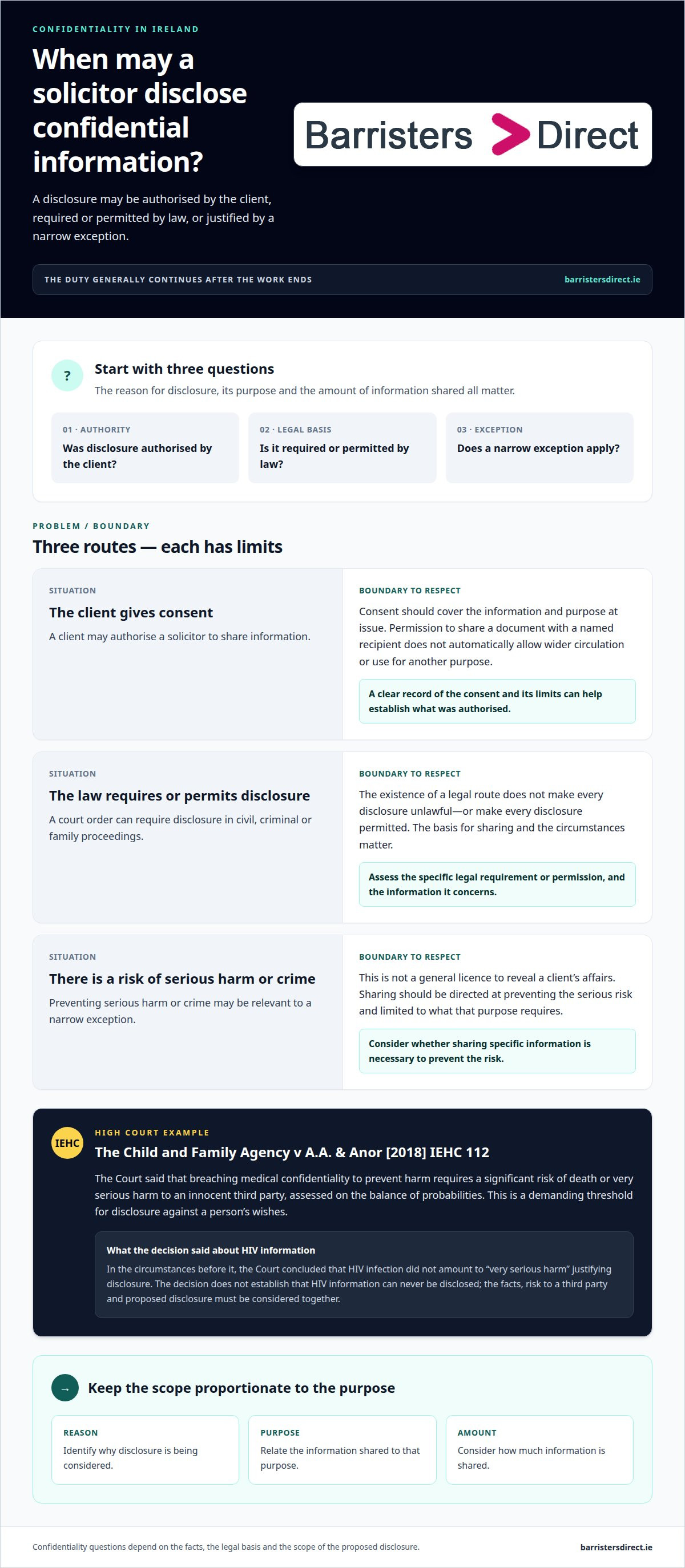
In Ireland, solicitors generally keep current and former clients’ affairs confidential unless the client authorises disclosure or it is required or permitted by law. The reason for disclosure, its purpose and the amount of information shared all matter.
Consent should cover the information and purpose at issue. If a client authorises a solicitor to share a document with a named recipient, that does not automatically permit wider circulation or use for another purpose. A clear record of the consent and its limits can help establish what was authorised if a dispute arises.
Disclosure to prevent serious harm or crime is a narrow exception, not a general licence to reveal a client’s affairs. The relevant question is whether sharing specific information is necessary to prevent a serious risk, such as a criminal act likely to cause serious bodily harm. Any disclosure should be directed at preventing that harm and limited to what the purpose requires.
Where a third party faces a risk, the Irish High Court’s decision in The Child and Family Agency v A.A. & Anor [2018] IEHC 112 provides an important example. The Court said breaching medical confidentiality to prevent harm requires a significant risk of death or very serious harm to an innocent third party, assessed on the balance of probabilities. This sets a demanding threshold for disclosure against a person’s wishes.
The same case considered information about a patient with HIV. The Court concluded that, in the circumstances before it, HIV infection did not amount to “very serious harm” that justified disclosure. The decision does not establish that HIV information can never be disclosed. It shows why the facts, the risk to a third party and the proposed disclosure must be considered together.
A court order can require disclosure in civil, criminal or family proceedings. Before information is made public, an injunction may restrain its release, but Irish courts are cautious about prior restraint where publication may be justified. An injunction against a third party outside the relevant contract can be harder to obtain. If information has already leaked, a court may consider an order no longer useful.
Irish courts may award damages, order an account of profits or grant an injunction for breach of confidence. Damages generally require quantifiable economic loss; an account of profits may address benefits gained through misappropriation. If an injunction is granted and the claimant later loses at a full hearing, compensation may be payable for losses caused by the order.
If a proposed disclosure involves a business dispute, specialist advice on the dispute can help assess the evidence, the urgency of protection and the appropriate remedy.
Confidentiality in litigation and employment disputes
In an Irish dispute, confidentiality and legal professional privilege can affect how parties use documents and evidence. They are distinct protections, and one does not automatically establish the other.
Confidentiality in Litigation
Confidentiality is a duty to keep information private, while legal professional privilege protects specific communications from disclosure in court. A document may be confidential without being privileged. For example, a commercially sensitive contract does not become privileged simply because it is relevant to proceedings or shared with a legal adviser.
Litigation privilege has a more specific threshold: litigation or a regulatory investigation must be ongoing or reasonably anticipated. The connection to anticipated proceedings matters when assessing whether communications or material created for a dispute may attract privilege. A general concern about possible future action does not, by itself, meet that threshold.
Irish courts may grant an injunction before trial to restrain improper use of confidential information. After a full hearing, a permanent injunction may protect rights in that information. A court can also order material involved in a breach of confidentiality to be delivered up. These remedies address different needs: stopping further use, protecting information over the longer term or recovering material.
The timing and use of evidence matter. If confidential documents are circulating during litigation, the concern may involve both their disclosure and their use in the dispute. Parties should distinguish the information’s confidential character from any claim that a particular communication is privileged. That helps clarify what protection is being asserted and what action is sought.
Employee Duties of Confidentiality
An employee’s contractual confidentiality obligation arises from an agreement and binds only the parties to that contract. The wording and scope of the agreement therefore matter when an employer alleges that an employee disclosed business information. A term in one employment contract does not, by itself, impose a contractual obligation on an unrelated recipient.
In an employment dispute, identify the information at issue and the contractual term said to protect it. For example, a claim that a former employee shared a client list requires attention to whether the list was treated as confidential and what the agreement says about its use or disclosure. The facts shape the legal analysis.
Keep confidentiality and privilege separate in workplace proceedings. An internal email may contain sensitive business information, but sensitivity alone does not make it privileged. A communication may attract privilege if the legal requirements are met. The existence of an employment dispute does not automatically make every related document privileged.
If a party seeks to restrain disclosure, the court considers the confidential information and the relief requested. A pre-trial injunction may address threatened misuse, while a final order can protect information after a full hearing. In either case, the parties’ evidence about the material and its handling helps define the issue before the court.
Evidence and proof of misappropriation
A breach-of-confidence case turns on the information, the circumstances in which it was shared and its alleged misuse. Evidence should connect these elements clearly, rather than rely on suspicion that a competitor gained an advantage.
Start by identifying the specific material said to be confidential. A marked business plan, customer proposal or unpublished pricing schedule gives the issue a clear focus. Then establish how it was communicated, such as through an email with restricted terms or access to a controlled file. The circumstances help show whether the recipient knew an obligation of confidence applied.
Next, look for evidence of what happened after access. Email trails, file-sharing records, document versions and meeting notes may help trace disclosure or use. For example, a proposal sent to one recipient in confidence, followed by a matching offer from a competitor, may prompt further investigation. Similarity alone does not establish who obtained the information or how it was used.
Preserve original records and their context. Keep relevant messages with attachments, retain existing access records and note when each item was found. A dated chronology can help distinguish authorised sharing from later disclosure. Avoid altering files or circulating sensitive material more widely, as this can complicate the evidence and create further confidentiality concerns.
Where relevant records are held by another party, Irish courts may make third-party discovery orders in breach-of-confidence cases. Search orders may also be available to uncover evidence of wrongdoing. These are court procedures, not a general entitlement to search another business’s systems. The material sought and its connection to the alleged misuse shape the application.
Evidence should also address whether the information was confidential. A document labelled “confidential” may help show how it was treated, but the label alone does not prove every issue. Records showing restricted access, confidentiality terms or limited circulation can provide further context. For trade-secret protection, the applicable regulation sets separate criteria concerning secrecy, commercial value and reasonable steps to preserve secrecy.
If financial loss is alleged, gather records that explain the claimed impact. Examples include lost business opportunities or evidence that the information could have been licensed. An account of profits may be relevant if the other party benefited from misappropriation. The link between the information and the claimed loss or benefit matters to the remedy sought.
Keep the evidence proportionate and relevant to the issue. A focused set of documents showing what was shared, who could access it and what use followed is more useful than an unorganised data dump. If personal data is included, handle it in line with data-protection obligations while preserving records relevant to the dispute.
What legal duties of confidentiality apply to employees in Ireland?
An employee’s contractual confidentiality duty depends on the agreement with the employer. The obligation binds those parties, so an employer’s claim should be assessed against the contract actually signed. A policy issued by another company, for example, does not automatically bind an employee who never agreed to it.
The wording helps define what the employee agreed to protect and how they may use it. A clause might identify customer records, internal forecasts or project documents, then restrict sharing outside assigned work. If a dispute concerns a particular file, compare its content and intended use with the clause rather than assuming every workplace document has the same status.
Permission may also matter. An employee asked to send a report to a named supplier may be acting within an authorised task, while forwarding it to a personal account for unrelated use raises a different question. Key details include who authorised the transfer, its purpose and whether the employee’s agreement restricts that conduct.
After employment ends, the contract’s wording remains central to any continuing obligation. A clause may expressly cover use or disclosure after departure. If a former employee uses information in a new role, the analysis turns on the relevant agreement and circumstances, not simply on the change of employer.
If an employer is reviewing a concern, keep the inquiry focused on the relevant terms and events. Identify the employee’s agreement, the material involved, who was authorised to receive it and the alleged action. A dated record of the decision-making process can help distinguish an approved work transfer from conduct outside the agreed scope.
Employees facing an allegation can identify the contract relied on and the specific act said to breach it. For example, a dispute about a report sent to a colleague may turn on whether the colleague needed it for work and whether the agreement allowed internal sharing. The surrounding instructions and communications help explain the context.
These contractual questions can arise within a wider workplace dispute, but they remain focused on the agreement and the parties it binds. If the concern involves an employment relationship, consider the precise contractual issue and the practical outcome sought before deciding how to respond.
Barristers Direct
Barristers Direct arranges fixed-fee initial consultations with barristers whose expertise matches your legal matter. If a suspected confidentiality breach raises questions about evidence, possible remedies or business risks, a specialist barrister can advise you on those issues and potential next steps.
For a business dispute, Commercial Dispute Resolution may be relevant. If the concern involves an employee’s conduct or contractual obligations, an Employment Law Consultation can address the employment-law issues alongside the confidentiality concern.
Contact Barristers Direct to discuss your situation and arrange a consultation with a barrister.
Choose a clear next step
A confidentiality concern can affect commercial decisions, working relationships and how you handle sensitive information in future. Decide what outcome should guide your next move, such as restoring confidence in a business relationship or setting clearer boundaries for handling sensitive material. A considered decision can help keep your response focused on what matters to you.
If you need legal advice in Ireland about a confidentiality breach, consider how specialist legal input could clarify the choices before you. Explore the consultation process with Barristers Direct as you consider your next step.
Set a clear objective and make a measured plan. A specialist perspective can help you understand the issues and consider how best to protect your interests.
Frequently Asked Questions
Are there any times a solicitor must break confidentiality?
Yes. A solicitor must disclose information when the law requires it, subject to applicable protections such as legal professional privilege. A court order in civil, criminal or family proceedings may require disclosure. In other situations, disclosure may be permitted rather than compulsory, including with the client’s consent or to prevent serious harm or crime. The purpose and scope matter: disclosure should be limited to what the legal requirement or protective purpose calls for.
Does confidentiality continue after a case is closed?
Yes. Closing a case does not, by itself, end a solicitor’s duty to protect a former client’s information. For example, a solicitor cannot treat a confidential business plan as available for another client simply because the original matter has concluded. If a new matter creates a conflict, the firm must consider whether it holds material confidential information that could be disclosed or used against the former client.
What is the difference between confidentiality and legal privilege?
Confidentiality concerns keeping information private; legal professional privilege protects qualifying communications from disclosure in legal proceedings. For example, a sensitive commercial contract may be confidential but not privileged merely because a solicitor received it. A communication seeking or giving legal advice may raise a privilege question. This distinction affects whether material can be withheld in proceedings, so labelling a document “confidential” does not settle its status.
What counts as a breach of confidentiality under Irish law?
A breach may arise when confidential information is shared in circumstances creating an obligation of confidence, then wrongfully communicated by someone who knew of that obligation. For instance, a recipient given a private proposal for a defined purpose may breach confidence by passing it to a competitor. The information’s confidential nature, the circumstances of disclosure and the recipient’s knowledge all matter when assessing a claim.
What are the rules on breach of confidence in Ireland?
A claimant generally needs to establish confidential information, an obligation of confidence arising from how it was communicated, and wrongful disclosure by someone who knew of that obligation. Trade secrets have additional criteria: the information must be secret, commercially valuable because it is secret, and protected by reasonable steps. Restricting access to a formula or pricing model can help demonstrate those protective measures.
Can a breach of confidentiality lead to damages or an injunction in Ireland?
Yes. Depending on the claim, an Irish court may award damages, order an account of profits or grant an injunction. Damages generally require quantifiable economic loss, such as lost business or the value of a licence that could have been obtained. An injunction may restrain threatened misuse, but timing matters: once information has spread widely, an order may no longer protect it effectively.
What exceptions allow confidential information to be disclosed in Ireland?
Disclosure may be allowed with the client’s consent, when required or permitted by law, or in limited circumstances involving serious harm or crime. For example, a court may order disclosure during proceedings. A disclosure in the public interest should go to an appropriate person or body and include only information needed for its purpose. These exceptions are not blanket permission to share a client’s entire file or unrelated details.
How do GDPR and data protection rules apply to confidentiality breaches in Ireland?
The Data Protection Act 2018 applies to solicitors’ handling of confidential information, and GDPR obligations concern the lawful processing of personal data. A breach involving personal data can therefore raise data-protection questions alongside whether confidence was breached.
Disclaimer
This article does not constitute legal advice. Barristers Direct does not provide legal advice. To obtain legal advice, you should contact a legal practitioner.


