

In Ireland, a non-resident parent or guardian can apply to court for access if agreement cannot be reached. Certain relatives and adults who live or have lived with the child may also apply. The court focuses on the child’s welfare and may hear the child’s views, giving appropriate weight to their age and maturity.
Disagreements about contact can be difficult to resolve, especially when a child’s routine and relationships are involved. This guide explains who may apply, what a court can consider or order when parents disagree, and how a child’s views may be gathered safely. It also clarifies the difference between access, custody and guardianship, helping you understand the issue before deciding on a practical next step.
Key Takeaways
- If parents cannot agree on access, they can seek a court order setting out when and how contact takes place.
- A child’s welfare remains central, and their views are considered in light of their age and maturity.
- Certain relatives and adults with a close connection to the child may be able to apply for access, subject to the court’s assessment.
- Where a child lives outside Ireland, cross-border rules may affect the access application and the next steps.
- Keep children out of adult conflict and avoid asking them to choose sides; the article explains how their views can be heard appropriately.
What happens if parents cannot agree on access arrangements?
If parents cannot agree, either may apply to court for an access order. The court’s central concern is the child’s welfare, including their safety, stability and established routines.
Informal arrangements, access orders and mediation
Parents can agree arrangements directly or use mediation, where a neutral person helps them discuss concerns and practical options. A solicitor can also support negotiations. Child access dispute advice can help clarify which issues need to be resolved before making an application.
An informal agreement can cover visits, overnight stays, holidays, special events, and phone or electronic contact. A written agreement is not legally binding unless made a Rule of Court. If agreement fails, a judge can make an access order specifying when contact takes place and the conditions that apply.
If a parent is unreasonably denied access already granted by a court order, they can apply for an enforcement order. The court may provide compensatory time, require reimbursement of expenses, or direct participation in parenting programmes, counselling or mediation information sessions.
Agreeing practical child access arrangements
Put practical details in writing, including collection and return times, handover locations, school commitments, overnight stays and holiday dates. For example, parents could agree that one parent collects the child from a familiar centre after school and returns them at an agreed time.
Agree how to handle changes, such as illness or a school event, and decide how you will communicate about them. Consider the child’s age, relationships with each parent, safety and stability. If grandparents help with handovers or attend events, clarify their role to avoid conflicting expectations.
Arrangements when a child lives abroad
Cross-border access disputes may involve the Hague Convention or EU regulations, so the child’s country of residence matters. If the child is not living in Ireland, the Irish Central Authority can be contacted about access applications on 01 479 0200.
Set out proposed contact clearly, including travel, holidays and phone or electronic communication. If you cannot agree, get advice on the cross-border process before relying on informal arrangements. Any application should explain where the child lives and how contact could work across borders.
Evidence, fees and application timescales
Organise relevant documents: existing court orders, written access proposals, messages about missed contact, and records of the child’s school or care routine. Court Form 58.1 is used for an application about arrangements for children. This child access dispute advice can help you focus on records that explain the disagreement and the arrangement sought.
Court fees depend on the application and procedural steps, while legal costs depend on the advice and representation required. The Legal Aid Board provides advice and legal aid for access matters, but legal aid is generally not free and most recipients contribute. The Family Mediation Service is free for couples negotiating separation agreements.
Uncontested access cases may resolve in weeks, while complex disputes can take several months. If safety or abuse concerns arise, tell the court and make the child’s safety central to any proposed arrangements. Seek legal advice promptly where the child’s welfare is at issue.
Hearing a child’s views in custody and access proceedings
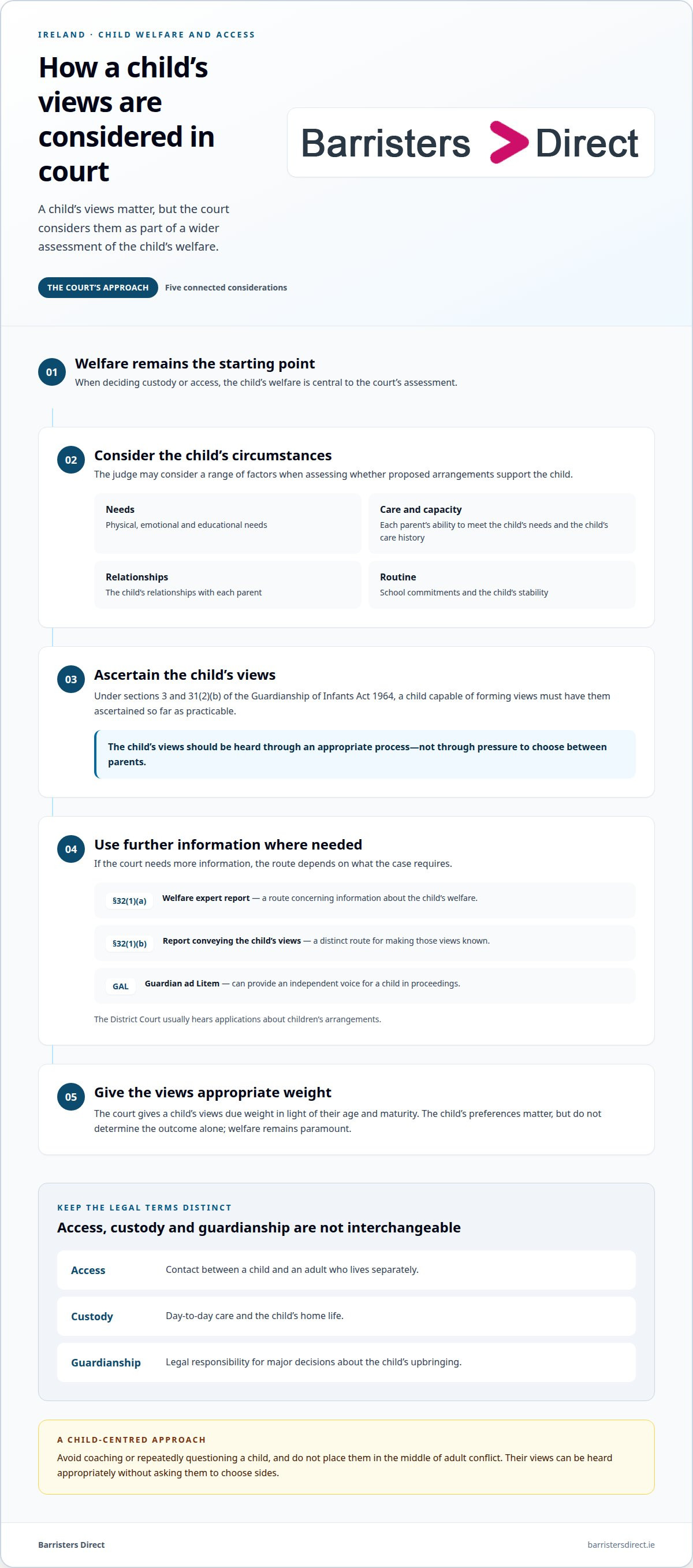
An Irish court considers a child’s views alongside their welfare when deciding custody or access. Under sections 3 and 31(2)(b) of the Guardianship of Infants Act 1964, a child capable of forming views must have them ascertained so far as practicable. The court gives those views due weight according to the child’s age and maturity. Their preferences matter, but they do not determine the outcome alone.
Access, custody and guardianship describe different legal relationships. Access concerns contact between a child and an adult who lives separately. Custody concerns day-to-day care and the child’s home life. Guardianship gives an adult legal responsibility for major decisions about the child’s upbringing. A parent may therefore have access without providing most of the child’s daily care.
Parents are usually a child’s guardians. Guardianship can involve important decisions about upbringing, while custody focuses on practical care. Joint custody describes shared responsibility for day-to-day care, but does not explain how every decision or handover will work. When proposing arrangements, parents should distinguish these issues rather than treating access, custody and guardianship as interchangeable.
When deciding access, a judge may consider the child’s physical, emotional and educational needs, each parent’s ability to meet them, the child’s care history, and their relationships with each parent. School commitments may also shape a practical schedule. The judge considers the child’s wishes in light of age and maturity, while keeping welfare paramount. These factors help assess whether proposed contact supports the child’s stability and relationships.
The District Court usually hears applications about children’s arrangements. If the court needs further information, section 32(1)(a) of the 1964 Act concerns a welfare expert report, while section 32(1)(b) concerns a report conveying the child’s views. A Guardian ad Litem can also provide an independent voice for a child in proceedings. These are distinct routes, and the court’s approach depends on what information the case requires.
For example, an appropriate process may be needed to gather a younger child’s views, rather than questioning them at home. Parents should avoid coaching, repeated questioning or presenting one parent’s preferred outcome as the child’s choice. Solicitors can help parents understand the process and prepare relevant information about care, school and relationships without placing responsibility for the dispute on the child.
If you need advice on how these issues apply to your circumstances, seek guidance on family-law matters before taking a step that could affect the child’s arrangements.
Access applications by relatives and other people close to a child
Certain relatives and adults with a close connection to a child may apply to court for access in Ireland. The court considers the child’s welfare, the applicant’s connection and whether an order is necessary.
Applications by relatives and grandparents
Grandparents may ask an Irish court for access, particularly if the child has a strong bond with them. A family relationship alone does not mean an order will be made. The court considers whether contact would benefit the child’s welfare and how it fits with existing relationships and routines.
Other eligible relatives may also apply. Before the District Court considers a relative’s application, the child’s guardians must be notified using Court Form 58.1. The applicant should explain the relationship, describe the contact sought and give concrete examples, such as regular visits or involvement in family events. Child access dispute advice can help a relative present those details clearly.
Applications by other adults
An adult who lives or has lived with the child may apply for access. This could include a former carer or another adult who shared the child’s household. The applicant should describe their relationship and contact history, explaining how the connection developed and what contact they are seeking.
For example, a former household member might explain how they helped with the child’s daily routine and the nature of their continuing relationship. The application must also follow the guardians’ notification process using Court Form 58.1. Getting child access dispute advice before filing can help clarify the requested arrangement and the information relevant to the application.
Factors considered in applications
The judge considers the applicant’s connection with the child, possible disruption or harm, the guardians’ wishes, the child’s views and whether an order is necessary. These factors are weighed together. A close bond may support contact, while a proposal that disrupts the child’s routine may need closer examination.
An applicant should explain the proposed contact, its practical effect and how it would fit the child’s life. For example, a request for visits should set out a workable pattern that accounts for existing commitments. The guardians’ views form part of the assessment, but the child’s welfare remains central.
Before applying, set out the relationship, relevant contact history and outcome sought. Then ensure the guardians receive the required notice through Court Form 58.1. These steps help the court understand both the basis for the application and the practical arrangement being requested.
A safe and age-appropriate opportunity for children to express their views
An Irish court decides access by assessing the child’s welfare, not simply choosing a parent’s preferred schedule. It may weigh the child’s physical, emotional and educational needs, each parent’s ability to meet them, the child’s care history and relationships. The child’s views also matter, with weight reflecting their age and maturity. A proposed arrangement should show how contact supports the child’s interests and day-to-day stability.
Under sections 3 and 31(2)(b) of the Guardianship of Infants Act 1964, a child capable of forming views must have those views ascertained so far as practicable. The court gives them due weight according to age and maturity, while the child’s best interests remain paramount. The child is not responsible for resolving the dispute. Their views inform the court’s decision; they do not make the decision for it.
Keep two report types distinct. Under section 32(1)(a), the court may seek an expert report about the child’s welfare. Section 32(1)(b) concerns a report conveying the child’s views. One addresses welfare assessment; the other communicates what the child thinks. The court can consider the information each provides alongside the wider circumstances, including safety, education and established relationships.
A Guardian ad Litem can provide an independent voice for a child in court proceedings. This gives the court a way to hear the child’s perspective without asking them to argue one parent’s case. Parents can support the process by avoiding leading questions, repeated conversations about court or promises linked to a particular answer. If the child raises a concern, record their words calmly and pass it on through appropriate legal channels.
The Voice of the Child Report Guidelines and Templates, issued in October 2026, address the child-views function under section 27 of the Domestic Violence Act 2018. Their relevance is specific to that statutory function. In a case involving safety concerns, the court’s welfare assessment remains central, and the child’s opportunity to express views should be handled with appropriate care.
The High Court’s decision in M. (Child Access Arrangements) v F. [2026] IEHC 537 noted that the child had last been interviewed approximately twelve months before the District Court hearing. That case detail shows why timing can matter: a child’s circumstances and preferences may change. The court considers the information before it in context, rather than treating an earlier account as automatically current.
Before a hearing, parents can help by giving their solicitor clear information about school routines, care history and any welfare concern. Keep the child out of adult discussions and do not ask them to represent either parent. Whether a case is heard in Dublin or another District Court location, the focus remains the child’s welfare and a safe, practical way to hear their views.
Avoiding pressure on children to choose between parents
In Ireland, access decisions centre on the child’s welfare, not a parent’s preferred outcome. Parents can reduce conflict by keeping adult disagreements separate from the child’s daily routine.
Keeping children out of parental conflict
Children under 18 have rights and protections under Irish law, but they should not carry responsibility for resolving a dispute. Avoid asking them to pass messages, report on the other parent, or explain why contact did or did not happen. Use direct, calm communication with the other parent about practical arrangements instead.
For example, if a school collection time changes, send the update directly to the other parent rather than asking the child to pass it on. Keep discussions about court, legal advice and allegations away from handovers. Irish family law cases are heard in private to protect family privacy, but parents should still avoid discussing case details where the child may overhear.
If a concern relates to the child’s safety, record the specific incident and raise it through appropriate legal channels. Distinguish an immediate welfare concern from frustration about missed contact. A clear account of what happened, when it happened and how the child was affected is more useful than involving them in an argument.
Supporting children without taking sides
Tell the child simply that adults are responsible for adult decisions and that they do not have to choose between parents. Avoid questions such as “Which home do you prefer?” or comments that make contact sound like disloyalty. If the child expresses a preference, listen without asking them to defend it or repeat it for either parent.
Under sections 3 and 31(2)(b) of the Guardianship of Infants Act 1964, a child capable of forming views must have them ascertained so far as practicable. The court gives those views due weight according to age and maturity, while the child’s best interests remain paramount. That process does not make the child responsible for the result.
Parents can support a balanced process by sharing relevant information with their solicitors, such as a change in the child’s routine or a specific welfare concern. Do not coach the child before a meeting or promise a preferred outcome. If the child’s circumstances change, explain the practical facts accurately and leave decisions to the adults and the court.
Where a dispute is affecting communication or arrangements, seek focused family-law advice on the next steps and how to keep the child’s welfare central.
Barristers Direct: Commercial Dispute Resolution
Barristers Direct provides Commercial Dispute Resolution for commercial matters, a separate area from child access disputes. If you need legal guidance about access arrangements, focus on advice that addresses the family law issues, the evidence relevant to your circumstances and options for resolving disagreement.
Barristers Direct enables individuals in Ireland to arrange a consultation with a specialist barrister for legal advice. This can help clarify the issues, consider next steps and prepare you to make informed decisions about a dispute. For a separate commercial matter, its Commercial Dispute Resolution service may be relevant.
To discuss your legal needs, contact Barristers Direct or visit barristersdirect.ie.
Take a clear next step for your family
Before deciding what to do, identify what needs to change and what would make daily life more workable for the child. A short note of your priorities and questions can help keep a legal discussion focused on the issues that matter. Child access dispute advice can clarify the options and help you consider a proportionate way forward.
Barristers Direct arranges consultations with specialist barristers for legal advice. Its other areas of work include Commercial Dispute Resolution, Wills and Probate Legal Advice, and Employment Law Consultation. For a child access matter, seek advice relevant to your family law circumstances and the decision you need to make.
Contact Barristers Direct for advice about your legal needs. A considered next step can help you approach a difficult family decision with greater clarity.
Frequently Asked Questions
Who can apply to the courts for access?
A parent or guardian can apply if agreement about contact cannot be reached. A father may apply whether or not he is a guardian, including if his name is absent from the birth certificate. Certain relatives and adults who live, or previously lived, with the child may also apply. For an eligible relative’s application, guardians must be notified using Court Form 58.1 before the District Court considers it.
Can child law disputes be resolved without going to court?
Yes. Parents can negotiate directly or use mediation, where a neutral person helps them discuss concerns and possible arrangements. For example, they could agree a school-term schedule first, then discuss holiday contact separately. If they reach agreement, they can ask for it to be made a Rule of Court, giving it legal enforceability. If discussions do not resolve the dispute, applying to court remains an option.
Can this service help before going to court?
Yes. Barristers Direct offers a Family Law Consultation, connecting you with a specialist barrister for initial advice before court proceedings. You can use the discussion to understand the legal issues, consider next steps and prepare focused questions about your circumstances. The consultation does not include court representation. If legal proceedings are required, getting legal advice may help you prepare for that stage.
How does a court decide custody arrangements?
The court decides custody arrangements by assessing the child’s welfare and practical needs. It may consider the child’s physical, emotional and educational needs, care history, relationships and each parent’s ability to provide care. For example, school commitments and an established routine can inform a workable arrangement. The court also considers the child’s views according to their age and maturity, while keeping their best interests paramount.
What are the court fees and legal costs for a child access dispute in Ireland?
Court fees depend on the application and procedural steps, while legal costs depend on the advice and representation required. The Legal Aid Board provides advice and legal aid, but most recipients contribute. The Family Mediation Service is free for couples negotiating separation agreements.
Disclaimer
This article does not constitute legal advice. Barristers Direct does not provide legal advice. To obtain legal advice, you should contact a legal practitioner.


