

A company’s insolvency doesn’t, on its own, tell you whether you may face director restriction or disqualification. If you’re looking for director disqualification advice Ireland, start by establishing the facts of your situation rather than assuming insolvency determines the outcome.
It’s understandable to be concerned about whether you can continue to act as a director. Restriction and disqualification are different measures, and each can affect your involvement in company management in a different way. The Companies Act 2014 provides the relevant Irish framework, but how it applies depends on the circumstances.
This guide explains the key concepts, the questions that may matter, and the records that could help a barrister assess your position. Barristers Direct arranges a paid, fixed-fee initial consultation with a specialist barrister. You can discuss your circumstances, identify what remains unclear and consider possible next steps. The advice is between you and the barrister, and no particular result is guaranteed.
Key Takeaways
- Company insolvency alone doesn’t determine whether director restriction or disqualification may apply; the facts and context matter.
- Restriction and disqualification have different effects, so establishing which issue you face is an important first step.
- Prepare for director disqualification advice Ireland by organising relevant records, setting out a timeline and listing your questions.
- A specialist barrister can assess your circumstances and discuss possible next steps, without guaranteeing an outcome.
- Barristers Direct arranges a paid consultation with a barrister online or by telephone. A solicitor may be needed for formal litigation or ongoing representation.
Director disqualification in Ireland: what the risk means for you
Uncertainty about your position can be difficult, particularly if a company is in financial difficulty or you’ve received questions about its conduct. Irish law gives you a starting point for understanding the issue, but the effect on you depends on the facts. This section explains the difference between disqualification and restriction without assuming either applies in your case.
In the Republic of Ireland, director disqualification is a legal prohibition on taking part in specified company roles or management, imposed under the Companies Act 2014. The Act sets out grounds for disqualification, including in section 842. The Corporate Enforcement Authority (CEA) is responsible for supervising and enforcing company law, including initiating relevant proceedings.
What does director disqualification mean in Ireland?
A person who is disqualified is prohibited from acting in roles such as company director or secretary, and from involvement in the promotion, formation or management of a company in Ireland. The precise legal effect depends on the applicable order or legal provision. This is the position under Republic of Ireland law, not Northern Ireland rules.
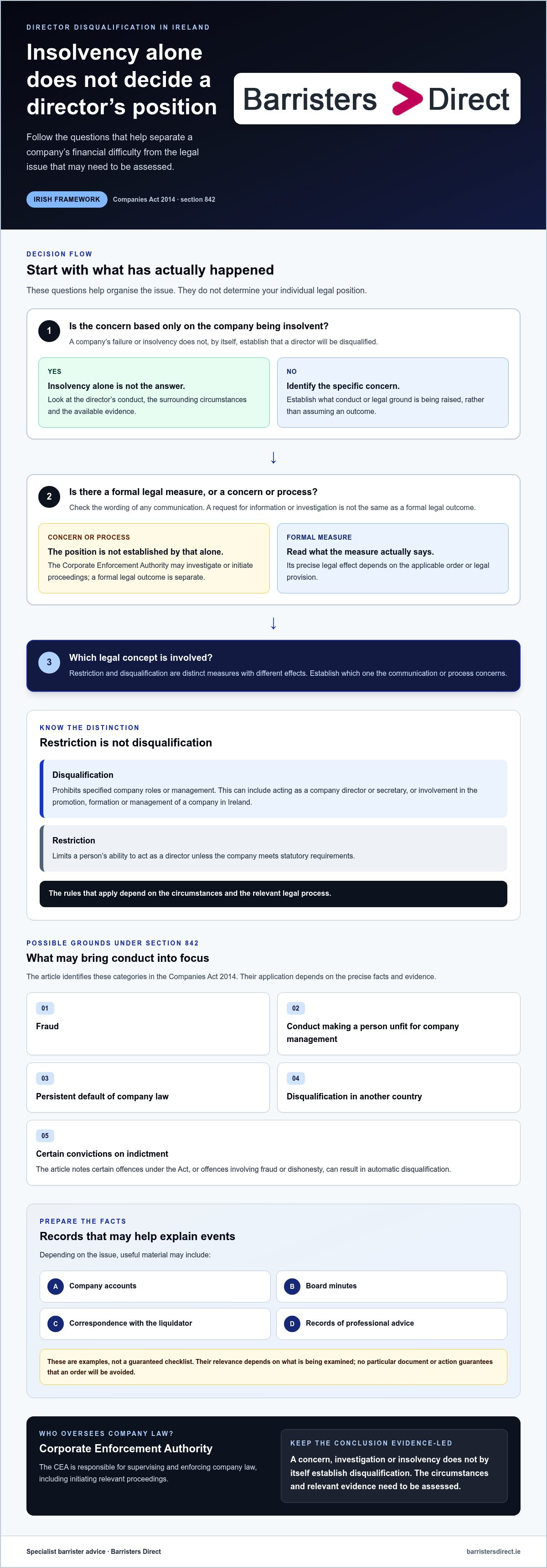
A possible concern is not the same as a formal outcome. Financial difficulty, a request for information or an investigation does not by itself establish that you’ve been disqualified. Insolvency may bring a director’s conduct into focus, but it isn’t automatic proof of disqualification. The circumstances and relevant evidence need to be assessed.
How is restriction different from disqualification?
Restriction and disqualification are distinct legal concepts, not interchangeable labels. Disqualification prohibits specified company roles and management. Restriction limits a person’s ability to act as a director unless the company meets statutory requirements. Which rules apply depends on the circumstances and the relevant legal process.
If you’ve heard that you may be “restricted” or “disqualified”, establish what the communication actually says. Does it describe a concern, a process or a formal legal measure? The distinction can affect what you may do next, but it doesn’t establish your individual position without considering the facts. For related context, see our guidance on corporate insolvency in Ireland.
If you’re seeking director disqualification advice Ireland, a focused review of the relevant circumstances can help clarify the legal terms and identify questions that need answers. It can also help you consider possible next steps without assuming a particular outcome.
What can lead to director disqualification, and what should you not assume?
The fact that a company has failed or entered insolvency doesn’t, by itself, establish that a director will be disqualified. The relevant question is what the evidence shows about the director’s conduct and whether a ground under Irish law applies. A list of possible grounds can help you understand the framework, but it cannot determine your position without the circumstances of your case.
Which circumstances may prompt scrutiny of a director’s conduct?
Under section 842 of the Companies Act 2014, grounds for disqualification include fraud, conduct that makes a person unfit to be involved in company management, persistent default of company law and disqualification in another country. Certain convictions on indictment for offences under the Act, or offences involving fraud or dishonesty, can also result in automatic disqualification. The legal basis and its application depend on the precise facts.
These categories are not a substitute for examining what happened. A concern about company records or a report relating to an insolvent company may lead to scrutiny, but it isn’t the same as a finding that a director is disqualified. The Corporate Enforcement Authority (CEA) may investigate or initiate proceedings; a formal legal outcome is a separate matter.
Directors’ responsibilities and company governance sit within the wider area of company law. The University College Dublin course description for Advanced Company Law 1 (LAW41830) includes director duties and corporate governance among its topics. That academic context illustrates the breadth of the subject, but it doesn’t decide how the Act applies to an individual case.
Does company insolvency automatically mean disqualification?
No. Insolvency alone doesn’t automatically mean disqualification. A company’s financial position may be relevant, but the director’s actions, the surrounding circumstances and the available records matter. A general online summary cannot establish how the law applies to your case.
Records can help explain the sequence of events, the decisions made and the information available to directors at the time. Depending on the issue, useful material may include accounts, board minutes, correspondence with the liquidator and records of professional advice. These are examples to help you prepare, not a guaranteed checklist. Their relevance depends on what is being examined, and no particular document or action guarantees that an order will be avoided.
If you’re unsure how a concern, investigation or formal notice relates to your circumstances, a specialist barrister can assess the information you provide and discuss the legal questions and possible next steps. Arrange a barrister consultation through Barristers Direct, which connects people and businesses in Ireland with a barrister for a paid consultation.
Restriction or disqualification: compare the questions that shape your position
Restriction and disqualification can both affect a person’s ability to take part in company management, but they are not interchangeable. Under the Companies Act 2014, their practical effects and the routes by which they arise differ. Use the comparison below as an orientation, not as a prediction of what will happen in an individual case.
| Question | Restriction | Disqualification |
|---|---|---|
| Legal status | A formal restriction on acting as a director, subject to statutory conditions. | A formal prohibition on specified company roles and involvement in company management. |
| Practical effect | A restricted person may act as a director only if the company meets the applicable requirements, including minimum paid-up share capital. | A disqualified person is prohibited from acting in roles covered by the disqualification or taking part in company management. |
| Possible route | May arise through a court process or an undertaking accepted by the Corporate Enforcement Authority (CEA). | May follow a court process or an undertaking; certain convictions on indictment can also lead to automatic disqualification under Irish law. |
| Individual assessment | What circumstances led to the issue, and what statutory requirements apply to any company you may be involved with? | What legal ground is relied on, what conduct or conviction is relevant, and what does any notice or order actually say? |
For restriction, the statutory capital thresholds identified in the Irish framework are €100,000 for a private company and €500,000 for a public limited company (PLC). The effect in a particular case still depends on the applicable law and the person’s circumstances. The relevant duration should be checked against the specific legal route and current authoritative sources.
Which differences matter most in practice?
The label matters, but so does the detail behind it. A barrister assessing your position may need to understand your role in the company, its circumstances, the conduct in question and the records available. To prepare, note whether there is a formal order or undertaking, or only a concern; which legal ground is being relied on; and what activities the measure may prevent.
Why does the relevant legal route matter?
The route can shape who makes the decision and what legal effect follows. The CEA may initiate proceedings or offer an undertaking; some disqualification consequences arise automatically following specified convictions. Each route must be considered under Republic of Ireland law. Northern Ireland materials concern a different legal framework and cannot establish your position here.
For related context on company circumstances and directors’ responsibilities, see this guide to corporate insolvency. A comparison table cannot decide your case. Specialist director disqualification advice Ireland should take account of the documents, events and legal process specific to your situation.
How to prepare for director disqualification advice in Ireland
A clear account of events helps a barrister focus on the legal questions that matter. If you’re seeking director disqualification advice Ireland, organise what you know, identify what remains uncertain and bring relevant papers to your consultation. The suggestions below can help you prepare, but they aren’t a mandatory checklist or a guarantee of any outcome.
What information should you organise before speaking to a barrister?
Gather materials that may explain your role, company decisions and communications. Depending on your circumstances, these might include company records, board minutes, financial information, correspondence with a liquidator, and any letter, notice or other document you’ve received about a possible restriction or disqualification. Make a dated chronology. For each point, distinguish what a document confirms from what you remember or assume.
A practical preparation sequence
- Clarify the issue. Note who raised it and what they said. Record whether you have received a formal notice, order or undertaking rather than relying on a verbal description.
- Organise relevant records. Collect potentially useful company documents and correspondence. Keep originals where possible, and note any records you haven’t been able to locate.
- Build a timeline. Set out key company events, decisions and communications in date order. Include your position and involvement at each relevant point.
- List your questions. Identify what you need to understand, including which Irish legal framework applies, what facts need closer analysis, and whether any immediate decision or deadline requires attention.
- Explain the context clearly. Be ready to describe your role, the decisions made, the information available at the time and any steps taken afterwards. Be open about uncertainty rather than filling gaps with assumptions.
Useful questions may include: What does the document I received mean? Which facts could be significant under the relevant Irish law? What should I prioritise now? If proceedings are involved, what further professional support may be appropriate? A solicitor may be needed for formal litigation or ongoing representation.
Barristers Direct arranges a paid, fixed-fee consultation with a barrister online or by telephone. The barrister can assess the information you provide, explain the issues and discuss possible next steps. Any advice is between you and the barrister, and an assessment cannot guarantee a particular result. Arrange a consultation with a barrister to discuss your circumstances.
How a specialist barrister consultation can clarify your next steps
If you’re facing questions about restriction or disqualification, a focused discussion with a barrister can help identify which issues need closer legal analysis. The value lies in applying relevant expertise to your circumstances, rather than relying on a general summary to decide your position.
What can a first consultation help you understand?
Barristers Direct arranges a paid consultation with a barrister whose expertise is relevant to the issue. The consultation can take place online or by telephone, giving you an opportunity to explain your role, the company’s circumstances, the events in question and any documents or correspondence you’ve received. Barristers Direct arranges access to the consultation; legal advice is provided by the barrister, not by the platform.
Depending on the information you provide, the barrister may be able to help you understand which legal questions arise, what facts need further examination and what possible next steps to consider. You can also ask how restriction and disqualification differ in your circumstances, and whether any immediate decisions or deadlines need attention. The discussion is an assessment, not a guarantee that proceedings will be avoided or that a particular outcome will follow.
Preparation can make the conversation more focused. Bring a concise timeline, relevant documents and a list of points you want addressed. Be clear about what you know, what you’re uncertain about and what you need to decide. This gives the barrister a clearer basis for discussing your circumstances.
When might a solicitor also be needed?
Barristers and solicitors have distinct professional roles within the Irish legal system. A barrister can provide legal advice during the consultation. If formal litigation or ongoing representation is needed, a solicitor may also be required. The appropriate arrangement depends on the work involved and your circumstances. For a broader explanation, read our guide to the difference between solicitors and barristers.
Any advice given, and any further professional relationship, is between you and the barrister introduced. Barristers Direct arranges access to the consultation and is not responsible for the barrister’s advice or any subsequent engagement. A consultation can help you understand the questions and possible options, but it cannot predetermine the result.
If you’re ready to discuss your circumstances with a barrister, arrange a paid barrister consultation through Barristers Direct.
Take a clear next step with specialist advice
Director restriction and disqualification are distinct measures, and company insolvency alone doesn’t establish that either will apply. Your role, the company’s circumstances and the evidence all matter. A clear timeline and relevant records can help a specialist barrister focus on the questions specific to your position.
If you need director disqualification advice Ireland, Barristers Direct can arrange a paid, fixed-fee consultation with a barrister whose expertise is relevant to the legal issue. Consultations can take place online or by telephone, connecting people and businesses with barristers across Ireland. The barrister can discuss your circumstances and possible next steps, but no consultation can guarantee a particular outcome. Any advice or further professional engagement is between you and the barrister. If formal litigation or ongoing representation is needed, a solicitor may also be required.
Take the next step with a focused discussion about your circumstances. Arrange a consultation with a specialist barrister and move forward with a clearer understanding of the questions to address.
Frequently Asked Questions
Can a director be disqualified because a company becomes insolvent?
No. A company becoming insolvent does not, by itself, automatically disqualify its directors. The relevant assessment concerns the director’s conduct and circumstances under the applicable Irish law, not simply the company’s financial outcome. Company records, decisions and communications may help explain what happened, but no particular document or action guarantees a result. If you’re concerned, seek advice on the specific facts and verify the current legal position in the Republic of Ireland.
What is the difference between director restriction and disqualification in Ireland?
Restriction and disqualification are separate legal measures in the Republic of Ireland. Disqualification prohibits a person from acting in specified company roles or participating in company management. Restriction limits acting as a director unless statutory conditions are met, including minimum paid-up share capital requirements for the company. The legal route and effect depend on the circumstances. Don’t apply Northern Ireland rules or assume the label alone explains what you may do.
How can I get director disqualification advice in Ireland?
To prepare, gather any notice or correspondence, relevant company records and a dated outline of key events. Separate confirmed facts from recollections or assumptions. Barristers Direct arranges a paid consultation with a barrister whose expertise is relevant to the issue. The consultation can take place online or by telephone, and the barrister can discuss your circumstances and possible next steps without guaranteeing an outcome.
Can I speak to a barrister directly about director disqualification?
Yes. Barristers Direct arranges a paid consultation with a barrister, without requiring a solicitor for that initial consultation. The platform arranges access; the barrister provides any advice during the meeting. Any further work or professional relationship is agreed directly between you and the barrister. Consultations can take place online or by telephone. A consultation is an assessment, not full litigation representation or a promised outcome.
Do I need a solicitor if director disqualification proceedings are involved?
Possibly. A barrister consultation can provide specialist advice on the legal issues, while a solicitor may be needed if formal litigation or ongoing representation is required. The professions have distinct roles, and one does not make the other unnecessary. Barristers Direct arranges the initial paid consultation; it does not provide representation. If proceedings are involved, the barrister can discuss what further professional support may be appropriate for your circumstances.
What should I bring to a director disqualification consultation?
Bring material that may help explain the issue, such as relevant company records, any notice or order, correspondence with the Corporate Enforcement Authority or a liquidator, and a dated timeline of key decisions and events. These are preparation examples, not a required checklist. Mark which details are documented, remembered or uncertain. The barrister can assess what information matters to your circumstances and identify any further material or questions for follow-up.
Disclaimer
This article does not constitute legal advice. Barristers Direct does not provide legal advice. To obtain legal advice, you should contact a legal practitioner.


