

Could a treatment going wrong prove that someone was negligent? Not by itself. If you’re trying to understand how to prove medical negligence Ireland, the key is evidence connecting the care provided, a breach of the required standard, the harm suffered and the link between them.
It’s understandable to be unsure where to begin, especially when records are incomplete or medical details are difficult to interpret. A poor outcome alone doesn’t establish negligence. In Ireland, an assessment depends on the circumstances of the care and often on independent expert opinion about whether the relevant standard was met and whether an alleged failure caused the injury.
This guide explains how medical records, a chronology and expert evidence may help clarify the issues. It also outlines how to prepare questions for a specialist barrister consultation arranged through Barristers Direct. The barrister provides any advice directly. A consultation can help you consider the evidence and possible next steps, but it cannot guarantee a claim will succeed or replace a solicitor where formal proceedings require one.
Key Takeaways
- Explore how to prove medical negligence Ireland claims by tracing the care provided, the alleged failure, the harm and the evidence linking them.
- Organise clinical records, appointment dates, correspondence and a dated account of events to build a clear chronology.
- Independent medical expertise may help assess whether the care fell below the required standard and contributed to the injury.
- Identify gaps in the available evidence and prepare focused questions before deciding on a next step.
- A specialist barrister consultation arranged through Barristers Direct can help you discuss the issues, but cannot guarantee a claim will succeed.
How to prove medical negligence in Ireland: what must the evidence show?
A disappointing result, even a serious one, doesn’t by itself establish that medical care was negligent. Treatment can involve recognised risks, and complications may occur despite appropriate care. The central questions are whether the evidence supports a failure to meet the required standard and whether that failure caused harm.
In Ireland, the standard is associated with the Supreme Court decision in Dunne v National Maternity Hospital. Put simply, a practitioner may be found negligent if their failure is one that a medical practitioner of equal specialist or general status and skill, acting with ordinary care, would not have made. Applying that principle depends on the treatment and circumstances, not simply on whether the outcome matched expectations.
Does a poor medical outcome prove negligence?
No. An adverse outcome might result from a recognised treatment risk, an underlying condition or a complication that can occur even where care was appropriate. A negligence claim raises a different question: did the care fall below the applicable standard, and did that shortfall contribute to the outcome? Evidence is needed to assess the distinction.
For example, a patient might develop an infection after a procedure. The infection alone doesn’t show whether care was negligent. Relevant context could include the patient’s condition, the care provided and when symptoms were identified and acted on. Those details may help an appropriate expert assess what happened, but the example cannot determine an individual case.
What does a claimant generally need to establish?
A useful starting framework is duty of care, breach, causation and harm, often described in legal discussions of a legal cause of action. This is a general overview, not a substitute for the Irish legal test or an assessment of a particular claim.
- Duty: the practitioner owed the patient a duty of care.
- Breach: the care allegedly fell below the relevant standard, assessed in light of the Dunne principles.
- Causation: the alleged breach must be linked to the injury. Showing that care was imperfect is not enough if that shortfall didn’t cause the harm claimed.
- Harm: the patient suffered an injury or loss that can be identified and evidenced.
So, how to prove medical negligence Ireland is not simply a matter of showing that treatment was followed by harm. The evidence needs to connect what happened, what may have fallen short and how that failure caused the injury or loss. Medical records and expert assessment may help clarify those links, while any conclusion depends on the full facts.
How to build the medical negligence evidence chain
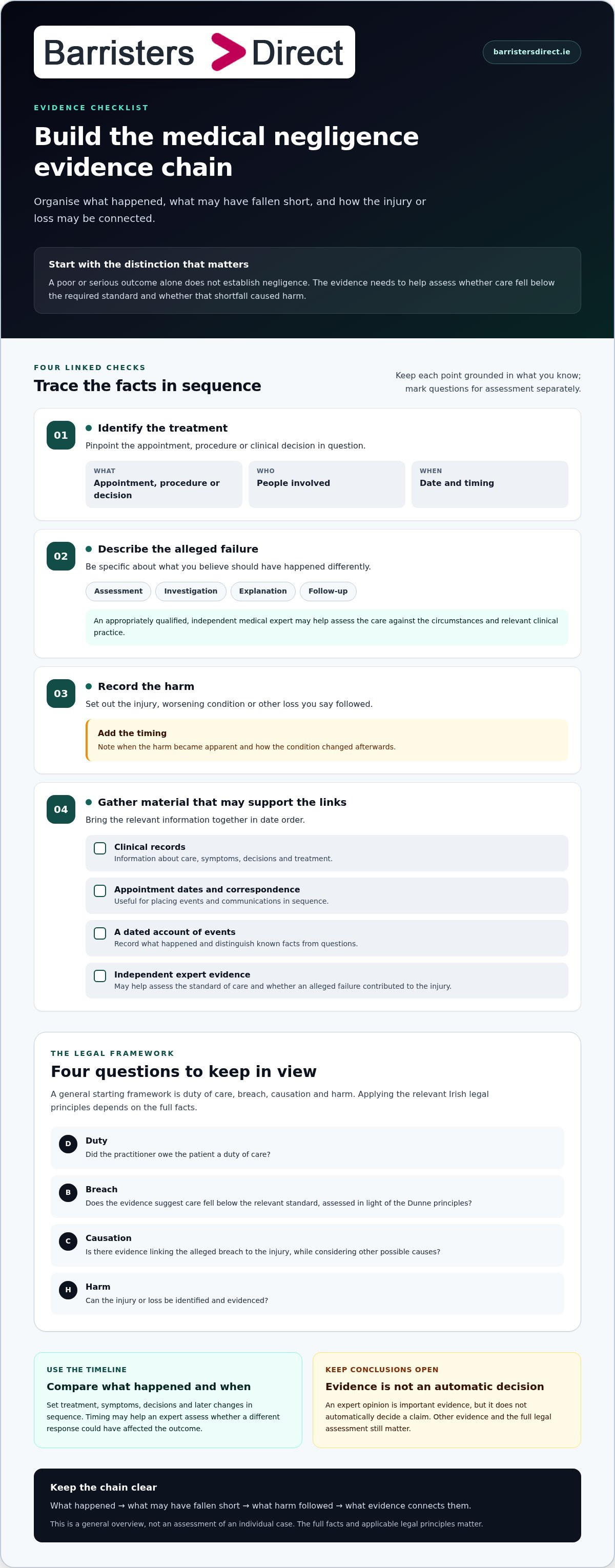
A clear evidence chain helps show how the treatment, alleged shortfall and resulting injury may be connected. Use this framework to organise the facts before drawing conclusions:
- 1. Identify the treatment. Note the appointment, procedure or clinical decision in question, including who was involved and when it happened.
- 2. Describe the alleged failure. Be specific about what you believe should have happened differently, such as an assessment, investigation, explanation or follow-up. An independent medical expert can help assess this against the circumstances and relevant clinical practice.
- 3. Record the harm. Set out the injury, worsening condition or other loss you say followed, and when it became apparent.
- 4. Gather supporting material. Bring together records, correspondence and a dated account of events that may help explain each link.
The Medical Council’s professional conduct and ethics guide provides context on doctors’ professional responsibilities. It does not, by itself, determine whether a legal breach occurred. That assessment depends on the facts and applicable legal principles.
How is the standard of care assessed?
Assessment depends on the care at issue, the patient’s circumstances and relevant clinical evidence. An appropriately qualified, independent medical expert may review the records and offer an opinion on whether the care fell below the applicable standard. That opinion is important evidence, but it doesn’t automatically decide a claim. Other evidence and the full legal assessment still matter.
How do you connect a breach to the harm?
Records can help establish what happened; expert analysis may help explain its consequences. Compare the timing of treatment, symptoms, decisions and later changes in condition. If the records show when symptoms were reported, for example, their timing may help an expert assess whether a different response could have affected the outcome. Other possible causes also need careful consideration.
Causation needs evidence, not assumption: the fact that harm followed treatment doesn’t, on its own, prove that an alleged failure caused it. Keep events in sequence and distinguish what you know from what you want assessed. This can make gaps and focused questions easier to identify. Understanding how to prove medical negligence Ireland cases require means examining the links, not relying on one isolated detail.
For a specialist view of the issues raised by your information, Barristers Direct can arrange a paid consultation with a relevant barrister. The barrister provides any advice directly.
Which records and expert evidence can support a medical negligence claim?
Useful evidence depends on the treatment and issues in question. A document may help establish what happened or when, but no single record proves negligence on its own. Organising material by date and source can make it easier to see what is documented, what remains unclear and what may need specialist assessment.
What medical records should you organise?
Start with a dated list of consultations, tests, diagnoses, treatment and follow-up. Group the documents you have by provider and date, and keep copies of relevant letters, emails and other correspondence. If you need additional records, ask the relevant healthcare provider about its process for handling requests. Processes can vary, so avoid assuming a particular procedure or deadline.
Include a personal account of events, written as factually as you can. Note what you remember, when symptoms arose, who you spoke with and what response followed. Mark anything you’re unsure about rather than filling gaps with assumptions.
| Evidence type | Question it may help answer |
|---|---|
| Clinical notes and treatment records | What assessment, decisions and care were recorded? |
| Test results and reports | What did investigations show, and when were results available? |
| Appointment dates and follow-up information | How did the sequence of care relate to symptoms or changes in condition? |
| Letters, emails and other correspondence | What concerns or information were communicated, and what response was recorded? |
| Your dated account of events | What do you recall that may help explain or provide context for the records? |
| Independent medical opinion | How might the care, the alleged shortfall or the resulting harm be assessed clinically? |
When might independent medical opinion matter?
A suitably qualified independent medical expert may review relevant records and address whether care met the applicable standard, whether an alleged failure contributed to the injury, or the nature of the harm. The appropriate expertise depends on the clinical issues involved. An expert opinion is evidence to consider, not a guaranteed finding or outcome.
A published surgical-error case study may illustrate how records and expert analysis are considered in one set of circumstances. Treat any example as an illustration, not a prediction: different facts, treatment and evidence can lead to different assessments. The material relevant to how to prove medical negligence Ireland claims will depend on the case. A specialist review can help identify which records and questions matter most.
Next steps: preserve evidence and prepare case questions
Once you’ve gathered the material available to you, make it easy to review. Keep original documents unchanged, save copies of relevant letters, emails and messages, and organise records by date and source. If you receive further records or explanations, note when and from whom they came. A careful file helps distinguish documented facts from recollection and unanswered questions.
How should you prepare a clear chronology?
Use a simple dated list to record symptoms, appointments, tests, treatment and communications. Keep the wording neutral. Separate what you directly remember from details taken from medical records or explained to you later, and flag uncertainty rather than filling gaps with guesses.
Beside each entry, note the document that may support it, if you have one. Then list missing records and questions, such as when a test result was reviewed or what follow-up was planned. This turns a broad concern into specific points for assessment.
What should you ask during an initial legal consultation?
Bring your chronology and ask which evidence may support or weaken the alleged breach and the link between that breach and the harm. You could also ask whether further records or an independent medical assessment may help address the clinical issues. A published surgical-error case study can illustrate how evidence is discussed in one case, but it can’t predict the assessment or outcome of yours.
Ask about time limits promptly. In Ireland, the general limitation period for a personal injuries claim, including medical negligence, is two years from the date of the alleged negligent act or the date of knowledge, whichever is later. The date of knowledge involves specific legal considerations, and exceptions may apply. Don’t rely on a chronology or consultation alone to calculate a deadline. A solicitor can advise on the time limit and any steps required for formal proceedings.
Preparing the evidence carefully can make a specialist discussion more focused. If you’re considering how to prove medical negligence Ireland, Barristers Direct can arrange a paid consultation with a barrister relevant to your legal needs. A consultation can help you consider the issues and possible next steps, but does not guarantee a claim’s outcome.
Learn about arranging a specialist barrister consultation to discuss the questions raised by your evidence.
How a specialist barrister consultation can clarify your next steps
Once you’ve organised the information available, a specialist barrister can help assess the legal and evidential questions it raises. A focused discussion may help you understand what appears supported, what remains uncertain and what further information could be relevant. That perspective can make the next step clearer, but it can’t guarantee that a claim will succeed, lead to a settlement or produce a particular result.
What happens in a direct barrister consultation?
Barristers Direct arranges a paid consultation with a barrister relevant to your legal needs. The service facilitates access to the barrister, who provides any legal advice directly. A consultation may take place online or by telephone.
To make the discussion useful, have your chronology, key records and questions to hand. You might ask how the information relates to the alleged breach and causation, which uncertainties matter most, and whether further records or expert assessment could help. A barrister can discuss the issues raised by what you provide, but the consultation does not guarantee a claim’s merits or outcome. Read more about the advantages of instructing a barrister directly.
When may a solicitor also be needed?
Barristers and solicitors have distinct roles, and both may be important in a medical negligence matter. A solicitor can provide client-facing support and assist with procedural steps. If formal litigation is being considered, solicitor involvement may be required; the appropriate arrangements depend on the circumstances and should be discussed with a legal professional. A barrister consultation does not replace representation or procedural support where those are needed.
Understanding how to prove medical negligence Ireland claims involve is one part of deciding what to do next. A barrister can help clarify legal and evidential questions, while a solicitor can advise on managing a claim and any formal proceedings. For a clearer explanation of how these roles differ, see the guide to the difference between solicitors and barristers.
If you’re ready to discuss the issues raised by your evidence, Barristers Direct can arrange a specialist barrister consultation. It’s an opportunity to receive advice directly from a relevant barrister and consider possible next steps, without assuming in advance that a claim will succeed.
Take a clear next step with your evidence
Understanding how to prove medical negligence Ireland requires more than showing that treatment had an unwanted outcome. The evidence needs to help explain what care was provided, what may have fallen below the relevant standard and whether that shortfall caused harm. Organising records, dates and a factual account can make those questions easier to assess.
Keep uncertainties visible rather than trying to resolve them yourself. A specialist barrister can consider the issues raised by the information you have and help clarify possible next steps. Barristers Direct arranges a paid consultation with a barrister whose expertise is relevant to the legal issue. Consultations can take place online or by telephone, and any advice is provided directly by the barrister. A consultation can’t guarantee that a claim will succeed, and a solicitor may be needed for formal proceedings.
To discuss the evidence and questions you’ve prepared, arrange a paid consultation with a relevant barrister through Barristers Direct. A considered assessment can help you move forward with greater clarity.
Frequently Asked Questions
Can I prove medical negligence in Ireland without an expert report?
Possibly, but clinical expert evidence may be important where the issues concern the standard of care or whether treatment caused harm. Whether a report is needed depends on the facts and applicable procedure; one report also doesn’t automatically determine the outcome. A specialist barrister can discuss what evidence may be relevant to your circumstances. This is a general guide, not an assessment of whether a particular claim can be proved.
Does a bad result mean medical negligence?
No. A poor outcome, complication or recognised treatment risk doesn’t automatically establish negligence. The questions include what care was provided, whether it fell below the applicable standard and whether any shortfall caused harm. Those issues need to be assessed against the evidence and relevant legal principles. Avoid reaching a conclusion from the outcome alone. An appropriately qualified professional can review the circumstances and help identify what further information may matter.
What evidence do I need for a medical negligence claim in Ireland?
Potentially relevant evidence includes clinical records, appointment dates, test results, correspondence, a factual chronology and, where appropriate, independent medical opinion. The material needed depends on the treatment and alleged injury. Keep original documents where possible, organise copies by date and note what each item may help establish. A specialist review can identify potential gaps, but having these documents does not by itself establish negligence or guarantee a claim will succeed.
How do I get my medical records in Ireland?
Identify the healthcare provider and the records relevant to the treatment, then ask the provider about its current process for making a request. Keep a copy of your request and any response, and organise records you receive by date. The process and applicable rights should be checked against current Irish requirements. If you’re unsure which records may be relevant, a legal professional can help you frame questions about the material needed.
How long do I have to make a medical negligence claim in Ireland?
The general time limit is two years from the date of the alleged negligent act or the date of knowledge, whichever is later. The date of knowledge involves when you knew, or could reasonably have been expected to know, about the significant injury, its connection to the act or omission, and the person responsible. Exceptions may apply. Seek case-specific legal advice promptly, as working out the deadline depends on the circumstances.
Can I speak to a barrister directly about a medical negligence concern?
Yes. Barristers Direct arranges paid consultations with a barrister whose expertise is relevant to your legal issue. The consultation may take place online or by telephone, and Barristers Direct facilitates access and doesn’t guarantee an outcome. If formal proceedings are pursued, a solicitor may also be needed. A consultation can help you discuss the available information and consider possible next steps.
Does a medical negligence consultation mean I have to start court proceedings?
No. A consultation is an opportunity to discuss the information available and consider possible next steps; it doesn’t itself mean court proceedings will follow. Nor does it guarantee that a claim will succeed or settle. If litigation is considered, the barrister can explain relevant issues, and a solicitor may need to be engaged for formal proceedings. The decision about what to do next depends on the advice and circumstances of the individual matter.
Disclaimer
This article does not constitute legal advice. Barristers Direct does not provide legal advice. To obtain legal advice, you should contact a legal practitioner.


