

What if a difficult recovery after surgery raises questions, but doesn’t show whether anything went wrong? An unexpected outcome alone doesn’t establish negligence. This illustrative case study explores surgical error legal advice Ireland and how a specialist barrister’s input can help someone make sense of the information they have, without jumping to conclusions.
Imagine a patient who is concerned about their treatment and unsure what to do next. They may not know which records or details will matter, or whether to speak to a solicitor or consult a barrister. Those are reasonable concerns. An early consultation can help clarify the issues to investigate and identify possible next steps, but it can’t determine the outcome of a claim without the necessary evidence.
Barristers Direct arranges a paid consultation with a qualified barrister whose area of expertise matches the legal issue. In this article, we’ll look at how the patient could organise key information, what specialist advice may and may not establish, and how a solicitor may be involved if formal proceedings are needed. The aim is a clearer way forward, not an assumed answer.
Key Takeaways
- An unexpected surgical outcome doesn’t, by itself, establish negligence. The fictional case study shows why the available facts need careful assessment.
- See how surgical error legal advice Ireland may begin with a specialist barrister considering what happened, when concerns arose and the outcome for the patient.
- Understand how early barrister advice differs from solicitor-led support and formal representation, and how these roles may fit together.
- Prepare a concise timeline and questions for a consultation. Missing records need not stop you from seeking advice.
- Learn what a paid specialist consultation arranged through Barristers Direct may clarify, and what it cannot determine without further information.
Surgical error legal advice in Ireland: when is a specialist view useful?
Illustrative scenario, fictional and not a client case: After an operation, Aoife experiences a problem that affects her recovery. She expected some discomfort, but this symptom is worrying her. She wonders whether it is a recognised complication, whether some aspect of her care needs to be examined, and what information could help answer those questions. The scenario doesn’t establish that an error occurred. It shows how uncertainty can prompt someone to seek an informed view.
Early specialist legal advice is a case-specific assessment of the information available and possible next steps. A barrister can consider the person’s account and relevant material, identify questions that may need further investigation, and explain what can and cannot reasonably be concluded at that stage. The purpose is clarity, not a premature decision about fault or a prediction of the outcome.
A surgical outcome is not, by itself, a legal conclusion
A patient’s experience matters, but it is distinct from the legal assessment that may follow. A poor or unexpected result alone doesn’t prove that care fell below an appropriate standard, that this caused the outcome, or that a person is entitled to compensation. Those issues can’t responsibly be decided from a short description. Irish legal tests and how they apply to particular facts require specialist review.
For general background, what constitutes medical negligence is discussed in broad terms in this overview. It isn’t an explanation of the specific Irish legal position or a substitute for advice on an individual situation. Surgical error legal advice Ireland patients seek should take account of the facts and relevant Irish law, rather than assume that an adverse outcome proves a legal wrong.
What an illustrative case study can, and cannot, show
Aoife might note when the operation took place, what she understood about the procedure, when her concern began and how the outcome has affected her. She could raise those points with a specialist barrister and ask what further information may be relevant. The discussion may help her understand what can be assessed now and what remains uncertain.
The example shows how an early consultation can bring structure to difficult questions. It cannot establish what happened in a real person’s treatment, determine liability or predict whether a claim would succeed. Each situation depends on its own evidence and circumstances. If information is incomplete, a specialist view can still help identify relevant questions and possible next steps without turning uncertainty into an assumption of fault.
How a barrister can assess a possible surgical error
At a consultation, a specialist barrister considers the information you provide and gives advice tailored to your circumstances. The discussion can help organise a complicated account into clear questions: what happened before, during and after the procedure; when the concern first arose; what you were told; and how the outcome has affected you.
This is an initial legal assessment, not a medical diagnosis or a guaranteed finding of negligence. A barrister can explain the strengths and uncertainties apparent from the information available, and what further steps may be worth considering. If the account raises issues that need medical assessment, further records or input from an appropriate professional may be relevant. What is needed depends on the circumstances.
Building a clear account of events
A concise chronology can make the consultation more focused. Start with the procedure and note what followed, including when symptoms or other concerns appeared and any relevant conversations or correspondence. Separate what you recall directly from what you learned later, and mark details you’re unsure about. Don’t guess why a clinical decision was made or who may be responsible.
- Known: dates, events and communications you can describe or document.
- Unclear: unanswered questions or details you can’t reliably recall.
- To ask: the points you want the barrister to address.
This approach helps the barrister assess your account without treating an assumption as an established fact. You don’t need to reach your own conclusion about liability before seeking advice.
What specialist advice may clarify
A barrister may discuss how the available information relates to the legal issues, where the uncertainties lie and what options could be considered next. The consultation can also help identify whether additional information or professional input may assist. It won’t, by itself, establish what happened medically or guarantee that a claim can be brought or will succeed.
Medical and legal questions are related, but they aren’t interchangeable. The Irish Statute Book includes material on professional competence standards for doctors; citing a standard doesn’t determine how it applies to an individual’s care. A barrister can explain the legal significance of the information available, while medical issues may require appropriate clinical evidence.
For surgical error legal advice Ireland, a focused early consultation can help turn uncertainty into clearer questions and possible next steps. Barristers Direct arranges paid consultations with qualified barristers matched to the relevant area of law. Explore direct access to specialist barrister advice.
Solicitor or barrister: comparing routes to surgical error legal advice
There isn’t one route that suits every concern. A specialist barrister consultation may help clarify legal issues early, while a solicitor can provide broader client support and manage work connected with a claim. If formal court proceedings are required, a solicitor must be engaged. These roles can work alongside one another rather than compete.
| Route | Purpose and professional role | Likely stage |
|---|---|---|
| Early barrister advice | A focused, paid consultation with a barrister specialising in the relevant area. The barrister considers the information provided and gives case-specific legal advice. | When you want an expert view on the issues and possible next steps. |
| Solicitor-led support | A solicitor provides direct client contact and broader support, which may include managing information and advising on legal work as a matter develops. | When you need ongoing assistance with the matter or help progressing it. |
| Formal representation | If court proceedings are required, a solicitor must be engaged. A barrister may also be involved for specialist advice or advocacy, depending on the matter. | If the matter proceeds towards formal court action. |
The barrister’s specialist advice and advocacy role
Barristers provide specialist legal advice and courtroom advocacy. In Ireland, barristers are independent sole practitioners. An early consultation can help you understand how a barrister views the information available and what questions may need attention. It doesn’t guarantee that the barrister will represent you later, that proceedings will follow or that you’ll achieve a particular result. For more on the distinction, read about the difference between solicitors and barristers.
The solicitor’s broader client and transactional role
Solicitors maintain direct contact with clients and advise across a broad range of legal matters. Their role may include managing ongoing communication and supporting the practical work involved as a matter progresses. That is distinct from an initial barrister consultation focused on specialist legal analysis. If formal proceedings are needed, a solicitor’s role in supporting the client and the proceedings is important; a barrister may contribute specialist advice or advocacy as appropriate.
For someone seeking surgical error legal advice Ireland, the useful question is not which profession matters more, but what kind of support is needed now. Early barrister advice can offer a focused legal perspective; solicitor-led support can provide broader continuity, and formal representation may involve both professionals. The routes can complement one another as the situation develops.
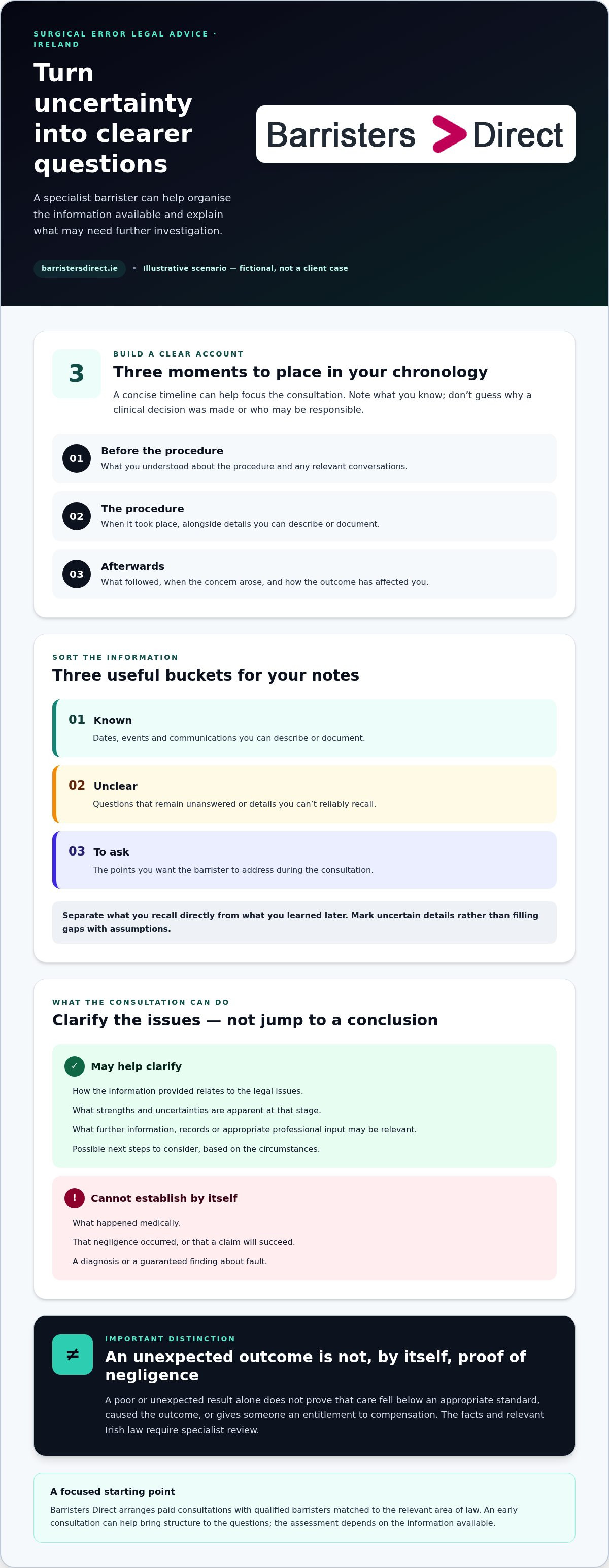
Preparing for surgical error legal advice: a practical consultation checklist
A little preparation can help you use a consultation well, but you don’t need a complete file or a polished account before seeking advice. Missing documents need not prevent you from speaking with a specialist. Focus on setting out what you know, what you’re unsure about and what you want to understand.
Organise records and a concise chronology
Gather relevant material that’s already available, such as letters, messages and medical records relating to the procedure and subsequent care. Keep copies together and separate documents from your own notes. A simple timeline can help the barrister follow events. Mark uncertain dates and details rather than filling gaps with guesses.
Make the consultation focused and useful
Use a short list of questions to guide the discussion. Describe the concern in straightforward language, including its practical effect on your health or day-to-day life. You’re not expected to decide whether anyone was at fault. The aim is to give the barrister a clear account to consider and identify the points on which you need advice.
- 1. Note the sequence of events. Include the procedure, when you first noticed a concern, what happened afterwards and any relevant communications. Add dates only when you know them; label approximate or uncertain details clearly.
- 2. Collect available records. Bring together relevant correspondence and medical documents you already have. Don’t delay seeking advice just because you’re waiting for records or don’t have every document.
- 3. Separate facts from questions. Keep your notes distinct from original documents. Mark what you remember, what a document says and what you don’t know. Avoid assuming why a clinical decision was made.
- 4. Describe the impact. Explain what has changed for you and which aspect of the outcome concerns you most. Clear, everyday language is more useful than trying to apply legal labels.
- 5. Prepare questions. You might ask what the information can establish, what remains uncertain, whether further material could assist and what next steps may be appropriate.
This preparation gives the consultation a practical focus without turning it into a self-assessment of liability. Surgical error legal advice Ireland should be based on the particular facts. A specialist barrister can explain what the information provided may support and what it cannot yet answer.
For an overview of the process, see how a direct barrister consultation works. Barristers Direct arranges paid consultations with qualified barristers matched to the relevant area of law.
From specialist advice to next steps with Barristers Direct
Once you have organised the information you can access, a specialist consultation can help you consider what it may mean and what questions remain. Barristers Direct arranges a paid consultation with a qualified barrister whose expertise matches the legal issue. The consultation can take place online via Zoom, Microsoft Teams or Google Meet, or by telephone. This gives people across Ireland a way to seek early specialist input without assuming what the final answer will be.
What the direct-access consultation is for
The consultation is an opportunity to discuss your circumstances with a barrister and receive case-specific legal advice. You can explain the concern, outline what you know and ask about uncertainties or possible next steps. The quality and relevance of that specialist view matter: the advice will depend on the information provided and the barrister’s assessment of it.
Barristers Direct arranges the consultation; it doesn’t itself provide legal advice or representation, and it can’t guarantee a finding, claim or outcome. The consultation is paid and arranged on payment of the advertised fee. Any advice given is between you and the barrister you’re introduced to. If you choose to explore further work, the terms and professional relationship for that work are agreed directly with the barrister.
Deciding what to do after receiving advice
After the discussion, you may have a clearer understanding of what appears relevant, which issues remain uncertain and what further information or professional input may be appropriate. There isn’t one next step that fits every situation. You can consider the advice and decide how you wish to proceed, without treating an initial view as a guaranteed conclusion or commitment to take a claim forward.
If formal court proceedings or representation are required, a solicitor must be engaged. A solicitor can provide broader client support and work alongside a barrister, whose specialist advice or advocacy may also be relevant. The roles can complement one another as circumstances develop; an initial consultation doesn’t replace solicitor involvement where it is needed.
Seeking surgical error legal advice Ireland can be a way to replace guesswork with a focused legal assessment. If you’re ready to discuss your circumstances with a specialist, arrange access to specialist barrister advice.
Take a considered next step
An unexpected surgical outcome deserves careful consideration, but it doesn’t, on its own, establish that a legal wrong occurred. A specialist barrister can assess the information you provide, explain what remains uncertain and discuss possible next steps without promising a particular finding or result.
A concise timeline, relevant records and questions can help make an early consultation more focused. If you’re considering surgical error legal advice Ireland, remember that early barrister advice and solicitor support can serve different purposes and may complement one another. A solicitor must be engaged if formal court proceedings are required.
Barristers Direct arranges paid consultations with qualified barristers matched to the relevant area of law. Consultations may take place online or by telephone, and the service operates nationally across Ireland. Advice is provided by the barrister, with any further engagement agreed directly between you and that barrister.
If you’re ready to discuss your circumstances with a specialist, arrange access to specialist barrister advice. A clearer understanding of your options can help you decide what to do next, one considered step at a time.
Frequently Asked Questions
Is every surgical error considered medical negligence?
No. An unexpected surgical outcome alone doesn’t establish medical negligence. Whether there may be a legal issue depends on the individual circumstances and requires assessment. In an early consultation, a specialist barrister can discuss the available information, identify uncertainties and explain what may need further consideration. A consultation can’t guarantee a definitive conclusion or predict an outcome, and it can’t determine medical facts on its own.
Can I get surgical error legal advice from a barrister without first instructing a solicitor?
Yes. In Ireland, you can seek an initial consultation with a barrister without first instructing a solicitor. Barristers Direct arranges a paid consultation with a qualified barrister whose expertise matches the legal issue. This early advice is distinct from formal representation. If court proceedings or representation are required, a solicitor must be engaged. The consultation can help clarify possible next steps, but it doesn’t replace solicitor support where needed.
What should I bring to a surgical negligence consultation?
Bring any relevant medical records and correspondence you already have, along with a concise timeline and a list of questions. Note what happened, when you first became concerned and what remains unclear. Keep personal recollections distinct from details shown in documents. You don’t need a complete file before seeking advice, and no particular document should be assumed to be a requirement for an initial consultation.
How can a barrister assess a possible surgical error?
A barrister can consider your account and the materials you provide, then discuss the legal issues they raise, any uncertainties and possible next steps. You can explain what happened, when concerns arose and how the outcome affected you. The consultation is an initial legal assessment, not a medical diagnosis. On its own, it can’t prove negligence, replace medical assessment or guarantee that a claim can be brought or succeed.
Do I need a solicitor if I speak to a barrister about a surgical error?
Not necessarily for an initial barrister consultation, but a solicitor may be needed for broader client support or if formal proceedings or representation are required. Barristers provide specialist legal advice and advocacy, while solicitors maintain direct client contact and support clients across a broad range of legal matters. Their roles can complement each other. Which support is appropriate depends on your circumstances and the stage your matter has reached.
How long do I have to take action after a surgical error in Ireland?
Time limits can depend on the circumstances, so don’t assume a particular deadline applies to your situation. Ask a qualified legal professional familiar with Irish law to assess the relevant facts and explain any time limit that may apply. If you’re concerned about possible action, seek advice promptly rather than relying on a general timeframe. An early consultation can help identify what needs to be checked.
Does an initial barrister consultation guarantee that I can bring a claim?
No. An initial consultation doesn’t guarantee that you can bring a claim, reach a settlement or achieve a particular result. The barrister can give advice based on your circumstances and the information you present, including what appears uncertain or may require further consideration. The consultation can help you understand options and possible next steps, but any further work is a separate matter to discuss directly with the barrister.
Disclaimer
This article does not constitute legal advice. Barristers Direct does not provide legal advice. To obtain legal advice, you should contact a legal practitioner.


