

Does using a path for years mean you have a legal right to cross a neighbour’s land? Not necessarily. The route’s history, the wording of deeds and whether access was used by permission can all affect the answer. This guide to rights of way legal advice Ireland explains what to look at and how to prepare if a disagreement arises.
It can be difficult to work out your position when maps, folios and family accounts appear to tell different stories. A dispute may also risk interrupting access or straining a neighbourly relationship. Long use alone does not settle every question: the route, the purpose of access and the circumstances in which it was used all matter.
This article explains the main concepts and the records and other evidence that may help clarify a claim. It also sets out practical steps to take before a disagreement escalates. Barristers Direct arranges paid consultations with barristers matched to the relevant legal issue. The barrister provides specialist advice on the facts and possible next steps; a solicitor may also be needed if formal proceedings are required.
Key Takeaways
- Understand what a right of way may permit, and why the route and purpose of access matter.
- Gather deeds, folios, maps and historical records that may clarify the position, while recognising that each needs to be read in context.
- Long use alone does not automatically establish a right of way. The circumstances and nature of the use also matter.
- Prepare for a dispute by organising relevant documents and keeping accurate, dated notes of events and communications.
- Before seeking rights of way legal advice Ireland, identify the questions you need answered and organise the evidence a barrister may need to assess.
What is a right of way in Ireland, and what does it allow?
A right of way may allow someone to pass over another person’s land for a defined purpose, such as reaching a property. It does not give the user ownership of the route or an unrestricted right to use the land. To understand what access is claimed, identify the route and the activity it is said to permit.
A right of way is a type of easement: a legal right enjoyed in connection with one property over a separate property. The property that benefits is often called the dominant tenement; the property crossed is the servient tenement. In simple terms, one parcel of land gains a particular access right, while another is subject to it. The term and its Irish context are outlined in Easements in Ireland.
The name given to a route does not resolve a disagreement. Access may be claimed as a legal property right, or it may have been allowed by consent. Deeds, maps, the history and circumstances of use, and other relevant evidence may all need to be considered. If a dispute also forms part of a wider business conflict, specialist input on commercial disputes may be relevant.
How is a right of way different from permission to cross land?
A claimed right of way asserts that access is legally attached to, or benefits, a property. Permission describes access allowed with the landowner’s consent. Simply seeing someone use a track may not make the distinction clear. For example, a landowner might let a neighbour cross a field to reach a shed. That arrangement alone does not establish the legal nature or scope of any right. The facts and documents need to be considered together.
Which properties and routes can be involved?
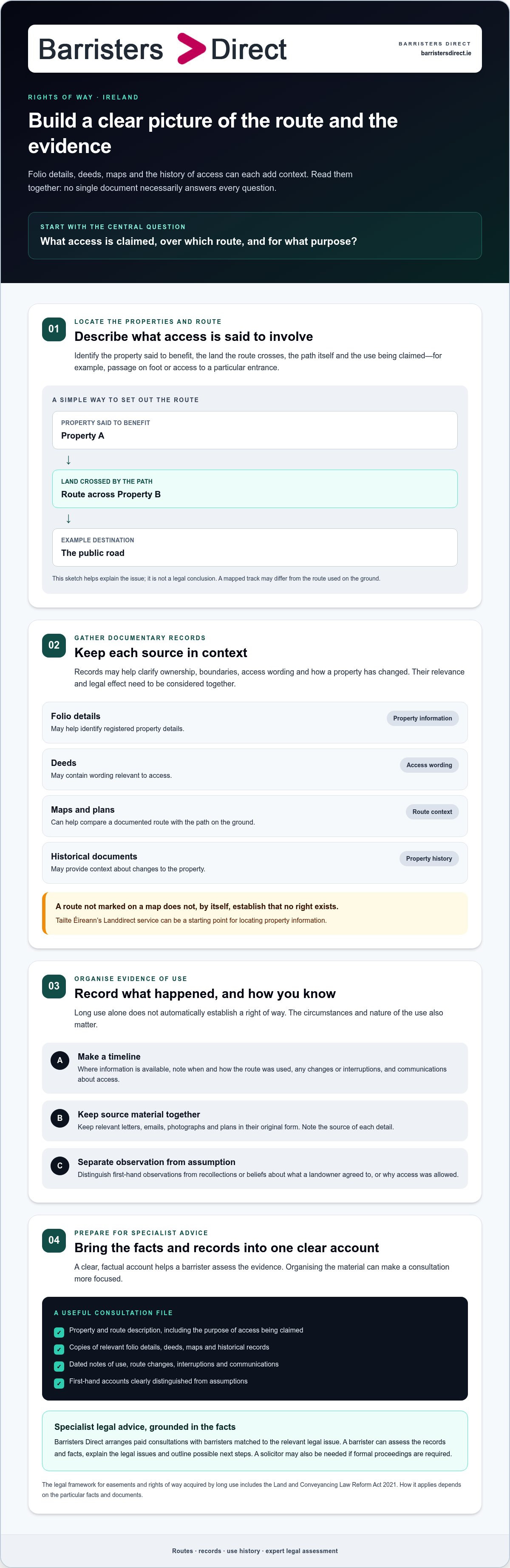
Start by identifying the property said to benefit from access and the land the route crosses. Then describe the path and the use being claimed, such as passage on foot or access to a particular entrance. A simple sketch can help organise the facts: “Property A benefits; the path runs across Property B; the route ends at the public road.” It is a way to explain the issue, not a legal conclusion.
Small differences may matter. A track shown on a map might not match the route used on the ground, and a boundary line alone may not show the purpose of access. Rights of way legal advice Ireland can help clarify the legal issues in context. Barristers Direct arranges a paid consultation with a relevant barrister, who can assess the facts and explain possible next steps. A solicitor may also be required if formal litigation is needed.
How can Irish land records and evidence help clarify a right of way?
Once you have identified the properties and route, gather records that may explain how access was intended to work. Start with the folio details for the lands, then look for relevant deeds, maps and historical documents. These may help establish recorded ownership and boundaries, describe an access right or provide context about changes to the property. No single document necessarily answers every question.
Land records can inform an enquiry, but they do not decide every dispute. A map may help locate a route without explaining the legal right claimed over it. An access right may also need to be considered alongside other records and evidence. The legal framework for easements and rights of way acquired by long use includes the Land and Conveyancing Law Reform Act 2021. How it applies depends on the particular facts and documents.
What can a folio, deed or map tell you?
Tailte Éireann’s Landdirect service can be a starting point for locating property information. A folio may help identify registered property details, while deeds may contain wording relevant to access. Maps can help you compare a documented route with the path on the ground. If a route is not marked, that fact alone does not establish that no right exists. The records and their legal effect need careful interpretation.
Keep documentary material separate from evidence of what happened in practice. A useful file could include copies of relevant records alongside dated letters, emails, photographs or plans. Label the source of each detail and avoid treating an assumption as an established fact.
What evidence of historical use should be organised?
Prepare a timeline, where information is available, showing when and how the route was used, any changes or interruptions, and communications about access. Identify people with first-hand knowledge of what they saw or experienced. Separate those observations from what they believe the landowner agreed to, or why access was allowed. A clear, factual account helps a barrister assess the evidence, but no individual item guarantees a particular outcome.
- Record dates, route changes and interruptions as accurately as possible.
- Keep relevant correspondence, photographs and plans in their original form.
- Label first-hand observations separately from recollections or assumptions.
Organising the material can make a consultation more focused. For rights of way legal advice Ireland, Barristers Direct arranges paid consultations with relevant barristers, who can assess the records and facts. Find out more about arranging a barrister consultation to discuss the issues and possible next steps.
Does long use automatically create a right of way in Ireland?
No. Using a route for a long time does not, by itself, make it a legal right of way. In Ireland, a right may be claimed through prescription, which concerns qualifying use over time. The legal test is technical: under the common law doctrine of lost modern grant, the usual period is 20 years of continuous use “as of right”. That means use without force, secrecy or the landowner’s permission. Different periods may apply to claims involving State land or the foreshore.
Time is only one part of the assessment. The circumstances, nature and continuity of access, the purpose and route used, relevant documents and any evidence of permission may all need to be examined. The Land and Conveyancing Law Reform Act 2021 changed the statutory framework, so older references to the 2009 Act or its registration deadline may not describe the current position. A specific claim needs to be considered against the law and evidence that apply to it.
Repeated use is evidence to assess, not a guarantee that a legal right of way exists.
Why does the history and character of access matter?
The history may help show who used the route, for what purpose, how often, and whether the path or manner of use changed. If a landowner expressly allowed someone to cross, that may be relevant to whether use was “as of right”. No single detail automatically establishes or defeats a claim. For example, regular passage along a track could have different significance depending on the surrounding circumstances and any communications about access.
Can a right of way be challenged or changed?
A disagreement may concern whether a right exists, where it runs, what use it permits, or whether something has interfered with its exercise. These are separate questions. Do not assume a route can be blocked or moved, or that a claimed right has ended, without understanding the legal basis and circumstances. Taking unilateral steps may intensify a neighbour dispute or affect access.
If a claim is disputed, gather the relevant records and evidence before deciding how to respond. A barrister with relevant expertise can assess the facts and explain possible next steps in a paid consultation arranged through Barristers Direct. This provides an opportunity to obtain rights of way legal advice Ireland that is focused on the issue. A solicitor may also be needed if formal litigation is required.
What should you do when a right-of-way dispute arises?
Keep your response measured. First, identify exactly what is disputed: whether access exists, where the route runs, what use is permitted, or whether access has been obstructed. Then organise the relevant records and make a factual note of events. This helps separate the core legal question from assumptions or frustration on either side.
Avoid confrontation and do not take unilateral steps, such as blocking or changing a route, before the legal position has been assessed. Even if you believe your documents support your view, acting without advice could escalate the disagreement or disrupt access. If restrictions are increasing, records conflict, or proceedings are threatened, seek specialist input promptly. Any applicable deadlines or urgent remedies must be checked by a qualified legal professional.
How should you prepare the facts and documents?
Prepare a concise chronology of who used the route, when and for what stated purpose. Record route changes, interruptions, objections and relevant conversations. Include dates where you know them, and mark gaps or uncertainty rather than filling them with guesses.
Gather available deeds, folio information, maps, correspondence, photographs and records of objections. Keep documents in their original context, including messages or letters that may explain what was being discussed. Do not alter or remove material, and distinguish what you witnessed from what someone else told you. This gives a legal professional a more reliable basis for assessing the issue.
When might a disagreement need specialist attention?
Seek advice if access is being restricted, the parties rely on conflicting records, or you receive notice of a proposed legal step. A barrister can assess the facts and documents, explain the legal issues and discuss possible next steps. Barristers Direct arranges paid consultations with relevant barristers, who provide the specialist advice. If formal litigation is needed, a solicitor may also be required and can play an important role in managing the wider legal process.
If the route serves business premises or the disagreement forms part of a wider property conflict, the relevant commercial dispute resolution issues may also need consideration. The right approach depends on the specific facts, so a general account of rights of way cannot settle your position.
Before a consultation, prepare your chronology and records so the specialist can focus on the facts and questions that matter. Learn about arranging a consultation with a relevant barrister to discuss the issue and possible next steps.
How can specialist barrister advice help assess a rights-of-way issue?
A barrister with relevant expertise can consider the route, the properties involved, the documents and the history of access together. That assessment can help clarify which legal questions need answering, what evidence may be significant and what practical next steps could be appropriate. It cannot guarantee a particular conclusion or outcome, but it can give you a focused view of the issues in your circumstances.
Barristers Direct arranges a paid consultation with a relevant barrister. The barrister provides the legal advice; Barristers Direct facilitates the introduction and does not itself advise on the dispute. Consultations may take place online or by telephone. You can use the meeting to explain the facts, raise uncertainties and discuss whether further legal steps may be needed.
What can you prepare before speaking with a barrister?
A short, organised summary helps make the discussion more useful. Bring the documents you have and be clear about what each one does and does not establish. Separate what you know from what you infer, and note any gaps rather than trying to resolve them yourself.
- A concise chronology of access, route changes, objections and relevant communications.
- The specific question you need answered, such as the route claimed or the scope of access.
- Relevant deeds, folio information, maps, correspondence, photographs and other records.
- Questions about the history of use, permission, conflicting documents or discussions with neighbours.
- The outcome you hope to understand, such as whether to respond to a request or how to approach a disagreement.
This preparation gives the barrister a clearer basis for identifying what is established, what remains uncertain and what further information may matter.
Where do barristers and solicitors fit in the process?
Barristers provide specialist legal advice and advocacy. Solicitors often have a broader role in client contact, transactions and managing the wider legal process. The roles can complement one another. If a dispute proceeds to formal litigation, a solicitor may be required; Barristers Direct does not provide representation in court. For a fuller explanation of the respective roles, read the guide to the difference between solicitors and barristers.
For rights of way legal advice Ireland, a specialist barrister’s assessment can help you understand the legal issues before deciding how to proceed. Find out about arranging a paid consultation with a relevant barrister to discuss your documents, concerns and possible next steps.
Clarify the route before deciding your next step
A right-of-way question is best assessed by looking at the route, the properties involved and the history of access together. Deeds, folios, maps and dated evidence can help clarify the picture, but long use alone does not guarantee that a legal right exists. If a disagreement arises, organise the records, keep a factual timeline and avoid steps that could escalate matters until you understand the legal position.
For rights of way legal advice Ireland, specialist barrister input can help you assess the documents, identify unresolved questions and understand possible next steps. Barristers Direct arranges direct access to a paid initial consultation with a barrister matched to the relevant legal issue. The barrister provides the advice; a solicitor may also be needed if formal litigation is required.
Arrange a paid consultation with a relevant barrister to discuss your access concern and understand the issues to consider next.
Frequently Asked Questions
Does using a path for many years automatically give me a right of way in Ireland?
No. Long use alone does not automatically establish a right of way. A prescriptive claim generally requires 20 years of continuous use “as of right”, meaning without force, secrecy or the landowner’s permission. The circumstances, route, nature of use and relevant documents also matter. The Land and Conveyancing Law Reform Act 2021 forms part of the current framework. For rights of way legal advice Ireland, a specialist barrister can assess how the rules may apply to your evidence.
How can I check whether a right of way is recorded against a property?
Start by identifying the property and reviewing its folio and relevant deeds. Tailte Éireann’s Landdirect service can help you locate property information, while deeds may contain wording about access. A map may help identify a route, but it does not necessarily explain the legal scope of a right. Registration of certain rights is now optional, so not finding a route recorded on a folio does not, by itself, prove that no right exists.
Can a landowner block a right of way in Ireland?
Do not assume a landowner can block a route simply because they own the land, or that someone claiming access can insist on using it without dispute. The answer depends on whether a legal right exists, its route and scope, and the circumstances. If access is obstructed or threatened, keep a record of events and seek case-specific legal advice before taking action. Unilateral steps could escalate the disagreement or affect access.
What evidence can help prove or challenge a right of way?
Relevant evidence may include folios, deeds, maps, historical documents, dated correspondence, photographs and first-hand accounts of how the route was used. A chronology can show when access occurred, its purpose, interruptions, route changes and any objections. Separate what a witness directly observed from assumptions about permission or the landowner’s intentions. No single document or account guarantees a conclusion; the evidence needs to be considered together and in context.
Can a right of way be changed or moved?
That depends on the legal basis and circumstances. A disagreement might concern the route itself, the permitted use or whether a proposed change would interfere with the right. Do not assume that either neighbour can move, block or alter a route unilaterally. Before agreeing to a change or acting on one, review the relevant documents and obtain legal advice about the particular right and its possible effect.
Do I need a solicitor or a barrister for a right-of-way dispute?
That depends on what the dispute requires. A barrister can provide specialist legal advice and advocacy, while a solicitor can support broader client needs and manage legal work, including steps connected with formal proceedings. The roles can work together. If litigation is required, a solicitor may be needed. A specialist consultation can help clarify the issues and whether further legal steps or support are appropriate.
Can I get specialist barrister advice about a right of way without first instructing a solicitor?
Yes. Barristers Direct arranges paid initial consultations with a barrister matched to the relevant legal issue, so you can access specialist advice without first instructing a solicitor for that consultation. The barrister provides the advice; Barristers Direct facilitates the introduction. Consultations may take place online or by telephone. If the matter proceeds to formal litigation, a solicitor may be required to support that process.
Disclaimer
This article does not constitute legal advice. Barristers Direct does not provide legal advice. To obtain legal advice, you should contact a legal practitioner.


