

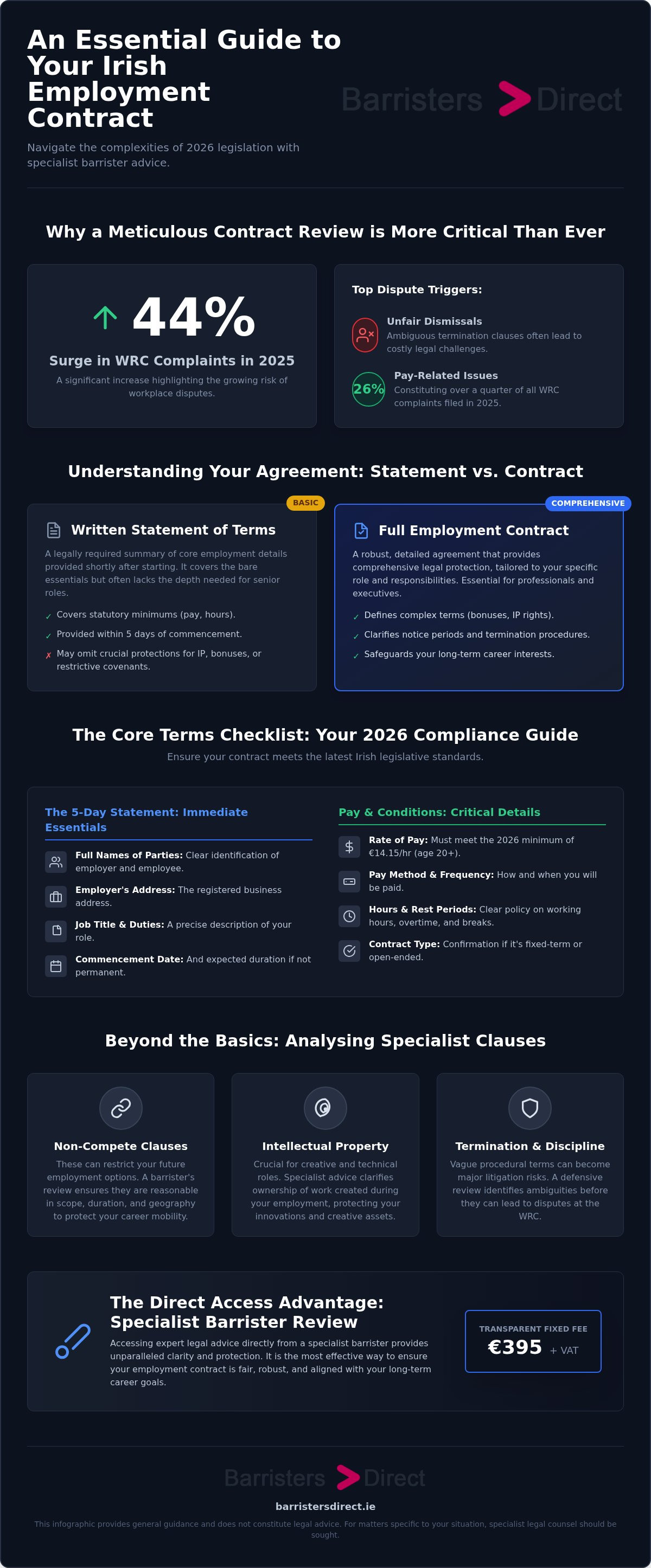
Did you know that Workplace Relations Commission (WRC) complaints surged by 44% in 2025, with pay-related issues and unfair dismissals topping the list? This spike highlights a critical reality: many professionals sign agreements they don't fully understand, only to face complications later. If you're looking for employment contract legal advice Ireland has specific statutory requirements you must consider to safeguard your career trajectory. If you've ever felt overwhelmed by dense terminology or worried about how a non-compete clause might stifle your future moves, you're certainly not alone.
We understand that a contract can feel like a maze of statutory rights and complex obligations. This guide provides a comprehensive review checklist designed to help you evaluate your Irish employment contract through the lens of specialist legal counsel. If you understand the mandatory terms and identify restrictive covenants early, then you can sign with the confidence that your professional interests are fully protected. We'll explore exactly what to look for to ensure your agreement is fair, enforceable, and aligned with the latest 2026 legislative updates, such as the new retirement age protections.
Key Takeaways
- Distinguish between a basic 'Written Statement of Terms' and a comprehensive employment contract to ensure you aren't missing vital legal protections.
- Accessing professional employment contract legal advice Ireland helps you verify that mandatory core terms meet current 2026 legislative standards.
- Identify and negotiate specialist clauses, such as non-compete and intellectual property provisions, to safeguard your future career mobility and creative work.
- Recognise how a barrister's defensive review can spot litigation risks in termination and disciplinary procedures before they lead to costly disputes.
- Learn how to use the direct access model to consult with a specialist barrister for a transparent fixed fee of €395 plus VAT.
The Legal Framework of Employment Contracts in Ireland
In the Irish legal system, an employment contract is formed the moment a candidate accepts a job offer. This agreement doesn't require a physical signature to be enforceable; a verbal acceptance creates a binding relationship. However, while a verbal contract is valid, it's notoriously difficult to prove in a dispute. This is why the Irish employment law framework, specifically the Terms of Employment (Information) Acts, requires employers to provide a written statement of core terms within five days of commencement. This statement covers basic elements like pay and hours, but it's often insufficient for high-level professionals.
If you're entering a senior or technical role, you need more than the statutory minimums. A comprehensive contract safeguards your interests regarding intellectual property, complex bonus structures, and notice periods. Obtaining professional employment contract legal advice ireland allows you to move beyond the basic statement of terms and secure a robust agreement that reflects your seniority and the strategic value you bring to an organisation.
Express vs. Implied Terms
Every contract contains two types of terms: express and implied. Express terms are those specifically discussed and written into your agreement. If your contract defines your salary as a specific figure, that's an express term. Implied terms are different; they're not written down but are legally binding nonetheless. These often stem from custom and practice or the necessity for business efficacy. For example, there's an implied term of mutual trust and confidence in every employment relationship. If a dispute reaches the Workplace Relations Commission, the 'officious bystander' test might be used to determine if a term should be implied because it was so obvious it didn't need to be stated. A barrister can help you identify these hidden obligations before they cause issues.
Fixed-Term vs. Open-Ended Contracts
While most roles are permanent, many professionals work under fixed-term or 'specified purpose' contracts. These agreements have unique requirements and protections. Under Irish law, a fixed-term employee cannot be treated less favourably than a comparable permanent employee. If you've been employed on successive fixed-term contracts for more than four years, you're generally considered to have a contract of indefinite duration, unless your employer can prove objective grounds for another renewal. Seeking employment contract legal advice ireland is essential if you're transitioning between these statuses, as it ensures your service history and statutory rights are fully preserved during the change.
The Core Terms Checklist: Mandatory Requirements for 2026
Precision in your employment agreement isn't just about compliance; it's about clarity. In 2025, the Workplace Relations Commission (WRC) handled over 10,500 complaints, with pay-related issues accounting for 26% of all cases. If you're seeking employment contract legal advice ireland requires a methodical approach to these mandatory elements. Employers who fail to provide these terms risk not only administrative penalties but also significant awards at the WRC if a dispute arises. Ensuring these foundational pillars are correctly documented is the first step in protecting your professional standing.
The Five-Day Statement
Irish law dictates that an employer must provide a written statement of terms of employment within five days of your start date. This document acts as the bedrock of your professional relationship. It must explicitly include the full names of the employer and employee, the registered business address, and the specific job title. Crucially, it must also detail the commencement date and the expected duration if the role is not permanent. Pay details are equally vital; this includes the rate of pay, which must meet the January 2026 national minimum wage of €14.15 per hour for those aged 20 or over, alongside the methods and frequency of payment. If your role involves variable hours or overtime, these policies must be transparent from the outset to avoid future ambiguity regarding rest period entitlements.
The One-Month Statement
Within one month of your start date, you're entitled to a more comprehensive document covering additional statutory requirements. This statement should outline your pension schemes, sick pay policies, and leave entitlements. It's essential to verify that your annual leave and public holiday rights align with current legislation. Notice periods are another critical area; they must be clearly defined for both you and your employer to prevent "at-will" style ambiguity that doesn't exist under Irish law. Under the Employment (Contractual Retirement Ages) Act 2025, which commenced in June 2026, you also have the right to request to continue working until the state pension age of 66, regardless of what a mandatory retirement clause might suggest. If these terms aren't explicitly clear in your documentation, then a specialist review can identify gaps before they lead to friction. Ensuring these details are accurate ensures that both your statutory and contractual rights are fully enforceable from day one.
Specialist Provisions: Protecting Your Career and Intellectual Property
While statutory terms provide a legal floor, specialist provisions define the ceiling of your professional mobility and financial security. For senior executives and technical experts, these clauses are often the most contentious elements of an agreement. If you're seeking employment contract legal advice ireland requires a focus on how these terms impact your ability to move between roles or protect the work you've created. A barrister's perspective is particularly valuable here, as they assess how these clauses would be interpreted in a courtroom rather than just how they look on paper.
Evaluating Restrictive Covenants
Restrictive covenants, such as non-compete and non-solicitation clauses, are only enforceable in Ireland if they pass a strict "reasonableness" test. Irish courts generally view these as a restraint of trade and will strike them down if they're too broad. To be valid, a covenant must protect a legitimate business interest and be limited in duration, geography, and scope of activity. For example, a 12-month non-compete covering the entire EU is rarely enforceable for a mid-level manager, whereas a 6-month restriction focused on a narrow, clearly defined territory might stand. If you're at the offer stage, a barrister can help you negotiate these terms down to a narrower, more reasonable scope that doesn't unfairly stifle your future career.
Confidentiality and 'Garden Leave' provisions also play a strategic role for senior staff. Garden leave allows an employer to keep you out of the market while paying your full salary during your notice period. This protects their trade secrets whilst preventing you from joining a competitor immediately. However, the contract must explicitly grant the employer this right; they cannot imply it. Similarly, Intellectual Property (IP) clauses must be crystal clear. Under Irish law, work created during the course of employment generally belongs to the employer, but "grey areas" often arise regarding work done outside office hours or using personal equipment. Ensuring your contract distinguishes between company IP and your own pre-existing expertise is vital.
Bonus and Commission Structures
Remuneration often extends far beyond a base salary, yet bonus and commission structures are frequently left to "management discretion." This ambiguity is a common trigger for disputes. You must distinguish between purely discretionary bonuses, which an employer can withhold without reason, and contractual schemes where payment is guaranteed if specific KPIs are met. Sales professionals, in particular, should look for "clawback" clauses that might force them to return commissions if a client cancels a contract months later. For a definitive review of these complex financial terms, you may wish to seek an Expert Employment Law Consultation to ensure your hard-earned incentives are legally protected.
Finally, pay close attention to probationary period clauses. In Ireland, these periods typically last between three and six months. While they allow for a shorter notice period, they don't grant an employer a "free pass" to ignore fair procedures. Even during probation, you're entitled to certain statutory protections, and an overly long probationary period (exceeding 12 months) may be legally questionable under the latest EU-derived regulations in Ireland.
The Barrister's Review: Identifying Litigation Risks and Ambiguities
A contract is more than a list of duties; it's a defensive shield against future disputes. In 2025, the Workplace Relations Commission (WRC) saw complaint applications rise by 44%, reaching a total of 10,559 cases. This surge suggests that many workplace relationships fail because of poorly defined terms. When you seek employment contract legal advice ireland requires a review that goes beyond statutory minimums to identify strategic vulnerabilities. A barrister doesn't just read what's there; they look for what's missing or what could be exploited in a courtroom.
The review process follows five critical steps to ensure your protection:
- Step 1: Termination Clauses. We analyse these for unfair dismissal triggers. With unfair dismissal making up 17% of WRC complaints in 2025, ensuring these clauses respect natural justice is vital.
- Step 2: Disciplinary Procedures. These must be WRC-compliant. If a procedure lacks a clear grievance path, then any subsequent disciplinary action may be deemed procedurally unfair.
- Step 3: Variation Clauses. Employers often include "right to vary" terms. However, they cannot unilaterally change core terms like pay or hours without your written agreement.
- Step 4: Entire Agreement Clauses. These state that only what's written in the contract counts. If you were promised a specific bonus or remote work flexibility during your interview, it won't be enforceable unless it's in the final document.
- Step 5: Jurisdiction. For international or remote roles, it's essential to specify the choice of law. We ensure that any arbitration or dispute resolution is centred in Dublin, Ireland, to protect your statutory rights under Irish law.
Courtroom-Tested Clauses
While solicitors play an indispensable role in the transactional drafting of agreements, barristers bring a unique advocacy-led perspective. Because barristers regularly argue these cases before the WRC and the Labour Court, they're uniquely positioned to spot "weak" language that an employer might use to justify a breach. Understanding the difference between solicitors and barristers helps you recognise why a litigation-focused review is a necessary safeguard for senior professionals.
Pre-Emptive Triage
Early specialist advice acts as a form of "legal triage." In 2025, the WRC conducted 5,145 inspections and found breaches of employment law in 1,775 cases. Identifying "red flag" clauses before you sign prevents these breaches from escalating into formal litigation. A strategic review provides a clear path forward, allowing you to address ambiguities whilst the relationship is still in the "honeymoon" phase. If a contractual dispute does escalate beyond the initial review stage, understanding your options for workplace dispute legal advice becomes essential to protecting your position before the WRC. If you want to ensure your agreement is litigation-proof, you can consult a specialist barrister to assess your contract's strength today.
Securing Specialist Advice: The Direct Access Advantage
Traditionally, accessing a barrister's expertise required a formal referral from a solicitor. While solicitors remain essential for managing litigation and complex procedural filings, the Legal Services Regulation Act has modernised the way professionals seek advisory services. If you require expert employment contract legal advice ireland now offers a direct pathway to specialist counsel. This direct access model strips away traditional layers of complexity, allowing you to consult with a specialist barrister who possesses deep experience in the Irish workplace relations system. It represents a shift towards a more transparent, solution-oriented approach to legal services.
Precision and transparency are at the core of this modern framework. We facilitate access to a network of over 100 independent barristers for a transparent fixed fee of €395 plus VAT. This model ensures that you receive the highest standard of legal expertise without the ambiguity often associated with billable hours for an initial review. It acts as a strategic triage service where a specialist assesses your contract's strength and identifies potential pitfalls before you commit to a new role. By prioritising high-level expertise, you can ensure that your professional interests are protected by the same individuals who argue these points in court.
The Consultation Process
Efficiency is vital for busy professionals. Your consultation takes place via Zoom, Teams, or telephone, fitting seamlessly into a demanding schedule. One of the primary advantages of instructing a barrister directly is the clarity provided by the digital process. You'll receive an automatically generated recording and a concise synopsis of the meeting for your records. This documentation serves as a vital reference point, ensuring you retain every strategic nuance discussed during the review. If you're comparing a new offer against your current obligations, then having a recorded expert opinion provides the certainty needed to make an informed decision.
Moving Forward with Confidence
Once the consultation concludes, there is no further obligation. You are equipped with a barrister's independent opinion, which you can use to negotiate better terms or clarify your obligations before signing. If the review identifies a significant breach or if the situation evolves into a formal dispute, the barrister's early assessment provides a solid foundation. In such instances, you can transition to a solicitor with a clear understanding of your legal standing, and developing a robust legal strategy for employment disputes in Ireland becomes the critical next step. This collaborative ecosystem ensures that you have the right level of expertise at every stage. You can move forward with the confidence that your contract is not just a formality, but a robustly reviewed professional asset.
Securing Your Professional Future
Your employment contract is a strategic asset. Ensuring your agreement meets the 2026 statutory standards whilst protecting your intellectual property requires more than a cursory glance. If you've identified potential litigation risks or restrictive covenants, then obtaining specialist employment contract legal advice ireland is the most effective way to gain clarity. A barrister's review provides a defensive shield, identifying ambiguities that could lead to future disputes before the Workplace Relations Commission.
You don't have to navigate these complex legal frameworks alone. Through our platform, you can access expert advice from independent sole practitioners who specialise in Irish employment law. We offer a transparent, fixed-fee consultation at €395 plus VAT, providing you with high-level strategic intelligence. To ensure you have a permanent record of the advice, an AI-generated synopsis is provided after every meeting.
Book a fixed-fee consultation with a specialist employment barrister today and sign your next agreement with total confidence. Your career deserves the protection of elite legal expertise.
Frequently Asked Questions
Do I need a written contract of employment in Ireland?
Yes, Irish law requires your employer to provide a written statement of core terms within five days of starting your role. A more comprehensive statement must follow within one month. While a verbal agreement is technically a binding contract, the statutory requirement for written documentation is absolute. This ensures both parties understand their specific obligations regarding pay, working hours, and job duties from the very beginning of the relationship.
Can my employer change my contract terms without my consent?
No, an employer cannot unilaterally change core terms like your salary, hours, or job description. Any significant variation generally requires your written agreement. If an employer attempts to force a change without your consent, it might constitute a breach of contract or lead to a claim for constructive dismissal. You should seek expert employment contract legal advice ireland to evaluate your options if your employer proposes unwanted changes.
What is the difference between a barrister and a solicitor for contract advice?
Solicitors are legal advisers who handle direct client contact and transactional work, such as drafting wills or managing property sales. Barristers are independent sole practitioners who specialise in courtroom advocacy and providing high-level opinions on complex legal problems. Think of a solicitor as a General Practitioner and a barrister as a specialist who provides a strategic, litigation-focused view of your contract based on how it would perform in court.
Are non-compete clauses actually enforceable in Irish law?
Non-compete clauses are enforceable only if they pass a strict test of reasonableness. They must protect a legitimate business interest and be limited in duration, geographical reach, and the scope of activities restricted. If a clause is too broad, such as a multi-year ban across an entire industry, Irish courts will likely strike it down as an unlawful restraint of trade. A barrister can assess if your specific clause is enforceable.
What should I do if my employer hasn't provided a written statement of terms?
You should first request the document in writing from your HR department or manager to ensure there is a record of your request. If they still fail to provide the statement within the statutory timelines, you can lodge a formal complaint with the Workplace Relations Commission. Employers can be ordered to pay compensation for failing to provide these mandatory documents, which are foundational to your statutory employment rights in Ireland.
How much does a specialist legal consultation for a contract review cost?
Through Barristers Direct, a consultation with a specialist barrister costs a fixed fee of €395 plus VAT. This flat-fee model provides total transparency and ensures you receive the highest standard of advice from a specialist without the uncertainty of traditional hourly billing. If the matter is contentious and requires a solicitor to also attend, the fee is €595 plus VAT. There is no further obligation after the initial meeting.
Can a barrister represent me directly in the Workplace Relations Commission (WRC)?
A barrister provides expert advice and strategic direction during a consultation, but a solicitor must be engaged if formal legal proceedings are initiated. While the Legal Services Regulation Act allows you to consult a barrister directly for advice, full representation in contentious WRC matters requires a two-professional model. This collaborative approach ensures you have the right level of expertise and representation for every stage of a workplace dispute legal advice situation or litigation.
What are 'implied terms' in an employment contract?
Implied terms are legally binding obligations that aren't explicitly written in your contract but exist by law, custom, or practice. Common examples include the mutual duty of trust and confidence and the requirement for a safe working environment. These terms can be as powerful as written clauses in a dispute. Obtaining employment contract legal advice ireland helps you understand these invisible duties that govern your day-to-day professional relationship and career security.
Disclaimer
This article does not constitute legal advice. Barristers Direct does not provide legal advice. To obtain legal advice, you should contact a legal practitioner.


