

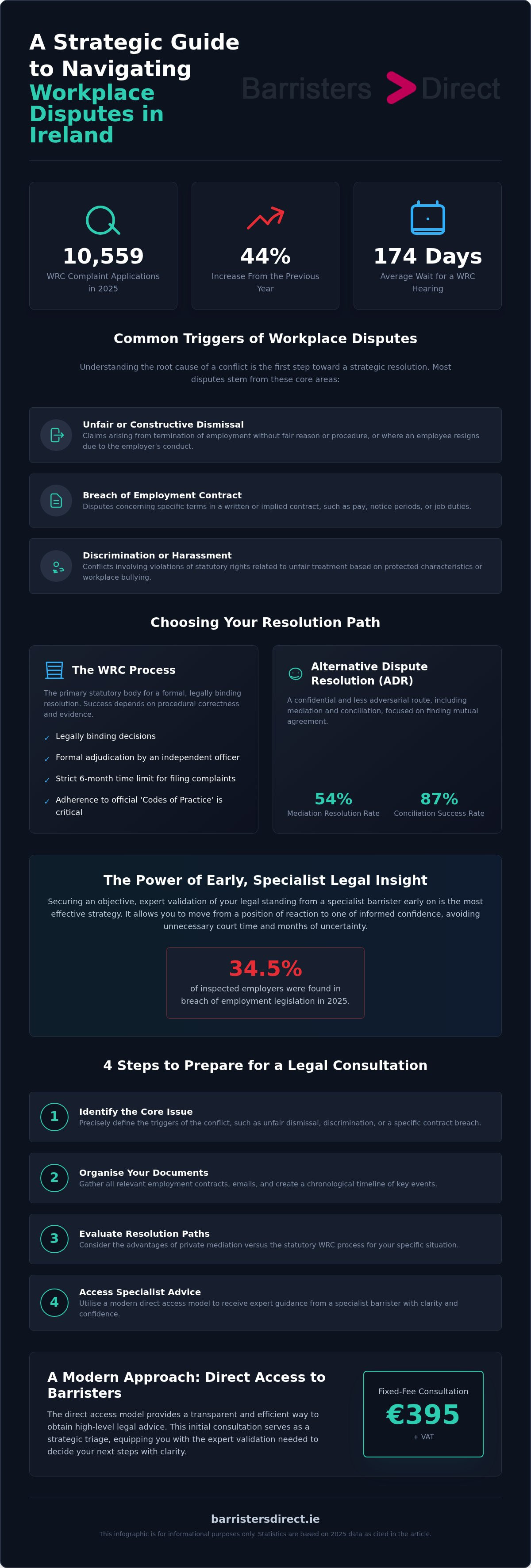
With 10,559 complaint applications submitted to the Workplace Relations Commission in 2025, representing a 44% increase from the previous year, the Irish employment landscape is more volatile than ever. If you find yourself caught in a conflict, the need for precise workplace dispute legal advice becomes urgent. You're likely facing the dual pressure of protecting your position whilst trying to decipher complex legislation that often feels designed to confuse. It's understandable to worry about escalating costs or the possibility of a dispute spiralling into a lengthy, public hearing.
We believe that clarity is the most powerful tool in any legal conflict. This guide explains how to strategically navigate these challenges by accessing the specialist expertise of independent barristers. By securing an objective, expert validation of your legal standing early on, you can avoid unnecessary court time and establish a clear path forward. We'll explore the latest 2026 regulatory updates, including the 10.4% interest rate on unpaid awards, and explain how a direct access model provides the strategic intelligence required to resolve disputes with confidence.
Key Takeaways
- Identify the specific triggers of your conflict, such as unfair dismissal or discrimination, to establish a precise foundation for your legal position.
- Evaluate the advantages of private mediation against the statutory WRC process to find a resolution path that avoids unnecessary court time.
- Access specialist workplace dispute legal advice to receive an objective, expert validation of your standing from an independent barrister.
- Organise your employment contracts and a chronological timeline of events to ensure your legal consultation is both efficient and strategically focused.
- Utilise a modern direct access model to secure expert guidance through a fixed-fee consultation for €395 plus VAT, ensuring transparency and clarity.
Workplace Dispute Legal Advice: Assessing Your Situation
A workplace dispute is a fundamental conflict between an employer and employee regarding their respective rights or obligations that requires a precise, objective legal assessment to resolve effectively. These conflicts typically stem from specific triggers that disrupt the professional relationship:
- Unfair dismissal or constructive dismissal claims.
- Breaches of written or implied employment contracts.
- Discrimination or harassment amongst colleagues.
When these issues arise, obtaining expert workplace dispute legal advice early is the most effective way to prevent a situation from escalating into a protracted Workplace Relations Commission (WRC) hearing. With the average waiting time for a hearing reaching 174 days in 2025, a strategic assessment can save months of uncertainty and prevent the entrenchment of opposing positions.
Identifying the Nature of Your Conflict
Understanding whether your issue is a breach of contract or a violation of statutory rights is the first step toward resolution. Contractual disputes often involve specific terms regarding pay or notice periods, whilst statutory violations concern rights granted by the Employment Law framework in Ireland, such as protection against discrimination or unfair treatment. Your behaviour throughout the initial stages of a conflict significantly impacts your legal standing; actions taken without guidance can inadvertently weaken a strong case. By examining various dispute resolution methods, you can determine if your conflict is best suited for internal grievance procedures, private mediation, or formal adjudication.
The Cost of Delayed Legal Insight
Allowing a dispute to remain unresolved creates a mounting emotional and financial toll. For employees, the uncertainty of their professional future can be overwhelming. For businesses, unaddressed conflicts often lead to significant reputational damage and internal disruption. In 2025, the WRC Inspectorate found that approximately 34.5% of inspected employers were in breach of employment legislation, highlighting the high risk of non-compliance. Securing workplace dispute legal advice through a direct access model offers a modern solution for those seeking early stage clarity. This approach serves as a strategic triage, providing the high level expertise needed to validate your position before significant damages accumulate. Securing this insight allows you to move from a position of reaction to one of informed strategy.
Navigating Resolution Paths: The WRC vs. Alternative Dispute Resolution
Choosing the right resolution path is a tactical decision that dictates the speed, privacy, and cost of your outcome. Whilst the Workplace Relations Commission (WRC) serves as the primary statutory body for employment conflicts, it's not the only route. Many parties find that strategic negotiation or mediation offers a more controlled environment for resolution. Before committing to a specific course of action, securing workplace dispute legal advice is essential to evaluate the strength of your position. If the matter escalates to formal legal proceedings or litigation, you'll need to engage a solicitor to manage the case and instruct counsel.
The Workplace Relations Commission (WRC) Process
The WRC adjudication process is a formal mechanism where an independent officer hears evidence and issues a legally binding decision. Success here often depends on strict adherence to 'Codes of Practice', which are the benchmarks the WRC uses to determine if an employer's actions were fair and procedurally sound. You must act quickly; the statute of limitations for filing a complaint is strictly six months from the date of the alleged breach. Whilst this can be extended to twelve months for 'reasonable cause', this standard is applied rigorously. Understanding these procedural hurdles is a core part of an effective employment law strategy.
Benefits of Alternative Dispute Resolution (ADR)
Alternative Dispute Resolution, particularly mediation, offers a confidential and less adversarial environment than a public hearing. In 2025, the WRC's pre-adjudication mediation service achieved a 54% resolution rate, whilst conciliation for collective disputes saw an impressive 87% success rate. These methods allow parties to preserve professional relationships that might otherwise be destroyed in an open forum. Accessing specialist workplace dispute legal advice allows you to identify the core legal issues and facilitates a faster settlement by highlighting the risks of proceeding to a full hearing. An independent barrister's objective view provides the 'triage' necessary to encourage both sides to reach a pragmatic agreement without the need for public exposure. If you're weighing these options, a specialist consultation can help you determine the most efficient path forward.
Preparing for a Legal Consultation: A Step-by-Step Guide
A barrister's expertise is sharpest when applied to a clear, well-organised set of facts. To ensure you receive the most precise workplace dispute legal advice, you must bridge the gap between your lived experience of the conflict and the legal reality of the case. Preparation isn't just about gathering papers; it's about providing the high-level 'triage' information that allows a specialist to validate your position quickly and effectively.
Start by gathering these essential components before your consultation:
- Employment Contracts and Handbooks: These documents form the legal foundation of your relationship and dictate the procedures that should have been followed.
- A Chronological Timeline: Draft a simple list of events by date. This ensures the barrister can review the case logic without having to cross-reference multiple documents.
- Written Correspondence: Include all relevant emails, letters, and internal messages regarding the dispute.
- Specific Questions: Prepare a list of concerns regarding your rights, the strength of your evidence, and the potential outcomes.
Documenting Evidence and Correspondence
You should keep meticulous records of every interaction related to the conflict, including meeting notes and witness statements. Contemporaneous notes, written immediately after an event occurs, are often a barrister's favourite piece of evidence because they carry significant weight in a legal setting. They provide a reliable record of what was said and done before memories fade or positions become defensive. If your dispute involves specific terms of your engagement, seeking Employment Contract Legal Advice is often a necessary prerequisite to understanding which clauses have been breached. Having these documents ready allows the barrister to focus on strategy rather than discovery.
Defining Your Objectives
Before your meeting, you must identify exactly what a successful resolution looks like to you. Objectives vary significantly; some individuals seek a formal apology or a change in workplace policy, whilst others require a financial settlement or reinstatement to their role. Clear objectives allow a barrister to provide a more precise strategic path forward. It's vital to remember that a specialist barrister provides an objective, independent view. This means their expert validation of your legal standing might differ from your initial preferences. However, this transparency is exactly what makes the advice valuable. It prevents you from pursuing a path that lacks legal merit and helps you focus on achievable outcomes that avoid unnecessary court time. Securing this level of workplace dispute legal advice ensures that your strategy is built on reality rather than emotion.
The Strategic Role of a Specialist Barrister in Workplace Conflicts
In the legal system, a specialist barrister operates much like a medical consultant. Whilst a general practitioner provides essential broad care, a consultant is called upon for their deep expertise in a specific, complex field. When you seek workplace dispute legal advice, a barrister provides that same level of high-level diagnostic insight. They specialise in courtroom advocacy and providing detailed opinions on intricate legal problems that require a specialist's eye. This level of expertise ensures that your strategy is built on a foundation of legal precision rather than guesswork.
Independent and Objective Specialist Advice
Every barrister in Ireland is an independent sole practitioner. This independence is a critical advantage; it ensures that the advice you receive is entirely objective and free from the institutional biases that can sometimes affect larger organisations. Because they aren't employees of a firm or public authority, their primary duty is to the law and their strict code of professional ethics. This allows them to provide a 'cold' assessment of the facts, which is vital when emotions run high in a workplace conflict.
This independence makes them ideal for 'triaging' a case. A barrister can look at your evidence and provide an expert validation of your legal position. If your case is weak, they'll tell you early, potentially saving you from a costly and unsuccessful WRC hearing. If it's strong, they'll provide the strategic intelligence needed to leverage that strength in negotiations. This objective view is often the difference between a failed grievance and a successful resolution. It's important to understand the difference between solicitors and barristers to appreciate how these roles complement each other. Solicitors provide the essential framework for case management, whilst barristers offer the deep-dive analysis required for complex disputes.
The Advantage of Direct Access
The Legal Services Regulation Act has modernised how the public interacts with the legal profession. It allows individuals and businesses to engage barristers directly for legal advice without always needing a referral. This Direct Access model significantly speeds up the process of obtaining an expert opinion, allowing for a faster 'triage' of employment matters. In a landscape where WRC complaint volumes increased by 44% in 2025, having immediate access to high-level counsel is a distinct strategic advantage.
Whilst barristers provide the strategic advice and advocacy, solicitors remain vital for managing client monies, handling transactional formalities, and conducting formal litigation. This partnership ensures you have the right expert for every stage of your dispute. By engaging a specialist barrister at the outset, you're not just getting an opinion; you're securing a strategic partner who understands how the WRC and the courts view your specific conflict. If you're ready to secure this level of expertise, you can arrange a consultation with a specialist barrister today.
Accessing Expert Counsel: How the Barristers Direct Service Works
Barristers Direct provides an efficient mechanism for individuals and businesses to connect with a network of over 100 specialist barristers. If you find yourself in need of workplace dispute legal advice, the platform simplifies the process of securing an expert opinion. After you submit your initial query, you are matched with a barrister whose expertise aligns with the specific nature of your conflict, whether that involves discrimination, contract disputes, or unfair dismissal. This matching process ensures that the advice you receive is of the highest standard, provided by a professional who understands the nuances of current Irish employment legislation.
The consultation is designed to be as accessible and efficient as possible. Meetings are conducted via Zoom, Teams, Google Meet, or telephone, depending on your preference. To ensure you have a clear record of the strategic path discussed, a recording and an AI-generated synopsis are provided after the meeting. These materials are confidential and are shared only with you and the barrister; they serve as a vital reference point as you move forward with your case.
Transparent Fixed-Fee Consultations
Clarity regarding costs is a cornerstone of the service. A barrister-only consultation is available for a fixed fee of €395 plus VAT. In situations where the matter is contentious and requires the presence of a solicitor, the fee is €595 plus VAT. This fixed-fee model allows you to access elite legal expertise without the uncertainty often associated with traditional billing methods. There is no obligation to continue the engagement after the initial consultation. If you decide that further work is required, such as drafting formal documents or providing a written opinion, any additional fees are agreed directly between you and the barrister. This ensures that you remain in control of the process at every stage.
Next Steps and Solicitor Referrals
Whilst the initial consultation provides the strategic triage needed to understand your position, some disputes may eventually require formal litigation. If your case moves into a phase that necessitates direct representation in court or the management of client funds, your barrister will recommend that you engage a solicitor. Solicitors play an indispensable role in managing the transactional and formal procedural elements of a legal claim. It is important to understand that Barristers Direct facilitates the introduction to independent counsel; the platform itself does not provide legal advice. For further queries or to begin the process of securing expert counsel, you can reach out via email at [email protected] to take the first step toward a clear resolution.
Securing Your Strategic Path to Resolution
Strategic triage is the essential first step in managing any employment conflict effectively. By distinguishing between statutory rights and contractual obligations at the outset, you position yourself for a more efficient and predictable outcome. The objective validation of your legal standing is the most critical asset you can hold, whether you're preparing for a WRC hearing or pursuing private mediation. Securing expert workplace dispute legal advice early prevents the escalation of costs and ensures your strategy is built on professional precision rather than emotional reaction.
Through our platform, you can access a network of over 100 specialist barristers for a transparent, fixed-fee consultation of €395 or €595 plus VAT. These secure online meetings provide the high-level expertise needed to resolve complex matters without unnecessary delays. Every consultation includes an AI-generated summary and transcript, giving you a clear roadmap for your next steps. If you're ready to move from uncertainty to a defined strategy, you can Book a Fixed-Fee Consultation with a Specialist Barrister today. Taking control of your situation starts with the right expert insight.
Frequently Asked Questions
Can I get legal advice on a workplace dispute without a solicitor?
Yes, you can receive workplace dispute legal advice directly from a barrister without first engaging a solicitor. This direct access model is permitted under the Legal Services Regulation Act, allowing individuals and businesses to seek specialist expertise for initial consultations. Whilst a solicitor is required for formal litigation and managing client funds, a barrister provides the strategic triage needed to assess your case's strength at an early stage.
How much does it cost to consult a barrister directly in Ireland?
The cost for a consultation through our platform is fixed at €395 plus VAT for a meeting with a specialist barrister. If the matter is contentious and requires a solicitor to attend, the fee is €595 plus VAT. This transparent pricing ensures you know the exact cost before the meeting occurs. After this initial session, there's no obligation to continue, and any further work is agreed directly with the barrister.
What is the difference between a barrister and a solicitor in employment law?
Solicitors and barristers play complementary roles in the Irish legal system. A solicitor typically manages the overall case, handles transactional matters, and can hold client monies. In contrast, a barrister is an independent sole practitioner who specialises in courtroom advocacy and providing detailed legal opinions. Think of a solicitor as a General Practitioner who may refer you to a barrister, the medical specialist, for specific, high-level expertise during complex workplace conflicts.
Is a barrister's opinion legally binding in a workplace dispute?
A barrister's opinion is an expert assessment of your legal position, but it isn't legally binding like a court order or a WRC adjudication. It serves as a strategic guide to help you understand the merits of your case and the likely outcome of litigation. This expert validation allows you to make informed decisions about whether to settle, pursue mediation, or proceed with formal legal action based on current legislation and precedents.
What happens if my workplace dispute needs to go to the WRC?
If your dispute proceeds to the Workplace Relations Commission, you must file a complaint within six months of the incident. The process involves an adjudication hearing where an officer issues a binding decision. Given that the average wait time for a hearing reached 174 days in 2025, obtaining employment dispute legal advice in Ireland early is vital. A barrister can help you prepare your arguments and evidence to ensure you're positioned for a clear path forward.
Can I use a recording of a legal consultation in court?
No, the automatically generated recording and AI synopsis provided after your consultation are for the private use of the user and the barrister only. These materials are not intended for use as evidence in court or WRC proceedings. Their purpose is to ensure you have a clear, accurate record of the advice given and the strategic path forward discussed during your meeting, allowing you to review complex details at your own convenience.
How do I know which barrister is right for my specific workplace problem?
Our platform facilitates the matching process by reviewing the details of your conflict and introducing you to a barrister with specific expertise in that area of employment law. With a network of over 100 specialist barristers, we ensure you're paired with a professional who has deep experience in cases similar to yours. This matching service removes the uncertainty of finding a specialist and ensures your consultation focuses on high-level strategic triage from the start.
What if I need to sue for breach of a verbal employment contract?
Verbal employment contracts are legally valid in Ireland, though proving their terms can be more challenging than written agreements. If you believe a breach has occurred, a barrister can assess the strength of your claim by reviewing supporting evidence, such as contemporaneous notes, emails, or witness statements. This expert review helps determine if there's a viable case to pursue and identifies the most effective resolution path to secure your rights without unnecessary court time. For a broader understanding of how to approach such claims, reviewing a comprehensive legal strategy for employment disputes in Ireland can provide valuable context before your consultation.
Disclaimer
This article does not constitute legal advice. Barristers Direct does not provide legal advice. To obtain legal advice, you should contact a legal practitioner.


