

A claim has no single settlement timetable. How long it takes depends on factors such as whether liability is disputed, how much evidence is needed and whether the medical position is clear. A legal expert can assess the legal and evidential issues, explain what may affect progress and discuss practical next steps, but cannot promise a settlement date.
It is understandable to want a clear timeframe when a claim affects your health, finances or business. Progress depends on the facts of the case, not simply on how quickly paperwork is submitted.
This guide explains how barristers provide specialist legal expertise in Ireland, what a consultation can help you understand and which factors may influence settlement time. It also clarifies the role of an expert witness, so you can distinguish specialist legal advice from expert evidence given to a court.
Key Takeaways
- Settlement time depends on the case’s evidence, whether liability is disputed and how clearly the losses can be assessed.
- A specialist barrister can analyse the legal issues and explain the strengths, risks and practical options in your case.
- A consultation can help you understand the next steps and what information may be needed to move a claim forward.
- Legal costs depend on the work involved, the complexity of the issues and the evidence required.
- For business disputes, direct access to specialist counsel can provide focused advice on your position and possible routes to resolution.
Barristers and specialist legal expertise
A barrister’s specialist knowledge can clarify how Irish law applies to a particular dispute, transaction or claim. Barristers advise on legal issues, assess evidence and can prepare written opinions or reports. Solicitors also provide legal advice and play an important role in managing a client’s wider legal needs. Depending on the matter, they may work together, each contributing different expertise.
The distinction between roles is practical, not a measure of importance. A solicitor may coordinate documents, communications and case administration, while a barrister can provide focused analysis of a complex legal point. For example, a landlord facing a disputed tenancy issue may need advice on the relevant legal arguments and the evidence supporting them. Understanding the difference between solicitors and barristers helps you identify the kind of advice your situation calls for.
A specialist barrister can examine the facts, identify gaps and explain possible ways forward. In a debt dispute, this could mean reviewing the agreement, payment records and correspondence, then explaining which points may matter legally. For a will or probate issue, the relevant documents and the specific dispute shape the advice. The value comes from applying legal knowledge to your circumstances, rather than relying on a general description of the law.
Expert witnesses have a different role. They provide specialist evidence to assist the court, rather than advocate for the party who retained them. In Ireland, an expert witness should be independent and has a primary obligation to the court. The judge decides whether a witness qualifies as an expert; a formal qualification is not an absolute requirement.
The Court of Appeal decision in Duffy v Brendan McGee highlighted expert witnesses’ duties and responsibilities in Ireland in 2022. An expert’s opinion should identify its factual basis and assumptions. Any underlying facts must be proved or explicitly described as assumed. If the available information cannot support a sound opinion, the expert should disclose that limitation instead of presenting an unsupported conclusion.
That independence matters because expert evidence can affect how a court assesses a disputed issue. For example, a specialist report may explain a technical matter beyond ordinary knowledge. The report must still show how its reasoning follows from the evidence. A court can assess the method, assumptions and limitations, rather than treating an expert’s conclusion as automatically decisive.
In criminal proceedings, the Criminal Procedure Act 2010 makes provision for pre-trial disclosure of defence expert evidence. The defence must give written notice of its intention to call an expert witness or adduce expert evidence at least 10 days before the scheduled start of the trial. The notice must include:
- The expert witness’s name and address.
- A relevant report or a summary of the expert’s findings.
The defence must obtain the court’s leave before calling the witness or adducing the evidence. The court must hear the prosecution on the application. If leave is granted, the prosecution must have a reasonable opportunity to consider the report or summary before the evidence is given. The court may allow the evidence without the required report or summary if the accused took all reasonable steps to obtain it before giving notice.
These requirements show why legal advice and expert evidence should not be confused. A barrister advises a client on legal rights, risks and strategy. An expert witness provides an independent opinion on specialist matters for the court. If a case relies on technical evidence, identify the precise issue, gather relevant records and discuss how that evidence relates to the legal questions with a suitably specialist lawyer.
Legal advice and consultations
A consultation can turn a specific legal concern into a clearer set of decisions. In Ireland, a client can ask a barrister to assess the law, available evidence and practical options. The discussion should focus on your facts, not just general legal principles. For example, a disagreement over unpaid invoices raises different questions from a dispute about medical treatment or a will.
Before the meeting, define the decision you need help making. You might need to understand your legal position, assess a proposed settlement or decide what evidence to gather. A legal expert can explain how the relevant rules apply to the facts you provide. The consultation is most useful when you explain what happened, what outcome you seek and what deadlines or events are approaching.
Prepare a short chronology, then collect documents linked to each event. In a debt dispute, these could include an agreement, invoices, payment records and messages about repayment. For a medical negligence concern, relevant records and a clear account of the treatment and its effects help frame the questions. Keep originals safe and organise copies by date. If someone witnessed an important event, note what they observed.
A focused meeting can address questions such as:
- Which legal issues arise from these facts?
- What evidence supports or weakens each point?
- What additional records or reports could clarify the position?
- Which practical steps could move the matter forward?
- What risks or consequences should inform the next decision?
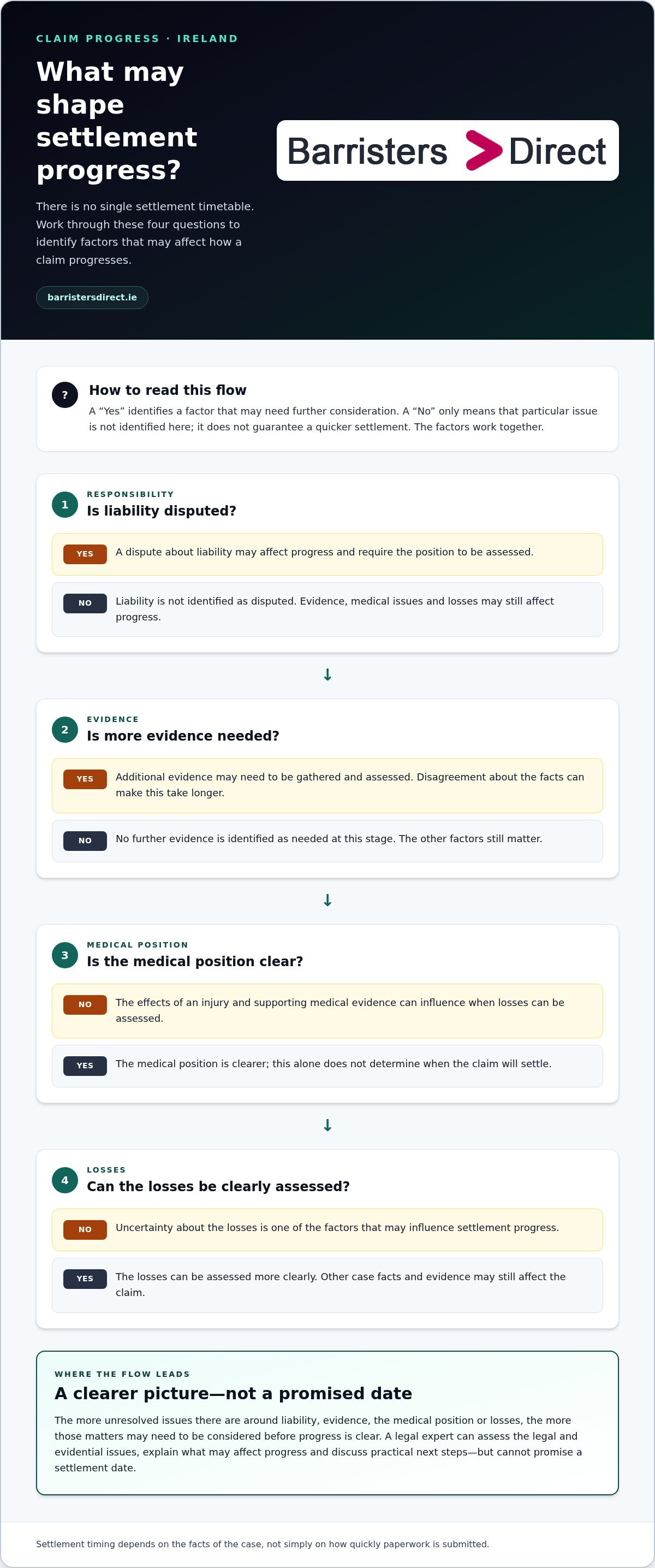
These questions help distinguish legal advice from a prediction. Counsel can analyse the strength of an argument and explain the factors that affect it. For example, a claim’s progress can depend on whether responsibility is disputed, whether key records are available and whether medical evidence is needed. If the parties disagree about the facts, gathering and assessing evidence can take longer than resolving a matter with clear documentation.
Settlement timing also depends on what must happen before the parties can assess the claim. In a personal injury matter, the effects of an injury and the supporting medical evidence can influence when losses are understood. In an employment dispute, correspondence, workplace records and the parties’ positions may shape discussions. A consultation can identify these factors and explain which are likely to matter in your circumstances.
Use the meeting to test assumptions. If you believe a particular document supports your case, ask how it relates to the legal argument and whether other evidence is needed. If the other party has made an offer, ask what it covers and which issues remain unresolved. Clear answers help you compare options, understand the consequences and decide what to do next.
Afterwards, record the advice, the documents to obtain and the next actions agreed. If a new letter, report or offer arrives, its date and contents may change the questions requiring attention. A further discussion can then focus on that development rather than repeating the original account. To understand how direct access to specialist counsel works in Ireland, explore direct barrister legal advice.
If a document is decisive, ask how it relates to the issue and whether other material could change its significance. You can also ask what remains uncertain, which assumptions need checking and what to do if new information emerges. If an answer depends on a document or event you have not located, identify that gap and discuss a practical way to address it. This keeps the discussion grounded in what is known and makes clear where further work may be needed.
Be sure to raise any concern about timing, even if you are unsure whether a deadline applies. The time limit for a claim does not begin to run until a claimant who is under 18 turns 18. Explain the relevant circumstances and ask how timing affects your own situation; do not rely on a general explanation to resolve a question about your particular claim. Before the meeting ends, summarise the advice in your own words and check that you understand the next steps, any information to obtain and any decisions that remain yours to make. A consultation can clarify choices, but it is not a substitute for keeping track of important events and following up on agreed actions. If your circumstances change or further records become available, ask whether that affects the earlier assessment. Clear questions and organised information make it easier to use the advice when deciding how to proceed.
Legal costs
Legal costs in Ireland depend on the work involved, the evidence required and how a matter develops. A consultation is different from preparing reports or arranging expert evidence for court. Ask for a clear explanation of the work covered, what could create further expense and how additional steps would be discussed. A straightforward document review, for example, may involve different work from a dispute requiring several specialist reports.
Some figures in Ireland relate specifically to civil legal aid, not private legal services. The Legal Aid Board sets fee limits for certain professional reports and witness work in civil legal aid cases. These limits explain how specified expenses are treated within that scheme. They are not general market rates and should not be read as a quote for legal advice or a barrister’s services.
For civil legal aid, the stated fee limit for a standard GP report is up to €215, while a consultant report is up to €385. A psychologist’s or psychiatrist’s examination and first family assessment report is also limited to €385. These amounts concern particular report types. The nature of the assessment and the case context determine which category applies.
Other listed limits relate to attendance or specialist evidence. A consultant within 30 kilometres of the court venue may receive up to €515 for half-day attendance or €765 for a full day. Beyond 30 kilometres, the limits are €555 for half a day and €805 for a full day. An engineer, architect or quantity surveyor’s report in a civil legal aid case has an all-in limit of €720, excluding VAT.
Professional witness work has separate limits. The Legal Aid Board’s maximum fee for an accountant partner or associate acting as a professional witness is €205 per hour. A consulting actuary acting in that role has a maximum fee of €1,015. These figures apply to the listed legal aid arrangements, not every expert engagement or private case.
Medical report limits also distinguish between initial and follow-up work. A follow-up report fee limit is up to €185 for a GP or consultant, and up to €300 for a psychiatrist or psychologist. Consultation by telephone with another party’s medical adviser is limited to €60. Each figure relates to a defined task, so it cannot establish the total cost of resolving a claim.
Legal aid also has procedures for managing expert expenditure. In a civil legal aid case, a solicitor must obtain written approval in advance before engaging an expert or incurring associated costs. Applications to amend a legal aid certificate for professional or expert witness expenditure are subject to the review and appeal procedures in Regulation 12 of the Civil Legal Aid Regulations 1996. This makes approval and the scope of proposed work important cost factors.
Witness expenses are treated separately from professional fees. Civilian witnesses must support claims for travel, parking and loss of earnings with vouchers. Travel in a private car is reimbursed at 68.47 cent per mile. Keep receipts and records together, because documentation supports the expense claim and clarifies what was incurred.
For private legal advice, the work required and the complexity of the issue affect the cost. Consultation with counsel other than on the day of a hearing is limited to €210 per hour. This figure applies to that stated consultation context, not to every legal service or case expense. If expert evidence, further advice or court attendance becomes relevant, each is a distinct part of the overall work.
To understand the likely scope of advice for your circumstances, request a discussion about your legal matter. Describe the issue, identify the documents involved and explain the decision you need to make. Those details help frame the advice and clarify which work may be relevant before further steps are taken.
Barristers Direct: Commercial Dispute Resolution
Barristers Direct connects individuals and businesses facing commercial disputes with specialist barristers for legal advice. If a contract, payment or business relationship has become contentious, a barrister can assess the relevant documents, explain your legal position and outline practical options. The initial consultation has a fixed fee and focuses on expert advice and a clear path forward.
The direct access service also covers Wills and Probate Legal Advice, Employment Law Consultation and Debt Recovery Legal Advice. It may suit you when you need focused insight from counsel on a defined legal issue, including before deciding what further steps to take. The advice is tailored to the matter, rather than a substitute for every form of legal support.
To discuss your circumstances, contact Barristers Direct.
Choose your next step with confidence
The most useful next step is to turn uncertainty into a defined question. Identify the decision you need to make, gather the key documents and set out the outcome that matters to you. A legal expert can then focus advice on the facts and explain which options deserve attention.
Barristers Direct connects clients with specialist barristers for Commercial Dispute Resolution, Wills and Probate Legal Advice, and Employment Law Consultation. If a business disagreement is affecting a contract or working relationship, focused advice can help you understand the legal issues and consider practical options. For a will, probate or employment concern, the relevant specialist can address the specific subject rather than offer a general answer.
Prepare a brief summary of the issue and the documents that relate to it. That gives the discussion a clear starting point and helps you identify the questions that matter most. Contact Barristers Direct for advice about your circumstances, and take the next step with a clearer understanding of your position.
Frequently Asked Questions
Is there a time limit to claim compensation?
Yes, compensation claims in Ireland can have time limits, and the applicable deadline depends on the type of claim and its circumstances. The date an injury or loss occurred, and when its cause became apparent, may be relevant. Keep records of key dates, including treatment, correspondence and when you first noticed the harm. Seek specialist advice promptly, particularly if you are considering a personal injury or medical negligence claim, so the relevant deadline can be assessed.
Disclaimer
This article does not constitute legal advice. Barristers Direct does not provide legal advice. To obtain legal advice, you should contact a legal practitioner.


