

Refusing mediation or arbitration doesn’t automatically decide a construction dispute in Ireland, but it can affect the options available. If a contract requires mediation, refusing to participate may be treated as a breach and give the other party grounds to seek a court order. The Arbitration Act 2010 is relevant to upholding an arbitration agreement in court, according to the Irish Statute Book. Sound construction dispute legal advice in Ireland can help you assess what your contract requires and what refusal could mean for your position.
When delays, defects or unpaid work are affecting a project, it helps to know what options are available. The right process depends on the contract and the dispute: mediation helps parties try to reach an agreement, while arbitration involves an independent third party making a determination.
This article explains how refusing to participate may affect a dispute, when statutory adjudication may be available for payment claims, and how evidence of defects and commercial priorities can shape your strategy. It also covers what to weigh before choosing a resolution route, so you can decide on a practical next step.
Key Takeaways
- Check your contract’s dispute-resolution terms before refusing mediation or arbitration, as refusal may have legal consequences.
- For eligible payment disputes, statutory adjudication may offer a focused route under the Construction Contracts Act 2013.
- Build a defect claim around clear records of the work, the alleged fault and its impact, supported by appropriate expert evidence.
- Compare mediation, adjudication, arbitration and court proceedings against your project’s commercial priorities and the outcome you need.
- Specialist barrister advice can help you assess the contract, evidence and resolution strategy before deciding your next step.
Adjudication under the Construction Contracts Act 2013
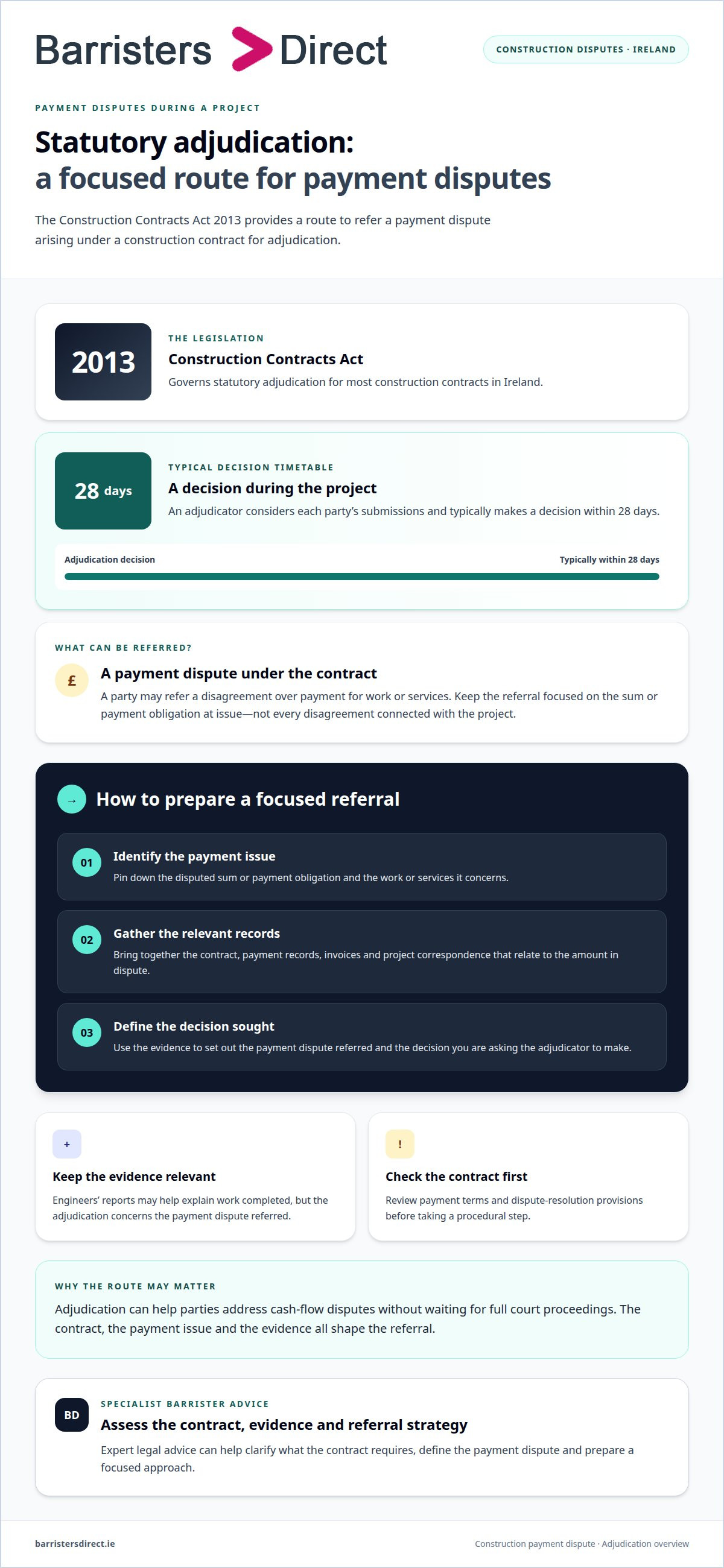
According to the Irish Statute Book, the Construction Contracts Act 2013 governs statutory adjudication for most construction contracts in Ireland. The Act gives a party to a construction contract the right to refer a payment dispute arising under that contract for adjudication, according to the Irish Statute Book.
This route can address a disagreement over payment for work or services during a project. An adjudicator considers each party’s submissions and makes a decision, typically within 28 days. That timetable can help parties address cash-flow disputes without waiting for full court proceedings.
Start by identifying the payment issue and gathering the relevant contract documents. The contract, payment records, invoices and project correspondence can help define what is disputed. Keep any referral focused on the sum or payment obligation at issue, rather than every disagreement connected with the project.
For example, if a contractor says an application for payment remains unpaid, the records can establish the amount claimed, the work covered and the response received. Engineers’ reports may help explain the work completed, but adjudication concerns the payment dispute referred.
- Read the contract: Identify payment terms and any dispute-resolution provisions before taking a procedural step.
- Organise the evidence: Match applications, invoices, payment responses and project records to the disputed amount.
- Define the issue: Keep the referral focused on the payment dispute and the decision sought.
Adjudication also makes clear contract drafting important. Clear payment procedures, notice requirements and dispute clauses can reduce uncertainty about what happens next. During negotiation, agree how to maintain project records and deliver notices. These details matter when a dispute emerges mid-project.
There is no single cost for construction dispute advice or resolution. Fees depend on the dispute’s complexity, evidence requirements and chosen process, and are set after the requested work is assessed.
Ireland’s Small Claims Court is an option for disputes under €2,000. The appropriate court route for a construction claim depends on its nature and value, so establish jurisdiction before issuing proceedings.
Public development procurement teams can address disputes earlier by aligning tender documents, payment terms and contract administration. For example, an in-house team can track notices and decisions against the contract’s requirements; a structured approach to in-house counsel can support that work.
Construction defects and snag list claims
A snag list records incomplete or defective items, but each entry needs enough detail to identify the issue. For example, “uneven flooring in the hall” is more useful than “poor finish”. Record the location, visible condition, date observed and relevant photograph. Compare each item with the contract documents and agreed specifications to distinguish defective work from a requested upgrade. Construction dispute legal advice in Ireland can help assess how the evidence supports a claim.
Building defect cases in Ireland may rely on expert opinion, such as an independent report from a chartered engineer or building surveyor. The report can describe the defect, consider its likely cause and explain remedial work. Where practicable, preserve the condition before repairs begin. If urgent work is needed to prevent further damage, keep dated photographs, invoices and records of the steps taken.
Organise evidence by defect instead of sending a large, unindexed file. A simple schedule can link each snag-list entry to a photograph, drawing, inspection record and relevant contract provision. For example, a leaking window might require the installation detail, inspection notes and evidence of water ingress. Clear records help an adviser assess responsibility, the scope of repairs and any disagreement about the work.
Delay and disruption claims need a separate timeline. Compare planned activities with actual progress, then record events such as late access, design changes or delayed information. Meeting minutes, site diaries, programme updates and correspondence can show when an event occurred and how it affected the work. Distinguish the cause from the impact: a late drawing matters only if the evidence connects it to affected activities. Construction dispute legal advice in Ireland can help analyse that connection.
- For performance claims: identify the contractual requirement, the work delivered and the specific shortfall.
- For delay claims: connect the event, affected activity and resulting time impact using project records.
- For defect claims: pair each alleged fault with evidence and a clear description of the remedy sought.
An extension-of-time claim should follow the contract’s notice and assessment procedures. Identify the relevant event, the period of delay claimed and the supporting programme evidence. If events overlap, distinguish their effects instead of treating the entire project delay as one cause. This makes the requested extension easier to assess against the contract terms.
Claims can overlap: defective work may require remedial work and affect the programme. Keep each issue and its evidence distinct, then explain how they interact. Advising on these disputes requires practical knowledge of construction contracts, project records, and the difference between a snag, a performance issue and a delay allegation. Construction dispute legal advice in Ireland can help bring those strands into a clear, evidence-led position.
If you need help assessing a construction claim and its evidence, construction dispute advice can help you consider the issues and possible next steps.
Refusal to participate in mediation or arbitration
Refusal can have different consequences depending on the construction contract and the process it requires. If a contract specifies mediation, declining to participate could be treated as a breach and give the other party grounds to seek a court order enforcing participation. Read the clause carefully: its wording, required steps and notice procedure shape how refusal may affect the dispute.
Distinguish a request to mediate from an agreement to arbitrate. Mediation is a voluntary, non-binding process in which an independent neutral helps the parties try to reach their own resolution. A party can refuse proposed mediation, but a contractual mediation clause may change the consequences. Keep a record of the invitation, response and reasons given, as these details may matter if the refusal is later raised in proceedings.
Arbitration has a different function. An independent arbitrator makes a determination for the parties, rather than helping them negotiate an outcome. Arbitration usually requires an arbitration clause in the contract. The Arbitration Act 2010 is relevant to upholding an arbitration agreement in court, according to the Irish Statute Book. If a party refuses to take part despite an applicable clause, the other party may seek to enforce the agreement through the courts.
Before responding, review the signed contract, amendments and any dispute notices. Identify whether the clause requires mediation, arbitration or another step, and whether it explains how to appoint a neutral. For example, a procurement contract may require the parties to attempt conciliation before arbitration. Refusing to follow that sequence can complicate the route to resolution.
- Keep a record: Save the invitation, proposed dates, response and related correspondence.
- Check the clause: Confirm which process applies and whether the contract sets procedural steps.
- State your position: Explain any objection clearly and identify a practical alternative, such as another date.
Construction dispute arbitrators need to understand the contract issues and the project material placed before them. The parties’ agreement and the nature of the dispute inform the appointment process. Arbitration can take 6-18 months, so consider the likely timetable alongside the effect of continuing proceedings and the commercial relationship.
Conciliation and arbitration are not interchangeable. Conciliation supports discussions towards agreement; arbitration produces a determination. If the parties disagree about whether a clause applies, get advice on its wording before refusing or starting a process. This analysis can clarify dispute-resolution obligations and help protect your position while the project continues.
Adjudication, arbitration and mediation
Irish construction disputes can follow different routes, depending on the contract and the issue. Compare the options by considering speed, the decision-maker’s role and the outcome sought.
Construction adjudication
Under the Construction Contracts Act 2013, statutory adjudication is available for most construction contracts in Ireland. A party can refer a payment dispute arising under a construction contract, and an adjudicator typically decides within 28 days. The process suits a defined payment issue, such as a disagreement over an unpaid application. Before referring, identify the relevant contract terms, payment records and decision required.
Construction adjudicators consider the parties’ submissions and issue a decision. Organise the referral around the disputed payment, with documents showing the claim and response. Keep other project disagreements separate unless they directly explain the payment issue. Focused preparation helps the adjudicator understand what is contested and what decision the referring party seeks.
Comparing dispute resolution processes
Adjudication provides a decision on a referred dispute, typically within 28 days. Mediation instead uses an independent neutral to help parties reach their own non-binding agreement. Arbitration involves an independent neutral making a determination, and usually requires an arbitration clause. Court proceedings involve litigation. Alternative dispute resolution is typically cheaper and faster than court litigation and can help preserve business relationships.
Choose a process that fits the need. A payment dispute may suit adjudication; parties seeking a negotiated settlement may prefer mediation. If the contract contains an arbitration clause, arbitration may provide the agreed decision-making route. Consider the dispute’s scope, evidence and potential effect on the working relationship before deciding.
The Mediation Act 2017 obliges solicitors in Ireland to advise clients about mediation before issuing proceedings, according to the Irish Statute Book. This makes mediation a relevant consideration before litigation begins. The advice requirement does not mean the parties must settle, since mediation remains non-binding and leaves the outcome with them.
The Arbitration Act 2010 is the legislation relevant to upholding an arbitration agreement in court in Ireland, according to the Irish Statute Book. If a construction contract contains such an agreement, review its wording and scope before starting court proceedings. The clause may guide how the dispute is referred and which issues fall within the agreed arbitration process.
For a practical comparison, list the disputed issues, the contract’s resolution clauses and the evidence each route would require. Then weigh whether the priority is a prompt decision, a negotiated outcome or a determination under an arbitration agreement. A legal consultation can clarify the procedural choices before a party commits to litigation or another process.
Strategic and commercial advice on construction disputes
A strong dispute strategy starts with the project’s commercial priorities, not just the strongest legal argument. A developer may prioritise completing a building, while a subcontractor may need payment to keep work moving. Identify the outcome that matters most, then weigh it against the contract, available evidence and likely effect on the working relationship.
Businesses and homeowners in Ireland can seek advice from a solicitor or specialist barrister. The Law Society of Ireland is a professional body for solicitors, and professional directories can help identify legal practitioners. For a construction matter, focus on relevant experience with construction contracts, project records and the dispute process involved.
Before a consultation, prepare a short chronology and collect the signed contract, amendments, payment records and key correspondence. Add a clear statement of the result you want, such as payment, remedial work or agreement on completion. This gives the barrister a practical starting point and helps identify which documents or technical evidence need closer attention.
Commercial strategy also means weighing the cost of delay to the project, the value of continued trading and the resources required for each process. For example, a contractor seeking payment may value a prompt decision, while a developer facing defects may need a workable repair plan. The right route should address the dispute without overlooking its operational consequences.
For public development procurement, align tender requirements with contract administration. Keep decision records, instructions and approvals in an accessible file. If a design change affects the construction programme, record who approved it and how the parties addressed its impact. Clear records support informed advice and reduce uncertainty about what happened.
The Construction Contracts Act 2013 provides a statutory adjudication route for payment disputes under most construction contracts. Strategic advice should consider whether the dispute fits that route, whether the contract contains other resolution clauses, and how each option affects project continuity. The courts may remain relevant where proceedings are needed, but the commercial objective should guide the decision.
- Define the outcome: Separate essential objectives from preferred terms.
- Map the evidence: Connect each claim to the contract and supporting records.
- Assess the impact: Consider cash flow, completion and the future business relationship.
A specialist adviser can assess the contract, evidence and commercial risks together. If you’re ready to consider your position, discuss your legal options.
Barristers Direct: Commercial Dispute Resolution
Barristers Direct provides Commercial Dispute Resolution for businesses facing construction contract disputes. If you need to assess a payment claim, alleged defect or dispute-resolution clause, specialist barrister advice can help clarify the legal issues and practical options. Barristers Direct matches you with counsel whose expertise fits the area of law, so you can discuss the contract, evidence and commercial objectives directly at an initial meeting.
This advice can help you understand whether adjudication, mediation, arbitration or another route suits the dispute, and what preparation each may require. It can also help you identify questions for your project team and organise the material relevant to your position. The focus is clear, tailored legal advice, not a promise of a particular outcome.
To discuss your construction dispute, contact Barristers Direct or visit barristersdirect.ie.
Make your next move with a clear strategy
The next step is to turn your understanding of the dispute into a considered decision. Before taking formal action, identify the outcome your business needs and the practical effect each available route could have on the project. A focused legal discussion can help test your assumptions, clarify the issues that need attention and decide what to address first.
If you’re seeking construction dispute legal advice in Ireland, Barristers Direct can match you with a specialist barrister for a fixed-fee initial consultation. Its services also include Wills and Probate Legal Advice and Employment Law Consultation for clients with separate legal needs.
Bring the key contract documents and a concise account of the issue to the consultation. A clear starting point helps counsel focus on the questions that matter to your position and commercial priorities. You can take the next step at your own pace, with a better basis for deciding how to proceed.
Contact Barristers Direct to discuss your legal advice needs and move forward with greater clarity.
Frequently Asked Questions
What happens if one party refuses mediation or arbitration?
The consequences depend on the contract and the process it sets out. If a contract requires mediation, refusal may be treated as a breach and could give the other party grounds to seek a court order. For arbitration, check whether the contract contains an applicable clause and what disputes it covers. Keep the invitation and response, then get advice on the clause before choosing your next procedural step.
When construction disputes go to court, what evidence will be required to support my case?
The evidence should establish the contractual obligation, what happened and the loss or remedy claimed. Relevant material may include the signed contract, variations, payment records, project correspondence, site diaries, photographs, programme updates and inspection reports. For an alleged defect, an independent report from a chartered engineer or building surveyor can assist. Organise documents by issue and date, and ensure each item supports a specific part of your case.
What legal options are available for resolving construction disputes in Ireland?
Options include negotiation, mediation, statutory adjudication for eligible payment disputes, arbitration where the contract provides for it, and court proceedings. Each serves a different purpose: negotiation and mediation seek agreement, while adjudication, arbitration and court proceedings involve a decision-maker. For example, parties seeking to preserve a working relationship may explore a negotiated resolution, while a clear payment disagreement may call for a more decisive process.
How does construction adjudication work under Ireland’s Construction Contracts Act 2013?
A party to a construction contract can refer a payment dispute arising under that contract to adjudication. The referring party sets out the dispute and the decision sought, then provides supporting documents for the adjudicator’s consideration. The other party can respond with its position and relevant records. Decisions are typically made within 28 days. Keep the referral focused on the payment issue, rather than adding unrelated project disagreements.
What are the time limits for referring a construction payment dispute to adjudication in Ireland?
A party can serve a Notice of Adjudication over non-payment for services during a construction project at any time. Before serving it, identify the payment dispute, relevant contract and amount at issue, then organise the supporting records. The contract’s payment provisions and the history of notices remain important to understanding the dispute. Get advice on the proposed referral so its scope and supporting material are clear from the outset.
What steps should a contractor or client take when a construction dispute arises in Ireland?
Start by preserving the contract, project correspondence and records linked to the disagreement. Write a short chronology, identify the outcome you need, and separate each issue, such as unpaid work, delay or defective performance. Then review the contract’s notice and dispute-resolution clauses before responding to the other party. For example, if a client alleges incomplete work, record the specific items and supporting inspection evidence before proposing a remedy.
What evidence and contract documents are needed for an Irish construction dispute claim?
Gather the executed contract, specifications, drawings, amendments, payment applications, invoices, notices and correspondence relevant to the claim. Add project records such as site diaries, meeting minutes, photographs and programme updates. For an alleged defect, link each fault to its location and supporting technical evidence. For delay, organise records by event and affected activity. A document index explaining what each item supports makes the claim easier to assess.
What are the risks and deadlines for enforcing an adjudicator’s decision in Ireland?
Do not assume that receiving a decision completes the process. Check its terms, the parties named, the amount or action required, and any steps or dates it sets. Preserve proof of delivery and subsequent correspondence, including any challenge or non-compliance. The enforcement route depends on the decision and applicable procedure, so obtain legal advice promptly if the other party does not comply or disputes its effect.
Disclaimer
This article does not constitute legal advice. Barristers Direct does not provide legal advice. To obtain legal advice, you should contact a legal practitioner.


