

A grievance can reveal a conduct issue, but it does not automatically justify disciplinary action. If an investigation identifies a separate allegation of misconduct, the employer may need to consider a disciplinary process while continuing to handle the grievance fairly. Sound employee grievance procedure advice for employers in Ireland starts by separating the complaint from any conduct concerns that emerge during the investigation.
A clear process can help resolve concerns without creating further conflict. A prompt, impartial investigation, accurate records and a reasoned outcome help employers respond consistently and give employees a proper opportunity to explain their concerns.
This article explains when an informal discussion may be appropriate, how to investigate and document a formal grievance, and what an appeal should involve. It also covers how to distinguish a grievance from a potential disciplinary matter, and when employment law advice can help you decide what to do next.
Key Takeaways
- Match the response to the concern: an informal discussion may help with a minor issue, while serious or repeated matters may need a formal process.
- Investigate impartially, hear the relevant accounts and evidence, then give a clear, reasoned outcome.
- Keep accurate records of meetings, decisions and agreed actions so the process is transparent and can be reviewed.
- Provide an internal appeal route and revisit the procedure periodically to keep it practical and current.
- Keep a grievance distinct from any separate allegation of misconduct, and assess whether employment law issues require specialist advice.
Informal resolution before a formal grievance
In Ireland, workplace procedures generally begin with an attempt to resolve concerns informally. The right route depends on the seriousness of the issue, its effect on the employee and whether an earlier conversation helped.
Raising Concerns with a Manager
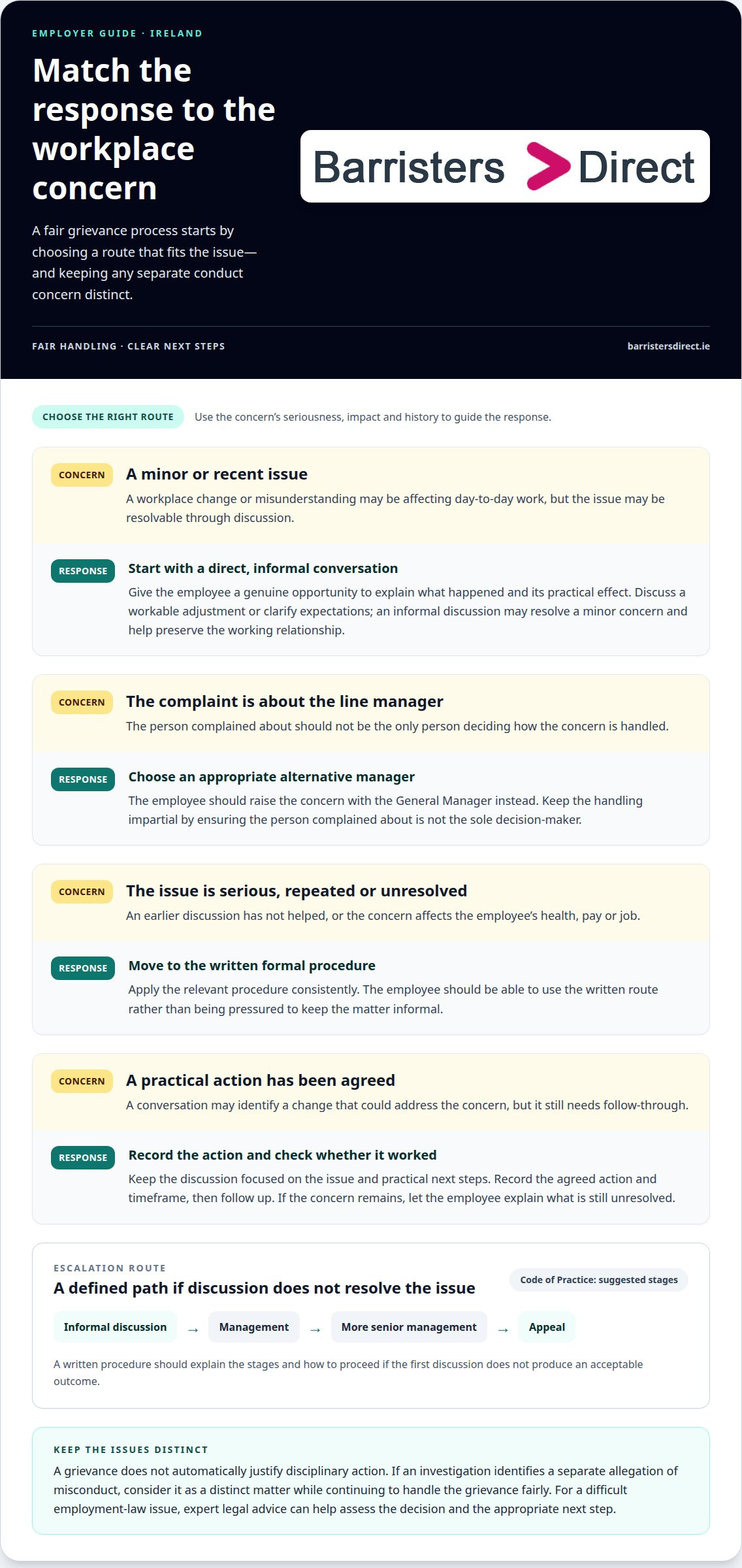
An informal discussion gives an employee and their immediate manager a chance to address a workplace concern before it becomes a formal grievance. For example, an employee concerned about a recent change to their daily work can explain its practical effect and discuss a workable adjustment. A direct conversation may resolve a minor or recent issue quickly and help preserve the working relationship.
Choose the right person to receive the concern. If it is about the line manager, the employee should raise it with the General Manager instead. The person complained about should not be the only one deciding how the concern is handled. If an informal conversation does not resolve the problem, the employee can use the formal procedure.
Open Communication About Workplace Concerns
Open communication means giving the employee a genuine opportunity to explain what happened and what outcome they want. It matters because a clear account can distinguish a misunderstanding from a continuing workplace problem. A manager can ask what change would help, clarify which events caused concern and agree whether another discussion is needed.
Keep the conversation focused on the issue and practical next steps. If colleagues disagree about work allocation, for example, the manager can clarify responsibilities and agree how future tasks will be assigned. Record any agreed action and timeframe, then follow up to see whether it addressed the concern. If not, the employee can explain what remains unresolved.
An informal approach is not suitable in every circumstance. A serious or repeated issue, an unsuccessful earlier discussion, or a problem affecting health, pay or the employee’s job may call for a formal grievance. The employee should be able to use the written procedure rather than being pressured to keep the matter informal.
The Code of Practice suggests escalating stages, from informal discussion to management, more senior management and appeal. A written procedure should explain those stages, including how an employee can proceed if the first discussion does not produce an acceptable outcome. This gives both sides a defined route without treating every workplace concern as a formal complaint from the outset.
For employers, the practical question is whether a direct conversation can address the concern fairly and effectively. If so, agree a clear action and follow-up. If the concern is serious or persists, move to the formal process and apply the relevant procedure consistently.
Appeals, record-keeping and periodic procedure reviews
A clear appeal route gives an employee a way to challenge the grievance outcome. Written records and regular policy reviews help the organisation apply that route consistently.
Internal Appeals and External Recourse
An internal appeal is a further review of the grievance decision within the organisation. It gives the employee a chance to explain what they believe was overlooked and allows a reviewer to reconsider the decision and its reasoning.
Set out how to submit an appeal, who will consider it and how the outcome will be communicated. Where possible, assign a manager who was not involved in the original decision. If internal stages do not resolve the complaint, an employee may be able to refer an employment-law complaint to the Workplace Relations Commission for mediation or adjudication, depending on the circumstances.
Appealing Employer Decisions
An appeal lets an employee explain why they disagree with the outcome or believe their complaint was not properly addressed. A written appeal should identify the decision being challenged, the reasons for disagreement and any relevant information the employee wants considered.
If an employer ignores a grievance or fails to investigate it properly, the employee can follow up in writing and ask about next steps. They can also escalate the complaint, appeal, raise a further grievance or consider a Workplace Relations Commission claim. Employers should address the substance of an appeal, rather than treating the act of raising it as misconduct.
Keeping Records and Reviewing Procedures
Good record-keeping means preserving a clear account of the complaint, meetings, evidence reviewed, decisions and agreed actions. These records help the organisation explain how it reached an outcome and give an appeal reviewer a reliable account of the process.
Keep the employee’s concerns, meeting notes, investigation material, written decision and appeal correspondence together for each case. Record who took each action and when, then limit access to people involved in handling the matter. A file containing only the final decision may not show how the employer considered the employee’s account.
Review the grievance procedure periodically so it reflects workplace circumstances, employment legislation, case law and good practice. Check that the appeal route identifies an appropriate reviewer, employees can understand the steps, and managers know how to record decisions. If the organisation changes its structure, ensure the named appeal contact remains suitable.
Where an appeal raises a difficult employment-law issue, expert legal advice can help an employer assess the decision and the appropriate next step. Employees should also avoid delaying advice about a possible Workplace Relations Commission claim, because applicable time limits still matter.
Investigating grievances
Acknowledge a formal grievance, identify who will handle it, and explain the next steps and expected timeframe. In Ireland, around one working week is generally considered reasonable for resolving many grievances, though the severity can affect timing. Procedures should set timelines and allow extensions in exceptional circumstances.
Acknowledging Grievances and Response Timeframes
An acknowledgement confirms that the employer has received the complaint and explains how it will be considered. This gives the employee a clear point of contact and an expectation of what happens next.
Respond promptly in writing, identify who will manage the matter and outline the investigation process. Give the employee an estimated timeframe based on the grievance procedure and the evidence needed. If witness interviews or document reviews cause delays, explain why and provide a revised timetable rather than leaving the employee without an update.
Triage and Appropriate Investigations
An initial assessment identifies the nature, seriousness and scope of the workplace problem before an investigation is chosen. This matters because a concern about work allocation may call for different enquiries from an allegation of bullying or discrimination.
Clarify what conduct or decision is being challenged, when it occurred, who was involved and what outcome the employee seeks. Identify relevant records and potential witnesses. If the concern involves several events, separate each allegation so the investigation can address them distinctly. The employee’s contract or workplace policies may help explain the context, but do not replace a fair assessment of the evidence.
Hearings, Findings and Decisions
A grievance meeting allows the employee to explain their complaint and answer questions before the employer decides the outcome. A decision based on a complete account is more likely to address the actual problem.
Give the employee an opportunity to identify documents, witnesses and relevant events. Interview other people separately where their evidence may clarify disputed facts, and compare accounts with records such as correspondence or work schedules. After the investigation, decide whether to uphold or dismiss the grievance in full or in part. Explain the findings and reasons in writing.
Confidentiality, Impartiality and Conflicts
Confidential handling means sharing grievance details only as needed to investigate and decide the complaint. Impartiality means assessing the evidence without favouring either party. Both matter because how information is handled can affect workplace relationships.
Where practicable, choose someone who was not directly involved in the events and ask them to disclose any personal connection. Speak to witnesses individually and avoid circulating accounts beyond those managing the case. Do not promise absolute secrecy: a fair investigation may require putting relevant allegations to people who need to respond. Keep the information gathered focused on resolving the specific grievance.
Before closing the case, check that each allegation has a finding, the employee has received a reasoned outcome, and any agreed action has an owner and timeframe. If exceptional circumstances extend the investigation, record why and tell the employee what happens next.
Preparing grievance letters and meeting notes
A written grievance gives the employer a clear account of the concern and the outcome sought. A structured letter and accurate meeting notes help keep later decisions focused on the employee’s actual complaint.
What to include in a grievance letter
In Ireland, an employee grievance should usually explain what happened, when it happened, who was involved, how the events affected the employee and what outcome they want. For example, an employee concerned about repeated changes to working hours can identify the dates, explain the impact and state what change they seek.
Employers can use these details to define the issues for discussion and identify relevant records. If the letter describes several concerns, separate them clearly so none is overlooked. Direct the employee to the written grievance procedure, which explains how the organisation will handle the complaint and what steps follow.
Arranging and recording the meeting
Arrange a meeting at a reasonable time and give the employee enough information to prepare. The meeting should let them explain the grievance, refer to documents, identify witnesses and answer questions. For instance, a concern about a performance review may require the employee and manager to discuss the review records and the specific comments being challenged.
Keep notes that distinguish the employee’s account, the questions asked and the responses given. Record any documents mentioned, actions agreed and follow-up timeframes. An independent note-taker can help capture the discussion accurately, particularly if the manager is also asking questions. Share a clear record through the organisation’s usual process and correct misunderstandings before relying on it.
Representation and employee participation
Explain any arrangements for accompaniment before the meeting, taking account of the organisation’s policy and the circumstances of the grievance. Under Ireland’s Code of Practice on Grievance and Disciplinary Procedures, an employee representative may be a chosen colleague or a registered trade union, but not an unconnected person or body.
Give the employee a proper opportunity to present their concerns and answer questions. The accompanying person can support their participation, but the employee’s own account remains central to understanding the complaint. If the employee refers to a witness or document, note it and consider its relevance before reaching an outcome. Keep the meeting focused on the grievance, not unrelated disciplinary issues.
Mediation as an option
Mediation is a voluntary way to address a workplace disagreement and requires cooperation from both parties. An impartial person helps them discuss the problem and explore an acceptable resolution. Mediation does not replace an investigation when the grievance requires findings on disputed facts.
Consider whether mediation suits the issue and whether both parties are willing to participate. A breakdown in working relations, for example, may suit facilitated discussion, while an allegation requiring a formal finding calls for the appropriate grievance process. Record any agreed actions and follow-up arrangements so the parties understand what happens next.
Grievance procedures and employment law
In Ireland, employers should use a written, understandable grievance procedure aligned with the Workplace Relations Commission’s Code of Practice. It should explain how complaints are raised, investigated and decided, and provide an internal appeal route. Practical employee grievance procedure advice for employers starts with a procedure that employees and managers can apply consistently.
What a Grievance Procedure Should Include
A grievance procedure explains how employees raise concerns and how the organisation responds. Clear steps help managers and employees understand the process before a dispute escalates.
According to the Irish Statute Book, Ireland's Code of Practice on Grievance and Disciplinary Procedures was declared under the Industrial Relations Act 1990 Code of Practice on Grievance and Disciplinary Procedures (Declaration) Order 2000, S.I. No. 146 of 2000. The Irish Statute Book records that this Order was made on the 26th day of May 2000.
Give employees the procedure in writing, using language they can understand, and explain where to raise a formal grievance. Set out who will consider it, how meetings and investigations work, how outcomes are communicated, and how an employee can appeal. Include expected timelines and explain how extensions may be handled in exceptional circumstances. Managers with staff-management responsibilities should understand the process and their role in applying it.
Explain how an employee can raise a concern about their own manager, such as by taking it to a more senior manager. Set out how employees can present information and respond to complaints made about them. These steps are particularly relevant when a concern involves harassment, discrimination or a possible disciplinary issue.
Risks of Mishandling a Grievance
Mishandling a grievance means failing to follow a fair process or properly consider the complaint. This can leave workplace issues unresolved and lead to wider employment disputes.
Depending on the issue and circumstances, an employee may bring a complaint to the Workplace Relations Commission. Grievances can concern discrimination, harassment, victimisation, penalisation, wages, working time, unfair dismissal or other employment rights. Ignoring a complaint, delaying without explanation or overlooking relevant evidence can make it harder for an employer to explain its decision. Sound employee grievance procedure advice for employers should address both the internal process and any legal issues raised by the complaint.
Assess whether a concern may be a protected disclosure rather than treating every report as an ordinary grievance. According to the Irish Statute Book, the Protected Disclosures Act 2014 is relevant legislation when employers assess whether a grievance may be a protected disclosure. The Irish Statute Book also identifies the Protected Disclosures (Amendment) Act 2022 as relevant to that assessment. The information reported and its context help distinguish the appropriate route.
The Workplace Relations Commission and the Health and Safety Authority have published a Code of Practice concerning the prevention and resolution of workplace bullying. A bullying complaint may require consideration of that code alongside the employer’s grievance procedure. Equality concerns may also involve employment equality protections.
For official guidance, consult the Workplace Relations Commission’s Code of Practice on Grievance and Disciplinary Procedures and the Irish Statute Book’s published Order and legislation. If a complaint raises difficult employment-law questions, seek expert employment law advice before deciding how to proceed.
Barristers Direct: Commercial Dispute Resolution
Barristers Direct offers an Employment Law Consultation for employers seeking advice on a workplace grievance, a disciplinary issue or the employment-law implications of an investigation. A specialist barrister can help assess the issues and clarify practical options for the next step.
If a workplace disagreement also involves a wider business dispute, Barristers Direct’s Commercial Dispute Resolution service may be relevant. The right advice depends on the issues, including the grievance process already followed and any decision the employer needs to make.
Strengthen your approach before the next concern arises
Use the experience of a grievance to review how decisions are made across your organisation. Consider whether managers know who should handle concerns, how to identify potential conflicts, and what information they need before deciding whether a matter raises a separate employment issue. This review can reveal process gaps before another complaint puts them under pressure.
Specialist employee grievance procedure advice for employers can clarify the legal question affecting your next decision. This might mean assessing whether a proposed response is appropriate or considering whether a workplace concern raises a distinct employment-law issue. A focused assessment can help you choose a proportionate next step based on the facts.
If you need advice on an employment issue, contact Barristers Direct to discuss your situation. A clear next step can help you move forward with confidence.
Frequently Asked Questions
Can a Grievance Lead to Disciplinary Action?
Yes. An investigation may uncover a separate allegation of misconduct that warrants disciplinary consideration. For example, a complaint about unfair treatment might include evidence of an independent breach of workplace rules by an employee. Assess that allegation through the appropriate disciplinary process, rather than treating the act of raising a grievance as misconduct. The employee concerned must have a fair opportunity to understand and respond to any allegation before a decision is made.
How do grievances arise in day-to-day work?
Grievances can arise from everyday workplace interactions or decisions, including concerns about pay, work practices, promotion, health and safety, or relationships with colleagues and managers. An employee might believe a rota change has been applied inconsistently, or that repeated comments from a colleague have affected their working environment. A concern becomes a grievance when the employee asks the employer to address it, informally or through the formal procedure.
What is a grievance procedure?
A grievance procedure is an organisation’s written method for receiving and addressing employee complaints. It explains how concerns can be raised, who considers them, how an outcome is communicated and how a decision may be challenged. In Ireland, employers should align their procedure with the Workplace Relations Commission’s Code of Practice on Grievance and Disciplinary Procedures. A clear policy helps employees understand the route available and supports consistent handling across teams.
What are the steps for investigating and deciding an employee grievance?
Start by identifying each issue the employee wants addressed, then decide what information is needed to assess it. Consider relevant workplace records and speak with people who can clarify disputed events. Before deciding, give those affected a fair opportunity to respond to relevant concerns. The written outcome should address each issue separately, explain the employer’s findings and state any action arising. If the evidence supports only part of the complaint, make that clear.
When should an employer use an informal resolution versus a formal grievance process?
An informal discussion can suit a limited misunderstanding, such as uncertainty about who approves a routine shift swap, if the employee is comfortable raising it directly. A formal process is more appropriate when the concern is serious, repeated, unresolved or affects pay, health or the employee’s job. The employee’s wishes and the nature of the issue matter. Do not keep a serious allegation informal simply to avoid a written record.
How should employers handle grievances involving bullying, harassment, discrimination, or protected disclosures?
Assess the substance of the report and use the relevant workplace process, rather than relying on its label. Allegations of bullying or harassment may require a focused investigation; discrimination concerns may also engage equality protections. If a report may be a protected disclosure, consider the Protected Disclosures Act 2014 and the Protected Disclosures (Amendment) Act 2022, according to the Irish Statute Book. Limit information-sharing to those who need it to assess and respond fairly.
What records and evidence should employers keep during a grievance process?
Keep a dated case chronology alongside the original grievance, relevant correspondence, meeting records, evidence considered and written decision. Preserve original documents where possible, and note when material was received or added to the file. If a later email clarifies an earlier account, for example, retain both messages rather than replacing the first. Organise records so an appeal reviewer can distinguish evidence, meeting notes and the employer’s conclusions.
How can an employee appeal a grievance decision, and who should hear the appeal?
An employee can follow the appeal route in the employer’s procedure and explain in writing which findings or parts of the outcome they dispute. They can identify relevant information they believe was missed and state the resolution they seek. Where practicable, a more senior manager who did not make the original decision should consider the appeal. The reviewer should address the stated grounds and communicate the outcome clearly in writing.
Disclaimer
This article does not constitute legal advice. Barristers Direct does not provide legal advice. To obtain legal advice, you should contact a legal practitioner.


